
“Well, how do you like them?” said Marilla.
Anne was standing in the gable room, looking solemnly at three new dresses spread out on the bed. One was of snuffy colored gingham which Marilla had been tempted to buy from a peddler the preceding summer because it looked so serviceable; one was of black-and-white checkered sateen which she had picked up at a bargain counter in the winter; and one was a stiff print of an ugly blue shade which she had purchased that week at a Carmody store.
She had made them up herself, and they were all made alike—plain skirts fulled tightly to plain waists, with sleeves as plain as waist and skirt and tight as sleeves could be.
“I’ll imagine that I like them,” said Anne soberly.
“I don’t want you to imagine it,” said Marilla, offended. “Oh, I can see you don’t like the dresses! What is the matter with them? Aren’t they neat and clean and new?”
“Yes.”
“Then why don’t you like them?”
“They’re—they’re not—pretty,” said Anne reluctantly.
“Pretty!” Marilla sniffed. “I didn’t trouble my head about getting pretty dresses for you. I don’t believe in pampering vanity, Anne, I’ll tell you that right off. Those dresses are good, sensible, serviceable dresses, without any frills or furbelows about them, and they’re all you’ll get this summer. The brown gingham and the blue print will do you for school when you begin to go. The sateen is for church and Sunday school. I’ll expect you to keep them neat and clean and not to tear them. I should think you’d be grateful to get most anything after those skimpy wincey things you’ve been wearing.”
“Oh, I AM grateful,” protested Anne. “But I’d be ever so much gratefuller if—if you’d made just one of them with puffed sleeves. Puffed sleeves are so fashionable now. It would give me such a thrill, Marilla, just to wear a dress with puffed sleeves.”
“Well, you’ll have to do without your thrill. I hadn’t any material to waste on puffed sleeves. I think they are ridiculous-looking things anyhow. I prefer the plain, sensible ones.”
“But I’d rather look ridiculous when everybody else does than plain and sensible all by myself,” persisted Anne mournfully.
“Trust you for that! Well, hang those dresses carefully up in your closet, and then sit down and learn the Sunday school lesson. I got a quarterly from Mr. Bell for you and you’ll go to Sunday school tomorrow,” said Marilla, disappearing downstairs in high dudgeon.
Anne clasped her hands and looked at the dresses.
“I did hope there would be a white one with puffed sleeves,” she whispered disconsolately. “I prayed for one, but I didn’t much expect it on that account. I didn’t suppose God would have time to bother about a little orphan girl’s dress. I knew I’d just have to depend on Marilla for it. Well, fortunately I can imagine that one of them is of snow-white muslin with lovely lace frills and three-puffed sleeves.”
The next morning warnings of a sick headache prevented Marilla from going to Sunday-school with Anne.
“You’ll have to go down and call for Mrs. Lynde, Anne.” she said. “She’ll see that you get into the right class. Now, mind you behave yourself properly. Stay to preaching afterwards and ask Mrs. Lynde to show you our pew. Here’s a cent for collection. Don’t stare at people and don’t fidget. I shall expect you to tell me the text when you come home.”
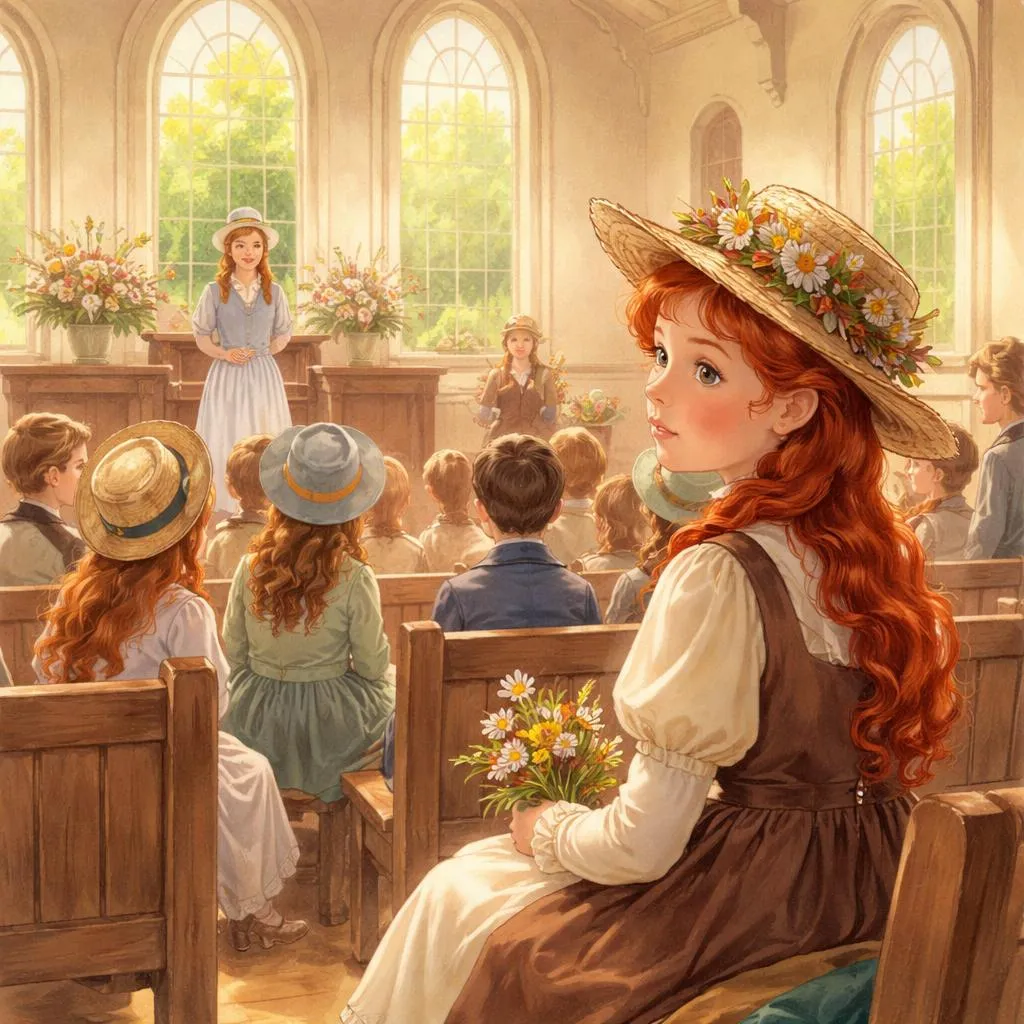
Anne started off irreproachable, arrayed in the stiff black-and-white sateen, which, while decent as regards length and certainly not open to the charge of skimpiness, contrived to emphasize every corner and angle of her thin figure. Her hat was a little, flat, glossy, new sailor, the extreme plainness of which had likewise much disappointed Anne, who had permitted herself secret visions of ribbon and flowers. The latter, however, were supplied before Anne reached the main road, for being confronted halfway down the lane with a golden frenzy of wind-stirred buttercups and a glory of wild roses, Anne promptly and liberally garlanded her hat with a heavy wreath of them. Whatever other people might have thought of the result it satisfied Anne, and she tripped gaily down the road, holding her ruddy head with its decoration of pink and yellow very proudly.
When she had reached Mrs. Lynde’s house she found that lady gone. Nothing daunted, Anne proceeded onward to the church alone. In the porch she found a crowd of little girls, all more or less gaily attired in whites and blues and pinks, and all staring with curious eyes at this stranger in their midst, with her extraordinary head adornment. Avonlea little girls had already heard queer stories about Anne. Mrs. Lynde said she had an awful temper; Jerry Buote, the hired boy at Green Gables, said she talked all the time to herself or to the trees and flowers like a crazy girl. They looked at her and whispered to each other behind their quarterlies. Nobody made any friendly advances, then or later on when the opening exercises were over and Anne found herself in Miss Rogerson’s class.
Miss Rogerson was a middle-aged lady who had taught a Sunday-school class for twenty years. Her method of teaching was to ask the printed questions from the quarterly and look sternly over its edge at the particular little girl she thought ought to answer the question. She looked very often at Anne, and Anne, thanks to Marilla’s drilling, answered promptly; but it may be questioned if she understood very much about either question or answer.
She did not think she liked Miss Rogerson, and she felt very miserable; every other little girl in the class had puffed sleeves. Anne felt that life was really not worth living without puffed sleeves.
“Well, how did you like Sunday school?” Marilla wanted to know when Anne came home. Her wreath having faded, Anne had discarded it in the lane, so Marilla was spared the knowledge of that for a time.
“I didn’t like it a bit. It was horrid.”
“Anne Shirley!” said Marilla rebukingly.
Anne sat down on the rocker with a long sigh, kissed one of Bonny’s leaves, and waved her hand to a blossoming fuchsia.
“They might have been lonesome while I was away,” she explained. “And now about the Sunday school. I behaved well, just as you told me. Mrs. Lynde was gone, but I went right on myself. I went into the church, with a lot of other little girls, and I sat in the corner of a pew by the window while the opening exercises went on. Mr. Bell made an awfully long prayer. I would have been dreadfully tired before he got through if I hadn’t been sitting by that window. But it looked right out on the Lake of Shining Waters, so I just gazed at that and imagined all sorts of splendid things.”
“You shouldn’t have done anything of the sort. You should have listened to Mr. Bell.”
“But he wasn’t talking to me,” protested Anne. “He was talking to God and he didn’t seem to be very much inter-ested in it, either. I think he thought God was too far off though. There was a long row of white birches hanging over the lake and the sunshine fell down through them, ‘way, ‘way down, deep into the water. Oh, Marilla, it was like a beautiful dream! It gave me a thrill and I just said, ‘Thank you for it, God,’ two or three times.”
“Not out loud, I hope,” said Marilla anxiously.
“Oh, no, just under my breath. Well, Mr. Bell did get through at last and they told me to go into the classroom with Miss Rogerson’s class. There were nine other girls in it. They all had puffed sleeves. I tried to imagine mine were puffed, too, but I couldn’t. Why couldn’t I? It was as easy as could be to imagine they were puffed when I was alone in the east gable, but it was awfully hard there among the others who had really truly puffs.”
“You shouldn’t have been thinking about your sleeves in Sunday school. You should have been attending to the lesson. I hope you knew it.”
“Oh, yes; and I answered a lot of questions. Miss Rogerson asked ever so many. I don’t think it was fair for her to do all the asking. There were lots I wanted to ask her, but I didn’t like to because I didn’t think she was a kindred spirit. Then all the other little girls recited a paraphrase. She asked me if I knew any. I told her I didn’t, but I could recite, ‘The Dog at His Master’s Grave’ if she liked. That’s in the Third Royal Reader. It isn’t a really truly religious piece of poetry, but it’s so sad and melancholy that it might as well be. She said it wouldn’t do and she told me to learn the nineteenth paraphrase for next Sunday. I read it over in church afterwards and it’s splendid. There are two lines in particular that just thrill me.
"'Quick as the slaughtered squadrons fell In Midian's evil day.'"
“I don’t know what ‘squadrons’ means nor ‘Midian,’ either, but it sounds SO tragical. I can hardly wait until next Sunday to recite it. I’ll practice it all the week. After Sunday school I asked Miss Rogerson—because Mrs. Lynde was too far away—to show me your pew. I sat just as still as I could and the text was Revelations, third chapter, second and third verses. It was a very long text. If I was a minister I’d pick the short, snappy ones. The sermon was awfully long, too. I suppose the minister had to match it to the text. I didn’t think he was a bit interesting. The trouble with him seems to be that he hasn’t enough imagination. I didn’t listen to him very much. I just let my thoughts run and I thought of the most surprising things.”
Marilla felt helplessly that all this should be sternly reproved, but she was hampered by the undeniable fact that some of the things Anne had said, especially about the minister’s sermons and Mr. Bell’s prayers, were what she herself had really thought deep down in her heart for years, but had never given expression to. It almost seemed to her that those secret, unuttered, critical thoughts had suddenly taken visible and accusing shape and form in the person of this outspoken morsel of neglected humanity.
Contexte et Introduction de l'Auteur
Cet extrait est tiré d'Anne de Green Gables, un roman classique écrit par l'auteur canadienne Lucy Maud Montgomery en 1908. L'histoire suit Anne Shirley, une orpheline imaginative et pleine d'esprit qui est envoyée par erreur vivre avec Marilla et Matthew Cuthbert, un frère et une sœur qui avaient l'intention d'adopter un garçon pour les aider à leur ferme à Avonlea, sur l'Île-du-Prince-Édouard. Le roman est célébré pour ses descriptions vivantes de la vie rurale, le monde intérieur riche d'Anne et ses thèmes d'appartenance, d'identité et de développement personnel.
Lucy Maud Montgomery elle-même est née en 1874 sur l'Île-du-Prince-Édouard. Ses expériences d'enfance dans un cadre rural ont profondément influencé son écriture. Elle a écrit avec chaleur et humour sur les joies et les défis de l'enfance et la beauté de la nature, captivant le cœur des lecteurs du monde entier.
Interprétation Détaillée et Signification
Ce passage met en évidence le désir d'Anne pour la beauté et l'individualité au milieu de la simplicité et du pragmatisme imposés par Marilla, qui représente une vision du monde plus conservatrice et pragmatique. Le désir d'Anne pour des manches bouffantes — un détail à la mode et quelque peu frivole — symbolise son désir d'expression de soi et une touche de magie dans sa vie. Le refus de Marilla reflète les réalités économiques et les attentes sociales de l'époque, mettant l'accent sur le devoir, la modestie et l'utilité plutôt que sur la vanité.
L'esprit imaginatif d'Anne transparaît alors qu'elle transforme mentalement ses robes simples en beaux vêtements, montrant sa résilience et sa créativité. Son expérience à l'école du dimanche souligne davantage son statut d'outsider — elle est différente, incomprise et désireuse de s'intégrer, mais elle reste fidèle à elle-même. Ses réflexions pendant le sermon révèlent un esprit réfléchi et sensible qui trouve l'émerveillement même lorsque la religion formelle semble ennuyeuse ou distante.
Cette scène explore également les thèmes de la solitude, de l'acceptation et de la tension entre la conformité et l'individualité. L'imagination vive et la profondeur émotionnelle d'Anne contrastent avec les normes sociales rigides qui l'entourent, faisant d'elle un symbole intemporel de l'espoir juvénile et du pouvoir de l'imagination.
Leçons et Aperçus pour les Étudiants
-
Embrassez Votre Individualité : L'histoire d'Anne encourage les jeunes lecteurs à valoriser leurs qualités et leurs rêves uniques, même lorsqu'ils ne correspondent pas parfaitement aux attentes des autres. Il est important de rester fidèle à soi-même et de trouver de la joie dans l'imagination et la créativité.
-
Résilience face à l'Adversité : Malgré ses déceptions et ses défis, Anne reste pleine d'espoir et pleine de ressources. Cela enseigne aux élèves la valeur de la persévérance et de la pensée positive face aux difficultés.
-
Appréciation de la Simplicité et du Pragmatisme : La perspective de Marilla nous rappelle que la vie exige souvent du pragmatisme et de la responsabilité. Équilibrer les rêves avec les exigences du monde réel est une compétence importante dans la vie.
-
Empathie et Compréhension : L'histoire invite les lecteurs à regarder au-delà des apparences et des jugements. Les camarades de classe d'Anne chuchotent à son sujet, mais son monde intérieur est riche et complexe. Cela encourage la gentillesse et l'ouverture d'esprit envers les autres qui semblent différents.
-
Trouver la Beauté dans la Vie Quotidienne : La capacité d'Anne à trouver l'émerveillement dans le monde naturel et même dans un long sermon montre l'importance de la pleine conscience et de l'appréciation des petits moments de beauté.
Applications dans la Vie Quotidienne
-
À l'École : Les élèves peuvent apprendre de la curiosité et de l'empressement d'Anne à répondre aux questions, même lorsqu'elle ne comprend pas tout à fait. Cela montre l'importance de la participation et de la volonté d'apprendre, ce qui peut renforcer la confiance et les connaissances.
-
Dans les Situations Sociales : L'expérience d'Anne qui se sent comme une étrangère rappelle aux élèves d'être inclusifs et accueillants envers les camarades de classe nouveaux ou différents. Pratiquer l'empathie et l'amitié peut créer un environnement de soutien.
-
Dans le Développement Personnel : Comme Anne, les élèves peuvent cultiver leur imagination et leur créativité grâce à la lecture, à l'écriture ou à l'art. Cela nourrit l'intelligence émotionnelle et les compétences en résolution de problèmes.
-
Dans la Vie Familiale : La dynamique entre Anne et Marilla met en évidence l'importance de la communication et du compromis dans les relations. Comprendre les différentes perspectives peut aider à résoudre les conflits.
Cultiver des Traits Positifs de l'Histoire
-
Imagination et Créativité : Encouragez les élèves à utiliser leur imagination non seulement pour le plaisir, mais aussi comme un outil de résolution de problèmes et d'expression émotionnelle.
-
Gratitude et Contentement : La gratitude d'Anne pour ses robes, malgré leur simplicité, enseigne l'appréciation de ce que l'on a.
-
Courage et Confiance en Soi : La volonté d'Anne d'être elle-même, même lorsque les autres la jugent, inspire les élèves à développer la confiance en soi et à défendre leurs valeurs.
-
Respect des Autres : Le soin de Marilla pour Anne, bien que strict, montre une forme d'amour et de responsabilité. Les élèves peuvent apprendre à respecter l'autorité et à apprécier ceux qui prennent soin d'eux.
Conclusion
Anne de Green Gables est plus qu'une simple histoire pour enfants ; c'est une riche exploration des émotions humaines, des valeurs sociales et du pouvoir transformateur de l'imagination. À travers les aventures et les défis d'Anne, les élèves peuvent tirer de précieuses leçons sur l'identité, la résilience, la gentillesse et la beauté des moments simples de la vie. En réfléchissant aux expériences d'Anne, les jeunes lecteurs sont encouragés à embrasser leur singularité, à affronter les difficultés de la vie avec espoir et à cultiver l'empathie et la créativité dans leur propre vie.
