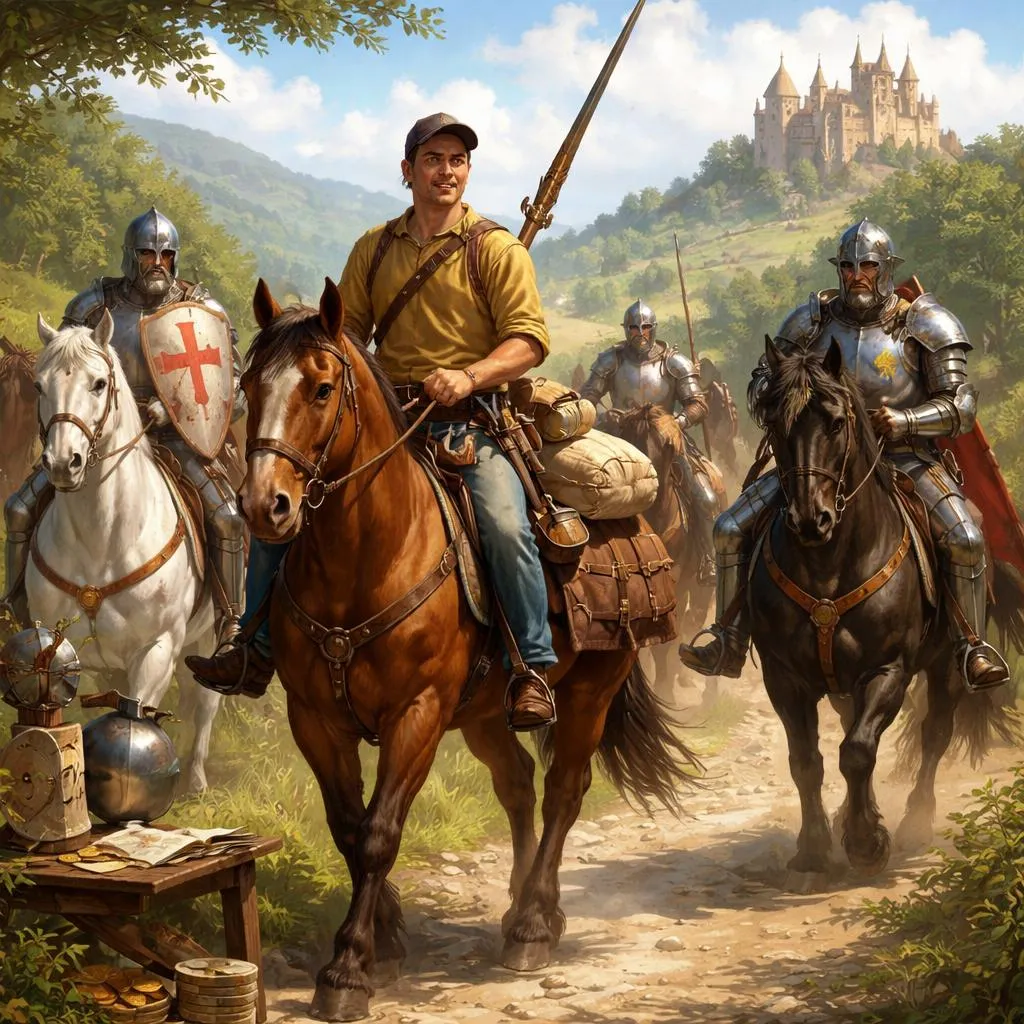

Sandy and I were on the road again, next morning, bright and early. It was so good to open up one’s lungs and take in whole luscious barrels-ful of the blessed God’s untainted, dew-fashioned, woodland-scented air once more, after suffocating body and mind for two days and nights in the moral and physical stenches of that intolerable old buzzard-roost! I mean, for me: of course the place was all right and agreeable enough for Sandy, for she had been used to high life all her days.
Poor girl, her jaws had had a wearisome rest now for a while, and I was expecting to get the consequences. I was right; but she had stood by me most helpfully in the castle, and had mightily supported and reinforced me with gigantic foolishnesses which were worth more for the occasion than wisdoms double their size; so I thought she had earned a right to work her mill for a while, if she wanted to, and I felt not a pang when she started it up:
“Now turn we unto Sir Marhaus that rode with the damsel of thirty winter of age southward—”
“Are you going to see if you can work up another half-stretch on the trail of the cowboys, Sandy?”
“Even so, fair my lord.”
“Go ahead, then. I won’t interrupt this time, if I can help it. Begin over again; start fair, and shake out all your reefs, and I will load my pipe and give good attention.”
“Now turn we unto Sir Marhaus that rode with the damsel of thirty winter of age southward. And so they came into a deep forest, and by fortune they were nighted, and rode along in a deep way, and at the last they came into a courtelage where abode the duke of South Marches, and there they asked harbour. And on the morn the duke sent unto Sir Marhaus, and bad him make him ready. And so Sir Marhaus arose and armed him, and there was a mass sung afore him, and he brake his fast, and so mounted on horseback in the court of the castle, there they should do the battle. So there was the duke already on horseback, clean armed, and his six sons by him, and every each had a spear in his hand, and so they encountered, whereas the duke and his two sons brake their spears upon him, but Sir Marhaus held up his spear and touched none of them. Then came the four sons by couples, and two of them brake their spears, and so did the other two. And all this while Sir Marhaus touched them not. Then Sir Marhaus ran to the duke, and smote him with his spear that horse and man fell to the earth. And so he served his sons. And then Sir Marhaus alight down, and bad the duke yield him or else he would slay him. And then some of his sons recovered, and would have set upon Sir Marhaus. Then Sir Marhaus said to the duke, Cease thy sons, or else I will do the uttermost to you all. When the duke saw he might not escape the death, he cried to his sons, and charged them to yield them to Sir Marhaus. And they kneeled all down and put the pommels of their swords to the knight, and so he received them. And then they holp up their father, and so by their common assent promised unto Sir Marhaus never to be foes unto King Arthur, and thereupon at Whitsuntide after, to come he and his sons, and put them in the king’s grace.*
[*Footnote: The story is borrowed, language and all, from the Morte d’Arthur.—M.T.]
“Even so standeth the history, fair Sir Boss. Now ye shall wit that that very duke and his six sons are they whom but few days past you also did overcome and send to Arthur’s court!”
“Why, Sandy, you can’t mean it!”
“An I speak not sooth, let it be the worse for me.”
“Well, well, well,—now who would ever have thought it? One whole duke and six dukelets; why, Sandy, it was an elegant haul. Knight-errantry is a most chuckle-headed trade, and it is tedious hard work, too, but I begin to see that there is money in it, after all, if you have luck. Not that I would ever engage in it as a business, for I wouldn’t. No sound and legitimate business can be established on a basis of speculation. A successful whirl in the knight-errantry line—now what is it when you blow away the nonsense and come down to the cold facts? It’s just a corner in pork, that’s all, and you can’t make anything else out of it. You’re rich—yes,—suddenly rich—for about a day, maybe a week; then somebody corners the market on you , and down goes your bucket-shop; ain’t that so, Sandy?”
“Whethersoever it be that my mind miscarrieth, bewraying simple language in such sort that the words do seem to come endlong and overthwart—”
“There’s no use in beating about the bush and trying to get around it that way, Sandy, it’s so, just as I say. I know it’s so. And, moreover, when you come right down to the bedrock, knight-errantry is worse than pork; for whatever happens, the pork’s left, and so somebody’s benefited anyway; but when the market breaks, in a knight-errantry whirl, and every knight in the pool passes in his checks, what have you got for assets? Just a rubbish-pile of battered corpses and a barrel or two of busted hardware. Can you call those assets? Give me pork, every time. Am I right?”
“Ah, peradventure my head being distraught by the manifold matters whereunto the confusions of these but late adventured haps and fortunings whereby not I alone nor you alone, but every each of us, meseemeth—”
“No, it’s not your head, Sandy. Your head’s all right, as far as it goes, but you don’t know business; that’s where the trouble is. It unfits you to argue about business, and you’re wrong to be always trying. However, that aside, it was a good haul, anyway, and will breed a handsome crop of reputation in Arthur’s court. And speaking of the cowboys, what a curious country this is for women and men that never get old. Now there’s Morgan le Fay, as fresh and young as a Vassar pullet, to all appearances, and here is this old duke of the South Marches still slashing away with sword and lance at his time of life, after raising such a family as he has raised. As I understand it, Sir Gawaine killed seven of his sons, and still he had six left for Sir Marhaus and me to take into camp. And then there was that damsel of sixty winter of age still excursioning around in her frosty bloom—How old are you, Sandy?”
It was the first time I ever struck a still place in her. The mill had shut down for repairs, or something.
Contexte et introduction de l'auteur
Cet extrait est tiré d'une histoire inspirée de la Morte d’Arthur, une célèbre collection de légendes arthuriennes compilée par Sir Thomas Malory au 15ème siècle. L'œuvre de Malory est l'une des sources les plus importantes pour les contes du roi Arthur, de ses chevaliers et des aventures chevaleresques qui ont façonné la littérature et la culture occidentales. La Morte d’Arthur mêle histoire, mythe et romance, présentant des récits de bravoure, de loyauté, d'honneur et de tragédie. L'histoire ici implique Sir Marhaus, un chevalier de la Table Ronde, et dépeint une bataille chevaleresque classique et des thèmes d'honneur et de réconciliation.
Interprétation détaillée et signification
Le passage capture l'esprit de la chevalerie errante médiévale — des chevaliers voyageant, recherchant l'aventure et s'engageant dans des batailles pour défendre la justice et la loyauté. La rencontre de Sir Marhaus avec le duc des Marches du Sud et ses fils est un exemple frappant des défis auxquels les chevaliers étaient confrontés : le combat physique, les épreuves de courage et la quête de la paix par la force. L'histoire oppose également l'idéalisme de la chevalerie aux dures réalités de la vie, car le narrateur réfléchit sur la nature éphémère du succès et le « métier » de la chevalerie errante.
Le dialogue entre le narrateur et Sandy ajoute une perspective moderne, quelque peu humoristique, sur les anciens contes. Il met en évidence la tension entre les idéaux romantiques et les réalités pratiques, un thème qui résonne auprès des lecteurs de tous âges. La mention de personnages comme Morgane la Fée et Sir Gauvain rattache cet épisode au mythe arthurien plus large, enrichissant la tapisserie des légendes.
Leçons et perspectives pour les étudiants
-
Courage et honneur : Les chevaliers font preuve de bravoure au combat et d'honneur dans la victoire et la défaite. Les élèves peuvent apprendre l'importance de défendre ce qui est juste, d'affronter les défis avec courage et de traiter les autres avec respect, même en cas de conflit.
-
Loyauté et réconciliation : L'histoire se termine avec le duc vaincu et ses fils promettant leur loyauté au roi Arthur, montrant que la vraie force inclut la capacité de pardonner et de se réconcilier. Cela enseigne la valeur de la résolution pacifique des conflits et du maintien des alliances.
-
Réalité contre idéalisme : Les réflexions du narrateur rappellent aux élèves que si les idéaux sont importants, comprendre le côté pratique de la vie est tout aussi crucial. Cet équilibre est essentiel pour prendre des décisions judicieuses à l'école, dans les amitiés et dans les futures carrières.
-
Le pouvoir de la narration : La narration de Sandy, malgré ses « énormes bêtises », soutient et encourage le narrateur. Cela montre comment les histoires peuvent nous inspirer, nous réconforter et nous enseigner, même lorsqu'elles semblent fantaisistes.
Appliquer ces leçons dans la vie quotidienne
-
Dans l'apprentissage : Relevez les défis comme le font les chevaliers, avec courage et détermination. Face à des matières difficiles, persévérez et demandez de l'aide, sachant que l'effort mène à la croissance.
-
Dans les situations sociales : Pratiquez la loyauté et l'équité dans vos amitiés. Lorsque des conflits surviennent, visez la réconciliation et la compréhension plutôt qu'une hostilité prolongée.
-
Dans le développement personnel : Équilibrez les rêves avec la réalité. Fixez-vous des objectifs, mais soyez prêt à vous adapter et à apprendre de vos échecs, un peu comme la vision du narrateur sur le « métier » de la chevalerie errante.
-
Dans la créativité : Utilisez la narration comme un outil pour vous exprimer et vous connecter aux autres. Comme Sandy, votre imagination peut être une source de force et de joie.
Cultiver des traits positifs à partir de l'histoire
-
Bravoure : Affrontez vos peurs et vos défis de front, que ce soit en public, aux examens ou dans des situations sociales.
-
Respect : Honorez les points de vue et les origines des autres, en favorisant une communauté solidaire.
-
Sagesse : Apprenez à la fois des succès et des échecs, en comprenant que chaque expérience contribue à votre croissance.
-
Imagination : Gardez votre créativité vivante ; elle peut aider à résoudre les problèmes et à enrichir votre vie.
Conclusion
Ce passage tiré d'un conte d'inspiration arthurienne offre aux étudiants une matière riche pour explorer des thèmes intemporels de courage, d'honneur, de loyauté et de l'équilibre entre l'idéalisme et la réalité. En réfléchissant à ces histoires, les jeunes lecteurs peuvent acquérir des connaissances précieuses qui s'appliquent non seulement à la littérature, mais aussi à la vie quotidienne, les aidant à devenir des individus réfléchis, courageux et compatissants.
