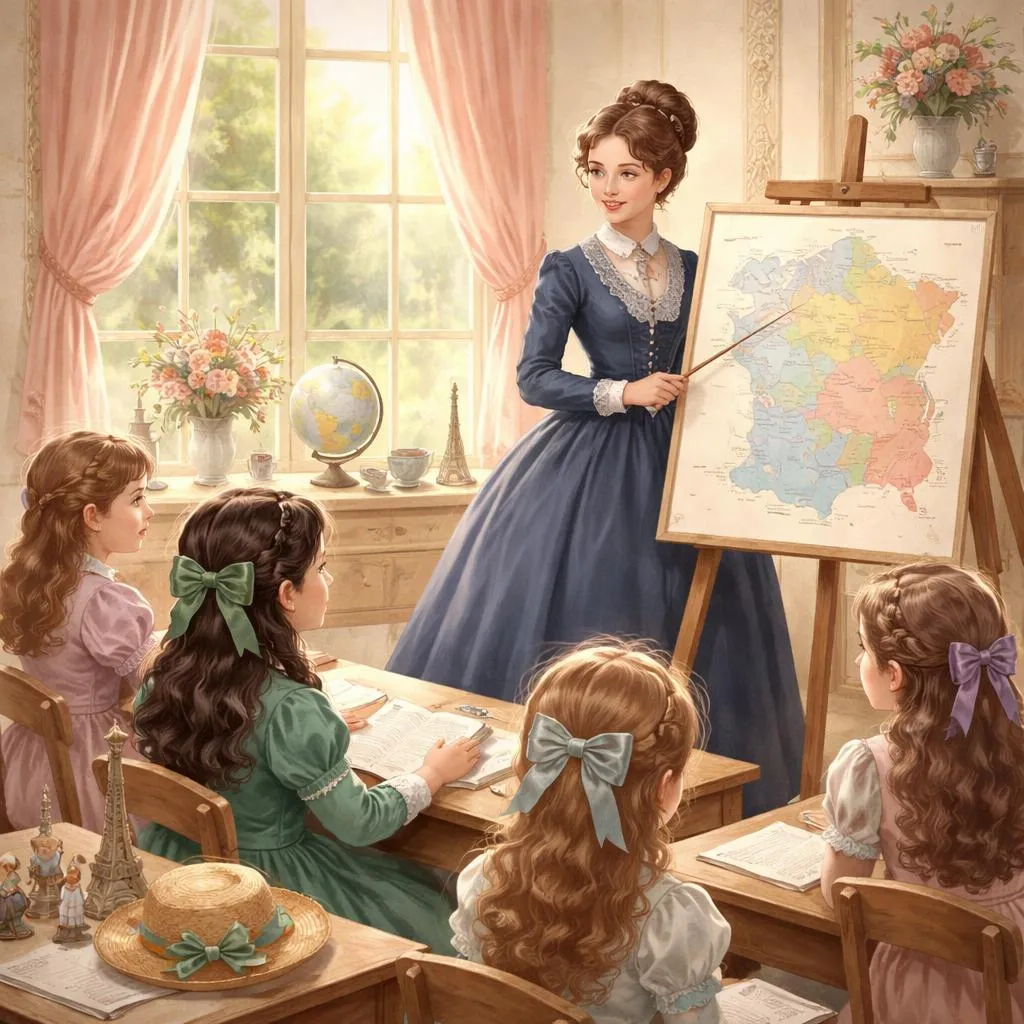

When Sara entered the schoolroom the next morning everybody looked at her with wide, interested eyes. By that time every pupil— from Lavinia Herbert, who was nearly thirteen and felt quite grown up, to Lottie Legh, who was only just four and the baby of the school— had heard a great deal about her. They knew very certainly that she was Miss Minchin’s show pupil and was considered a credit to the establishment. One or two of them had even caught a glimpse of her French maid, Mariette, who had arrived the evening before. Lavinia had managed to pass Sara’s room when the door was open, and had seen Mariette opening a box which had arrived late from some shop.
“It was full of petticoats with lace frills on them—frills and frills,” she whispered to her friend Jessie as she bent over her geography. “I saw her shaking them out. I heard Miss Minchin say to Miss Amelia that her clothes were so grand that they were ridiculous for a child. My mamma says that children should be dressed simply. She has got one of those petticoats on now. I saw it when she sat down.”
“She has silk stockings on!” whispered Jessie, bending over her geography also. “And what little feet! I never saw such little feet.”
“Oh,” sniffed Lavinia, spitefully, “that is the way her slippers are made. My mamma says that even big feet can be made to look small if you have a clever shoemaker. I don’t think she is pretty at all. Her eyes are such a queer color.”
“She isn’t pretty as other pretty people are,” said Jessie, stealing a glance across the room; “but she makes you want to look at her again. She has tremendously long eyelashes, but her eyes are almost green.”
Sara was sitting quietly in her seat, waiting to be told what to do. She had been placed near Miss Minchin’s desk. She was not abashed at all by the many pairs of eyes watching her. She was interested and looked back quietly at the children who looked at her. She wondered what they were thinking of, and if they liked Miss Minchin, and if they cared for their lessons, and if any of them had a papa at all like her own. She had had a long talk with Emily about her papa that morning.
“He is on the sea now, Emily,” she had said. “We must be very great friends to each other and tell each other things. Emily, look at me. You have the nicest eyes I ever saw—but I wish you could speak.”
She was a child full of imaginings and whimsical thoughts, and one of her fancies was that there would be a great deal of comfort in even pretending that Emily was alive and really heard and understood. After Mariette had dressed her in her dark-blue schoolroom frock and tied her hair with a dark-blue ribbon, she went to Emily, who sat in a chair of her own, and gave her a book.
“You can read that while I am downstairs,” she said; and, seeing Mariette looking at her curiously, she spoke to her with a serious little face.
“What I believe about dolls,” she said, “is that they can do things they will not let us know about. Perhaps, really, Emily can read and talk and walk, but she will only do it when people are out of the room. That is her secret. You see, if people knew that dolls could do things, they would make them work. So, perhaps, they have promised each other to keep it a secret. If you stay in the room, Emily will just sit there and stare; but if you go out, she will begin to read, perhaps, or go and look out of the window. Then if she heard either of us coming, she would just run back and jump into her chair and pretend she had been there all the time.”
“Comme elle est drole!” Mariette said to herself, and when she went downstairs she told the head housemaid about it. But she had already begun to like this odd little girl who had such an intelligent small face and such perfect manners. She had taken care of children before who were not so polite. Sara was a very fine little person, and had a gentle, appreciative way of saying, “If you please, Mariette,” “Thank you, Mariette,” which was very charming. Mariette told the head housemaid that she thanked her as if she was thanking a lady.
“Elle a l’air d’une princesse, cette petite,” she said. Indeed, she was very much pleased with her new little mistress and liked her place greatly.
After Sara had sat in her seat in the schoolroom for a few minutes, being looked at by the pupils, Miss Minchin rapped in a dignified manner upon her desk.
“Young ladies,” she said, “I wish to introduce you to your new companion.” All the little girls rose in their places, and Sara rose also. “I shall expect you all to be very agreeable to Miss Crewe; she has just come to us from a great distance—in fact, from India. As soon as lessons are over you must make each other’s acquaintance.”
The pupils bowed ceremoniously, and Sara made a little curtsy, and then they sat down and looked at each other again.
“Sara,” said Miss Minchin in her schoolroom manner, “come here to me.”
She had taken a book from the desk and was turning over its leaves. Sara went to her politely.
“As your papa has engaged a French maid for you,” she began, “I conclude that he wishes you to make a special study of the French language.”
Sara felt a little awkward.
“I think he engaged her,” she said, “because he—he thought I would like her, Miss Minchin.”
“I am afraid,” said Miss Minchin, with a slightly sour smile, “that you have been a very spoiled little girl and always imagine that things are done because you like them. My impression is that your papa wished you to learn French.”
If Sara had been older or less punctilious about being quite polite to people, she could have explained herself in a very few words. But, as it was, she felt a flush rising on her cheeks. Miss Minchin was a very severe and imposing person, and she seemed so absolutely sure that Sara knew nothing whatever of French that she felt as if it would be almost rude to correct her. The truth was that Sara could not remember the time when she had not seemed to know French. Her father had often spoken it to her when she had been a baby. Her mother had been a French woman, and Captain Crewe had loved her language, so it happened that Sara had always heard and been familiar with it.
“I—I have never really learned French, but—but—” she began, trying shyly to make herself clear.
One of Miss Minchin’s chief secret annoyances was that she did not speak French herself, and was desirous of concealing the irritating fact. She, therefore, had no intention of discussing the matter and laying herself open to innocent questioning by a new little pupil.
“That is enough,” she said with polite tartness. “If you have not learned, you must begin at once. The French master, Monsieur Dufarge, will be here in a few minutes. Take this book and look at it until he arrives.”
Sara’s cheeks felt warm. She went back to her seat and opened the book. She looked at the first page with a grave face. She knew it would be rude to smile, and she was very determined not to be rude. But it was very odd to find herself expected to study a page which told her that “le pere” meant “the father,” and “la mere” meant “the mother.”
Miss Minchin glanced toward her scrutinizingly.
“You look rather cross, Sara,” she said. “I am sorry you do not like the idea of learning French.”
“I am very fond of it,” answered Sara, thinking she would try again; “but—”
“You must not say `but’ when you are told to do things,” said Miss Minchin. “Look at your book again.”
And Sara did so, and did not smile, even when she found that “le fils” meant “the son,” and “le frere” meant “the brother.”
“When Monsieur Dufarge comes,” she thought, “I can make him understand.”
Monsieur Dufarge arrived very shortly afterward. He was a very nice, intelligent, middle-aged Frenchman, and he looked interested when his eyes fell upon Sara trying politely to seem absorbed in her little book of phrases.
“Is this a new pupil for me, madame?” he said to Miss Minchin. “I hope that is my good fortune.”
“Her papa—Captain Crewe—is very anxious that she should begin the language. But I am afraid she has a childish prejudice against it. She does not seem to wish to learn,” said Miss Minchin.
“I am sorry of that, mademoiselle,” he said kindly to Sara. “Perhaps, when we begin to study together, I may show you that it is a charming tongue.”
Little Sara rose in her seat. She was beginning to feel rather desperate, as if she were almost in disgrace. She looked up into Monsieur Dufarge’s face with her big, green-gray eyes, and they were quite innocently appealing. She knew that he would understand as soon as she spoke. She began to explain quite simply in pretty and fluent French. Madame had not understood. She had not learned French exactly—not out of books—but her papa and other people had always spoken it to her, and she had read it and written it as she had read and written English. Her papa loved it, and she loved it because he did. Her dear mamma, who had died when she was born, had been French. She would be glad to learn anything monsieur would teach her, but what she had tried to explain to madame was that she already knew the words in this book— and she held out the little book of phrases.
When she began to speak Miss Minchin started quite violently and sat staring at her over her eyeglasses, almost indignantly, until she had finished. Monsieur Dufarge began to smile, and his smile was one of great pleasure. To hear this pretty childish voice speaking his own language so simply and charmingly made him feel almost as if he were in his native land—which in dark, foggy days in London sometimes seemed worlds away. When she had finished, he took the phrase book from her, with a look almost affectionate. But he spoke to Miss Minchin.
“Ah, madame,” he said, “there is not much I can teach her. She has not learned French; she is French. Her accent is exquisite.”
“You ought to have told me,” exclaimed Miss Minchin, much mortified, turning to Sara.
“I—I tried,” said Sara. “I—I suppose I did not begin right.”
Miss Minchin knew she had tried, and that it had not been her fault that she was not allowed to explain. And when she saw that the pupils had been listening and that Lavinia and Jessie were giggling behind their French grammars, she felt infuriated.
“Silence, young ladies!” she said severely, rapping upon the desk. “Silence at once!”
And she began from that minute to feel rather a grudge against her show pupil.
Contexte et introduction de l'auteur
Ce passage est tiré de Une petite princesse, un roman pour enfants bien-aimé écrit par Frances Hodgson Burnett, publié pour la première fois en 1905. Burnett était un auteur américano-britannique renommé pour ses œuvres qui explorent souvent les thèmes de l'enfance, de la résilience et de la gentillesse. Une petite princesse raconte l'histoire de Sara Crewe, une jeune fille qui affronte les difficultés avec dignité et grâce après avoir perdu son père riche et être tombée dans la pauvreté. Le roman est célébré pour le développement riche de ses personnages et son accent sur le pouvoir de l'imagination et de la force intérieure.
Interprétation détaillée et signification de l'histoire
Dans cet extrait, nous voyons Sara entrer dans un nouvel environnement scolaire où elle est à la fois admirée et enviée par ses camarades de classe. La scène met en évidence le parcours unique de Sara — sa richesse, sa femme de chambre française et ses manières raffinées — qui la distinguent des autres filles. Pourtant, Sara reste humble et posée, faisant preuve d'une maturité supérieure à son âge. L'interaction avec Miss Minchin, la directrice stricte, introduit un conflit : l'incompréhension de Miss Minchin de la connaissance du français de Sara symbolise le thème plus large du jugement erroné et des préjugés auxquels Sara est confrontée.
La conversation imaginative de Sara avec sa poupée Emily révèle sa nature tendre et créative. Ce moment illustre comment Sara fait face à la solitude et à l'incertitude en créant un monde secret de réconfort et de camaraderie. L'arrivée de Monsieur Dufarge, le professeur de français, et le discours de Sara en français courant soulignent davantage son intelligence et sa richesse culturelle, contrastant fortement avec l'étroitesse d'esprit de Miss Minchin.
Leçons et aperçus pour les enfants et les étudiants
-
Résilience et grâce sous pression : Le calme de Sara face aux critiques et aux malentendus enseigne aux jeunes lecteurs l'importance de maintenir la dignité et le respect de soi, même lorsque les autres jugent injustement.
-
Le pouvoir de l'imagination : La conviction de Sara que sa poupée Emily pourrait secrètement prendre vie encourage les enfants à utiliser leur imagination comme source de réconfort et de créativité, surtout pendant les moments difficiles.
-
Appréciation culturelle et apprentissage des langues : La maîtrise du français par Sara, malgré les suppositions de Miss Minchin, souligne la valeur de la diversité culturelle et les avantages de l'apprentissage de nouvelles langues. Cela encourage les étudiants à embrasser et à respecter les différentes cultures.
-
Gentillesse et politesse : Les manières douces de Sara, comme remercier Mariette avec respect, montrent comment la gentillesse et la politesse peuvent influencer positivement les relations et créer de la bonne volonté.
Appliquer ces leçons dans la vie quotidienne
-
À l'école : Les élèves peuvent apprendre à faire face aux défis et aux malentendus avec patience et confiance, comme Sara. Face à des enseignants ou à des pairs difficiles, rester calme et poli peut aider à maintenir un environnement positif.
-
Dans les contextes sociaux : Les interactions respectueuses de Sara nous rappellent de traiter tout le monde avec gentillesse, quel que soit son statut. Cela aide à construire des amitiés et à gagner le respect.
-
Dans l'apprentissage : Adopter de nouvelles langues et cultures élargit les horizons et favorise l'empathie. Les élèves doivent être encouragés à explorer différentes langues et traditions pour devenir plus ouverts d'esprit.
-
Dans le développement personnel : Utiliser l'imagination et la créativité comme le fait Sara peut être un moyen sain de gérer le stress ou la solitude. Écrire des histoires, dessiner ou jouer à des jeux imaginatifs peut nourrir le bien-être émotionnel.
Cultiver des traits positifs de l'histoire
-
Empathie : Comprendre les sentiments de Sara aide les élèves à développer de l'empathie pour les autres qui pourraient être différents ou incompris.
-
Confiance : L'assurance tranquille de Sara inspire les enfants à croire en leurs propres capacités, même lorsque les autres en doutent.
-
Curiosité : L'intérêt de Sara pour son nouvel environnement et sa volonté d'apprendre le français montrent l'importance de la curiosité et de l'amour de l'apprentissage.
-
Gratitude : Les expressions polies de remerciement de Sara enseignent la valeur d'apprécier les efforts des autres.
Conclusion
Une petite princesse est plus qu'une histoire sur une fille riche à l'école ; c'est une leçon intemporelle de gentillesse, de résilience et de force de l'esprit humain. En étudiant les expériences de Sara, les jeunes lecteurs peuvent acquérir des connaissances précieuses sur la façon de faire face aux défis de la vie avec courage et grâce, sur la façon d'apprécier la diversité culturelle et sur la façon de nourrir leur imagination et leur empathie. Ces leçons sont essentielles non seulement pour la réussite scolaire, mais aussi pour construire des relations significatives et mener une vie compatissante.
