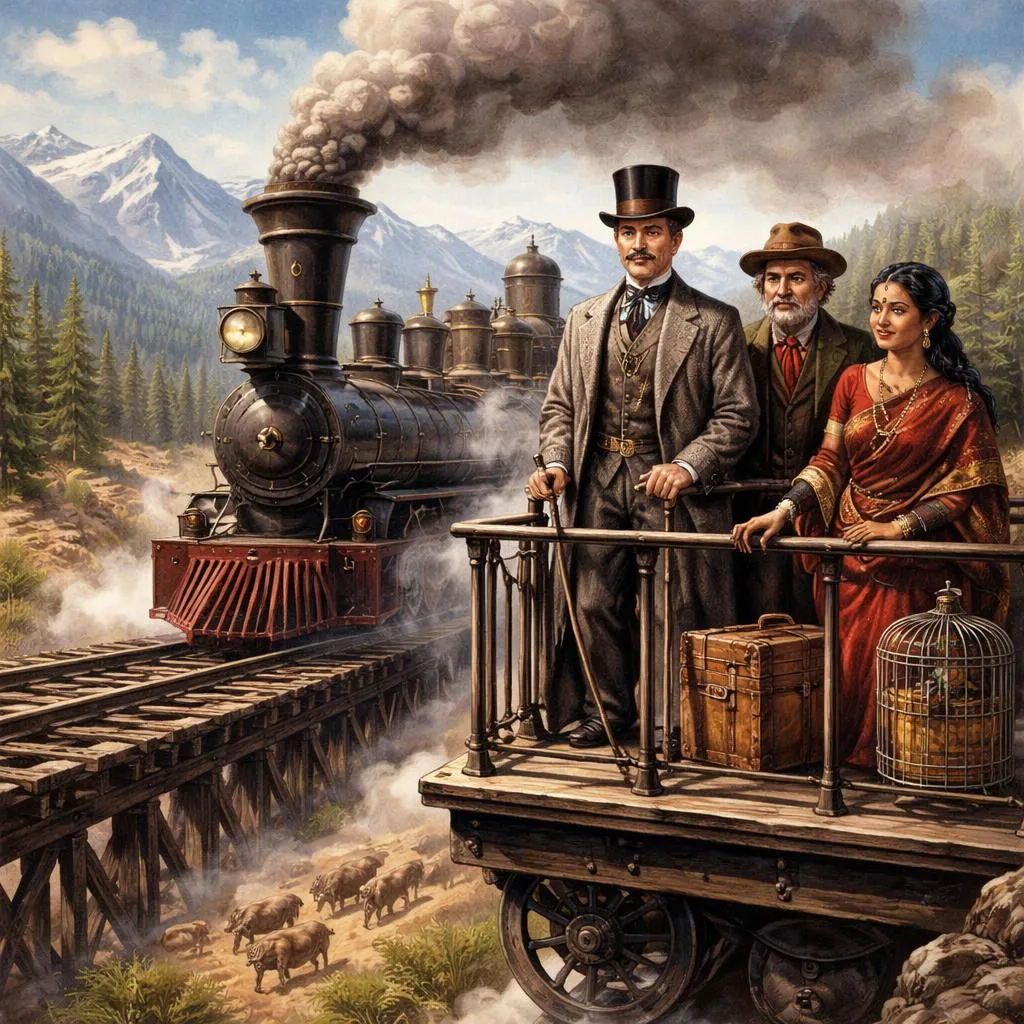

"From ocean to ocean"—so say the Americans; and these four words compose the general designation of the "great trunk line" which crosses the entire width of the United States. The Pacific Railroad is, however, really divided into two distinct lines: the Central Pacific, between San Francisco and Ogden, and the Union Pacific, between Ogden and Omaha. Five main lines connect Omaha with New York.
New York and San Francisco are thus united by an uninterrupted metal ribbon, which measures no less than three thousand seven hundred and eighty–six miles. Between Omaha and the Pacific the railway crosses a territory which is still infested by Indians and wild beasts, and a large tract which the Mormons, after they were driven from Illinois in 1845, began to colonise.
The journey from New York to San Francisco consumed, formerly, under the most favourable conditions, at least six months. It is now accomplished in seven days.
It was in 1862 that, in spite of the Southern Members of Congress, who wished a more southerly route, it was decided to lay the road between the forty–first and forty–second parallels. President Lincoln himself fixed the end of the line at Omaha, in Nebraska. The work was at once commenced, and pursued with true American energy; nor did the rapidity with which it went on injuriously affect its good execution. The road grew, on the prairies, a mile and a half a day. A locomotive, running on the rails laid down the evening before, brought the rails to be laid on the morrow, and advanced upon them as fast as they were put in position.
The Pacific Railroad is joined by several branches in Iowa, Kansas, Colorado, and Oregon. On leaving Omaha, it passes along the left bank of the Platte River as far as the junction of its northern branch, follows its southern branch, crosses the Laramie territory and the Wahsatch Mountains, turns the Great Salt Lake, and reaches Salt Lake City, the Mormon capital, plunges into the Tuilla Valley, across the American Desert, Cedar and Humboldt Mountains, the Sierra Nevada, and descends, via Sacramento, to the Pacific—its grade, even on the Rocky Mountains, never exceeding one hundred and twelve feet to the mile.
Such was the road to be traversed in seven days, which would enable Phileas Fogg—at least, so he hoped—to take the Atlantic steamer at New York on the 11th for Liverpool.
The car which he occupied was a sort of long omnibus on eight wheels, and with no compartments in the interior. It was supplied with two rows of seats, perpendicular to the direction of the train on either side of an aisle which conducted to the front and rear platforms. These platforms were found throughout the train, and the passengers were able to pass from one end of the train to the other. It was supplied with saloon cars, balcony cars, restaurants, and smoking–cars; theatre cars alone were wanting, and they will have these some day.
Book and news dealers, sellers of edibles, drinkables, and cigars, who seemed to have plenty of customers, were continually circulating in the aisles.
The train left Oakland station at six o'clock. It was already night, cold and cheerless, the heavens being overcast with clouds which seemed to threaten snow. The train did not proceed rapidly; counting the stoppages, it did not run more than twenty miles an hour, which was a sufficient speed, however, to enable it to reach Omaha within its designated time.
There was but little conversation in the car, and soon many of the passengers were overcome with sleep. Passepartout found himself beside the detective; but he did not talk to him. After recent events, their relations with each other had grown somewhat cold; there could no longer be mutual sympathy or intimacy between them. Fix's manner had not changed; but Passepartout was very reserved, and ready to strangle his former friend on the slightest provocation.
Snow began to fall an hour after they started, a fine snow, however, which happily could not obstruct the train; nothing could be seen from the windows but a vast, white sheet, against which the smoke of the locomotive had a greyish aspect.
At eight o'clock a steward entered the car and announced that the time for going to bed had arrived; and in a few minutes the car was transformed into a dormitory. The backs of the seats were thrown back, bedsteads carefully packed were rolled out by an ingenious system, berths were suddenly improvised, and each traveller had soon at his disposition a comfortable bed, protected from curious eyes by thick curtains. The sheets were clean and the pillows soft. It only remained to go to bed and sleep which everybody did—while the train sped on across the State of California.
The country between San Francisco and Sacramento is not very hilly. The Central Pacific, taking Sacramento for its starting–point, extends eastward to meet the road from Omaha. The line from San Francisco to Sacramento runs in a north–easterly direction, along the American River, which empties into San Pablo Bay. The one hundred and twenty miles between these cities were accomplished in six hours, and towards midnight, while fast asleep, the travellers passed through Sacramento; so that they saw nothing of that important place, the seat of the State government, with its fine quays, its broad streets, its noble hotels, squares, and churches.
The train, on leaving Sacramento, and passing the junction, Roclin, Auburn, and Colfax, entered the range of the Sierra Nevada. 'Cisco was reached at seven in the morning; and an hour later the dormitory was transformed into an ordinary car, and the travellers could observe the picturesque beauties of the mountain region through which they were steaming. The railway track wound in and out among the passes, now approaching the mountain–sides, now suspended over precipices, avoiding abrupt angles by bold curves, plunging into narrow defiles, which seemed to have no outlet. The locomotive, its great funnel emitting a weird light, with its sharp bell, and its cow–catcher extended like a spur, mingled its shrieks and bellowings with the noise of torrents and cascades, and twined its smoke among the branches of the gigantic pines.
There were few or no bridges or tunnels on the route. The railway turned around the sides of the mountains, and did not attempt to violate nature by taking the shortest cut from one point to another.
The train entered the State of Nevada through the Carson Valley about nine o'clock, going always northeasterly; and at midday reached Reno, where there was a delay of twenty minutes for breakfast.
From this point the road, running along Humboldt River, passed northward for several miles by its banks; then it turned eastward, and kept by the river until it reached the Humboldt Range, nearly at the extreme eastern limit of Nevada.
Having breakfasted, Mr. Fogg and his companions resumed their places in the car, and observed the varied landscape which unfolded itself as they passed along the vast prairies, the mountains lining the horizon, and the creeks, with their frothy, foaming streams. Sometimes a great herd of buffaloes, massing together in the distance, seemed like a moveable dam. These innumerable multitudes of ruminating beasts often form an insurmountable obstacle to the passage of the trains; thousands of them have been seen passing over the track for hours together, in compact ranks. The locomotive is then forced to stop and wait till the road is once more clear.
This happened, indeed, to the train in which Mr. Fogg was travelling. About twelve o'clock a troop of ten or twelve thousand head of buffalo encumbered the track. The locomotive, slackening its speed, tried to clear the way with its cow–catcher; but the mass of animals was too great. The buffaloes marched along with a tranquil gait, uttering now and then deafening bellowings. There was no use of interrupting them, for, having taken a particular direction, nothing can moderate and change their course; it is a torrent of living flesh which no dam could contain.
The travellers gazed on this curious spectacle from the platforms; but Phileas Fogg, who had the most reason of all to be in a hurry, remained in his seat, and waited philosophically until it should please the buffaloes to get out of the way.
Passepartout was furious at the delay they occasioned, and longed to discharge his arsenal of revolvers upon them.
"What a country!" cried he. "Mere cattle stop the trains, and go by in a procession, just as if they were not impeding travel! Parbleu! I should like to know if Mr. Fogg foresaw this mishap in his programme! And here's an engineer who doesn't dare to run the locomotive into this herd of beasts!"
The engineer did not try to overcome the obstacle, and he was wise. He would have crushed the first buffaloes, no doubt, with the cow–catcher; but the locomotive, however powerful, would soon have been checked, the train would inevitably have been thrown off the track, and would then have been helpless.
The best course was to wait patiently, and regain the lost time by greater speed when the obstacle was removed. The procession of buffaloes lasted three full hours, and it was night before the track was clear. The last ranks of the herd were now passing over the rails, while the first had already disappeared below the southern horizon.
It was eight o'clock when the train passed through the defiles of the Humboldt Range, and half–past nine when it penetrated Utah, the region of the Great Salt Lake, the singular colony of the Mormons.
Contexte et introduction de l'auteur
Ce passage est tiré du roman d'aventure classique Le tour du monde en quatre-vingts jours de Jules Verne, un auteur français renommé pour ses histoires de science-fiction et d'aventure imaginatives et novatrices. Écrit en 1873, le roman capture l'esprit de la fascination du XIXe siècle pour l'exploration, la technologie et le monde qui rétrécit grâce à des innovations comme le chemin de fer transcontinental et les navires à vapeur. Les œuvres de Verne mélangent souvent des connaissances scientifiques détaillées avec des récits passionnants, inspirant des générations de lecteurs à rêver grand et à valoriser la curiosité et la persévérance.
Interprétation détaillée de l'histoire et signification
L'extrait décrit un segment crucial du voyage entrepris par le protagoniste, Phileas Fogg, alors qu'il traverse les États-Unis par le chemin de fer du Pacifique nouvellement achevé. Ce chemin de fer, reliant les côtes est et ouest, symbolise le progrès, l'ingéniosité humaine et le pouvoir de la détermination. Le récit dépeint de manière vivante les défis de la traversée de vastes paysages sauvages, la rencontre avec les obstacles de la nature comme l'énorme troupeau de bisons, et l'émerveillement devant la prouesse technologique consistant à apprivoiser un si vaste continent.
L'attitude calme et philosophique de Phileas Fogg pendant le retard dû aux bisons contraste avec l'impatience de son serviteur Passepartout, soulignant les thèmes de la patience, de l'adaptabilité et du respect de la nature et des circonstances hors du contrôle humain. Le passage fait également allusion à la diversité culturelle et géographique de l'Amérique à cette époque, mentionnant les Mormons et les chaînes de montagnes accidentées, enrichissant le contexte historique et social de l'histoire.
Leçons et inspirations pour les étudiants
-
Persévérance et patience : Le voyage de Fogg enseigne aux étudiants l'importance de rester calmes et patients face à des obstacles inattendus. Dans la vie, tout ne se déroule pas comme prévu, et apprendre à attendre et à s'adapter est une compétence précieuse.
-
Respect de la nature : L'histoire montre que la nature ne peut pas toujours être contrôlée ou précipitée. Comprendre et respecter le monde naturel est crucial, en particulier dans le contexte actuel de la sensibilisation à l'environnement.
-
Curiosité et apprentissage : Les descriptions détaillées de Verne encouragent la curiosité pour la géographie, l'histoire et la technologie. Les étudiants peuvent être inspirés pour en savoir plus sur les lieux et les inventions qui façonnent notre monde.
-
Sensibilisation culturelle : La mention de différents groupes, comme les Mormons, et le vaste paysage américain présentent aux lecteurs des cultures et des environnements divers, favorisant l'ouverture d'esprit et la conscience mondiale.
Applications dans la vie quotidienne
- Dans l'apprentissage : Tout comme Fogg planifie méthodiquement son voyage, les étudiants peuvent apprendre à organiser leurs études et leurs projets, en anticipant les défis et en préparant des solutions.
- Dans les situations sociales : La patience et le calme, comme le montre Fogg, aident à gérer les conflits ou les retards dans les amitiés et le travail d'équipe.
- Dans le développement personnel : Accepter les défis comme faisant partie du voyage de la vie encourage la résilience et un état d'esprit positif.
Cultiver des qualités positives de l'histoire
- Adaptabilité : Lorsque les plans changent de manière inattendue, comme le troupeau de bisons bloquant le train, être flexible et ouvert d'esprit aide à surmonter les difficultés.
- Respect et empathie : Comprendre les points de vue des autres, qu'il s'agisse de l'approche prudente de l'ingénieur ou du comportement naturel des animaux, favorise l'empathie.
- Courage et détermination : L'engagement indéfectible de Fogg envers son objectif inspire les étudiants à poursuivre leurs rêves avec courage et persévérance.
En lisant et en réfléchissant à Le tour du monde en quatre-vingts jours, les étudiants apprécient non seulement une aventure palpitante, mais acquièrent également des connaissances sur l'histoire, la géographie, le caractère humain et les valeurs qui sont essentielles à leur développement en tant qu'individus réfléchis et résilients.
