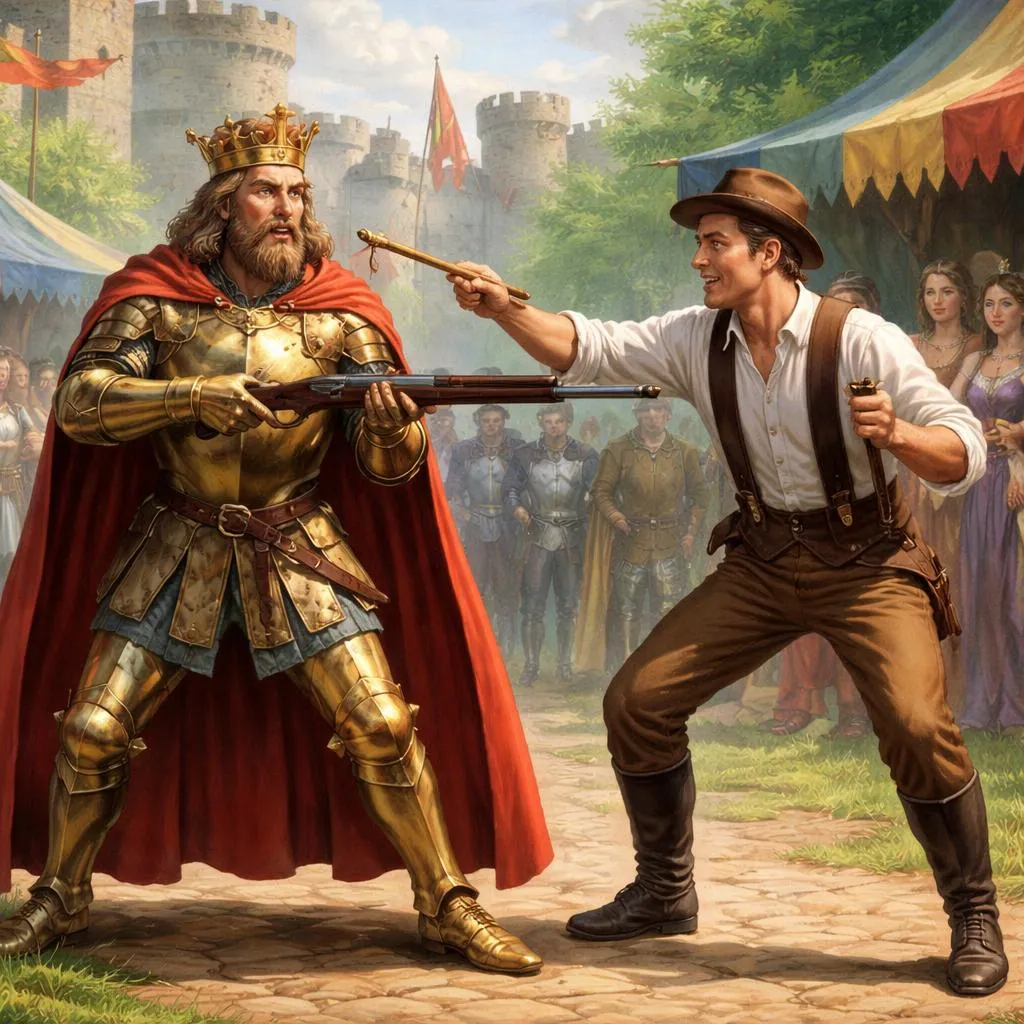

On the morning of the fourth day, when it was just sunrise, and we had been tramping an hour in the chill dawn, I came to a resolution: the king must be drilled; things could not go on so, he must be taken in hand and deliberately and conscientiously drilled, or we couldn’t ever venture to enter a dwelling; the very cats would know this masquerader for a humbug and no peasant. So I called a halt and said:
“Sire, as between clothes and countenance, you are all right, there is no discrepancy; but as between your clothes and your bearing, you are all wrong, there is a most noticeable discrepancy. Your soldierly stride, your lordly port—these will not do. You stand too straight, your looks are too high, too confident. The cares of a kingdom do not stoop the shoulders, they do not droop the chin, they do not depress the high level of the eye-glance, they do not put doubt and fear in the heart and hang out the signs of them in slouching body and unsure step. It is the sordid cares of the lowly born that do these things. You must learn the trick; you must imitate the trademarks of poverty, misery, oppression, insult, and the other several and common inhumanities that sap the manliness out of a man and make him a loyal and proper and approved subject and a satisfaction to his masters, or the very infants will know you for better than your disguise, and we shall go to pieces at the first hut we stop at. Pray try to walk like this.”
The king took careful note, and then tried an imitation.
“Pretty fair—pretty fair. Chin a little lower, please—there, very good. Eyes too high; pray don’t look at the horizon, look at the ground, ten steps in front of you. Ah—that is better, that is very good. Wait, please; you betray too much vigor, too much decision; you want more of a shamble. Look at me, please—this is what I mean.... Now you are getting it; that is the idea—at least, it sort of approaches it.... Yes, that is pretty fair. But! There is a great big something wanting, I don’t quite know what it is. Please walk thirty yards, so that I can get a perspective on the thing.... Now, then—your head’s right, speed’s right, shoulders right, eyes right, chin right, gait, carriage, general style right—everything’s right! And yet the fact remains, the aggregate’s wrong. The account don’t balance. Do it again, please.... Now I think I begin to see what it is. Yes, I’ve struck it. You see, the genuine spiritlessness is wanting; that’s what’s the trouble. It’s all amateur—mechanical details all right, almost to a hair; everything about the delusion perfect, except that it don’t delude.”
“What, then, must one do, to prevail?”
“Let me think... I can’t seem to quite get at it. In fact, there isn’t anything that can right the matter but practice. This is a good place for it: roots and stony ground to break up your stately gait, a region not liable to interruption, only one field and one hut in sight, and they so far away that nobody could see us from there. It will be well to move a little off the road and put in the whole day drilling you, sire.”
After the drill had gone on a little while, I said:
“Now, sire, imagine that we are at the door of the hut yonder, and the family are before us. Proceed, please—accost the head of the house.”
The king unconsciously straightened up like a monument, and said, with frozen austerity:
“Varlet, bring a seat; and serve to me what cheer ye have.”
“Ah, your grace, that is not well done.”
“In what lacketh it?”
“These people do not call each other varlets.”
“Nay, is that true?”
“Yes; only those above them call them so.”
“Then must I try again. I will call him villein.”
“No-no; for he may be a freeman.”
“Ah—so. Then peradventure I should call him goodman.”
“That would answer, your grace, but it would be still better if you said friend, or brother.”
“Brother!—to dirt like that?”
“Ah, but we are pretending to be dirt like that, too.”
“It is even true. I will say it. Brother, bring a seat, and thereto what cheer ye have, withal. Now ‘tis right.”
“Not quite, not wholly right. You have asked for one, not us —for one, not both; food for one, a seat for one.”
The king looked puzzled—he wasn’t a very heavy weight, intellectually. His head was an hour-glass; it could stow an idea, but it had to do it a grain at a time, not the whole idea at once.
“Would you have a seat also—and sit?”
“If I did not sit, the man would perceive that we were only pretending to be equals—and playing the deception pretty poorly, too.”
“It is well and truly said! How wonderful is truth, come it in whatsoever unexpected form it may! Yes, he must bring out seats and food for both, and in serving us present not ewer and napkin with more show of respect to the one than to the other.”
“And there is even yet a detail that needs correcting. He must bring nothing outside; we will go in—in among the dirt, and possibly other repulsive things,—and take the food with the household, and after the fashion of the house, and all on equal terms, except the man be of the serf class; and finally, there will be no ewer and no napkin, whether he be serf or free. Please walk again, my liege. There—it is better—it is the best yet; but not perfect. The shoulders have known no ignobler burden than iron mail, and they will not stoop.”
“Give me, then, the bag. I will learn the spirit that goeth with burdens that have not honor. It is the spirit that stoopeth the shoulders, I ween, and not the weight; for armor is heavy, yet it is a proud burden, and a man standeth straight in it.... Nay, but me no buts, offer me no objections. I will have the thing. Strap it upon my back.”
He was complete now with that knapsack on, and looked as little like a king as any man I had ever seen. But it was an obstinate pair of shoulders; they could not seem to learn the trick of stooping with any sort of deceptive naturalness. The drill went on, I prompting and correcting:
“Now, make believe you are in debt, and eaten up by relentless creditors; you are out of work—which is horse-shoeing, let us say—and can get none; and your wife is sick, your children are crying because they are hungry—”
And so on, and so on. I drilled him as representing in turn all sorts of people out of luck and suffering dire privations and misfortunes. But lord, it was only just words, words—they meant nothing in the world to him, I might just as well have whistled. Words realize nothing, vivify nothing to you, unless you have suffered in your own person the thing which the words try to describe. There are wise people who talk ever so knowingly and complacently about “the working classes,” and satisfy themselves that a day’s hard intellectual work is very much harder than a day’s hard manual toil, and is righteously entitled to much bigger pay. Why, they really think that, you know, because they know all about the one, but haven’t tried the other. But I know all about both; and so far as I am concerned, there isn’t money enough in the universe to hire me to swing a pickaxe thirty days, but I will do the hardest kind of intellectual work for just as near nothing as you can cipher it down—and I will be satisfied, too.
Intellectual “work” is misnamed; it is a pleasure, a dissipation, and is its own highest reward. The poorest paid architect, engineer, general, author, sculptor, painter, lecturer, advocate, legislator, actor, preacher, singer is constructively in heaven when he is at work; and as for the musician with the fiddle-bow in his hand who sits in the midst of a great orchestra with the ebbing and flowing tides of divine sound washing over him—why, certainly, he is at work, if you wish to call it that, but lord, it’s a sarcasm just the same. The law of work does seem utterly unfair—but there it is, and nothing can change it: the higher the pay in enjoyment the worker gets out of it, the higher shall be his pay in cash, also. And it’s also the very law of those transparent swindles, transmissible nobility and kingship.
Contexte et introduction de l'auteur
Ce passage est tiré du roman classique de Mark Twain, Le Prince et le Pauvre, publié pour la première fois en 1881. Twain, l'un des plus grands écrivains et humoristes américains, a utilisé cette histoire pour explorer les thèmes de l'inégalité sociale, de l'identité et de l'empathie. Le roman raconte l'histoire de deux garçons, l'un prince et l'autre pauvre, qui échangent leurs places et découvrent les vies très différentes de chacun. L'esprit vif et l'observation sociale perspicace de Twain font de ce livre une critique puissante des distinctions de classe et de l'injustice.
Interprétation détaillée et signification
Dans cet extrait, le narrateur explique au prince comment imiter de manière convaincante la posture et le comportement d'un pauvre roturier. L'allure royale naturelle du prince le trahit, il doit donc apprendre à marcher et à se comporter comme quelqu'un accablé par les difficultés et la pauvreté. L'exercice ne porte pas seulement sur l'apparence physique, mais sur l'incarnation de l'esprit de souffrance et d'humilité qu'impose la pauvreté.
Cette scène met en évidence la difficulté de comprendre réellement l'expérience d'une autre personne sans la vivre. Le narrateur souligne que les mots seuls ne peuvent pas transmettre la réalité des difficultés ; seule l'expérience vécue le peut. Il s'agit d'une leçon profonde sur l'empathie et les limites de la compréhension superficielle.
De plus, le passage critique les rôles sociaux et l'artificialité des distinctions de classe. Le prince doit apprendre à paraître abattu pour être accepté par le peuple, montrant ainsi comment les jugements de la société sont basés sur les apparences et les comportements façonnés par le statut social.
Leçons et perspectives pour les élèves
-
L'empathie par l'expérience : L'histoire enseigne que la véritable empathie exige plus que d'imaginer la situation d'un autre ; elle exige un effort profond pour comprendre ses sentiments et ses luttes. Les élèves peuvent apprendre à être plus compatissants en écoutant attentivement et en essayant de voir le monde du point de vue des autres.
-
Le pouvoir de l'humilité : La tentative du prince de s'humilier montre l'importance de l'humilité dans les interactions sociales. Reconnaître ses propres privilèges et ses limites peut favoriser le respect et la gentillesse envers les autres.
-
Réflexion critique sur les rôles sociaux : Le roman encourage les lecteurs à remettre en question les structures et les stéréotypes sociaux. Les élèves peuvent réfléchir à la manière dont les apparences et les étiquettes sociales influencent la façon dont nous traitons les autres et comment ils pourraient remettre en question les jugements injustes.
-
La valeur de la pratique et de la persévérance : Les efforts répétés du prince pour maîtriser le comportement d'un pauvre illustrent que l'apprentissage de nouvelles compétences, qu'elles soient sociales, émotionnelles ou intellectuelles, exige de la patience et de la persévérance.
Application dans la vie quotidienne
-
À l'école : Les élèves peuvent faire preuve d'empathie en soutenant les camarades de classe qui peuvent être en difficulté ou se sentir exclus. La compréhension des différents milieux peut améliorer le travail d'équipe et l'amitié.
-
Dans les situations sociales : La pratique de l'humilité et de la gentillesse permet de construire des relations plus solides. Être conscient des différences sociales sans jugement favorise l'inclusion.
-
Dans le développement personnel : Relever les défis et pratiquer de nouveaux comportements, comme le fait le prince, peut aider les élèves à développer leur résilience et leur capacité d'adaptation.
Cultiver des qualités positives à partir de l'histoire
-
Empathie : Encouragez les élèves à lire des histoires diverses et à participer à des jeux de rôle pour mieux comprendre les expériences des autres.
-
Humilité : Enseignez la valeur de la reconnaissance de ses propres forces et faiblesses et du respect des autres, quel que soit leur statut.
-
Persévérance : Soulignez l'importance de la pratique et de l'apprentissage par les erreurs, comme le fait le prince lorsqu'il s'entraîne à s'intégrer dans un nouveau rôle social.
-
Sens critique : Favorisez les discussions sur l'équité, la justice sociale et l'impact des stéréotypes afin de développer des individus réfléchis et socialement conscients.
En explorant Le Prince et le Pauvre, les élèves apprécient non seulement une histoire captivante, mais acquièrent également de précieuses leçons de vie qui les aident à devenir des individus empathiques, humbles et socialement conscients.
