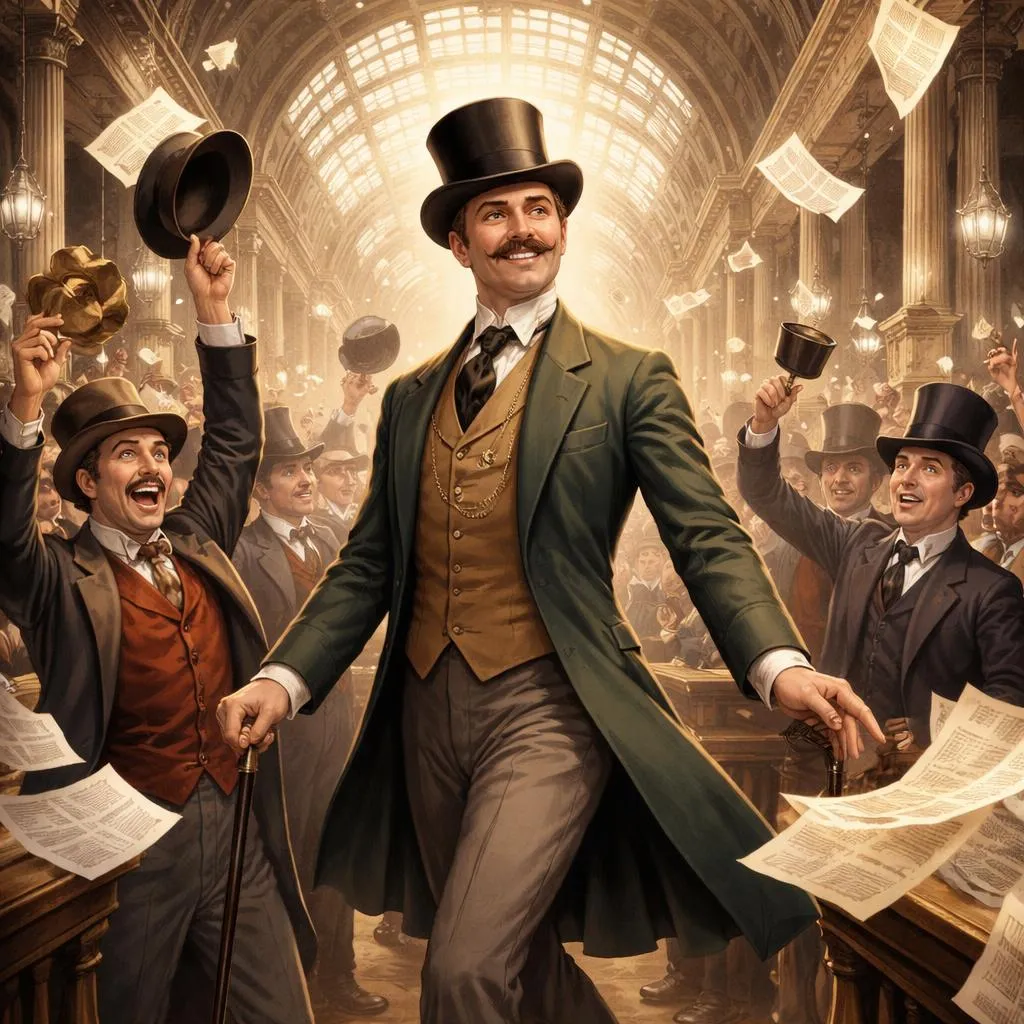

It is time to relate what a change took place in English public opinion when it transpired that the real bankrobber, a certain James Strand, had been arrested, on the 17th day of December, at Edinburgh. Three days before, Phileas Fogg had been a criminal, who was being desperately followed up by the police; now he was an honourable gentleman, mathematically pursuing his eccentric journey round the world.
The papers resumed their discussion about the wager; all those who had laid bets, for or against him, revived their interest, as if by magic; the "Phileas Fogg bonds" again became negotiable, and many new wagers were made. Phileas Fogg's name was once more at a premium on 'Change.
His five friends of the Reform Club passed these three days in a state of feverish suspense. Would Phileas Fogg, whom they had forgotten, reappear before their eyes! Where was he at this moment? The 17th of December, the day of James Strand's arrest, was the seventy–sixth since Phileas Fogg's departure, and no news of him had been received. Was he dead? Had he abandoned the effort, or was he continuing his journey along the route agreed upon? And would he appear on Saturday, the 21st of December, at a quarter before nine in the evening, on the threshold of the Reform Club saloon?
The anxiety in which, for three days, London society existed, cannot be described. Telegrams were sent to America and Asia for news of Phileas Fogg. Messengers were dispatched to the house in Saville Row morning and evening. No news. The police were ignorant what had become of the detective, Fix, who had so unfortunately followed up a false scent. Bets increased, nevertheless, in number and value. Phileas Fogg, like a racehorse, was drawing near his last turning–point. The bonds were quoted, no longer at a hundred below par, but at twenty, at ten, and at five; and paralytic old Lord Albemarle bet even in his favour.
A great crowd was collected in Pall Mall and the neighbouring streets on Saturday evening; it seemed like a multitude of brokers permanently established around the Reform Club. Circulation was impeded, and everywhere disputes, discussions, and financial transactions were going on. The police had great difficulty in keeping back the crowd, and as the hour when Phileas Fogg was due approached, the excitement rose to its highest pitch.
The five antagonists of Phileas Fogg had met in the great saloon of the club. John Sullivan and Samuel Fallentin, the bankers, Andrew Stuart, the engineer, Gauthier Ralph, the director of the Bank of England, and Thomas Flanagan, the brewer, one and all waited anxiously.
When the clock indicated twenty minutes past eight, Andrew Stuart got up, saying, "Gentlemen, in twenty minutes the time agreed upon between Mr. Fogg and ourselves will have expired."
"What time did the last train arrive from Liverpool?" asked Thomas Flanagan.
"At twenty–three minutes past seven," replied Gauthier Ralph; "and the next does not arrive till ten minutes after twelve."
"Well, gentlemen," resumed Andrew Stuart, "if Phileas Fogg had come in the 7:23 train, he would have got here by this time. We can, therefore, regard the bet as won."
"Wait; don't let us be too hasty," replied Samuel Fallentin. "You know that Mr. Fogg is very eccentric. His punctuality is well known; he never arrives too soon, or too late; and I should not be surprised if he appeared before us at the last minute."
"Why," said Andrew Stuart nervously, "if I should see him, I should not believe it was he."
"The fact is," resumed Thomas Flanagan, "Mr. Fogg's project was absurdly foolish. Whatever his punctuality, he could not prevent the delays which were certain to occur; and a delay of only two or three days would be fatal to his tour."
"Observe, too," added John Sullivan, "that we have received no intelligence from him, though there are telegraphic lines all along is route."
"He has lost, gentleman," said Andrew Stuart, "he has a hundred times lost! You know, besides, that the China the only steamer he could have taken from New York to get here in time arrived yesterday. I have seen a list of the passengers, and the name of Phileas Fogg is not among them. Even if we admit that fortune has favoured him, he can scarcely have reached America. I think he will be at least twenty days behind–hand, and that Lord Albemarle will lose a cool five thousand."
"It is clear," replied Gauthier Ralph; "and we have nothing to do but to present Mr. Fogg's cheque at Barings to–morrow."
At this moment, the hands of the club clock pointed to twenty minutes to nine.
"Five minutes more," said Andrew Stuart.
The five gentlemen looked at each other. Their anxiety was becoming intense; but, not wishing to betray it, they readily assented to Mr. Fallentin's proposal of a rubber.
"I wouldn't give up my four thousand of the bet," said Andrew Stuart, as he took his seat, "for three thousand nine hundred and ninety–nine."
The clock indicated eighteen minutes to nine.
The players took up their cards, but could not keep their eyes off the clock. Certainly, however secure they felt, minutes had never seemed so long to them!
"Seventeen minutes to nine," said Thomas Flanagan, as he cut the cards which Ralph handed to him.
Then there was a moment of silence. The great saloon was perfectly quiet; but the murmurs of the crowd outside were heard, with now and then a shrill cry. The pendulum beat the seconds, which each player eagerly counted, as he listened, with mathematical regularity.
"Sixteen minutes to nine!" said John Sullivan, in a voice which betrayed his emotion.
One minute more, and the wager would be won. Andrew Stuart and his partners suspended their game. They left their cards, and counted the seconds.
At the fortieth second, nothing. At the fiftieth, still nothing.
At the fifty–fifth, a loud cry was heard in the street, followed by applause, hurrahs, and some fierce growls.
The players rose from their seats.
At the fifty–seventh second the door of the saloon opened; and the pendulum had not beat the sixtieth second when Phileas Fogg appeared, followed by an excited crowd who had forced their way through the club doors, and in his calm voice, said, "Here I am, gentlemen!"
Contexte et présentation de l'auteur
Ce passage est tiré du roman d'aventure classique Le Tour du monde en quatre-vingts jours de Jules Verne, un auteur français connu pour ses œuvres pionnières en science-fiction et en littérature d'aventure. Écrit en 1873, ce roman capture l'esprit du XIXe siècle, une époque de progrès technologique rapide et d'exploration mondiale. La narration imaginative et les descriptions détaillées de Verne ont rendu ses œuvres intemporelles, inspirant des générations de lecteurs à rêver de lieux lointains et d'exploits audacieux.
Interprétation détaillée et signification
L'histoire tourne autour de Phileas Fogg, un gentleman anglais précis et méthodique qui parie qu'il peut faire le tour du monde en seulement quatre-vingts jours. Cet extrait capture le point culminant du récit, où l'opinion publique bascule de façon spectaculaire alors que le sort de Fogg est en jeu. Initialement soupçonné d'un crime, l'honneur et la détermination de Fogg sont rétablis lorsque le véritable coupable est arrêté. La tension monte à mesure que l'horloge tourne jusqu'au moment final du pari, culminant avec le retour triomphal de Fogg.
Cette scène met en évidence les thèmes de la persévérance, de la ponctualité et du triomphe de la volonté humaine face à des obstacles apparemment insurmontables. Elle reflète également la fascination de l'époque victorienne pour le progrès, la ponctualité et l'expansion de l'Empire britannique. L'histoire combine habilement l'aventure avec une critique subtile des normes sociales et de la valeur accordée aux apparences et à la réputation.
Leçons et inspirations pour les étudiants
-
Persévérance et détermination : Le voyage de Phileas Fogg enseigne l'importance de rester fidèle à ses objectifs, même face aux revers et aux doutes. Les étudiants peuvent apprendre à persister dans leurs études et leurs défis personnels en adoptant un état d'esprit similaire.
-
Gestion du temps et ponctualité : L'adhésion stricte de Fogg à son emploi du temps est un exemple puissant de la façon dont une gestion efficace du temps peut mener au succès. Les jeunes lecteurs peuvent réfléchir à la façon dont la planification et la ponctualité aident dans les travaux scolaires et les responsabilités quotidiennes.
-
Esprit critique et jugement : L'opinion publique fluctuante sur Fogg nous rappelle de ne pas tirer de conclusions hâtives basées sur des informations incomplètes. Les étudiants doivent cultiver des compétences de pensée critique et éviter les jugements hâtifs sur les autres.
-
Le courage de prendre des risques : Le pari de Fogg est audacieux et risqué, mais il le pousse à explorer le monde et à grandir. Cela encourage les étudiants à sortir de leur zone de confort et à relever des défis qui favorisent l'apprentissage et la découverte de soi.
-
Résilience sociale et émotionnelle : Malgré les soupçons du public et la pression du pari, Fogg reste calme et posé. Cela enseigne la résilience émotionnelle et la valeur de garder son sang-froid sous le stress.
Appliquer ces leçons dans la vie quotidienne
-
Dans l'apprentissage : Les étudiants peuvent fixer des objectifs et des délais clairs pour leurs devoirs, tout comme Fogg a planifié son voyage. Décomposer les tâches importantes en étapes plus petites et respecter un emploi du temps peut améliorer les performances scolaires.
-
Dans les interactions sociales : Comprendre l'importance de ne pas juger les autres prématurément aide à construire l'empathie et de meilleures relations. Les étudiants peuvent s'exercer à écouter et à recueillir des faits avant de se faire une opinion.
-
Dans le développement personnel : Prendre des risques calculés, comme rejoindre de nouveaux clubs ou essayer de nouveaux passe-temps, peut élargir les horizons et renforcer la confiance.
-
Dans le développement du caractère : Imiter le calme et la détermination de Fogg peut aider les étudiants à affronter les examens, les compétitions ou les défis personnels avec un esprit stable.
Cultiver des traits positifs à partir de l'histoire
Les enseignants et les parents peuvent encourager les enfants à :
- Développer un sens des responsabilités en se fixant des objectifs personnels.
- Pratiquer la ponctualité en créant des routines quotidiennes.
- Renforcer la résilience en discutant d'histoires de surmontement des obstacles.
- Favoriser la curiosité pour le monde grâce à la lecture et à l'exploration.
- Apprécier la valeur de l'amitié et du soutien, comme on le voit chez les compagnons de Fogg.
En résumé, Le Tour du monde en quatre-vingts jours n'est pas seulement une aventure passionnante ; c'est une riche source de leçons de vie qui inspirent les jeunes lecteurs à rêver grand, à travailler dur et à affronter les défis de la vie avec courage et intégrité.
