
It seemed to me that this quaint lie was most simply and beautifully told; but then I had heard it only once, and that makes a difference; it was pleasant to the others when it was fresh, no doubt.
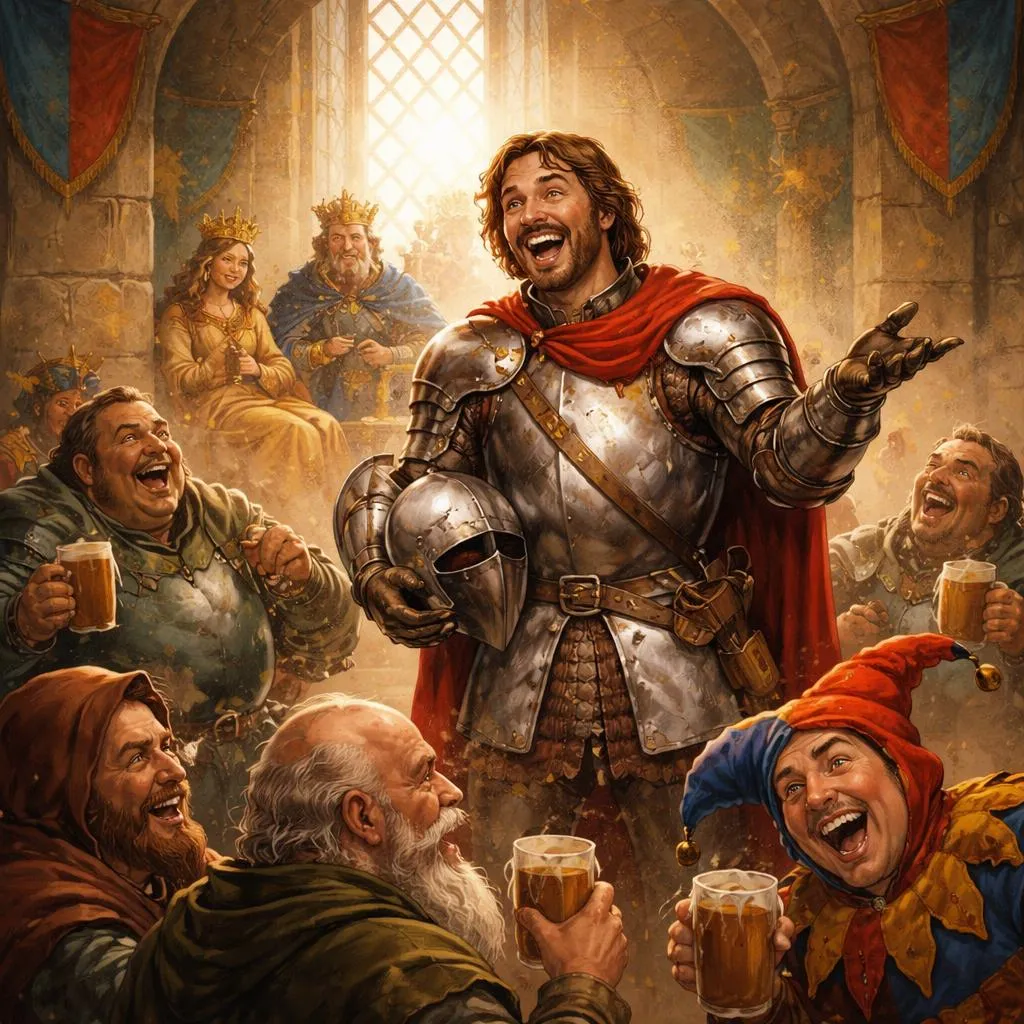
Sir Dinadan the Humorist was the first to awake, and he soon roused the rest with a practical joke of a sufficiently poor quality. He tied some metal mugs to a dog’s tail and turned him loose, and he tore around and around the place in a frenzy of fright, with all the other dogs bellowing after him and battering and crashing against everything that came in their way and making altogether a chaos of confusion and a most deafening din and turmoil; at which every man and woman of the multitude laughed till the tears flowed, and some fell out of their chairs and wallowed on the floor in ecstasy. It was just like so many children. Sir Dinadan was so proud of his exploit that he could not keep from telling over and over again, to weariness, how the immortal idea happened to occur to him; and as is the way with humorists of his breed, he was still laughing at it after everybody else had got through. He was so set up that he concluded to make a speech —of course a humorous speech. I think I never heard so many old played-out jokes strung together in my life. He was worse than the minstrels, worse than the clown in the circus. It seemed peculiarly sad to sit here, thirteen hundred years before I was born, and listen again to poor, flat, worm-eaten jokes that had given me the dry gripes when I was a boy thirteen hundred years afterwards. It about convinced me that there isn’t any such thing as a new joke possible. Everybody laughed at these antiquities —but then they always do; I had noticed that, centuries later. However, of course the scoffer didn’t laugh—I mean the boy. No, he scoffed; there wasn’t anything he wouldn’t scoff at. He said the most of Sir Dinadan’s jokes were rotten and the rest were petrified. I said “petrified” was good; as I believed, myself, that the only right way to classify the majestic ages of some of those jokes was by geologic periods. But that neat idea hit the boy in a blank place, for geology hadn’t been invented yet. However, I made a note of the remark, and calculated to educate the commonwealth up to it if I pulled through. It is no use to throw a good thing away merely because the market isn’t ripe yet.
Now Sir Kay arose and began to fire up on his history-mill with me for fuel. It was time for me to feel serious, and I did. Sir Kay told how he had encountered me in a far land of barbarians, who all wore the same ridiculous garb that I did—a garb that was a work of enchantment, and intended to make the wearer secure from hurt by human hands. However he had nullified the force of the enchantment by prayer, and had killed my thirteen knights in a three hours’ battle, and taken me prisoner, sparing my life in order that so strange a curiosity as I was might be exhibited to the wonder and admiration of the king and the court. He spoke of me all the time, in the blandest way, as “this prodigious giant,” and “this horrible sky-towering monster,” and “this tusked and taloned man-devouring ogre”, and everybody took in all this bosh in the naivest way, and never smiled or seemed to notice that there was any discrepancy between these watered statistics and me. He said that in trying to escape from him I sprang into the top of a tree two hundred cubits high at a single bound, but he dislodged me with a stone the size of a cow, which “all-to brast” the most of my bones, and then swore me to appear at Arthur’s court for sentence. He ended by condemning me to die at noon on the 21st; and was so little concerned about it that he stopped to yawn before he named the date.
I was in a dismal state by this time; indeed, I was hardly enough in my right mind to keep the run of a dispute that sprung up as to how I had better be killed, the possibility of the killing being doubted by some, because of the enchantment in my clothes. And yet it was nothing but an ordinary suit of fifteen-dollar slop-shops. Still, I was sane enough to notice this detail, to wit: many of the terms used in the most matter-of-fact way by this great assemblage of the first ladies and gentlemen in the land would have made a Comanche blush. Indelicacy is too mild a term to convey the idea. However, I had read “Tom Jones,” and “Roderick Random,” and other books of that kind, and knew that the highest and first ladies and gentlemen in England had remained little or no cleaner in their talk, and in the morals and conduct which such talk implies, clear up to a hundred years ago; in fact clear into our own nineteenth century—in which century, broadly speaking, the earliest samples of the real lady and real gentleman discoverable in English history—or in European history, for that matter—may be said to have made their appearance. Suppose Sir Walter, instead of putting the conversations into the mouths of his characters, had allowed the characters to speak for themselves? We should have had talk from Rebecca and Ivanhoe and the soft lady Rowena which would embarrass a tramp in our day. However, to the unconsciously indelicate all things are delicate. King Arthur’s people were not aware that they were indecent and I had presence of mind enough not to mention it.
They were so troubled about my enchanted clothes that they were mightily relieved, at last, when old Merlin swept the difficulty away for them with a common-sense hint. He asked them why they were so dull—why didn’t it occur to them to strip me. In half a minute I was as naked as a pair of tongs! And dear, dear, to think of it: I was the only embarrassed person there. Everybody discussed me; and did it as unconcernedly as if I had been a cabbage. Queen Guenever was as naively interested as the rest, and said she had never seen anybody with legs just like mine before. It was the only compliment I got—if it was a compliment.
Finally I was carried off in one direction, and my perilous clothes in another. I was shoved into a dark and narrow cell in a dungeon, with some scant remnants for dinner, some moldy straw for a bed, and no end of rats for company.
Contexte et introduction de l'auteur
Cet extrait est tiré du roman de Mark Twain, Un Yankee à la cour du roi Arthur, publié pour la première fois en 1889. Twain, l'un des plus grands humoristes et critiques sociaux américains, utilise cette histoire pour mêler fantaisie, satire et fiction historique. Le roman raconte l'histoire d'un ingénieur américain du XIXe siècle qui est mystérieusement transporté dans le temps, à l'époque du roi Arthur. Twain utilise cette mise en scène imaginative pour explorer les thèmes du progrès, de la technologie, de la justice sociale et de la nature humaine.
Interprétation détaillée et signification
L'extrait capture le choc humoristique et souvent absurde entre les mondes moderne et médiéval. Le protagoniste, un homme venu du futur, observe les chevaliers et les nobles de la légende arthurienne avec un mélange d'ironie et d'incrédulité. La blague de Sire Dinadan et les récits exagérés de Sire Kay mettent en évidence le contraste entre les idéaux chevaleresques et la réalité souvent ridicule qui se cache derrière eux.
Le style narratif de Twain combine un ton enjoué avec une critique sociale acerbe. Le « mensonge curieux » et les « vieilles blagues usées » symbolisent la façon dont les histoires et les traditions peuvent se déformer ou perdre leur sens avec le temps. Les réflexions du protagoniste sur la langue et les manières du passé révèlent la critique de Twain sur les prétentions sociales et l'hypocrisie, tant dans le cadre médiéval que dans son propre temps.
Les vêtements enchantés et l'emprisonnement du protagoniste illustrent la tension entre la superstition et la raison, un thème récurrent dans le roman. Le conseil pratique de Merlin de déshabiller le protagoniste pour rompre l'enchantement représente le triomphe du bon sens sur la croyance aveugle.
Leçons et perspectives pour les étudiants
-
Esprit critique et scepticisme : L'histoire encourage les lecteurs à remettre en question les vérités et les traditions acceptées. Tout comme le protagoniste doute des récits des chevaliers et du pouvoir des enchantements, les étudiants doivent apprendre à réfléchir de manière critique aux informations et à ne pas tout accepter tel quel.
-
L'humour comme outil de réflexion : L'utilisation de l'humour par Twain aide à exposer les folies humaines et les défauts sociaux. Les étudiants peuvent apprécier comment le rire et la satire peuvent être des moyens puissants de comprendre et de critiquer le monde qui les entoure.
-
Comprendre le contexte historique : Le roman mêle légende historique et idées modernes, montrant comment les perspectives changent avec le temps. Cela encourage les étudiants à explorer l'histoire avec un esprit ouvert et à reconnaître l'influence de la culture et du temps sur les histoires et les croyances.
-
Respect de la connaissance et du progrès : Le passé du protagoniste en tant qu'ingénieur symbolise l'importance de la science et de la technologie pour faire progresser la société. Les étudiants peuvent être inspirés pour valoriser l'éducation et l'innovation tout en respectant les leçons du passé.
-
Empathie et ouverture d'esprit : L'expérience du protagoniste en tant qu'étranger dans un monde étrange enseigne l'importance de l'empathie et de l'adaptabilité. Les étudiants peuvent apprendre à apprécier les différentes cultures et points de vue, ce qui est essentiel dans la société diversifiée d'aujourd'hui.
Appliquer l'esprit de l'histoire dans la vie quotidienne
-
Dans l'apprentissage : Embrasser la curiosité et remettre en question les hypothèses. Aborder les études avec un équilibre de scepticisme et d'ouverture, un peu comme le protagoniste naviguant dans un monde inconnu.
-
Dans les interactions sociales : Utiliser l'humour avec gentillesse pour atténuer les tensions et créer des liens, mais être attentif aux sentiments des autres. Comme les blagues de Sire Dinadan, l'humour peut unir les gens lorsqu'il est utilisé avec réflexion.
-
Face aux défis : Appliquer la raison et le bon sens pour résoudre les problèmes, comme le conseille Merlin. N'ayez pas peur de supprimer les complications inutiles pour trouver des solutions claires.
-
Dans le développement du caractère : Cultiver la résilience et l'adaptabilité. Le voyage du protagoniste montre que les situations inattendues exigent du courage et de la flexibilité.
Encourager les valeurs positives
Les étudiants peuvent apprendre de l'expérience du protagoniste à développer des vertus telles que l'honnêteté, la bravoure et l'humilité. Reconnaître les défauts des autres et de soi-même avec humour et grâce aide à construire un caractère fort. Le roman promeut également la valeur de défendre ce qui est juste, de remettre en question l'injustice et d'utiliser les connaissances de manière responsable.
En lisant et en réfléchissant à Un Yankee à la cour du roi Arthur, les jeunes lecteurs acquièrent non seulement du divertissement, mais aussi une compréhension plus approfondie de l'histoire, de la société et de la nature humaine. Ils sont invités à réfléchir de manière indépendante, à apprécier le pouvoir de la narration et à porter l'esprit d'enquête et de gentillesse dans leur propre vie.
