
However, my attention was suddenly snatched from such matters; our child began to lose ground again, and we had to go to sitting up with her, her case became so serious. We couldn’t bear to allow anybody to help in this service, so we two stood watch-and-watch, day in and day out. Ah, Sandy, what a right heart she had, how simple, and genuine, and good she was! She was a flawless wife and mother; and yet I had married her for no other particular reasons, except that by the customs of chivalry she was my property until some knight should win her from me in the field. She had hunted Britain over for me; had found me at the hanging-bout outside of London, and had straightway resumed her old place at my side in the placidest way and as of right. I was a New Englander, and in my opinion this sort of partnership would compromise her, sooner or later. She couldn’t see how, but I cut argument short and we had a wedding.
Now I didn’t know I was drawing a prize, yet that was what I did draw. Within the twelvemonth I became her worshiper; and ours was the dearest and perfectest comradeship that ever was. People talk about beautiful friendships between two persons of the same sex. What is the best of that sort, as compared with the friendship of man and wife, where the best impulses and highest ideals of both are the same? There is no place for comparison between the two friendships; the one is earthly, the other divine.
In my dreams, along at first, I still wandered thirteen centuries away, and my unsatisfied spirit went calling and harking all up and down the unreplying vacancies of a vanished world. Many a time Sandy heard that imploring cry come from my lips in my sleep. With a grand magnanimity she saddled that cry of mine upon our child, conceiving it to be the name of some lost darling of mine. It touched me to tears, and it also nearly knocked me off my feet, too, when she smiled up in my face for an earned reward, and played her quaint and pretty surprise upon me:
“The name of one who was dear to thee is here preserved, here made holy, and the music of it will abide alway in our ears. Now thou’lt kiss me, as knowing the name I have given the child.”
But I didn’t know it, all the same. I hadn’t an idea in the world; but it would have been cruel to confess it and spoil her pretty game; so I never let on, but said:
“Yes, I know, sweetheart—how dear and good it is of you, too! But I want to hear these lips of yours, which are also mine, utter it first—then its music will be perfect.”
Pleased to the marrow, she murmured:
“HELLO-CENTRAL!”
I didn’t laugh—I am always thankful for that—but the strain ruptured every cartilage in me, and for weeks afterward I could hear my bones clack when I walked. She never found out her mistake. The first time she heard that form of salute used at the telephone she was surprised, and not pleased; but I told her I had given order for it: that henceforth and forever the telephone must always be invoked with that reverent formality, in perpetual honor and remembrance of my lost friend and her small namesake. This was not true. But it answered.
Well, during two weeks and a half we watched by the crib, and in our deep solicitude we were unconscious of any world outside of that sick-room. Then our reward came: the center of the universe turned the corner and began to mend. Grateful? It isn’t the term. There isn’t any term for it. You know that yourself, if you’ve watched your child through the Valley of the Shadow and seen it come back to life and sweep night out of the earth with one all-illuminating smile that you could cover with your hand.
Why, we were back in this world in one instant! Then we looked the same startled thought into each other’s eyes at the same moment; more than two weeks gone, and that ship not back yet!
In another minute I appeared in the presence of my train. They had been steeped in troubled bodings all this time—their faces showed it. I called an escort and we galloped five miles to a hilltop overlooking the sea. Where was my great commerce that so lately had made these glistening expanses populous and beautiful with its white-winged flocks? Vanished, every one! Not a sail, from verge to verge, not a smoke-bank—just a dead and empty solitude, in place of all that brisk and breezy life.
I went swiftly back, saying not a word to anybody. I told Sandy this ghastly news. We could imagine no explanation that would begin to explain. Had there been an invasion? an earthquake? a pestilence? Had the nation been swept out of existence? But guessing was profitless. I must go—at once. I borrowed the king’s navy—a “ship” no bigger than a steam launch—and was soon ready.
The parting—ah, yes, that was hard. As I was devouring the child with last kisses, it brisked up and jabbered out its vocabulary! —the first time in more than two weeks, and it made fools of us for joy. The darling mispronunciations of childhood!—dear me, there’s no music that can touch it; and how one grieves when it wastes away and dissolves into correctness, knowing it will never visit his bereaved ear again. Well, how good it was to be able to carry that gracious memory away with me!
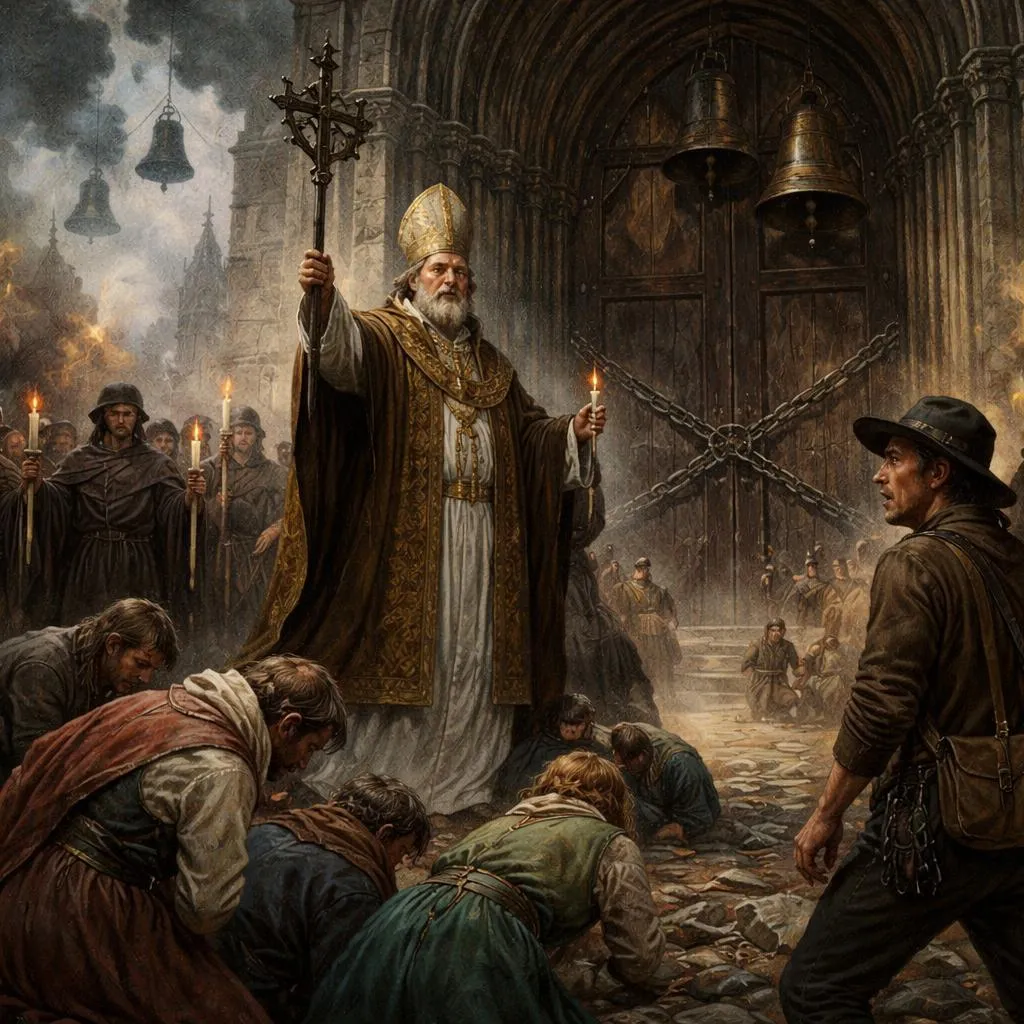
I approached England the next morning, with the wide highway of salt water all to myself. There were ships in the harbor, at Dover, but they were naked as to sails, and there was no sign of life about them. It was Sunday; yet at Canterbury the streets were empty; strangest of all, there was not even a priest in sight, and no stroke of a bell fell upon my ear. The mournfulness of death was everywhere. I couldn’t understand it. At last, in the further edge of that town I saw a small funeral procession —just a family and a few friends following a coffin—no priest; a funeral without bell, book, or candle; there was a church there close at hand, but they passed it by weeping, and did not enter it; I glanced up at the belfry, and there hung the bell, shrouded in black, and its tongue tied back. Now I knew! Now I understood the stupendous calamity that had overtaken England. Invasion? Invasion is a triviality to it. It was the INTERDICT!
I asked no questions; I didn’t need to ask any. The Church had struck; the thing for me to do was to get into a disguise, and go warily. One of my servants gave me a suit of clothes, and when we were safe beyond the town I put them on, and from that time I traveled alone; I could not risk the embarrassment of company.
A miserable journey. A desolate silence everywhere. Even in London itself. Traffic had ceased; men did not talk or laugh, or go in groups, or even in couples; they moved aimlessly about, each man by himself, with his head down, and woe and terror at his heart. The Tower showed recent war-scars. Verily, much had been happening.
Of course, I meant to take the train for Camelot. Train! Why, the station was as vacant as a cavern. I moved on. The journey to Camelot was a repetition of what I had already seen. The Monday and the Tuesday differed in no way from the Sunday. I arrived far in the night. From being the best electric-lighted town in the kingdom and the most like a recumbent sun of anything you ever saw, it was become simply a blot—a blot upon darkness—that is to say, it was darker and solider than the rest of the darkness, and so you could see it a little better; it made me feel as if maybe it was symbolical—a sort of sign that the Church was going to keep the upper hand now, and snuff out all my beautiful civilization just like that. I found no life stirring in the somber streets. I groped my way with a heavy heart. The vast castle loomed black upon the hilltop, not a spark visible about it. The drawbridge was down, the great gate stood wide, I entered without challenge, my own heels making the only sound I heard—and it was sepulchral enough, in those huge vacant courts.
Contexte et présentation de l'auteur
Ce passage est tiré d'une œuvre qui mêle des éléments historiques et fantastiques, évoquant l'atmosphère de l'Angleterre médiévale avec une sensibilité moderne. L'auteur, souvent connu pour tisser des récits complexes de chevalerie, de loyauté et de l'esprit humain, utilise des images vives et une profondeur émotionnelle pour explorer les thèmes de l'amour, de la perte et de la résilience. L'histoire appartient probablement au genre de la fantasy historique ou de la fiction inspirée de la légende arthurienne, où le protagoniste est confronté à des bouleversements personnels et sociétaux.
Interprétation détaillée et signification
Le récit est centré sur le lien profond entre le narrateur et sa femme, Sandy, soulignant la force que l'on trouve dans la camaraderie et l'amour authentiques. Leur veillée commune sur leur enfant malade symbolise la dévotion et la capacité humaine d'endurance face à l'adversité. L'histoire aborde également les thèmes de l'identité et de l'appartenance, le narrateur étant aux prises avec ses racines de la Nouvelle-Angleterre et les coutumes chevaleresques qui ont façonné son mariage.
La mystérieuse disparition des navires et le silence étrange en Angleterre suggèrent une crise plus vaste : un interdit imposé par l'Église, un événement puissant et sombre qui perturbe la société et force le protagoniste à se déguiser et à vivre dans la solitude. Cela reflète la tension entre les désirs individuels et l'autorité institutionnelle, un thème courant dans la littérature explorant les contextes médiévaux.
Leçons et idées pour les élèves
-
Le pouvoir de l'amour et de l'engagement : L'histoire enseigne l'importance de la constance dans les relations, montrant comment le soutien mutuel peut aider à surmonter les moments les plus sombres de la vie. Les élèves peuvent apprendre à valoriser l'empathie, la patience et le dévouement dans leurs propres amitiés et liens familiaux.
-
Le courage face à l'adversité : Le voyage du narrateur à travers une terre silencieuse et troublée encourage les lecteurs à affronter l'incertitude avec courage et ingéniosité. Cela peut inciter les jeunes à développer leur résilience face aux défis à l'école ou dans leur vie personnelle.
-
Comprendre l'histoire et la culture : Le cadre offre un aperçu des coutumes médiévales, du rôle de l'Église et des structures sociales. Les élèves peuvent apprécier comment l'histoire façonne les expériences humaines et comment la littérature préserve la mémoire culturelle.
-
L'importance de l'imagination et des rêves : Les rêves du narrateur d'un monde disparu et la dénomination symbolique de l'enfant montrent comment l'imagination peut apporter réconfort et sens, une leçon précieuse pour nourrir la créativité.
Appliquer ces leçons dans la vie quotidienne
- Dans l'apprentissage : Imitez la persévérance du narrateur en vous engageant dans vos études, même lorsque les sujets semblent difficiles ou que les progrès sont lents.
- Dans les interactions sociales : Pratiquez l'empathie et la gentillesse, en reconnaissant que chacun est confronté à des difficultés invisibles, tout comme les personnages qui s'occupent de leur enfant malade.
- Dans le développement personnel : Cultivez le courage d'explorer de nouvelles idées et d'affronter vos peurs, en vous inspirant du voyage audacieux du protagoniste à travers une terre silencieuse et dangereuse.
- Dans la créativité : Utilisez la narration, les rêves et l'imagination comme outils d'expression de soi et de résolution de problèmes.
Cultiver des valeurs positives à partir de l'histoire
- Loyauté et partenariat : Encouragez le travail d'équipe et le respect mutuel dans les projets de groupe et les amitiés.
- Patience et attention : Développez des habitudes d'attention et de soutien envers les autres, en particulier dans les moments de besoin.
- Adaptabilité : Apprenez à vous adapter aux circonstances changeantes avec grâce, comme le fait le narrateur lorsque la société se tait.
- Respect de l'histoire : Engagez-vous dans des histoires historiques pour comprendre les racines des valeurs et des sociétés modernes.
En réfléchissant à cette histoire, les élèves enrichissent non seulement leurs connaissances littéraires, mais acquièrent également une sagesse pratique pour naviguer dans leur propre vie avec courage, compassion et imagination.
