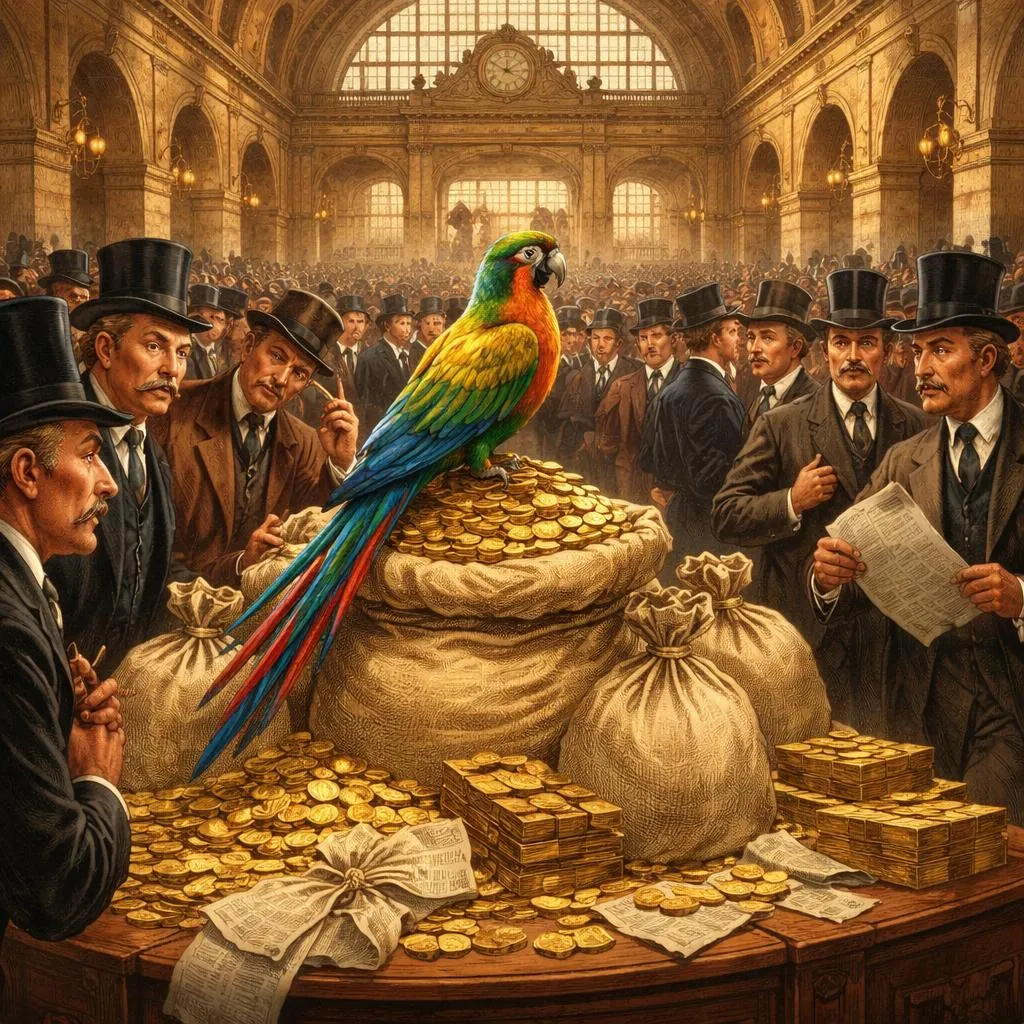

Phileas Fogg rightly suspected that his departure from London would create a lively sensation at the West End. The news of the bet spread through the Reform Club, and afforded an exciting topic of conversation to its members. From the club it soon got into the papers throughout England. The boasted "tour of the world" was talked about, disputed, argued with as much warmth as if the subject were another Alabama claim. Some took sides with Phileas Fogg, but the large majority shook their heads and declared against him; it was absurd, impossible, they declared, that the tour of the world could be made, except theoretically and on paper, in this minimum of time, and with the existing means of travelling. The Times, Standard, Morning Post, and Daily News, and twenty other highly respectable newspapers scouted Mr. Fogg's project as madness; the Daily Telegraph alone hesitatingly supported him. People in general thought him a lunatic, and blamed his Reform Club friends for having accepted a wager which betrayed the mental aberration of its proposer.
Articles no less passionate than logical appeared on the question, for geography is one of the pet subjects of the English; and the columns devoted to Phileas Fogg's venture were eagerly devoured by all classes of readers. At first some rash individuals, principally of the gentler sex, espoused his cause, which became still more popular when the Illustrated London News came out with his portrait, copied from a photograph in the Reform Club. A few readers of the Daily Telegraph even dared to say, "Why not, after all? Stranger things have come to pass."
At last a long article appeared, on the 7th of October, in the bulletin of the Royal Geographical Society, which treated the question from every point of view, and demonstrated the utter folly of the enterprise.
Everything, it said, was against the travellers, every obstacle imposed alike by man and by nature. A miraculous agreement of the times of departure and arrival, which was impossible, was absolutely necessary to his success. He might, perhaps, reckon on the arrival of trains at the designated hours, in Europe, where the distances were relatively moderate; but when he calculated upon crossing India in three days, and the United States in seven, could he rely beyond misgiving upon accomplishing his task? There were accidents to machinery, the liability of trains to run off the line, collisions, bad weather, the blocking up by snow—were not all these against Phileas Fogg? Would he not find himself, when travelling by steamer in winter, at the mercy of the winds and fogs? Is it uncommon for the best ocean steamers to be two or three days behind time? But a single delay would suffice to fatally break the chain of communication; should Phileas Fogg once miss, even by an hour; a steamer, he would have to wait for the next, and that would irrevocably render his attempt vain.
This article made a great deal of noise, and, being copied into all the papers, seriously depressed the advocates of the rash tourist.
Everybody knows that England is the world of betting men, who are of a higher class than mere gamblers; to bet is in the English temperament. Not only the members of the Reform, but the general public, made heavy wagers for or against Phileas Fogg, who was set down in the betting books as if he were a race–horse. Bonds were issued, and made their appearance on 'Change; "Phileas Fogg bonds" were offered at par or at a premium, and a great business was done in them. But five days after the article in the bulletin of the Geographical Society appeared, the demand began to subside: "Phileas Fogg" declined. They were offered by packages, at first of five, then of ten, until at last nobody would take less than twenty, fifty, a hundred!
Lord Albemarle, an elderly paralytic gentleman, was now the only advocate of Phileas Fogg left. This noble lord, who was fastened to his chair, would have given his fortune to be able to make the tour of the world, if it took ten years; and he bet five thousand pounds on Phileas Fogg. When the folly as well as the uselessness of the adventure was pointed out to him, he contented himself with replying, "If the thing is feasible, the first to do it ought to be an Englishman."
The Fogg party dwindled more and more, everybody was going against him, and the bets stood a hundred and fifty and two hundred to one; and a week after his departure an incident occurred which deprived him of backers at any price.
The commissioner of police was sitting in his office at nine o'clock one evening, when the following telegraphic dispatch was put into his hands:
Suez to London.
Rowan, Commissioner of Police, Scotland Yard:
I've found the bank robber, Phileas Fogg. Send with out delay warrant of arrest to Bombay.
Fix, Detective.
The effect of this dispatch was instantaneous. The polished gentleman disappeared to give place to the bank robber. His photograph, which was hung with those of the rest of the members at the Reform Club, was minutely examined, and it betrayed, feature by feature, the description of the robber which had been provided to the police. The mysterious habits of Phileas Fogg were recalled; his solitary ways, his sudden departure; and it seemed clear that, in undertaking a tour round the world on the pretext of a wager, he had had no other end in view than to elude the detectives, and throw them off his track.
Introduction et présentation de l'auteur
Cet extrait est tiré du roman classique Le Tour du monde en quatre-vingts jours de Jules Verne, un auteur français connu pour ses œuvres pionnières de science-fiction et de littérature d'aventure. Écrit en 1873, le récit capture l'esprit de la fascination du XIXe siècle pour l'exploration, la technologie et le rétrécissement du monde grâce aux progrès des transports. L'imagination vive et les recherches détaillées de Verne ont rendu ses romans à la fois divertissants et éducatifs, inspirant des générations de lecteurs à rêver de contrées lointaines et d'aventures audacieuses.
Aperçu de l'histoire et importance
L'histoire suit Phileas Fogg, un gentleman anglais précis et fortuné, qui parie qu'il peut faire le tour du monde en seulement quatre-vingts jours. Ce pari audacieux prépare le terrain pour un voyage passionnant rempli de défis, de rencontres culturelles et de moments de suspense. Le passage décrit la réaction initiale du public au plan de Fogg, soulignant le scepticisme et l'incrédulité des journaux et du public, ainsi que la dynamique sociale autour des paris et de la réputation dans l'Angleterre victorienne.
Le voyage de Fogg n'est pas seulement une aventure physique, mais aussi une épreuve de la détermination humaine, de l'ingéniosité et de la puissance de la technologie moderne. L'histoire explore des thèmes tels que le temps, le progrès et le choc entre la tradition et l'innovation. Elle reflète également la nature humaine - comment la société réagit à l'inconventionnel et à l'inconnu, souvent avec le doute ou la peur.
Leçons et perspectives pour les étudiants
-
Courage et détermination : La volonté de Phileas Fogg de relever un défi presque impossible enseigne aux élèves la valeur du courage et de la persévérance. Même face au doute et aux obstacles généralisés, il est crucial de rester fidèle à ses objectifs.
-
Esprit critique et scepticisme : La réaction du public montre comment les gens jugent souvent les idées en fonction de leurs propres expériences et préjugés. Les élèves peuvent apprendre à évaluer attentivement les nouvelles idées, mais aussi à rester ouverts aux possibilités au-delà des limites actuelles.
-
L'importance de la planification et de l'adaptabilité : Le voyage de Fogg dépend d'un timing et d'une coordination précis, mais des événements inattendus menacent son succès. Cela souligne la nécessité d'une planification minutieuse et de la capacité de s'adapter lorsque les choses ne se passent pas comme prévu.
-
Sensibilisation culturelle : Alors que Fogg voyage à travers le monde, il rencontre diverses cultures et environnements. Cela encourage les élèves à apprécier la diversité mondiale et à développer de l'empathie et de la curiosité pour d'autres modes de vie.
-
Le rôle de la technologie : L'histoire montre comment les progrès technologiques (comme les chemins de fer et les navires à vapeur) peuvent transformer la société. Les élèves peuvent réfléchir à l'impact de l'innovation sur la vie quotidienne et à l'importance d'embrasser le changement.
Appliquer ces leçons dans la vie et l'apprentissage
-
À l'école : Les élèves peuvent appliquer l'exemple de Fogg en se fixant des objectifs stimulants mais réalisables, en gérant bien leur temps et en persévérant face aux difficultés dans leurs études.
-
Dans les situations sociales : Le comportement calme et respectueux de Fogg, malgré les critiques, enseigne l'importance de la confiance et de l'intégrité face à la pression des pairs ou au scepticisme.
-
Dans le développement personnel : Embrasser de nouvelles expériences et apprendre de différentes cultures peut élargir sa perspective et favoriser l'ouverture d'esprit.
Cultiver des qualités positives à partir de l'histoire
-
Résilience : Comme Fogg, les élèves doivent apprendre à se remettre des revers et à aller de l'avant.
-
Curiosité et exploration : Encourager un esprit d'aventure dans l'apprentissage - que ce soit par la lecture, les voyages ou de nouveaux passe-temps - peut enrichir la vie.
-
Respect des autres : Comprendre et valoriser la diversité, comme le fait Fogg lors de ses voyages, aide à construire de meilleures relations.
Réflexion et appréciation
La lecture du Tour du monde en quatre-vingts jours invite les élèves à imaginer le frisson de l'aventure tout en réfléchissant de manière critique aux défis du changement et du progrès. C'est une histoire qui célèbre l'ingéniosité humaine et le désir de repousser les limites, inspirant les lecteurs à rêver grand et à agir avec audace. Grâce au voyage de Fogg, les jeunes lecteurs acquièrent non seulement du divertissement, mais aussi de précieuses leçons de vie qui les encouragent à être courageux, réfléchis et ouverts dans leur propre vie.
