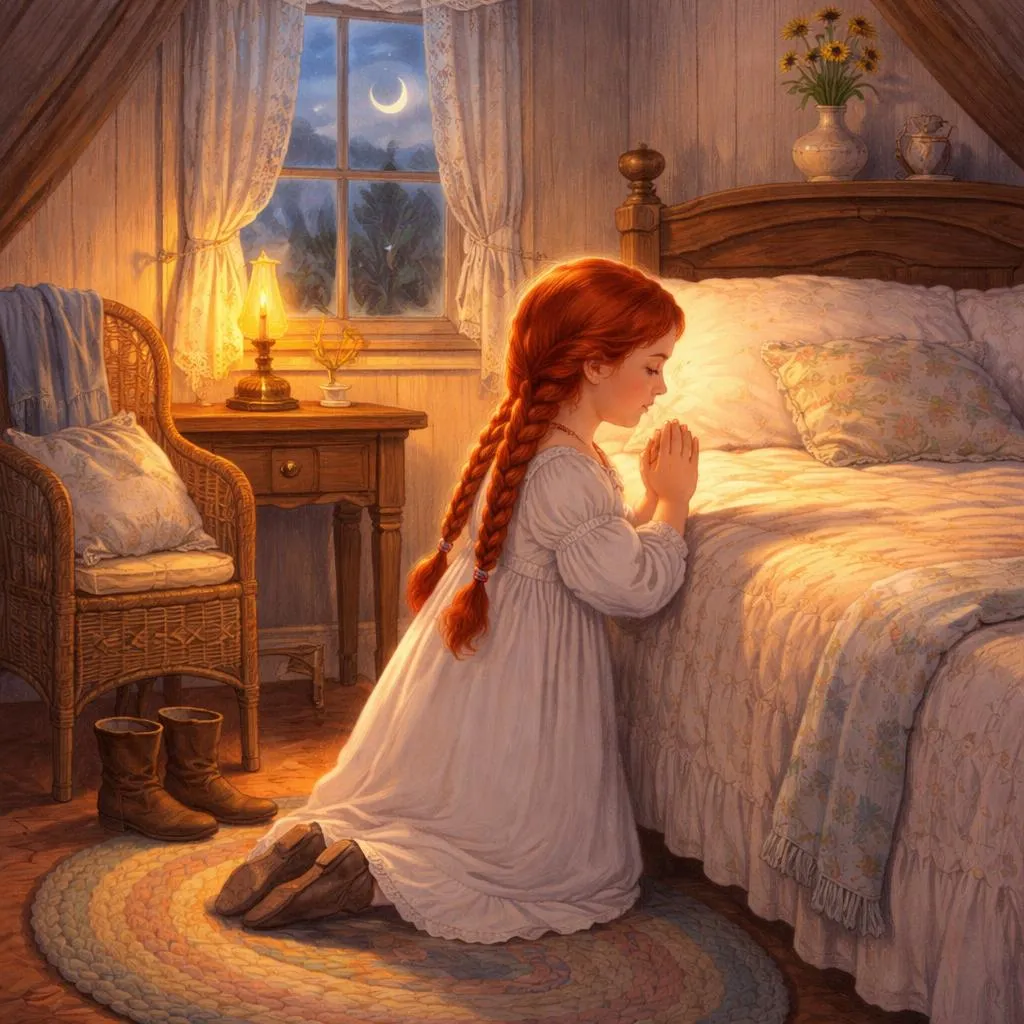

When Marilla took Anne up to bed that night she said stiffly:
“Now, Anne, I noticed last night that you threw your clothes all about the floor when you took them off. That is a very untidy habit, and I can’t allow it at all. As soon as you take off any article of clothing fold it neatly and place it on the chair. I haven’t any use at all for little girls who aren’t neat.”
“I was so harrowed up in my mind last night that I didn’t think about my clothes at all,” said Anne. “I’ll fold them nicely tonight. They always made us do that at the asylum. Half the time, though, I’d forget, I’d be in such a hurry to get into bed nice and quiet and imagine things.”
“You’ll have to remember a little better if you stay here,” admonished Marilla. “There, that looks something like. Say your prayers now and get into bed.”
“I never say any prayers,” announced Anne.
Marilla looked horrified astonishment.
“Why, Anne, what do you mean? Were you never taught to say your prayers? God always wants little girls to say their prayers. Don’t you know who God is, Anne?”
”’God is a spirit, infinite, eternal and unchangeable, in His being, wisdom, power, holiness, justice, goodness, and truth,’” responded Anne promptly and glibly.
Marilla looked rather relieved.
“So you do know something then, thank goodness! You’re not quite a heathen. Where did you learn that?”
“Oh, at the asylum Sunday-school. They made us learn the whole catechism. I liked it pretty well. There’s something splendid about some of the words. ‘Infinite, eternal and unchangeable.’ Isn’t that grand? It has such a roll to it—just like a big organ playing. You couldn’t quite call it poetry, I suppose, but it sounds a lot like it, doesn’t it?”
“We’re not talking about poetry, Anne—we are talking about saying your prayers. Don’t you know it’s a terrible wicked thing not to say your prayers every night? I’m afraid you are a very bad little girl.”
“You’d find it easier to be bad than good if you had red hair,” said Anne reproachfully. “People who haven’t red hair don’t know what trouble is. Mrs. Thomas told me that God made my hair red ON PURPOSE, and I’ve never cared about Him since. And anyhow I’d always be too tired at night to bother saying prayers. People who have to look after twins can’t be expected to say their prayers. Now, do you honestly think they can?”
Marilla decided that Anne’s religious training must be begun at once. Plainly there was no time to be lost.
“You must say your prayers while you are under my roof, Anne.”
“Why, of course, if you want me to,” assented Anne cheerfully. “I’d do anything to oblige you. But you’ll have to tell me what to say for this once. After I get into bed I’ll imagine out a real nice prayer to say always. I believe that it will be quite interesting, now that I come to think of it.”
“You must kneel down,” said Marilla in embarrassment.
Anne knelt at Marilla’s knee and looked up gravely.
“Why must people kneel down to pray? If I really wanted to pray I’ll tell you what I’d do. I’d go out into a great big field all alone or into the deep, deep, woods, and I’d look up into the sky—up—up—up—into that lovely blue sky that looks as if there was no end to its blueness. And then I’d just FEEL a prayer. Well, I’m ready. What am I to say?”
Marilla felt more embarrassed than ever. She had intended to teach Anne the childish classic, “Now I lay me down to sleep.” But she had, as I have told you, the glimmerings of a sense of humor—which is simply another name for a sense of fitness of things; and it suddenly occurred to her that that simple little prayer, sacred to white-robed childhood lisping at motherly knees, was entirely unsuited to this freckled witch of a girl who knew and cared nothing bout God’s love, since she had never had it translated to her through the medium of human love.
“You’re old enough to pray for yourself, Anne,” she said finally. “Just thank God for your blessings and ask Him humbly for the things you want.”
“Well, I’ll do my best,” promised Anne, burying her face in Marilla’s lap. “Gracious heavenly Father—that’s the way the ministers say it in church, so I suppose it’s all right in private prayer, isn’t it?” she interjected, lifting her head for a moment.
"Gracious heavenly Father, I thank Thee for the White Way of Delight and the Lake of Shining Waters and Bonny and the Snow Queen. I'm really extremely grateful for them. And that's all the blessings I can think of just now to thank Thee for. As for the things I want, they're so numerous that it would take a great deal of time to name them all so I will only mention the two most important. Please let me stay at Green Gables; and please let me be good-looking when I grow up. I remain,"
Yours respectfully, Anne Shirley.
“There, did I do all right?” she asked eagerly, getting up. “I could have made it much more flowery if I’d had a little more time to think it over.”
Poor Marilla was only preserved from complete collapse by remembering that it was not irreverence, but simply spiritual ignorance on the part of Anne that was responsible for this extraordinary petition. She tucked the child up in bed, mentally vowing that she should be taught a prayer the very next day, and was leaving the room with the light when Anne called her back.
“I’ve just thought of it now. I should have said, ‘Amen’ in place of ‘yours respectfully,’ shouldn’t I?—the way the ministers do. I’d forgotten it, but I felt a prayer should be finished off in some way, so I put in the other. Do you suppose it will make any difference?”
“I—I don’t suppose it will,” said Marilla. “Go to sleep now like a good child. Good night.”
“I can only say good night tonight with a clear conscience,” said Anne, cuddling luxuriously down among her pillows.
Marilla retreated to the kitchen, set the candle firmly on the table, and glared at Matthew.
“Matthew Cuthbert, it’s about time somebody adopted that child and taught her something. She’s next door to a perfect heathen. Will you believe that she never said a prayer in her life till tonight? I’ll send her to the manse tomorrow and borrow the Peep of the Day series, that’s what I’ll do. And she shall go to Sunday-school just as soon as I can get some suitable clothes made for her. I foresee that I shall have my hands full. Well, well, we can’t get through this world without our share of trouble. I’ve had a pretty easy life of it so far, but my time has come at last and I suppose I’ll just have to make the best of it.”
Contexte et présentation de l'auteur
Ce passage est tiré de Anne de Green Gables, un roman classique bien-aimé écrit par l'auteur canadienne Lucy Maud Montgomery, publié pour la première fois en 1908. L'histoire suit Anne Shirley, une orpheline imaginative et pleine d'esprit, qui est envoyée par erreur vivre avec Marilla et Matthew Cuthbert, un frère et une sœur qui avaient l'intention d'adopter un garçon pour les aider à leur ferme. Situé dans le village fictif d'Avonlea sur l'Île-du-Prince-Édouard, le roman explore les thèmes de l'appartenance, de l'identité et du pouvoir de l'imagination.
Lucy Maud Montgomery s'est fortement inspirée de ses propres expériences d'enfance dans le Canada rural, imprégnant l'histoire de descriptions vivantes de la nature et d'un fort sentiment de communauté. Sa représentation du personnage d'Anne — fougueuse, créative et parfois têtue — a captivé des générations de lecteurs du monde entier.
Interprétation détaillée et signification
Cet extrait met en évidence un moment charnière dans l'adaptation d'Anne à sa nouvelle maison et aux attentes qui l'accompagnent. Marilla, une femme stricte et pragmatique, essaie d'inculquer la discipline et l'ordre dans la vie d'Anne, tandis que la nature imaginative et émotionnelle d'Anne se heurte à ces exigences. Le dialogue sur la prière révèle le manque d'éducation religieuse formelle d'Anne, mais aussi sa façon unique et sincère de se connecter au monde spirituel.
La prière d'Anne, bien qu'inconventionnelle et parsemée d'humour, montre sa sincère gratitude et ses désirs, reflétant son innocence et son espoir. La réaction de Marilla souligne les défis liés au rapprochement de différentes expériences de vie et de perspectives. Cette scène illustre magnifiquement le thème de la croissance — personnelle et spirituelle — et l'importance de la compréhension et de la patience dans l'épanouissement de l'enfant.
Leçons et réflexions pour les élèves
-
La valeur de l'imagination et de l'individualité : L'approche imaginative d'Anne envers la prière et la vie encourage les jeunes lecteurs à embrasser leur singularité et leur créativité, même face à des règles ou des attentes rigides.
-
L'importance de l'adaptation et de la croissance : Comme Anne, les élèves sont souvent confrontés à de nouveaux environnements et défis. Apprendre à équilibrer l'expression personnelle avec les normes sociales est une compétence essentielle pour la croissance.
-
Compréhension et empathie : L'attitude évolutive de Marilla envers Anne nous enseigne la patience et l'empathie — reconnaître que les gens viennent d'horizons différents et ont besoin de temps et de conseils pour s'adapter.
-
Gratitude et réflexion : La prière d'Anne nous rappelle d'apprécier les bénédictions dans nos vies, aussi petites ou inhabituelles soient-elles.
Application dans la vie quotidienne
-
À l'école : Les élèves peuvent apprendre à respecter les règles et les routines tout en trouvant des moyens d'exprimer leur individualité. L'histoire d'Anne encourage à équilibrer la discipline avec la créativité.
-
Dans les contextes sociaux : Comprendre les antécédents et les perspectives des autres favorise la gentillesse et réduit le jugement, un peu comme Marilla apprenant à accepter les bizarreries d'Anne.
-
Développement personnel : Développer des habitudes comme la gratitude et la réflexion, comme Anne essaie de le faire avec sa prière, peut aider les élèves à construire un état d'esprit positif et une résilience émotionnelle.
Cultiver les qualités positives de l'histoire
-
Curiosité et imagination : Encouragez l'écriture, le dessin ou la narration pour nourrir la créativité.
-
Responsabilité et ordre : Comme l'insistance de Marilla sur la propreté, les élèves peuvent s'exercer à organiser leurs espaces et leurs effets personnels.
-
Conscience spirituelle et émotionnelle : Que ce soit par la prière, la méditation ou la réflexion tranquille, les élèves peuvent développer une compréhension plus profonde de leurs sentiments et de leurs valeurs.
-
Patience et compassion : Tant pour soi que pour les autres, reconnaître que la croissance est un processus.
Conclusion
Anne de Green Gables offre une sagesse intemporelle enveloppée dans un récit charmant. Ce passage, en particulier, invite les lecteurs à apprécier la complexité de grandir et la beauté de mélanger l'imagination avec la discipline. Pour les élèves et les jeunes lecteurs, le voyage d'Anne est une source d'inspiration pour être fidèle à soi-même tout en apprenant à naviguer dans le monde avec gentillesse, gratitude et courage.
