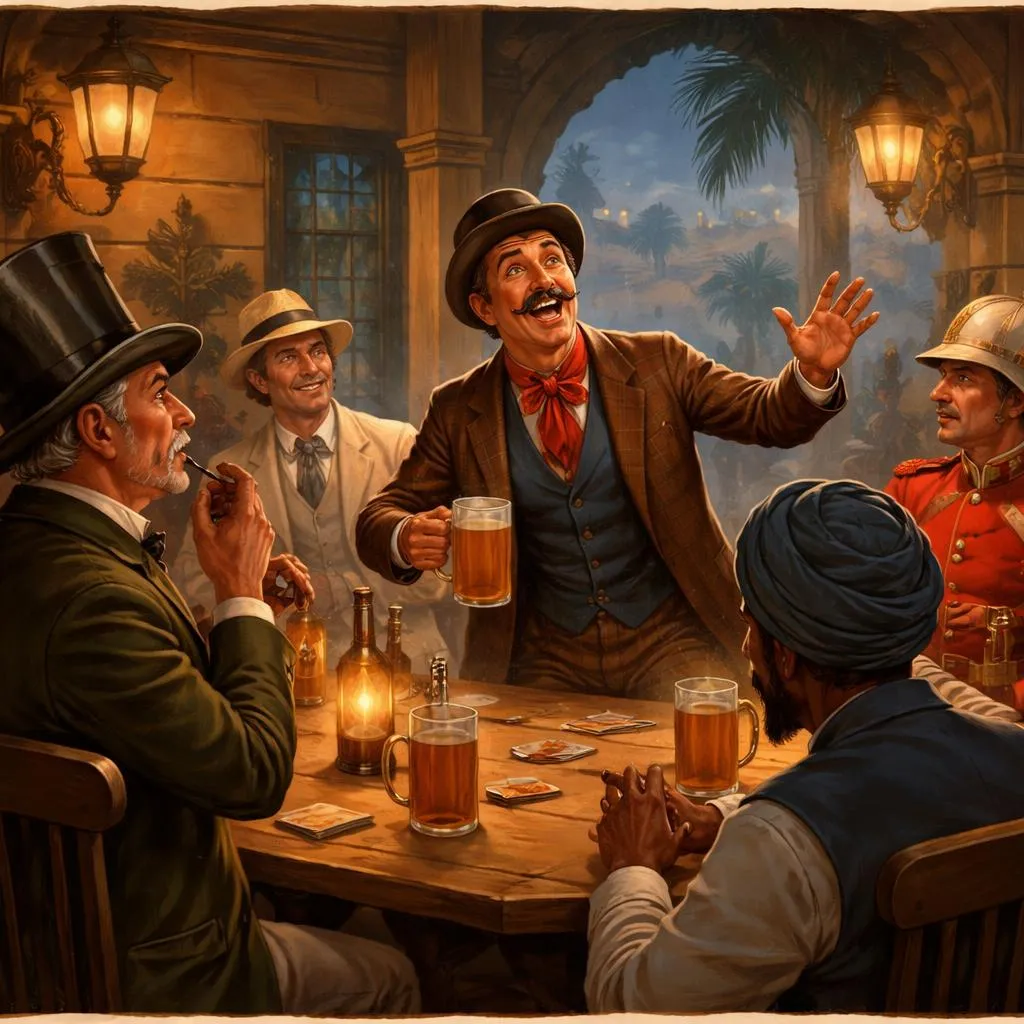

Fix soon rejoined Passepartout, who was lounging and looking about on the quay, as if he did not feel that he, at least, was obliged not to see anything.
"Well, my friend," said the detective, coming up with him, "is your passport visaed?"
"Ah, it's you, is it, monsieur?" responded Passepartout. "Thanks, yes, the passport is all right."
"And you are looking about you?"
"Yes; but we travel so fast that I seem to be journeying in a dream. So this is Suez?"
"Yes."
"In Egypt?"
"Certainly, in Egypt."
"And in Africa?"
"In Africa."
"In Africa!" repeated Passepartout. "Just think, monsieur, I had no idea that we should go farther than Paris; and all that I saw of Paris was between twenty minutes past seven and twenty minutes before nine in the morning, between the Northern and the Lyons stations, through the windows of a car, and in a driving rain! How I regret not having seen once more Pere la Chaise and the circus in the Champs Elysees!"
"You are in a great hurry, then?"
"I am not, but my master is. By the way, I must buy some shoes and shirts. We came away without trunks, only with a carpet–bag."
"I will show you an excellent shop for getting what you want."
"Really, monsieur, you are very kind."
And they walked off together, Passepartout chatting volubly as they went along.
"Above all," said he; "don't let me lose the steamer."
"You have plenty of time; it's only twelve o'clock."
Passepartout pulled out his big watch. "Twelve!" he exclaimed; "why, it's only eight minutes before ten."
"Your watch is slow."
"My watch? A family watch, monsieur, which has come down from my great–grandfather! It doesn't vary five minutes in the year. It's a perfect chronometer, look you."
"I see how it is," said Fix. "You have kept London time, which is two hours behind that of Suez. You ought to regulate your watch at noon in each country."
"I regulate my watch? Never!"
"Well, then, it will not agree with the sun."
"So much the worse for the sun, monsieur. The sun will be wrong, then!"
And the worthy fellow returned the watch to its fob with a defiant gesture. After a few minutes silence, Fix resumed: "You left London hastily, then?"
"I rather think so! Last Friday at eight o'clock in the evening, Monsieur Fogg came home from his club, and three–quarters of an hour afterwards we were off."
"But where is your master going?"
"Always straight ahead. He is going round the world."
"Round the world?" cried Fix.
"Yes, and in eighty days! He says it is on a wager; but, between us, I don't believe a word of it. That wouldn't be common sense. There's something else in the wind."
"Ah! Mr. Fogg is a character, is he?"
"I should say he was."
"Is he rich?"
"No doubt, for he is carrying an enormous sum in brand new banknotes with him. And he doesn't spare the money on the way, either: he has offered a large reward to the engineer of the Mongolia if he gets us to Bombay well in advance of time."
"And you have known your master a long time?"
"Why, no; I entered his service the very day we left London."
The effect of these replies upon the already suspicious and excited detective may be imagined. The hasty departure from London soon after the robbery; the large sum carried by Mr. Fogg; his eagerness to reach distant countries; the pretext of an eccentric and foolhardy bet—all confirmed Fix in his theory. He continued to pump poor Passepartout, and learned that he really knew little or nothing of his master, who lived a solitary existence in London, was said to be rich, though no one knew whence came his riches, and was mysterious and impenetrable in his affairs and habits. Fix felt sure that Phileas Fogg would not land at Suez, but was really going on to Bombay.
"Is Bombay far from here?" asked Passepartout.
"Pretty far. It is a ten days' voyage by sea."
"And in what country is Bombay?"
"India."
"In Asia?"
"Certainly."
"The deuce! I was going to tell you there's one thing that worries me—my burner!"
"What burner?"
"My gas–burner, which I forgot to turn off, and which is at this moment burning at my expense. I have calculated, monsieur, that I lose two shillings every four and twenty hours, exactly sixpence more than I earn; and you will understand that the longer our journey—"
Did Fix pay any attention to Passepartout's trouble about the gas? It is not probable. He was not listening, but was cogitating a project. Passepartout and he had now reached the shop, where Fix left his companion to make his purchases, after recommending him not to miss the steamer, and hurried back to the consulate. Now that he was fully convinced, Fix had quite recovered his equanimity.
"Consul," said he, "I have no longer any doubt. I have spotted my man. He passes himself off as an odd stick who is going round the world in eighty days."
"Then he's a sharp fellow," returned the consul, "and counts on returning to London after putting the police of the two countries off his track."
"We'll see about that," replied Fix.
"But are you not mistaken?"
"I am not mistaken."
"Why was this robber so anxious to prove, by the visa, that he had passed through Suez?"
"Why? I have no idea; but listen to me."
He reported in a few words the most important parts of his conversation with Passepartout.
"In short," said the consul, "appearances are wholly against this man. And what are you going to do?"
"Send a dispatch to London for a warrant of arrest to be dispatched instantly to Bombay, take passage on board the Mongolia, follow my rogue to India, and there, on English ground, arrest him politely, with my warrant in my hand, and my hand on his shoulder."
Having uttered these words with a cool, careless air, the detective took leave of the consul, and repaired to the telegraph office, whence he sent the dispatch which we have seen to the London police office. A quarter of an hour later found Fix, with a small bag in his hand, proceeding on board the Mongolia; and, ere many moments longer, the noble steamer rode out at full steam upon the waters of the Red Sea.
Contexte et introduction de l'auteur
Cet extrait est tiré du roman classique Le tour du monde en quatre-vingts jours de Jules Verne, un auteur français renommé pour ses récits d'aventure et de science-fiction. Écrit en 1872, ce roman capture l'esprit d'exploration et les merveilles des progrès technologiques du XIXe siècle, tels que les navires à vapeur et les chemins de fer, qui ont rendu les voyages mondiaux plus accessibles que jamais. Verne est souvent appelé le "Père de la science-fiction" pour ses œuvres imaginatives et visionnaires.
Interprétation détaillée et signification
L'histoire suit Phileas Fogg, un gentleman anglais précis et fortuné, qui parie qu'il peut faire le tour du monde en seulement quatre-vingts jours. Son fidèle serviteur français, Passepartout, l'accompagne. Le passage nous présente ces personnages, ainsi que Fix, un détective qui soupçonne Fogg d'être un voleur de banque en fuite. La tension entre les personnages et le rythme rapide du voyage mettent en évidence les thèmes du temps, de la confiance et du choc entre les apparences et la réalité.
Cette partie de l'histoire met également l'accent sur l'excitation et les défis des voyages à cette époque. L'émerveillement de Passepartout en voyant des endroits comme Suez et l'Égypte pour la première fois contraste avec ses attentes initiales limitées du voyage. Les soupçons du détective ajoutent une couche de mystère et de suspense, illustrant comment les malentendus et les suppositions peuvent conduire à des conflits.
Leçons et perspectives pour les étudiants
-
Curiosité et ouverture d'esprit : L'émerveillement de Passepartout face aux nouveaux endroits qu'il visite encourage les lecteurs à embrasser la curiosité et à apprécier la diversité du monde. Les étudiants peuvent apprendre à s'ouvrir à de nouvelles expériences et cultures, ce qui élargit leur compréhension et leur empathie.
-
Esprit critique et jugement : Les soupçons de Fix envers Fogg rappellent aux lecteurs de remettre en question les apparences et de rechercher des preuves avant de porter des jugements. Cela enseigne l'importance de l'esprit critique et de ne pas tirer de conclusions hâtives basées sur des informations incomplètes.
-
Gestion du temps et planification : Le voyage de Fogg est une leçon sur la valeur d'une planification minutieuse et de la gestion du temps. Les étudiants peuvent réfléchir à la façon dont la fixation d'objectifs et la gestion efficace du temps peuvent les aider à accomplir des tâches difficiles.
-
Loyauté et service : Le dévouement de Passepartout envers son maître montre l'importance de la loyauté et de la responsabilité. Cela souligne comment le soutien aux autres peut être à la fois un devoir et une source d'épanouissement personnel.
-
Adaptabilité : L'histoire démontre la nécessité de s'adapter aux circonstances imprévues, comme voyager rapidement et faire face à de nouveaux environnements. Les étudiants peuvent apprendre à être flexibles et résilients face au changement.
Appliquer ces leçons dans la vie quotidienne
- Dans l'apprentissage : Tout comme Fogg planifie soigneusement son itinéraire, les étudiants peuvent planifier leurs horaires d'étude et fixer des objectifs clairs pour gérer efficacement leur charge de travail.
- Dans les situations sociales : Être ouvert d'esprit comme Passepartout aide à nouer des amitiés à travers les cultures et les origines.
- Dans la résolution de problèmes : Utiliser l'esprit critique comme Fix peut aider les étudiants à analyser les situations en profondeur avant d'agir.
- Dans le développement personnel : Montrer de la loyauté et de la responsabilité dans le travail d'équipe ou la vie de famille renforce les relations et la confiance.
- Face aux défis : Adopter l'adaptabilité aide les étudiants à surmonter les obstacles et à rester positifs pendant les périodes difficiles.
Cultiver les qualités positives de l'histoire
Pour développer les vertus présentées dans l'histoire, les étudiants peuvent :
- Pratiquer la curiosité en explorant de nouveaux sujets ou passe-temps.
- Réfléchir avant de juger les autres, en cherchant à comprendre leurs points de vue.
- Fixer des objectifs personnels et créer des plans pour les atteindre.
- Soutenir leurs amis et leur famille avec gentillesse et fiabilité.
- Accueillir le changement comme une opportunité d'apprendre et de grandir.
En lisant Le tour du monde en quatre-vingts jours, les étudiants apprécient non seulement une aventure passionnante, mais acquièrent également de précieuses compétences de vie qui les préparent à leurs propres voyages, que ce soit dans l'apprentissage, l'amitié ou les défis personnels.