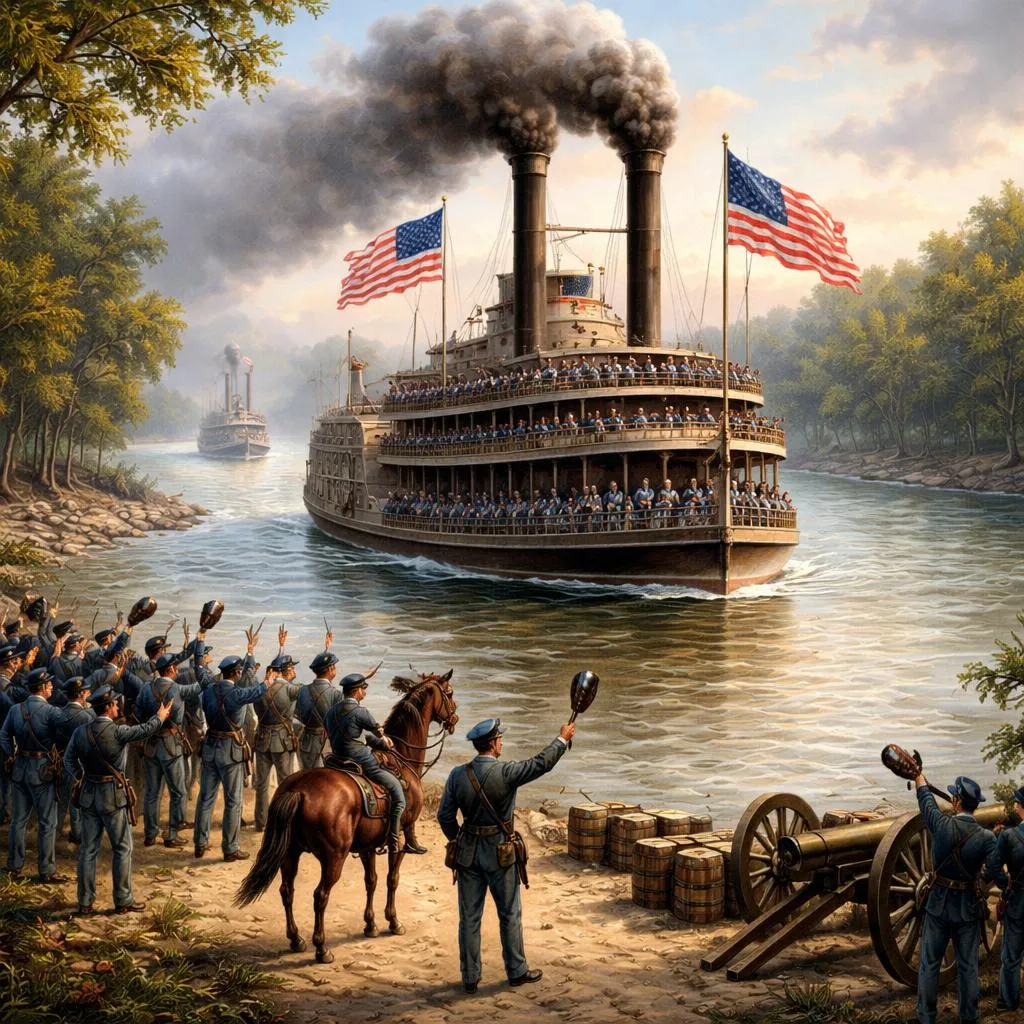

The fog, which had been coming and going during the whole of the night, had now lifted so that everything in the vicinity of the fort could be seen; but across the point, down the ship channel, it was dense, dark, and black. The wind was fresh from the south-west, which rolled up the fog banks, and then rolled them away. Such was the atmospheric condition near Mobile Point, and Christy believed it was the same at the southward. He thought it probable that the commander of the Tallahatchie would wait for a more favorable time than the present appeared to be before he got under way.
“All hands to the forecastle,” he called to the men on the cotton bales.
All of them, knowing his voice as well as they knew their own names, hastened to answer to the call.
“We have to heave up the anchor with a windlass, Mr. Graines,” said he to the engineer. “We had better get the hang of it while we have time to do so. Ship the handspikes, my men.”
Doubtless all of them had worked a windlass before, for every one of them was an able seaman, which had been one of the elements in their selection, and they went to work very handily. A turn or two was given, which started the vessel ahead, showing that the anchor was not hove entirely short. Graines went to the bow, and reported a considerable slant of the cable with the surface of the water. Christy ordered the six seamen to work the windlass, with French to take in the slack. They continued to heave over with the handspikes for some time longer.
“Cable up and down, sir,” reported Graines.
“Avast heaving!” added the lieutenant; and he had taken the command, paying no attention to the fact that he was the second mate under the new order of things, and the engineer did not remind him that he was the chief officer. “Let off the cable a couple of notches, so that the anchor will not break out. Make fast to the bitts, French, but don’t foul it with the towline.”
“We are all right now,” said Graines, as he moved aft from the heel of the bowsprit.
“What time is it now?” asked the lieutenant. “Bring that lantern forward, Lines.”
“Ten minutes of three,” replied the engineer, holding his watch up to the light.
“The fog is settling down again, and I have no doubt the captain of the steamer will get under way at about the hour named,” said Christy, putting his hand on the wire towline, and giving it a shake, to assure himself that it was all clear. “Now, Mr. Graines, or rather, Mr. Balker, as you are the mate and I am only the second mate, I think you had better go aft and see that all goes well there.”
“Very well, Mr. Sandman; I will leave you in charge of the forecastle,” replied the engineer, with a light laugh; but they had been boys together, and understood each other perfectly.
“Captain Sullendine is the only dangerous man on board, and I think you had better look after him,” added Christy. “If there is any lock on the door of his stateroom, it would be well to turn the key.”
“I will look after him at once, sir,” answered Graines, as he leaped upon the cotton bales and made his way to the quarter-deck.
On the way he examined the condition of Sopsy, and found him snoring like a roaring lion, in an uneasy position. He turned him over on his side, and then went to the lair of Bokes, who was in the same condition; and he concluded that neither of them would come to his senses for a couple of hours at least.
Captain Sullendine had been assisted to a comfortable position when he turned in, and he was sleeping with nothing to disturb him. There was no lock on the door, and Graines could not turn the key. The interior of the cabin was finished in the most primitive manner, for the vessel had not been built to accommodate passengers. The door of the captain’s stateroom was made of inch and a half boards, with three battens, and the handle was an old-fashioned bow-latch. There was a heavy bolt on the inside, as though the apartment had been built to enable the master to fortify himself in case of a mutiny.
The engineer could not fasten the door with any of the fixtures on it; but it opened inward, as is generally the case on shipboard, and this fact suggested to the ingenious officer the means of securing it even more effectually than it could have been done with a lock and key. In the pantry he found a rolling-pin, which the cook must have left there for some other purpose.
This implement he applied to the bow-handle of the fixture on the door. It would not fit the iron loop, but he whittled it down on one side with his pocket-knife till he made it fit exactly in its place with some hard pressure. But shaking the door might cause it to drop out, and he completed the job by lashing it to the handle of the door with a lanyard he had in his pocket. When he had finished his work he was confident the captain could not get out of his room unless he broke down the door, which he lacked the means to accomplish.
“West Wind, ahoy!” shouted some one from the stern of the steamer before the engineer had completed his work in the cabin.
Christy thought that French’s voice was a better imitation of Captain Sullendine’s than his own, and he directed him to reply to the hail, telling him what to say.
“On board the Tallahatchie!” returned the seaman at the lieutenant’s dictation.
“Are you all ready?” shouted the same officer.
“All ready, sir!” replied French.
“Captain Rombold will get under way in five minutes!” called the speaker on the stern of the steamer. “Wait for three short whistles, and then heave up your anchor!”
“Understood, and all right,” added the spokesman of the West Wind.
“Captain Rombold!” exclaimed Christy to himself, as he heard for the first time the name of the commander of the Tallahatchie.
The lieutenant, acting as the servant of the French detective at St. George’s in the Bermudas, had seen Captain Rombold, and had heard him converse for an hour with Mr. Gilfleur, when he was in command of the Dornoch, which had been captured by the Chateaugay, on board of which Christy was a passenger. He was known to be a very able and brave officer, and his defeat was owing more to the heavier metal of the loyal ship than to any lack of skill or courage on the part of the Confederate commander. The last the young officer knew about him, he was a prisoner of war in New York, and had doubtless been exchanged for some loyal officer of equal rank, for the enemy had plenty of them on hand.
“Man the windlass, my lads,” said Christy in a quiet tone, though he was still thinking of the commander of the steamer which was to tow out the schooner.
While he was waiting for the three short whistles, Graines came forward and reported in what manner he had secured the captain, and that the two men on the cotton bales were still insensible.
“You may be sure the captain will not come out of his stateroom until we let him out,” added the engineer; and Christy proceeded to explain what had passed between the schooner and the steamer.
“The Tallahatchie has one of the ablest commanders that sail the ocean, for I have seen and know him,” continued the lieutenant. “It is Captain Rombold, now or formerly, of the British Navy. He is a gentleman and a scholar, as well as a brave and skilful officer.”
“Then Captain Breaker may have his hands full before he captures the steamer,” added the engineer.
“He certainly will; but a great deal depends upon the weight of the Tallahatchie’s metal.”
“We shall soon have a chance to judge of that.”
“I should like to know something more about this steamer, though my father’s letter gives us the principal details; but we have no time now to examine her,” continued Christy.
“Who’s that?” demanded Graines, as he saw a man walking forward over the bales of cotton.
It proved to be Bokes, who had slept off a part of the effects of the debauch; but Sopsy had probably consumed a large portion of the contents of his bottle.
“Does you uns happen to have any more apple-jack?” asked the fellow. "Somehow I lost nigh all o’ mine, and I’m sufferin’, dyin’ for a drink.”
“French, take him to the deck-house, and fasten him in,” said Christy in a low tone.
“Come with me, my hearty, and we’ll see what there is in the deck-house,” said the seaman, as he took the man by the arm and led him to the place indicated. “Now go in and find your bunk. Get into it, and I will look for a bottle here.”
Bokes crept to his bunk, and stretched himself out there. French took the bottle the lieutenant had emptied into the bay, and gave it to him. Then he closed the door, and finding a padlock and hasp on it, he locked him in. Two of the three men who had remained on board of the schooner were now prisoners; and Sopsy was considered as harmless as a fishworm.
French had hardly reported what he had done before the three short whistles were sounded, and Christy gave the order to heave up the anchor.
“West Wind, ahoy!” shouted the same officer who had spoken before.
“On board the steamer!” replied French, when he was directed to reply.
“Dowse that glim on your fo’castle!” shouted the officer, as with a liberal dose of profanity he demanded if they were all fools on board of the schooner. “Put out every light on board!”
“Ay, ay, sir!” responded French, as Graines extinguished the lantern on the forecastle; and Christy directed him to do the same with the cabin lamp.
He looked at his watch before he put it out, and found it was quarter-past three. The captain of the steamer had evidently waited for a favorable moment to start on his perilous voyage, and the engineer noticed when he went forward after he had secured Captain Sullendine, that the fog was again settling down on the bay.
“On board the steamer!” shouted French, as directed. “Anchor aweigh, sir!” Then a minute later, “All clear, and the towline slack!”
From the sounds that came from the forward part of the steamer, it was evident that she had heaved up her anchor before she gave the three whistles for the schooner to do so.
“West Wind, ahoy!” called the officer from the Tallahatchie. “Stand by your helm with your best man!”
Graines had just gone aft, and had taken the wheel of the vessel; but Christy sent French to take his first trick at the helm. The tide was still setting into the bay, and it was within half an hour of the flood. The schooner was beginning to sway off from the shore as the tide struck her, when the gong bell in the engine-room of the steamer was heard. She went ahead very slowly, and straightened the towline. Christy took a careful survey of its fastenings, to assure himself that it was all right, and then mounted the cotton bales, to observe the progress of the vessel.
Of course the steamer was under the direction of a skilful pilot, doubtless the best that could be had, for the present venture was an exceedingly important one to the Confederate cause. The Tallahatchie was perhaps a better vessel than any of those which had done so much mischief among the ships of the loyal American marine, and in no manner could the Southern cause be more effectually assisted than by these cruisers.
As the vessels headed to the southward, Christy went to the binnacle, and watched the course.
Contexte et introduction de l'auteur
Ce passage est tiré d'une aventure maritime palpitante qui se déroule pendant la guerre de Sécession américaine, où la stratégie navale et les exploits audacieux jouent un rôle crucial. L'histoire tourne autour de la goélette West Wind et du navire à vapeur Tallahatchie, mettant en évidence les moments de tension précédant une opération secrète en mer. L'auteur, qui a écrit à la fin du XIXe siècle, était connu pour ses descriptions vivantes et ses récits captivants qui ont fait découvrir aux lecteurs, en particulier aux jeunes adultes, la guerre navale et la vie maritime. Ses œuvres combinaient souvent des faits historiques avec des récits fictifs pour éduquer et divertir simultanément.
Interprétation détaillée et signification
L'extrait capture une scène pleine de suspense où l'équipage se prépare à appareiller dans des conditions difficiles : brouillard, nuit et menace de capture ennemie. Les personnages font preuve d'esprit d'équipe, de vivacité d'esprit et de leadership, en particulier Christy, qui prend le commandement malgré son grade officiel. Le passage reflète également les thèmes de la loyauté, du courage et de l'ingéniosité. L'arraisonnement du capitaine Sullendine pour empêcher le sabotage montre la tension et la méfiance à bord, tandis que l'anticipation du commandement du capitaine Rombold présente une figure de respect et de compétence.
L'histoire ne se contente pas de divertir, elle éduque également les lecteurs sur les termes et les procédures nautiques, comme la manipulation du guindeau, la gestion des ancres et l'importance du timing dans la navigation. Elle introduit subtilement le contexte historique des conflits navals pendant la guerre de Sécession, en soulignant l'importance stratégique des opérations maritimes.
Leçons et perspectives pour les élèves
-
Leadership et responsabilité : Les actions de Christy enseignent l'importance de se manifester en cas de besoin, quels que soient les titres officiels. Les élèves peuvent apprendre que le leadership consiste à prendre des initiatives et à prendre des décisions pour le bien commun.
-
Travail d'équipe et communication : Les efforts coordonnés de l'équipage soulignent à quel point une communication et une coopération claires sont vitales pour mener à bien des tâches complexes. Cela s'applique aux projets scolaires, aux sports et aux activités sociales.
-
Résolution de problèmes et ingéniosité : La méthode ingénieuse de l'ingénieur pour sécuriser la porte de la cabine du capitaine avec un rouleau à pâtisserie montre la créativité dans la résolution de problèmes avec des ressources limitées. Les élèves sont encouragés à sortir des sentiers battus lorsqu'ils sont confrontés à des défis.
-
Patience et timing : Attendre le bon moment pour agir, comme on le voit avec la levée du brouillard et le départ du navire à vapeur, enseigne la valeur de la patience et de la planification stratégique dans la vie et les études.
-
Courage face à la pression : Les personnages affrontent l'incertitude et le danger avec calme, faisant preuve de bravoure. Cela incite les élèves à affronter leurs peurs et à rester sereins dans les situations difficiles.
Appliquer ces leçons dans la vie quotidienne
- Dans l'apprentissage : Aborder les sujets difficiles avec patience et esprit d'équipe. N'hésitez pas à demander de l'aide ou à diriger les efforts du groupe.
- Dans les contextes sociaux : Pratiquer une communication claire et soutenir les amis, tout comme l'équipage se soutient mutuellement.
- Dans le développement personnel : Cultiver la créativité et l'ingéniosité en essayant de nouvelles façons de résoudre les problèmes.
- Dans les défis : Affronter les obstacles avec courage, en sachant qu'une planification minutieuse et le calme peuvent mener au succès.
Cultiver des valeurs positives à partir de l'histoire
Les élèves peuvent développer des vertus telles que la loyauté, le courage et la responsabilité en réfléchissant aux actions des personnages. Les enseignants et les parents peuvent encourager les jeunes lecteurs à discuter de ces thèmes, à jouer des scénarios ou à rédiger des essais sur la façon dont ils agiraient dans des situations similaires. Cela permet d'intérioriser les leçons morales de l'histoire et de les appliquer dans la vie réelle.
Conclusion
Cette aventure maritime offre plus que de l'excitation ; elle constitue une riche source d'apprentissage sur l'histoire, le leadership et le développement du caractère. En s'engageant dans l'histoire, les élèves améliorent non seulement leurs compétences en lecture, mais acquièrent également des connaissances précieuses qui peuvent guider leur comportement et leurs décisions à l'école et au-delà.
