
It had not occurred to Christy Passford before Captain Rombold mentioned it that his daring exploit had in any especial manner assisted in the final and glorious result of the action. He was confident that, if he had not unmasked the plan of the Confederate commander, Captain Breaker would have discovered it, and perhaps had already done so when, without any order, he had impetuously leaped over the rail, followed by a portion of the second division, urged forward by lieutenant Walbrook, to capture the gun before it could be discharged.
He realized, as the thought flashed through his brain like a bolt of lightning, that the Confederate commander’s scheme must be counteracted on the instant, or Captain Breaker might give the command to board, for which the impatient seamen on his deck were waiting. He had accomplished his purpose in a few seconds; and the enemy’s force, huddled together on the starboard side, were suddenly piled up in a heap on the planks, weltering in their gore, and a large proportion of them killed.
Captain Rombold was standing abreast of the stump of his mizzen mast observing the whole affair, and he had a better opportunity to observe it than any other person on the deck of either ship. He had ordered up his men to receive the boarders on the quarter-deck when the gun was discharged, and before he believed it could be done. Christy had only to reverse the direction of the carriage, hastily sight the piece, and pull the lanyard. The missiles with which the thirty-pounder was loaded cut down the advancing column, rushing to obey their commander’s order, and then carried death and destruction into the crowd of seamen in their rear.
“Good Heavens, Mr. Passford!” exclaimed the Confederate commander, rising with difficulty from his seat. “You are badly wounded!”
“Not badly, Captain Rombold,” replied the young officer, gathering up his remaining strength, and resting his right arm upon the planks.
“But my dear fellow, you are bleeding to death, and the blood is running in a stream from the ends of the fingers on your left hand!” continued the Confederate commander, apparently as full of sympathy and kindness as though the sufferer had been one of his own officers. “Gill!” he called to his steward, who was assisting in the removal of the injured seamen. “My compliments to Dr. Davidson, and ask him to come on deck instantly.”
Christy had hardly noticed the ball which passed through the fleshy part of his arm above the elbow at the time it struck him. While he kept the wounded member raised the blood was absorbed by his clothing. It had been painful from the first; but the degree of fortitude with which a wounded person in battle endures suffering amounting to agony is almost incredible. So many had been killed, and so many had lost legs and arms on both sides, that it seemed weak and pusillanimous to complain, or even mention what he regarded as only a slight wound.
“This is the executive officer of the Bellevite, Dr. Davidson,” said Captain Rombold when the surgeon appeared, not three minutes after he had been sent for. “But he is a gentleman in every sense of the word, and the bravest of the brave. It was he who defeated my scheme; but I admire and respect him. Attend to him at once, doctor.”
“If he saved the day for the Yankees, it is a pity that his wound had not killed him,” added the surgeon, with a pleasant smile on his handsome face. “But that is taking the patriotic rather than the humane view of his case.”
“It would have been better for us, and especially for me, if he had been killed; but I am sincerely glad that he was not,” added the commander.
“Thank you, Captain Rombold,” said Christy. “You are the most magnanimous of enemies, and it is a pleasure to fight such men as you are.”
“Good-morning, Mr. Passford,” continued Dr. Davidson, as he took the right hand of the patient. “I like to serve a brave man, on whichever side he fights, when the action is finished.”
“You are very kind, doctor,” added Christy faintly.
With the assistance of Gill, the surgeon removed the coat of the lieutenant, and tore off the shirt from the wounded arm.
“Not a bad wound at all, Mr. Passford,” said Dr. Davidson, after he had examined it. “But it has been too long neglected, and it would not have given you half the trouble if you had taken it to your surgeon as soon as the action was decided. You have lost some blood, and that makes you faint. You will have to lie in your berth a few days, which might have been spared to you if you had had it attended to sooner.”
The doctor sent for needed articles; and as soon as Gill brought them he dressed the wound, after giving the patient a restorative which made him feel much better. While the surgeon was still at work on his arm, Captain Breaker rushed in desperate haste to the scene of operations, for some one had informed him that the surgeon of the Tallahatchie was dressing a wound on his executive officer.
“Merciful Heaven, Mr. Passford!” exclaimed the loyal commander. “Are you wounded?”
“Nothing but a scratch in the arm, Captain. Don’t bother about me,” replied Christy, whose spirits had been built up by the medicine Dr. Davidson had given him; but he did not know that it was half brandy, the odor of which was disguised by the mixture of some other ingredient.
“I did not know that you were wounded, my dear boy,” said his commander tenderly; so tenderly that the patient could hardly restrain the tears which were struggling for an outflow.
“Mr. Watts,” called Captain Breaker to the chief steward of the Bellevite, who happened to be the first person he saw on the deck of his own ship.
“On deck, Captain,” replied the steward, touching his cap to the commander.
“My compliments to Dr. Linscott, and ask him to come to the deck of the prize without any delay,” added the captain.
Such a message implied an emergency; and the surgeon of the Bellevite, who was a man well along in years, hastened with all the speed he could command to the place indicated. The captain, who had heard the name of the Confederate medical officer, introduced his own surgeon, with an apology for summoning him.
“My executive officer, the patient in your hands, is the son of my best friend on earth, for whom I sailed for years before the war, and I hope you will pardon my great anxiety for your patient, Dr. Davidson,” said he.
“The most natural thing in the world, Captain Breaker, and no apology or explanation is necessary,” politely added the Confederate surgeon, as he and Dr. Linscott shook hands. “My patient is not severely wounded; but I should be happy to have you examine his injury. It was too long neglected, and he is rather weak from the loss of blood.”
“Mr. Passford was too proud a young man to mention his wound or to call upon the surgeon of his ship; but I was determined that he should no longer be neglected,” interposed Captain Rombold.
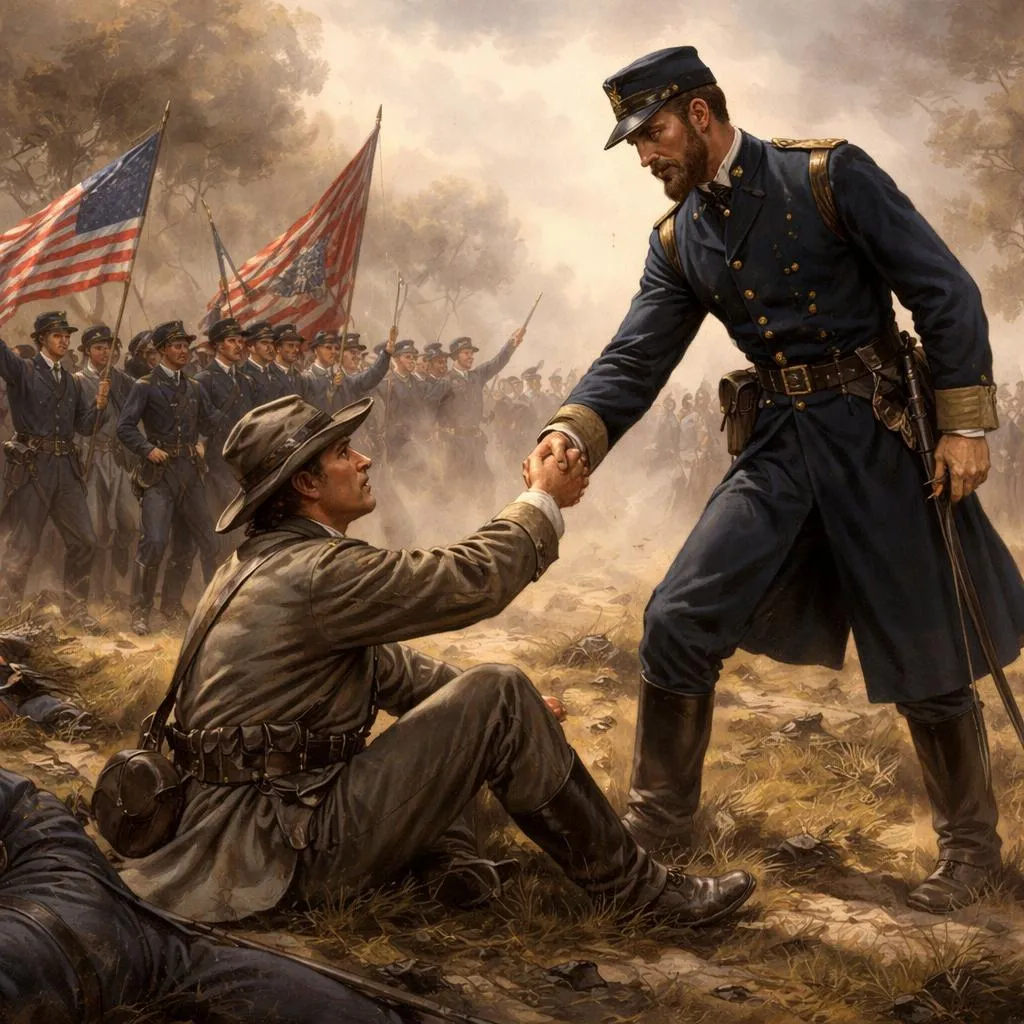
Christy was aware that the two commanders had never met before, and he introduced them while Dr. Linscott was examining his arm. They were both brave and noble men, and each received the other in the politest and most gentlemanly manner. It was evident to all who witnessed the interview that they met with mutual respect, though half an hour before they had been engaged in a desperate fight the one against the other. But enemies can be magnanimous to each other without any sacrifice of their principles on either side.
“I thank you most heartily, Captain Rombold, for your kindness to my principal officer; and if the opportunity is ever presented to me, I shall reciprocate to the extent of my ability,” continued Captain Breaker. “You have been more than magnanimous; you have been a self-sacrificing Christian, for you have required your surgeon to bind up the wound of an enemy before he assuaged your own. This is Christianity in war; and I shall strive to emulate your noble example.”
“You are extremely considerate, Captain; and we are friends till the demands of duty require us to become technical enemies on the quarter-deck each of his own ship,” said Captain Rombold, as he grasped the hand of the loyal commander.
“I heartily approve of the treatment of my friend Dr. Davidson, and fully indorse his opinion that the wound of Mr. Passford is not a dangerous or very severe one,” interposed Dr. Linscott. “I agree with him that the patient had better spend a couple of days or more in his berth.”
The Confederate surgeon had finished the dressing of Christy’s wound, and he was in a hurry to return to his duty in the cockpit. He shook hands with Dr. Linscott, and both of them hastened to their posts. The patient had been seated on a bench, and Captain Rombold had returned to his former position. He had tied his handkerchief around his thigh, and both of them appeared to be very comfortable.
“Well, Mr. Passford, if you are ready to return to the Bellevite, I will assist you to the ward room,” said Captain Breaker.
“Excuse me, Captain, if I detain you a few minutes, for I desire to settle a point in dispute between Mr. Passford and myself, though it is doubtless his extreme modesty which creates this difference between us,” interposed the Confederate commander.
He proceeded to state his view of the exploit of Christy, by which he had rendered inutile the scheme to slaughter the loyal boarders.
“I was absolutely delighted, Captain Breaker, when I realized that you intended to board the Tallahatchie.” he continued. “I was confident that I should defeat your boarders, and board and carry your deck in my turn. I have not yet changed my view of the situation. You can judge of my consternation when I saw Mr. Passford leap into the mizzen rigging with the agility of a cat, and especially when the order to board my ship was withheld.”
“Mr. Passford acted without orders, for I should hardly have sent him into the rigging while we were alongside, for it was almost sure death, for your men, armed with muskets and revolvers, were all looking for the firing of the thirty-pounder,” added Captain Breaker.
“He was as nimble as a cat, and it seemed to me that he was twice as quick. But all he needed to unearth my scheme was a single glance at the gun and its crew on the quarter-deck. In the twinkling of an eye he dropped to the deck, called his boarders, and leaped over the rail into our midst. It was the most daring and quickly executed manœuvre I ever observed,” continued the Confederate commander with enthusiasm.
“I quite agree with you, Captain Rombold,” replied Captain Breaker, as he looked with an affectionate expression upon the pale face of the patient.
“Now, Mr. Passford chooses to regard his brilliant exploit as a matter of little consequence, for he declares that you had discovered, or would have discovered, my plan to annihilate your boarders.”
“Mr. Passford is entirely in the wrong so far as I am concerned,” protested Captain Breaker with a good deal of earnestness. “To make the matter clear, I will explain my own actions. When the Bellevite ranged alongside the Tallahatchie, everything was in readiness for boarding. I was about to give the order to do this when I discovered that the crew of your ship were drawn up on the starboard side, instead of the port, and it suggested to me that something was wrong, and I withheld the command. In order to obtain more information, I went further aft, where I hoped to get a view of a portion of the deck of your ship. I had raised a hawser port with the assistance of a quartermaster; but I could see only the wreck of your spare wheel. At this moment Mr. Passford was in the mizzen rigging. He did all; I did nothing.”
“I hope your report of the action will do him full justice, for he deserves promotion,” added Captain Rombold.
“My admiration of the conduct of Mr. Passford is equal to yours.”
They separated after some further conversation, and her commander and Christy returned to the Bellevite.
Contexte et introduction de l'auteur
Cette histoire se déroule pendant une bataille navale de la guerre de Sécession américaine, un conflit qui a opposé l'Union (le Nord) et la Confédération (le Sud) de 1861 à 1865. L'histoire met en évidence la bravoure et la vivacité d'esprit d'un jeune officier, Christy Passford, qui joue un rôle crucial en renversant le cours d'un abordage dangereux. Le récit reflète les thèmes du courage, de l'honneur et du respect, même entre ennemis.
L'auteur de ce conte, bien que non nommé ici, s'est probablement inspiré de la guerre navale historique et des émotions humaines complexes impliquées dans la guerre. De telles histoires étaient courantes dans la littérature du XIXe siècle, visant à enseigner aux jeunes lecteurs la valeur, le devoir et la gentillesse parfois surprenante que l'on trouve même dans les conflits.
Interprétation détaillée et signification
À la base, cette histoire parle du courage sous pression et de l'importance d'une action décisive. La vivacité d'esprit et la bravoure de Christy Passford empêchent un abordage potentiellement désastreux par les forces ennemies. Ses actions sauvent non seulement des vies, mais démontrent également le leadership et l'altruisme.
De plus, l'histoire met l'accent sur le respect et l'humanité entre ennemis. Le capitaine Rombold et le capitaine Breaker, bien qu'adversaires, font preuve d'un respect et d'une gentillesse mutuels, en particulier dans la façon dont ils prennent soin de Christy blessé. Cela met en évidence un message puissant : même en temps de guerre, la compassion et l'honneur peuvent l'emporter.
La coopération des officiers médicaux de part et d'autre des lignes ennemies renforce encore ce thème. Leur professionnalisme et leur empathie rappellent aux lecteurs que l'humanité partagée transcende les conflits.
Leçons et inspirations pour les étudiants
-
Bravoure et initiative : L'exemple de Christy enseigne la valeur du courage et de la prise d'initiative lorsque la situation l'exige. Les élèves peuvent apprendre que parfois, faire un pas en avant sans attendre d'ordres peut faire une différence significative.
-
Respect des autres : L'interaction respectueuse entre les commandants opposés montre qu'il est possible de ne pas être d'accord ou de rivaliser sans haine. C'est une leçon essentielle pour les interactions sociales, encourageant le respect même en cas de désaccord.
-
Compassion et empathie : Les soins prodigués au soldat ennemi blessé par les deux camps enseignent l'importance de la gentillesse et de l'empathie, même envers ceux que nous pouvons considérer comme des opposants.
-
Travail d'équipe et soutien : L'histoire montre comment le travail d'équipe entre les soldats, les officiers et le personnel médical est crucial pour surmonter les défis. Les élèves peuvent l'appliquer en valorisant la collaboration dans leurs études et leur vie sociale.
-
Humilité : La modestie de Christy concernant son acte héroïque nous rappelle que le vrai courage s'accompagne souvent d'humilité, une qualité qui contribue à bâtir un caractère fort.
Appliquer ces leçons dans la vie
- À l'école : Face à des défis, les élèves peuvent être inspirés à agir avec courage et responsabilité, en aidant leurs pairs ou en défendant ce qui est juste.
- Dans les situations sociales : Respecter les opinions des autres et faire preuve de gentillesse, même en cas de conflits ou de compétitions, favorise des relations plus saines.
- Dans le développement personnel : Développer l'empathie et l'humilité aide les élèves à devenir de meilleurs amis, dirigeants et citoyens.
Cultiver des qualités positives à partir de l'histoire
- Pratiquer le courage : Encourager les élèves à relever de nouveaux défis et à s'exprimer lorsque cela est nécessaire.
- Faire preuve de respect : Enseigner l'importance d'écouter et de valoriser les autres, même en cas de désaccord.
- Développer l'empathie : Participer à des activités qui permettent de comprendre les sentiments des autres.
- Travailler en équipe : Promouvoir les projets de groupe et l'apprentissage coopératif pour renforcer les compétences de travail d'équipe.
- Être humble : Célébrer les réalisations en silence et reconnaître les contributions des autres.
Cette histoire, riche en action et en leçons morales, offre aux jeunes lecteurs non seulement une aventure passionnante, mais aussi des valeurs durables qui peuvent les guider tout au long de leur vie.
