
French ascended the gangway followed by Captain Sullendine. The seaman who had acted as prize-master of the West Wind touched his cap very respectfully to the first officer he met when he came on board. Christy had asked the chief engineer to send Mr. Graines to him, and he was talking to him about the prize and the chief prisoner when French presented himself before them.
“I have come on board to report, sir,” said the prize-master of the West Wind.
“Is all well on board, French?” asked the wounded lieutenant.
“All well now, sir,” replied the seaman, with a suggestive emphasis on the last word. “I am very sorry to learn that you have been wounded, Mr. Passford.”
“Not severely, French,” replied Christy. “I am ready to hear your report.”
“I have something to say about this business, Jerry Sandman,” interposed the captain of the West Wind, whose wrath had suddenly got the better of his judgment, interlarding his brief remark with a couple of ringing oaths.
“I will hear the prize-master first,” replied Christy very quietly.
The discomfited master of the schooner called down a shocking malediction upon the prize-master just as Captain Breaker presented himself before the group assembled at the arm-chair of the lieutenant, and had heard the last oaths of the angry man.
“Who is this man, Mr. Passford?” asked the commander.
“I’ll let you know who I am!” exclaimed Captain Sullendine, with another couplet of oaths.
“I do not permit any profane language on the deck of this ship,” said Captain Breaker. “Pass the word for the master-at-arms,” he added to the nearest officer.
“Oh, you are the cap’n of this hooker,” added the master of the West Wind, this time without any expletives. “I have somethin’ to say to you, Cap’n, and I want to complain of your officers.”
“When you have learned how to behave yourself, I will hear you,” replied the commander, as the master-at-arms, who is the chief of police on board a ship of war, presented himself, touching his cap to the supreme authority of the steamer. “What is the trouble here, Mr. Passford?” asked Captain Breaker in a very gentle tone, in contrast with the quiet sternness with which he had spoken to Captain Sullendine.
“No trouble at all, sir; I was about to hear the report of French, the prize-master of the schooner, when the captain of her interfered,” replied Christy.
“My story comes in before the prize-master’s, as you call him, though he ain’t nothin’ but a common sailor,” interposed Captain Sullendine again.
“Will you be silent?” demanded the commander.
“No, I will not! This is an outrage!” stormed the captain of the West Wind, with a liberal spicing of oaths in his speech.
“Put this man in irons, master-at-arms, and commit him to the brig,” added Captain Breaker.
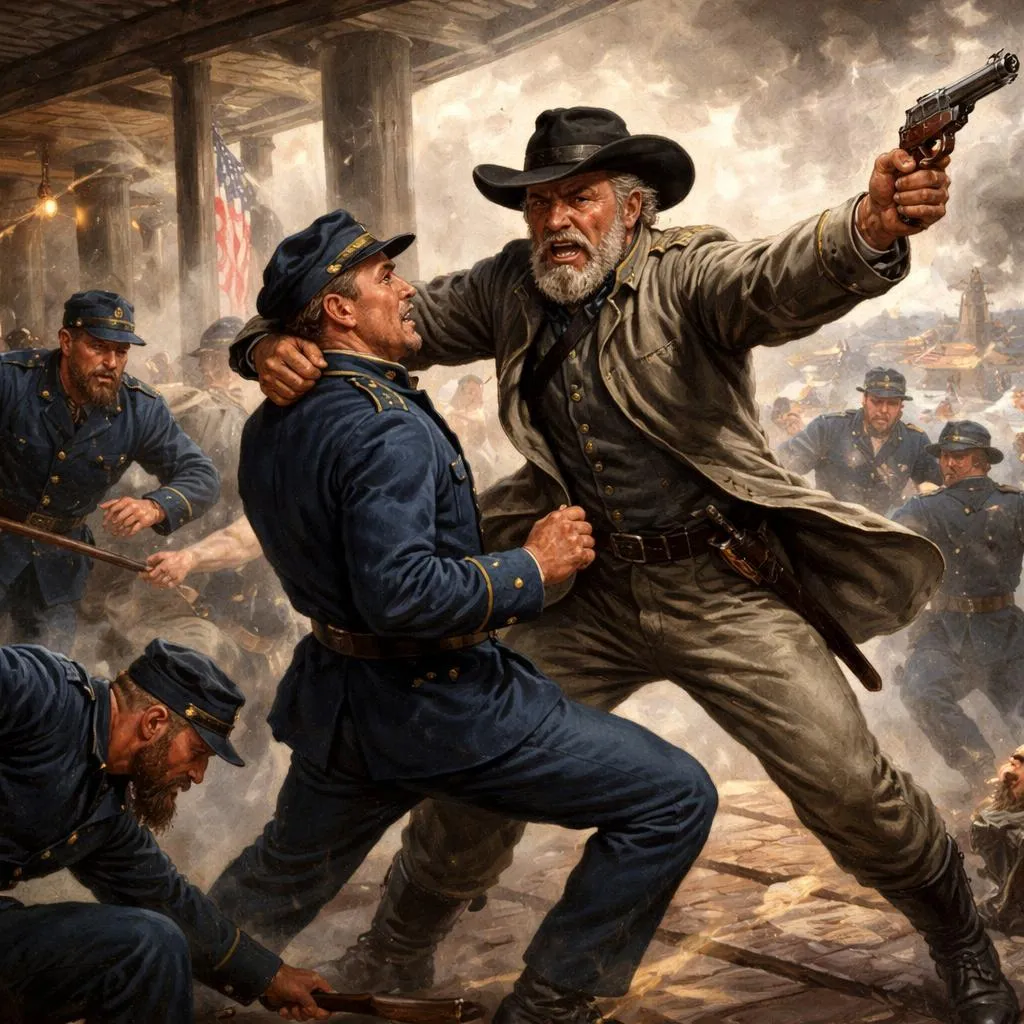
The petty officer called upon the ship’s corporal, whom he had brought with him, and placed his hand on the arm of the rebellious master, who showed fight. A couple of seamen were called to assist the police force, and Captain Sullendine was dragged below with his wrists ironed behind him.
“Now you can proceed, French,” said the captain.
“When I left you, all was quiet on board of the West Wind,” added Christy, beginning to make a slight explanation for the benefit of the commander. “Captain Sullendine was very drunk, asleep in his berth, with the door of his stateroom securely fastened upon him. Bokes the seaman and Sopsy the cook were in the same condition. Go on, French.”
“I picked up the boat you set adrift, Mr. Passford, and then headed for the eastward of Sand Island lighthouse, where you ordered me to anchor. The Holyoke followed the schooner, and came to anchor near the West Wind. She sent a boat on board, and I told my story to the second lieutenant. We did not need any assistance, and he left us.
“About four bells in the forenoon watch I heard a tremendous racket in the cabin, and I went below. Captain Sullendine was doing his best to break down the door of his stateroom, cursing hard enough to make the blood of a Christian run cold. But he had nothing to work with, and I let him kick and pound till he got tired of it. I put Vogel in the cabin to keep watch of him, and went on deck.
“He kept it up for half an hour or more, and then he seemed to have enough of it. Vogel came on deck and told me the prisoner was very humble then, and wanted to come out. I knew you did not mean that I should starve him, and I made Sopsy put his breakfast on the table in the cabin; but I did not do so till I had locked the liquor closet and put the key in my pocket.
“I let him out then, and his first move was to get at his whiskey; but the door was locked. He begged like a child for a drink; but I did not give him a drop. Sopsy and Bokes, who were tied up forward, did the same; but they did not get any. Captain Sullendine ate his breakfast, and I told him his vessel was a prize to the United States steamer Bellevite. Then he was so furious that we had to shut him up in his stateroom again.
“After a while he promised to behave himself, and I let him out again. He declared that his vessel was not a legal prize, and got off a lot of stuff that I did not take any notice of. He wanted to make a protest to the commander of the Bellevite, and when he promised to behave like a gentleman, I let him come on board with me.”
“You acted with very good judgment, French, and Mr. Passford has already commended your good conduct in the expedition last night,” said the commander.
“Thank you, sir,” replied the prize-master, touching his cap, and backing away without another word.
“Loring,” called the captain to the master-at-arms, who had just returned to the quarter-deck, or as near it as etiquette permitted him to go. “How is your prisoner?”
“He broke down completely after he had been in the brig a few minutes, and promised to behave like a gentleman if the commander would hear him.”
“Bring him to the quarter-deck,” added the captain.
In a few minutes, the ship’s corporal conducted him into the presence of the commander. He began with a very lame apology for his previous conduct, and then declared that he was the victim of a “Yankee trick,” and that the West Wind had not been fairly captured.
“Your officers imposed upon me,” he continued. “Mr. Balker and Jerry Sandman”—
“Who are they?” inquired Captain Breaker, interrupting him.
“I was Mr. Balker, engaged as mate of the West Wind, selected for that position by Mr. Passford, while the lieutenant was Jerry Sandman, second mate, which he chose to be himself so that he could be with the men,” interposed Mr. Graines.
“I did not know what their names was, and I reckoned all was honest and square. These men, whoever they were, got me drunk, and got drunk themselves; and while I was taking a nap, waiting for the steamer to get under way, they fastened me into my stateroom so I couldn’t get out.”
“I went through the forms, but I did not take a drop of liquor into my mouth,” said Christy.
“I did not take more than a tablespoonful both on board and at the camp of the runaways,” added Mr. Graines.
“Then you cheated me more’n I thought.”
“Is this all the complaint you have to make, Captain Sullendine?” asked Captain Breaker, turning to the master of the West Wind.
“I reckon that’s enough!” protested the complainant. “I say it was not a fair capture, and you ought to send my vessel back to Mobile Point, where your officers found her.”
“I shall not do that, but I will compromise the matter by sending you to Mobile Point, as I have no further use for you,” replied the commander. “You are a non-combatant, and not a prisoner of war.”
French was ordered to leave Captain Sullendine, Bokes, and Sopsy at the shore where the whaleboat had made a landing, as soon as it was dark. For some reason not apparent, the master of the West Wind protested against this sentence; but no attention was given to his protest. The commander was confident that he had evidence enough to secure the condemnation of the prize, and he regarded such an unreasonable fellow as her late captain as a nuisance. That night the order in regard to him and his companions were carried out.
Captain Breaker asked some questions in regard to French, which Christy and Mr. Graines were able to answer. He was one of those men, of whom there were thousands in the army and navy who had become soldiers and sailors purely from patriotic duty, and at the sacrifice of brighter present prospects. French had been the mate of a large coaster, whose captain had become an ensign in the navy, and he might have had the command of her if he had not shipped as an able seaman in the same service.
He understood navigation, and had been the second mate of an Indiaman. The commander said nothing when he had learned all he could about the prize-master; but it was evident that he had something in view which might be of interest to the subject of his inquiries. He turned his attention to the condition of his first lieutenant then, asking about his arm.
“It does not feel quite so easy as it did,” replied Christy, who had been suffering some pain from his wound for the last two hours, though he was so interested in the proceedings on board, and especially in the report from the West Wind, that he had not been willing to retire to his stateroom.
“Then you must turn in at once, Mr. Passford,” said the commander, with more energy than he had spoken to the lieutenant before. “I am afraid you have delayed it too long.”
“I think not, sir.” replied the wounded officer.
“Mr. Graines shall go with you and assist you,” added the captain. “I will send Dr. Linscott to you as soon as you get into your berth.”
Christy had been sitting so long that he was quite stiff when he attempted to get out of his chair, and the engineer assisted him. He was still very weak, and Mr. Graines supported him, though he presently recovered himself. The ship’s company, by this time relieved of all heavy work, had been observing him with affectionate admiration, and rehearsing the daring exploit in which he had received his wound, gave three rousing cheers as he rose to leave the quarter-deck.
Christy turned his pale face towards them, raised his cap, and bowed to them. Another cheer followed, and then another. The men knew that his prompt action in mounting the mizzen rigging, boarding the Tallahatchie, and firing the thirty-pounder after he had reversed its position, had saved the lives or limbs of a great number of them, and they were extremely grateful to him.
With the assistance of his friend the engineer, Christy was soon between the sheets in his berth. Dr. Linscott came in as soon as he was in his bed, spoke very tenderly to him, and then proceeded to dress his injured arm. He found the member was somewhat swollen, and the patient’s pulse indicated some fever.
“I must send you home, Mr. Passford,” said the surgeon. “You are the hero of the day, you have earned a vacation, and you will need your mother’s care for the next three weeks.”
In spite of Christy’s protest, the doctor insisted, and left him.
Contexte et présentation de l'auteur
Cette histoire est un extrait d'un roman d'aventure maritime, probablement situé au XIXe siècle, lorsque la guerre navale et la course étaient courantes. Le récit est centré sur des officiers de marine et des marins impliqués dans la capture d'un navire appelé le West Wind. L'auteur, dont l'identité n'est pas précisée ici, écrit avec des détails vifs sur la vie navale, la chaîne de commandement et les tensions entre les capitaines et les équipages en temps de guerre. De telles histoires étaient populaires aux XIXe et au début du XXe siècles, reflétant la fascination de l'époque pour les aventures maritimes, l'honneur et le devoir.
Interprétation détaillée et signification
Le passage explore les thèmes de l'autorité, de la discipline et de l'honneur à bord des navires de guerre. L'ivresse et l'insubordination du capitaine Sullendine contrastent fortement avec le leadership calme et juste du capitaine Breaker et la conduite consciencieuse de French et Christy. L'histoire souligne l'importance de l'ordre et du respect des règles pour maintenir la sécurité et l'efficacité d'un navire. Elle aborde également les complexités de la justice en temps de guerre, car la légalité de la capture de la prise est remise en question, mais finalement maintenue en raison des preuves et de la conduite appropriée.
Leçons et perspectives pour les étudiants
-
Respect de l'autorité et de la discipline : L'histoire montre comment la discipline et le respect du leadership sont cruciaux dans tout cadre de groupe, en particulier dans des environnements à enjeux élevés comme un navire en mer. Les élèves peuvent apprendre la valeur de suivre les règles et de comprendre la chaîne de commandement pour maintenir l'harmonie et atteindre des objectifs communs.
-
Courage et responsabilité : Le lieutenant Christy, bien que blessé, reste attaché à ses devoirs et au bien-être de son équipage. Cela enseigne aux jeunes lecteurs la responsabilité, la bravoure et la persévérance face à l'adversité.
-
Justice et équité : Le récit démontre que l'équité et la justice sont essentielles, même en cas de conflit. Le capitaine Breaker écoute attentivement toutes les parties avant de prendre des décisions, montrant l'importance de l'impartialité et des jugements fondés sur des preuves.
-
Maîtrise de soi : La chute du capitaine Sullendine est en partie due à son manque de maîtrise de soi, en particulier son ivresse. Cela sert de mise en garde contre les conséquences d'un mauvais comportement et l'importance de garder son sang-froid.
Application de ces leçons dans la vie quotidienne
-
À l'école : Les élèves peuvent appliquer le respect de l'autorité en écoutant les enseignants et en coopérant avec leurs camarades de classe, en comprenant que les règles aident tout le monde à apprendre et à grandir dans un environnement sûr.
-
Dans les contextes sociaux : L'histoire encourage la gestion des émotions et des conflits avec calme et respect, en évitant les actions précipitées qui pourraient nuire aux relations.
-
Dans le développement personnel : Émuler le courage et le sens du devoir de Christy peut inciter les élèves à assumer la responsabilité de leurs actions et à affronter les défis avec courage.
Cultiver des qualités positives à partir de l'histoire
-
Discipline : Pratiquez l'autodiscipline en fixant des objectifs, en gérant bien le temps et en respectant les engagements.
-
Respect : Montrez du respect à vos pairs et à vos aînés, en valorisant leurs rôles et leurs contributions.
-
Équité : Efforcez-vous d'être juste dans vos jugements et vos interactions, en écoutant les autres avant de prendre des décisions.
-
Courage : Relevez les défis et défendez ce qui est juste, même lorsque c'est difficile.
Conclusion
Cette histoire maritime, bien que passionnante et pleine d'action, offre de riches leçons sur le leadership, la justice et le caractère personnel. Les élèves qui la lisent peuvent non seulement apprécier l'aventure, mais aussi réfléchir à la manière dont les valeurs représentées peuvent guider leur comportement et leurs décisions à l'école, dans leurs amitiés et au-delà. En tirant des leçons des exemples positifs et négatifs de l'histoire, les jeunes lecteurs peuvent devenir des individus responsables, courageux et justes.
