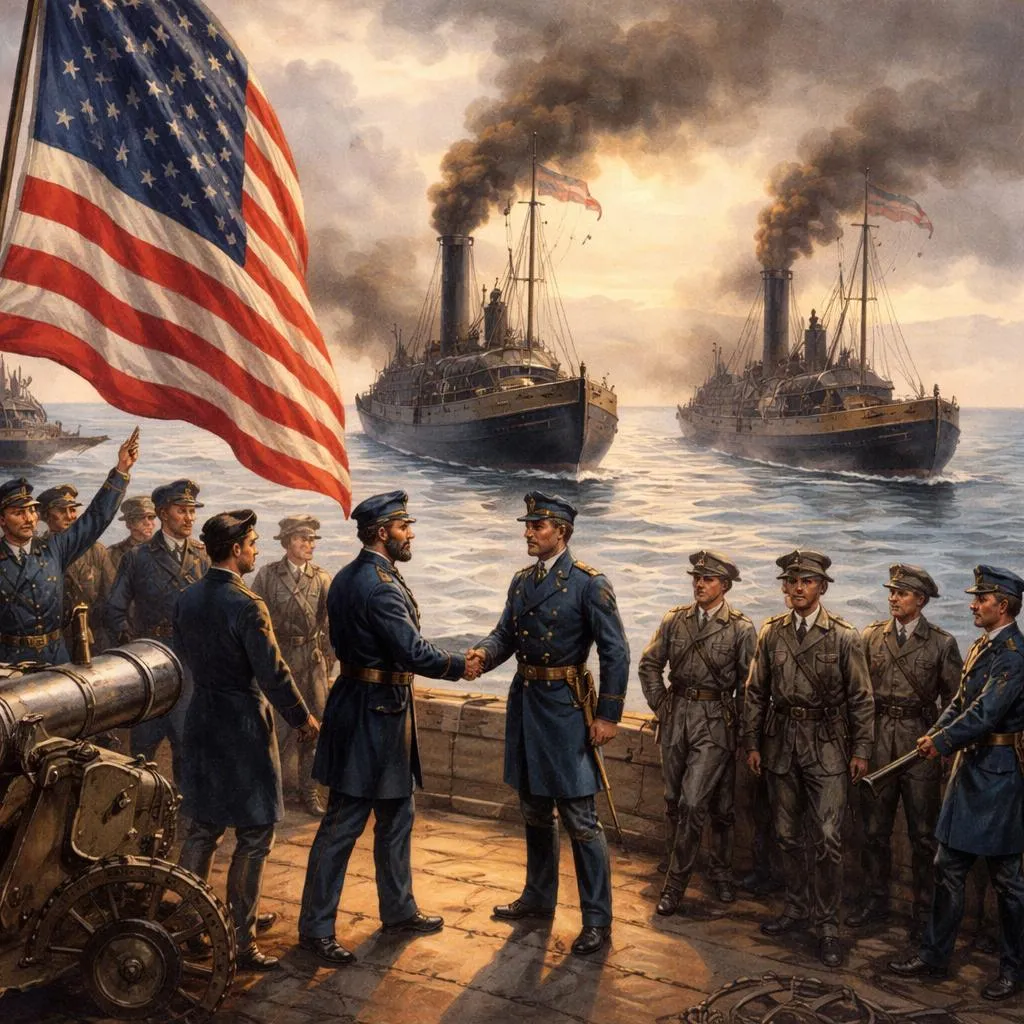

The surgeon reported the condition of the first lieutenant to the commander at once, and a long conversation between them followed. Devoted as Captain Breaker was to his executive officer, and filled with admiration as he was for the gallant exploit of that day, he was not willing to do anything that could be fairly interpreted as favoritism towards the son of Captain Passford. The summer weather of the South was coming on, and the heat was already oppressive, even on board of the ships of war at anchor so much of the time on the blockade, and this was the strong point of the doctor in caring for his patient.
Dr. Linscott was very earnest in insisting upon his point; and the commander yielded, for he could hardly do otherwise in the face of the surgeon’s recommendation, for the latter was the responsible person. The next morning, after the wounded officer had passed a feverish night, Captain Breaker visited him in his stateroom, and announced the decision. Christy began to fight against it.
“I am not so badly off as many officers who have been treated in the hospital down here; and if I am sent home it will be regarded as favoritism to the son of my father,” protested the lieutenant.
“You are too sensitive, my dear boy, as you have always been; and you are entirely mistaken. You have earned a furlough if you choose to ask for it, and every officer and seaman who has served with you would say so,” argued the captain. “I shall insert in my report, with other matter concerning you, Christy, that you were sent home on the certificate of the surgeon; and even an unreasonable person cannot call it favoritism.”
“I don’t know,” added Christy, shaking his head.
“I know, my boy. Merciful Heaven!” exclaimed Captain Breaker. “You did enough yesterday to entitle you to any favor it is possible for the department to extend to you. You saved the lives of a quarter or a third of the ship’s company. But it was not simply a brave and daring exploit, my boy, though even that would entitle you to the fullest commendation; but it included sound judgment on the instant, lightning invention, and consummately skilful action;” and the commander became positively eloquent as he proceeded.
“Come, come, Captain Breaker! You are piling it on altogether too thick,” cried Christy, overwhelmed by the torrent of praise. “I only did what I could not help doing.”
“No matter if you did; it was the right thing to do, and it was done at precisely the right instant. A moment’s delay would have brought the whole force of the enemy down upon you. It was absolutely wonderful how you got that gun off in such a short space of time. I report Captain Rombold’s words to you.”
“He is a magnanimous gentleman,” said Christy.
“He says, too, that a dozen muskets and revolvers were discharged at you, and it is a miracle that only one bullet struck you.”
“I found a bullet-hole in my cap, and two more in the skirt of my coat,” added the patient with a smile, as he pointed to his coat and cap.
“But we are off the subject; and I was only trying to show that you are entitled to a furlough,” said the commander; but the discussion was continued for some time longer, though Christy consented to be sent home in the end.
The thought of going to Bonnydale was exceedingly pleasant to him, and he allowed his mind to dwell upon each member of the family, and to picture in his imagination the greeting they would all give him. Not to the members of his family alone did he confine his thoughts; for they included the beautiful Bertha Pembroke, whom, with her father, he had taken from the cabin of a cotton steamer he had captured. He concluded that the surgeon’s certificate would shield him from adverse criticism, after he had fully considered the matter.
The flag-officer of the Eastern Gulf Squadron was not off Mobile Point; and Captain Breaker, as the senior officer present, was obliged to dispose of his prizes himself. Some necessary repairs had to be made upon both ships before anything could be done; and the carpenter and his gang, with all the other seamen who could handle an axe or an adze, were hurrying forward the work. The prize had lost her mizzen mast, her steering gear had been knocked to pieces both forward and aft, she had been riddled in a dozen places, and shot-holes in the hull had been hastily plugged during the action.
Her Armstrong gun amidships had been disabled by Blumenhoff at his first fire. Christy had not found the opportunity to examine this piece, as he desired; but Mr. Graines had done so for him; and it was found that the gun carriage had been knocked into a shapeless mass so that it could not be put in condition for use. The machinists from the engine room of both vessels, for those of the Tallahatchie had no feeling on the subject, were restoring the steering apparatus, and were likely to have the work completed the next day.
Captain Breaker was in great doubt as to what he ought to do with Colonel Passford. He was certainly a non-combatant; and it could not be shown that he had any mission to Nassau or elsewhere in the service of the Confederacy, though it would have been otherwise if the steamer and the West Wind had not been captures, for he was to sell the cotton in England, and purchase a steamer with the proceeds; but his mission ended with the loss of the vessels. He finally decided to send him to Fort Morgan under a flag of truce.
Before he left he called upon his nephew. He was still in a state of despondency over his own losses, and his failures to benefit the Confederacy, whose loss he counted as greater than his own. He stated that the commander had announced his intention to send him on shore. Christy had seen him but for a moment, for his uncle had not desired to meet him again.
“We will not talk about the war, Uncle Homer,” said Christy. “How are Aunt Lydia, Corny, and Gerty? I hope they are all very well.”
“Your aunt is not very well, for the hardships of the war have worn upon her. Except Uncle Jerry and Aunty Chloe, the cook, all our negroes have left us, or been taken by the government to work on fortifications, and my wife and Gerty have to do most of the housework,” replied Uncle Homer very gloomily; and it was plain to Christy that the mansion at Glenfield was not what it had been in former years.
“How is Corny? I have not heard from him lately.”
“Corny is now a captain in the Army of Virginia, and is doing his duty like a man,” answered the colonel proudly; and this fact seemed to be almost the only pleasant feature of his experience. “We have been called upon to endure a great many hardships; but we still feel that the God of justice will give us the victory in the end, and we try to bear our burdens with resignation. The captain informs me that you are going home, Christy.”
“The surgeon has ordered me to the North on account of the heat in this locality.”
“I learned in Nassau as well as when I was at Bonnydale, that your father holds a very prominent and influential position among your people, and your advancement seems to be made sure,” added the planter.
“He has never held any office under the United States government, and I hope I do not owe my advancement to him; and he has often assured me that he never asked for my promotion or appointment,” said Christy.
“You have been of very great service to your government, as I know to my sorrow, and I have no doubt you deserved whatever promotion you have obtained,” added the colonel, observing that he had touched his nephew in a very tender spot. “But I suppose the boat is waiting for me, and I must bid you good-by. Remember me in the kindliest manner to your father and mother, and to Miss Florry. They were all as good to me when I was on parole at Bonnydale as though no war had ever divided us.”
The colonel took Christy by the hand, and betrayed no little emotion as they parted. The lieutenant realized that his uncle was suffering severely under the hardships and anxieties of the war, and he was profoundly sorry for him, though he uttered no complaint. Both on his own account and on that of the Confederacy, he had shipped several cargoes of cotton to Nassau to be sent from there to England; but every one of them had been captured, most of them by his nephew while in command of the Bronx. But he was still confident that the Confederacy would triumph.
Colonel Passford had been sent to the fort under a flag of truce, and had been received by the commandant. In a couple of days the repairs of both ships had been completed. Captain Rombold, though his wound was quite severe, was getting along very well. Captain Breaker had completed his arrangements for the disposal of the prizes and prisoners; and it became necessary to remove the wounded commander to the cabin of the Tallahatchie, to which he did not object, for the wounded in his cabin had been placed in a temporary hospital between decks. He was permitted to occupy the stateroom he had used while in command, while the other was reserved for the prize-master.
Ensign Palmer Drake, the senior of the two officers waiting appointments, was made prize-master of the Tallahatchie, for he had proved to be an able and brave man in the recent action. Mr. Ballard became executive officer of the Bellevite, and Mr. Walbrook the second lieutenant, while the place of the third was filled by Mr. Bostwick, who had been master. French was appointed prize-master of the West Wind, with a crew of five men, as she was to be towed by the prize steamer.
It was found that the Tallahatchie had gone into the action with ninety-five men, including the forward officers. More than one-third of them had been killed or disabled, without counting those who were still able to keep the deck and sleep in their hammocks. Fifty of them were in condition to do duty; and Captain Breaker did not consider it prudent to send so many prisoners to the North in the prize. He therefore sent forty of them to Key West in the Holyoke, assured that the Bellevite was abundantly able to maintain the blockade, even with her reduced ship’s company, during the absence of his consort.
The engineers of the prize were willing to continue their services at the expense of their new employer, or even to accept permanent appointments; for they did not belong to the upper classes in England who favored the cause of the Confederacy, and were only looking for the highest wages. Weeks, the oiler, and Bingham, a boatswain’s mate, were appointed first and second officers of the Tallahatchie, and twenty seamen were detailed as a prize crew. To insure the fidelity of the four foreign engineers Mr. Graines was sent as a sort of supervisor, with the knowledge and assent of those in actual charge of the machinery.
When all was ready for her departure, Christy went on board of the Tallahatchie in the same boat with the engineer, after a rather sad parting with the captain and his fellow-officers, and amid the cheers of the seamen, who had mounted the rail and the rigging to see him off. Mr. Drake conducted him to the captain’s cabin when he went on board of the prize, where he met Captain Rombold, with whom he exchanged friendly greetings.
“Fellow passengers again, Mr. Passford; but you are going to your reward, and I to my punishment,” said the late commander very cheerfully.
“Hardly to my reward, for I neither desire nor expect any further promotion,” replied Christy. “I am not yet twenty years old.”
“But God makes some fully-developed men before they are twenty-one, and you are one of them.”
“Thank you, Captain.”
“I am willing to wager the salary I have lost that you will be promoted whether you desire it or not.”
“I hope not,” replied the lieutenant, as he went to the temporary stateroom which had been prepared for him.
The apartment was much larger than the permanent ones, and it was provided with everything that could contribute to his comfort. While Mr. Graines was assisting him to arrange his baggage, the steamer got under way.
Contexte et introduction de l'auteur
Cette histoire se déroule pendant une période tumultueuse de guerre navale, probablement inspirée par l'époque de la guerre de Sécession américaine, où les blocus et les engagements navals jouèrent un rôle crucial. Le récit est centré sur le capitaine Breaker, le lieutenant Christy Passford et d'autres officiers de marine qui affrontent les difficultés de la guerre, la loyauté et le devoir. L'auteur, dont l'identité n'est pas précisée ici, fait preuve d'une profonde compréhension des opérations navales, du courage humain et des émotions complexes vécues par ceux qui sont au service militaire. Les descriptions détaillées des réparations de navires, des décisions de commandement et des interactions personnelles révèlent un engagement envers le réalisme et l'exactitude historique, enrichissant l'authenticité de l'histoire.
Interprétation détaillée et signification
À la base, cette histoire explore les thèmes de la bravoure, du devoir et des défis éthiques auxquels sont confrontés les chefs pendant la guerre. Les actions héroïques du lieutenant Christy Passford au combat, malgré sa jeunesse et sa blessure, mettent en évidence le courage et la vivacité d'esprit requis dans les situations de vie ou de mort. La lutte du capitaine Breaker pour concilier l'admiration pour la valeur de Christy et la nécessité d'éviter le favoritisme reflète les complexités du leadership et de l'équité dans le commandement militaire.
L'histoire aborde également le coût humain de la guerre au-delà du champ de bataille. La représentation de la famille du colonel Passford souffrant des difficultés de la guerre, de la perte de serviteurs et du fardeau émotionnel sur les individus rappelle aux lecteurs que la guerre affecte non seulement les soldats, mais aussi des communautés entières. L'attention du récit aux soins des officiers blessés et à la logistique des réparations de navires souligne les réalités pratiques du maintien d'une force de combat.
Leçons et perspectives pour les étudiants
-
Courage et responsabilité : La volonté de Christy d'agir avec décision sous le feu enseigne l'importance de la bravoure et de la prise de responsabilité, même lorsque la situation est dangereuse ou incertaine. Les élèves peuvent apprendre que le courage n'est pas l'absence de peur, mais la capacité d'agir correctement malgré elle.
-
Leadership et équité : La considération attentive du capitaine Breaker sur la façon de traiter Christy de manière équitable, sans favoritisme, offre une leçon précieuse en matière de leadership éthique. À l'école ou dans un cadre social, cela se traduit par le fait de traiter les pairs avec équité et intégrité, en évitant les préjugés, même lorsque des sentiments personnels sont impliqués.
-
Résilience face à l'adversité : L'histoire montre comment les personnages endurent des blessures physiques, des douleurs émotionnelles et les difficultés de la guerre. Cette résilience est une qualité essentielle pour les élèves confrontés à des défis dans leurs études ou leur vie personnelle, les encourageant à persévérer face aux difficultés.
-
Empathie et compassion : Le souci des blessés et la représentation des difficultés familiales encouragent l'empathie. Les élèves peuvent être inspirés à prendre soin des autres, à comprendre les différentes perspectives et à offrir un soutien à ceux qui en ont besoin.
Appliquer l'esprit de l'histoire dans la vie quotidienne
-
Dans l'apprentissage : Comme Christy, les élèves doivent être prêts à réfléchir rapidement et à faire preuve de bon jugement lorsqu'ils résolvent des problèmes ou font face à des défis inattendus dans leurs études.
-
Dans les interactions sociales : L'équité et le respect dont fait preuve le capitaine Breaker peuvent guider les élèves dans la résolution des conflits et l'établissement de la confiance entre amis et camarades de classe.
-
Dans le développement personnel : L'humilité de Christy malgré les éloges rappelle aux élèves de rester modestes et de se concentrer sur ce qui est juste plutôt que de rechercher la reconnaissance.
-
Face aux défis : La résilience dont font preuve les personnages encourage les élèves à développer une force mentale et émotionnelle, les aidant à surmonter les revers.
Cultiver des valeurs positives à partir de l'histoire
-
Bravoure : Encouragez les élèves à relever de nouveaux défis avec courage, que ce soit en public, dans le sport ou en défendant ce qui est juste.
-
Jugement : Enseignez l'importance de la pensée critique et de la prise de décisions judicieuses, en particulier sous pression.
-
Compassion : Promouvoir la gentillesse et le soutien aux pairs, en particulier à ceux qui peuvent être en difficulté.
-
Intégrité : Favoriser l'honnêteté et l'équité dans toutes les actions, en soulignant qu'un véritable leadership implique de servir les autres avec justice.
Conclusion
Cette histoire, riche en contexte historique et en émotion humaine, offre aux jeunes lecteurs bien plus qu'une simple aventure navale passionnante. Elle offre une exploration approfondie du caractère, du leadership et des coûts du conflit. En étudiant et en réfléchissant aux expériences de Christy Passford et de ses camarades, les élèves peuvent acquérir des connaissances précieuses sur la bravoure, l'équité et la résilience, des qualités qui leur seront utiles à l'école, dans leurs amitiés et dans leurs futures entreprises. Encourager les élèves à incarner ces vertus les aidera à devenir des personnes réfléchies, courageuses et compatissantes.
