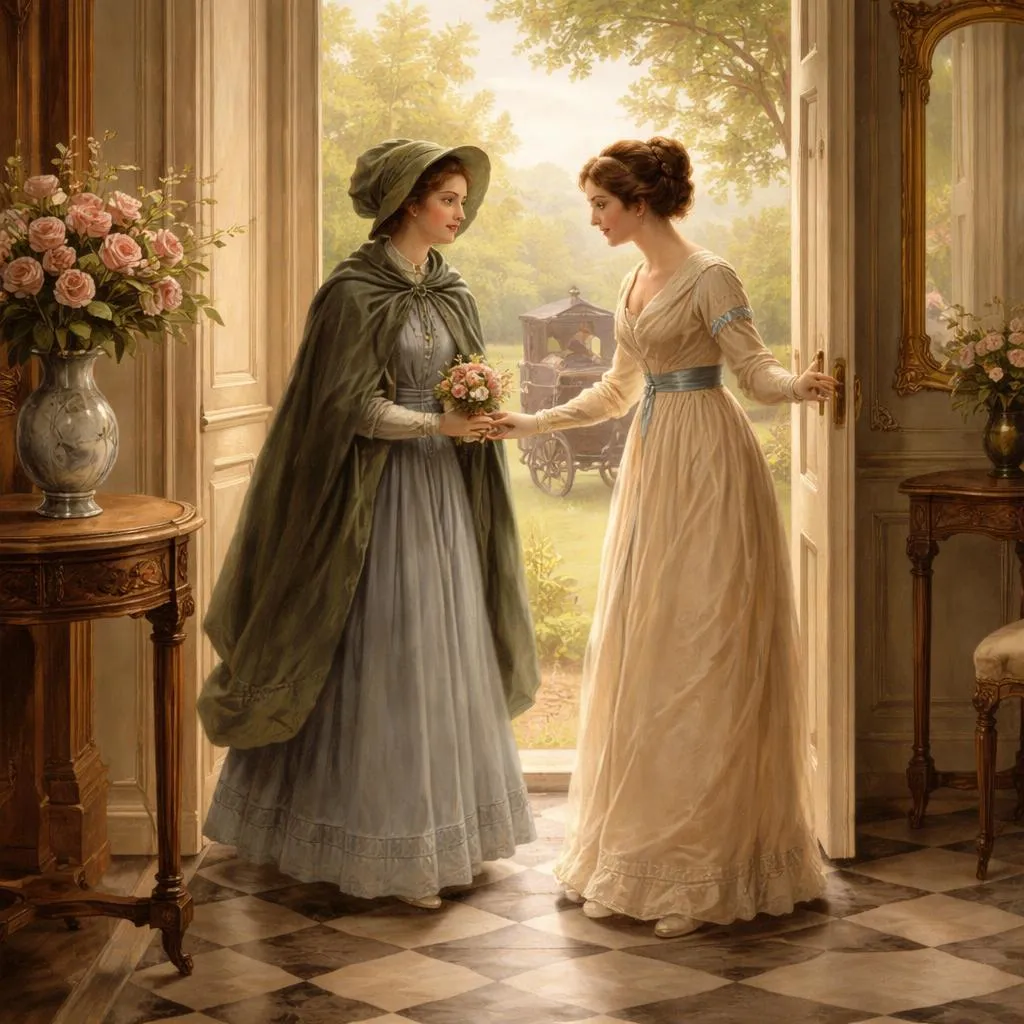

Ashby Park was certainly a very delightful residence. The mansion was stately without, commodious and elegant within; the park was spacious and beautiful, chiefly on account of its magnificent old trees, its stately herds of deer, its broad sheet of water, and the ancient woods that stretched beyond it: for there was no broken ground to give variety to the landscape, and but very little of that undulating swell which adds so greatly to the charm of park scenery. And so, this was the place Rosalie Murray had so longed to call her own, that she must have a share of it, on whatever terms it might be offered—whatever price was to be paid for the title of mistress, and whoever was to be her partner in the honour and bliss of such a possession! Well I am not disposed to censure her now.
She received me very kindly; and, though I was a poor clergyman’s daughter, a governess, and a schoolmistress, she welcomed me with unaffected pleasure to her home; and—what surprised me rather— took some pains to make my visit agreeable. I could see, it is true, that she expected me to be greatly struck with the magnificence that surrounded her; and, I confess, I was rather annoyed at her evident efforts to reassure me, and prevent me from being overwhelmed by so much grandeur—too much awed at the idea of encountering her husband and mother–in–law, or too much ashamed of my own humble appearance. I was not ashamed of it at all; for, though plain, I had taken good care not to shabby or mean, and should have been pretty considerably at my ease, if my condescending hostess had not taken such manifest pains to make me so; and, as for the magnificence that surrounded her, nothing that met my eyes struck me or affected me half so much as her own altered appearance. Whether from the influence of fashionable dissipation, or some other evil, a space of little more than twelve months had had the effect that might be expected from as many years, in reducing the plumpness of her form, the freshness of her complexion, the vivacity of her movements, and the exuberance of her spirits.
I wished to know if she was unhappy; but I felt it was not my province to inquire: I might endeavour to win her confidence; but, if she chose to conceal her matrimonial cares from me, I would trouble her with no obtrusive questions. I, therefore, at first, confined myself to a few general inquiries about her health and welfare, and a few commendations on the beauty of the park, and of the little girl that should have been a boy: a small delicate infant of seven or eight weeks old, whom its mother seemed to regard with no remarkable degree of interest or affection, though full as much as I expected her to show.
Shortly after my arrival, she commissioned her maid to conduct me to my room and see that I had everything I wanted; it was a small, unpretending, but sufficiently comfortable apartment. When I descended thence—having divested myself of all travelling encumbrances, and arranged my toilet with due consideration for the feelings of my lady hostess, she conducted me herself to the room I was to occupy when I chose to be alone, or when she was engaged with visitors, or obliged to be with her mother–in–law, or otherwise prevented, as she said, from enjoying the pleasure of my society. It was a quiet, tidy little sitting–room; and I was not sorry to be provided with such a harbour of refuge.
‘And some time,’ said she, ‘I will show you the library: I never examined its shelves, but, I daresay, it is full of wise books; and you may go and burrow among them whenever you please. And now you shall have some tea—it will soon be dinner–time, but I thought, as you were accustomed to dine at one, you would perhaps like better to have a cup of tea about this time, and to dine when we lunch: and then, you know, you can have your tea in this room, and that will save you from having to dine with Lady Ashby and Sir Thomas: which would be rather awkward—at least, not awkward, but rather— a—you know what I mean. I thought you mightn’t like it so well— especially as we may have other ladies and gentlemen to dine with us occasionally.’
‘Certainly,’ said I, ‘I would much rather have it as you say, and, if you have no objection, I should prefer having all my meals in this room.’
‘Why so?’
‘Because, I imagine, it would be more agreeable to Lady Ashby and Sir Thomas.’
‘Nothing of the kind.’
‘At any rate it would be more agreeable to me.’
She made some faint objections, but soon conceded; and I could see that the proposal was a considerable relief to her.
‘Now, come into the drawing–room,’ said she. ‘There’s the dressing bell; but I won’t go yet: it’s no use dressing when there’s no one to see you; and I want to have a little discourse.’
The drawing–room was certainly an imposing apartment, and very elegantly furnished; but I saw its young mistress glance towards me as we entered, as if to notice how I was impressed by the spectacle, and accordingly I determined to preserve an aspect of stony indifference, as if I saw nothing at all remarkable. But this was only for a moment: immediately conscience whispered, ‘Why should I disappoint her to save my pride? No—rather let me sacrifice my pride to give her a little innocent gratification.’ And I honestly looked round, and told her it was a noble room, and very tastefully furnished. She said little, but I saw she was pleased.
She showed me her fat French poodle, that lay curled up on a silk cushion, and the two fine Italian paintings: which, however, she would not give me time to examine, but, saying I must look at them some other day, insisted upon my admiring the little jewelled watch she had purchased in Geneva; and then she took me round the room to point out sundry articles of vertu she had brought from Italy: an elegant little timepiece, and several busts, small graceful figures, and vases, all beautifully carved in white marble. She spoke of these with animation, and heard my admiring comments with a smile of pleasure: that soon, however, vanished, and was followed by a melancholy sigh; as if in consideration of the insufficiency of all such baubles to the happiness of the human heart, and their woeful inability to supply its insatiate demands.
Then, stretching herself upon a couch, she motioned me to a capacious easy–chair that stood opposite—not before the fire, but before a wide open window; for it was summer, be it remembered; a sweet, warm evening in the latter half of June. I sat for a moment in silence, enjoying the still, pure air, and the delightful prospect of the park that lay before me, rich in verdure and foliage, and basking in yellow sunshine, relieved by the long shadows of declining day. But I must take advantage of this pause: I had inquiries to make, and, like the substance of a lady’s postscript, the most important must come last. So I began with asking after Mr. and Mrs. Murray, and Miss Matilda and the young gentlemen.
I was told that papa had the gout, which made him very ferocious; and that he would not give up his choice wines, and his substantial dinners and suppers, and had quarrelled with his physician, because the latter had dared to say that no medicine could cure him while he lived so freely; that mamma and the rest were well. Matilda was still wild and reckless, but she had got a fashionable governess, and was considerably improved in her manners, and soon to be introduced to the world; and John and Charles (now at home for the holidays) were, by all accounts, ‘fine, bold, unruly, mischievous boys.’
‘And how are the other people getting on?’ said I—‘the Greens, for instance?’
‘Ah! Mr. Green is heart–broken, you know,’ replied she, with a languid smile: ‘he hasn’t got over his disappointment yet, and never will, I suppose. He’s doomed to be an old bachelor; and his sisters are doing their best to get married.’
‘And the Melthams?’
‘Oh, they’re jogging on as usual, I suppose: but I know very little about any of them—except Harry,’ said she, blushing slightly, and smiling again. ‘I saw a great deal of him while we were in London; for, as soon as he heard we were there, he came up under pretence of visiting his brother, and either followed me, like a shadow, wherever I went, or met me, like a reflection, at every turn. You needn’t look so shocked, Miss Grey; I was very discreet, I assure you, but, you know, one can’t help being admired. Poor fellow! He was not my only worshipper; though he was certainly the most conspicuous, and, I think, the most devoted among them all. And that detestable—ahem—and Sir Thomas chose to take offence at him—or my profuse expenditure, or something—I don’t exactly know what—and hurried me down to the country at a moment’s notice; where I’m to play the hermit, I suppose, for life.’
And she bit her lip, and frowned vindictively upon the fair domain she had once so coveted to call her own.
‘And Mr. Hatfield,’ said I, ‘what is become of him?’
Again she brightened up, and answered gaily—‘Oh! he made up to an elderly spinster, and married her, not long since; weighing her heavy purse against her faded charms, and expecting to find that solace in gold which was denied him in love—ha, ha!’
‘Well, and I think that’s all—except Mr. Weston: what is he doing?’
‘I don’t know, I’m sure. He’s gone from Horton.’
‘How long since? and where is he gone to?’
‘I know nothing about him,’ replied she, yawning—‘except that he went about a month ago—I never asked where’ (I would have asked whether it was to a living or merely another curacy, but thought it better not); ‘and the people made a great rout about his leaving,’ continued she, ‘much to Mr. Hatfield’s displeasure; for Hatfield didn’t like him, because he had too much influence with the common people, and because he was not sufficiently tractable and submissive to him—and for some other unpardonable sins, I don’t know what. But now I positively must go and dress: the second bell will ring directly, and if I come to dinner in this guise, I shall never hear the end of it from Lady Ashby. It’s a strange thing one can’t be mistress in one’s own house! Just ring the bell, and I’ll send for my maid, and tell them to get you some tea. Only think of that intolerable woman—’
‘Who—your maid?’
‘No;—my mother–in–law—and my unfortunate mistake! Instead of letting her take herself off to some other house, as she offered to do when I married, I was fool enough to ask her to live here still, and direct the affairs of the house for me; because, in the first place, I hoped we should spend the greater part of the year, in town, and in the second place, being so young and inexperienced, I was frightened at the idea of having a houseful of servants to manage, and dinners to order, and parties to entertain, and all the rest of it, and I thought she might assist me with her experience; never dreaming she would prove a usurper, a tyrant, an incubus, a spy, and everything else that’s detestable. I wish she was dead!’
She then turned to give her orders to the footman, who had been standing bolt upright within the door for the last half minute, and had heard the latter part of her animadversions; and, of course, made his own reflections upon them, notwithstanding the inflexible, wooden countenance he thought proper to preserve in the drawing–room. On my remarking afterwards that he must have heard her, she replied—‘Oh, no matter! I never care about the footmen; they’re mere automatons: it’s nothing to them what their superiors say or do; they won’t dare to repeat it; and as to what they think—if they presume to think at all—of course, nobody cares for that. It would be a pretty thing indeed, it we were to be tongue–tied by our servants!’
So saying, she ran off to make her hasty toilet, leaving me to pilot my way back to my sitting–room, where, in due time, I was served with a cup of tea. After that, I sat musing on Lady Ashby’s past and present condition; and on what little information I had obtained respecting Mr. Weston, and the small chance there was of ever seeing or hearing anything more of him throughout my quiet, drab–colour life: which, henceforth, seemed to offer no alternative between positive rainy days, and days of dull grey clouds without downfall. At length, however, I began to weary of my thoughts, and to wish I knew where to find the library my hostess had spoken of; and to wonder whether I was to remain there doing nothing till bed–time.
As I was not rich enough to possess a watch, I could not tell how time was passing, except by observing the slowly lengthening shadows from the window; which presented a side view, including a corner of the park, a clump of trees whose topmost branches had been colonized by an innumerable company of noisy rooks, and a high wall with a massive wooden gate: no doubt communicating with the stable–yard, as a broad carriage–road swept up to it from the park. The shadow of this wall soon took posession of the whole of the ground as far as I could see, forcing the golden sunlight to retreat inch by inch, and at last take refuge in the very tops of the trees. Ere long, even they were left in shadow—the shadow of the distant hills, or of the earth itself; and, in sympathy for the busy citizens of the rookery, I regretted to see their habitation, so lately bathed in glorious light, reduced to the sombre, work–a–day hue of the lower world, or of my own world within. For a moment, such birds as soared above the rest might still receive the lustre on their wings, which imparted to their sable plumage the hue and brilliance of deep red gold; at last, that too departed. Twilight came stealing on; the rooks became more quiet; I became more weary, and wished I were going home to–morrow. At length it grew dark; and I was thinking of ringing for a candle, and betaking myself to bed, when my hostess appeared, with many apologies for having neglected me so long, and laying all the blame upon that ‘nasty old woman,’ as she called her mother–in–law.
‘If I didn’t sit with her in the drawing–room while Sir Thomas is taking his wine,’ said she, ‘she would never forgive me; and then, if I leave the room the instant he comes—as I have done once or twice—it is an unpardonable offence against her dear Thomas. SHE never showed such disrespect to HER husband: and as for affection, wives never think of that now–a–days, she supposes: but things were different in HER time—as if there was any good to be done by staying in the room, when he does nothing but grumble and scold when he’s in a bad humour, talk disgusting nonsense when he’s in a good one, and go to sleep on the sofa when he’s too stupid for either; which is most frequently the case now, when he has nothing to do but to sot over his wine.’
‘But could you not try to occupy his mind with something better; and engage him to give up such habits? I’m sure you have powers of persuasion, and qualifications for amusing a gentleman, which many ladies would be glad to possess.’
‘And so you think I would lay myself out for his amusement! No: that’s not MY idea of a wife. It’s the husband’s part to please the wife, not hers to please him; and if he isn’t satisfied with her as she is—and thankful to possess her too—he isn’t worthy of her, that’s all. And as for persuasion, I assure you I shan’t trouble myself with that: I’ve enough to do to bear with him as he is, without attempting to work a reform. But I’m sorry I left you so long alone, Miss Grey. How have you passed the time?’
‘Chiefly in watching the rooks.’
‘Mercy, how dull you must have been! I really must show you the library; and you must ring for everything you want, just as you would in an inn, and make yourself comfortable. I have selfish reasons for wishing to make you happy, because I want you to stay with me, and not fulfil your horrid threat of running away in a day or two.’
‘Well, don’t let me keep you out of the drawing–room any longer to–night, for at present I am tired and wish to go to bed.’
Contexte et Introduction de l'auteur
Cet extrait est tiré d'un roman classique du XIXe siècle qui explore les thèmes du statut social, de la lutte personnelle et des complexités des relations au sein de la classe supérieure. L'histoire se déroule dans un grand domaine anglais appelé Ashby Park, symbole de richesse et de prestige. L'auteur, un observateur attentif de la société victorienne, utilise le cadre et les personnages pour révéler les tensions qui se cachent sous la surface de la vie bourgeoise. Le récit est raconté à travers les yeux d'une gouvernante, une figure souvent utilisée en littérature pour donner une perspective extérieure sur les familles aristocratiques.
Interprétation détaillée et signification
Le passage brosse un tableau vivant d'Ashby Park, en soulignant sa grandeur et son élégance. Cependant, la beauté du domaine contraste fortement avec les luttes émotionnelles et sociales de ses habitants, en particulier Rosalie Murray. Son désir de posséder Ashby Park reflète un désir de statut et de sécurité, mais sa vie personnelle est pleine de malheur et d'insatisfaction. Les observations de la gouvernante révèlent la solitude et les contraintes que subissaient les femmes de cette époque, en particulier dans le mariage et la dynamique familiale.
Les interactions entre la gouvernante et Rosalie mettent en évidence les thèmes de la différence de classe et de l'empathie. Malgré leurs différents statuts sociaux, il existe une véritable connexion et une compréhension. Les réflexions de la gouvernante sur la beauté et l'esprit fanés de Rosalie suggèrent le prix que les attentes de la société et les déceptions personnelles peuvent faire payer à un individu.
Leçons et perspectives pour les étudiants
-
Comprendre les contextes sociaux : Cette histoire encourage les lecteurs à regarder au-delà des apparences et à comprendre les réalités plus profondes de la vie des gens. Elle apprend aux élèves à être empathiques et conscients que tout le monde est confronté à des défis, quelles que soient ses circonstances extérieures.
-
Le rôle des femmes dans la société : Le récit donne un aperçu des rôles et des attentes limités qui étaient placés sur les femmes dans le passé, ce qui incite à réfléchir à ce qui a changé et aux défis qui subsistent aujourd'hui.
-
Compétences d'observation : Les observations détaillées de la gouvernante servent de modèle aux élèves pour développer une grande attention aux détails, une compétence importante à la fois en littérature et dans la vie quotidienne.
-
Intelligence émotionnelle : Reconnaître les sentiments inexprimés et la complexité des relations humaines est un élément essentiel à retenir. Les élèves peuvent apprendre à être plus sensibles et à soutenir les autres dans leurs propres interactions sociales.
-
Résilience et respect de soi : Malgré les difficultés, la gouvernante conserve sa dignité et sa gentillesse. Cela enseigne la valeur de la résilience et du respect de soi dans les situations difficiles.
Applications dans la vie quotidienne et l'apprentissage
- À l'école : Les élèves peuvent appliquer la leçon d'empathie en étant plus compréhensifs et en soutenant les camarades de classe qui peuvent être confrontés à des difficultés invisibles.
- Dans les contextes sociaux : L'histoire encourage des attitudes respectueuses et non jugeantes envers les autres, favorisant de meilleures amitiés et la coopération.
- Dans le développement personnel : Apprendre à observer et à réfléchir, comme le fait la gouvernante, peut aider les élèves à mieux se comprendre et à mieux comprendre les autres, ce qui favorise la maturité émotionnelle.
- Dans les études littéraires : Ce passage offre un riche exemple de voix narrative, de cadre et de développement des personnages, utile pour analyser les techniques littéraires.
Cultiver des valeurs positives à partir de l'histoire
- Empathie : S'exercer à se mettre à la place des autres pour comprendre leurs sentiments et leurs points de vue.
- Humilité : Reconnaître que la richesse et le statut ne garantissent pas le bonheur.
- Gentillesse : Offrir du soutien et de la gentillesse même lorsque cela n'est pas attendu ou récompensé.
- Courage : Faire face aux défis personnels avec dignité et force.
- Curiosité : Conserver le désir d'apprendre sur le monde et les gens qui nous entourent, tout comme la gouvernante cherche à comprendre son hôtesse et son environnement.
En étudiant cette histoire, les élèves peuvent acquérir non seulement des connaissances littéraires, mais aussi de précieuses compétences de vie qui les aideront à naviguer dans leurs propres mondes sociaux et émotionnels avec une plus grande conscience et compassion.
