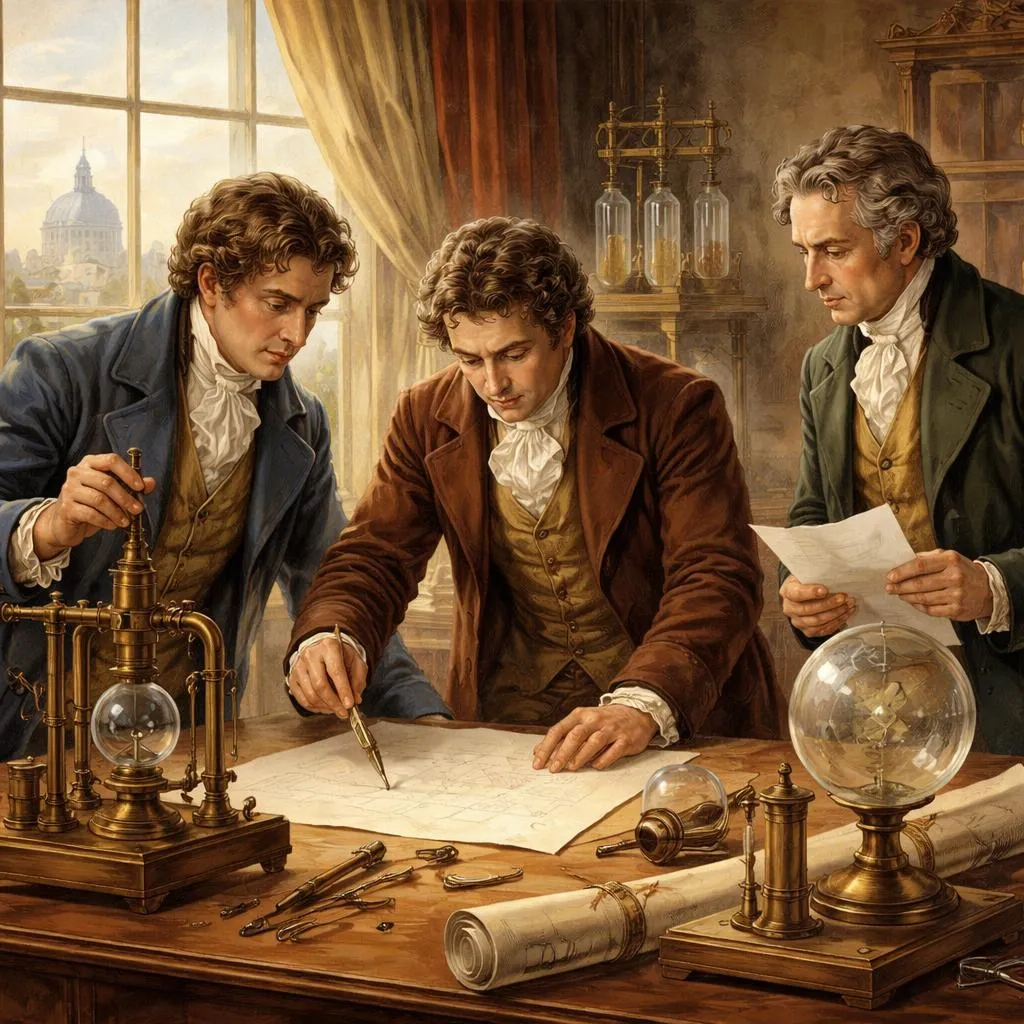

Sadi Carnot
Among Fourier's contemporaries who were interested in the theory of heat the most eminent was Sadi Carnot, a son of the eminent geometrician mentioned above. Sadi Carnot was born at Paris in 1796, and died there of cholera in August 1832; he was an officer in the French army. In 1824 he issued a short work entitled Réflexions sur la puissance motrice du feu , in which he attempted to determine in what way heat produced its mechanical effect. He made the mistake of assuming that heat was material, but his essay may be taken as initiating the modern theory of thermodynamics.
Ampère
André Marie Ampère was born at Lyons on January 22, 1775, and died at Marseilles on June 10, 1836. He was widely read in all branches of learning, and lectured and wrote on many of them, but after the year 1809, when he was made professor of analysis at the Polytechnic school in Paris, he confined himself almost entirely to mathematics and science. His papers on the connection between electricity and magnetism were written in 1820. According to his theory, propounded in 1826, a molecule of matter which can be magnetized is traversed by a closed electric current, and magnetization is produced by any cause which makes the direction of these currents in the different molecules of the body approach parallelism.
Fresnel, Biot
Augustin Jean Fresnel, born at Broglie on May 10, 1788, and died at Ville-d'Avray on July 14, 1827, was a civil engineer by profession, but he devoted his leisure to the study of physical optics. The undulatory theory of light, which Hooke, Huygens, and Euler had supported on a priori grounds, had been based on experiment by the researches of Young. Fresnel deduced the mathematical consequences of these experiments, and explained the phenomena of interference both of ordinary and polarized light. Fresnel's friend and contemporary, Jean Baptiste Biot, who was born at Paris on April 21, 1774, and died there in 1862, requires a word or two in passing. Most of his mathematical work was in connection with the subject of optics, and especially the polarization of light. His systematic works were produced within the years 1805 and 1817; a selection of his more valuable memoirs was published in Paris in 1858.
Arago
François Jean Dominique Arago was born at Estagel in the Pyrenees on February 26, 1786, and died in Paris on October 2, 1853. He was educated at the Polytechnic school, Paris, and we gather from his autobiography that however distinguished were the professors in that institution they were remarkably incapable of imparting their knowledge or maintaining discipline.
In 1804 Arago was made secretary to the observatory at Paris, and from 1806 to 1809 he was engaged in measuring a meridian arc in order to determined the exact length of a metre. He was then appointed to a leading post in the observatory, given a residence there, and made a professor at the Polytechnic school, where he enjoyed a marked success as a lecturer. He subsequently gave popular lectures on astronomy, which were both lucid and accurate ‐ a combination of qualities which was rarer then than now. He reorganized the national observatory, the management of which has long been inefficient, but in doing this his want of tact and courtesy raised many unnecessary difficulties. He remained to the end a consistent republican, and after the coup d'état of 1852, though half blind and dying, he resigned his post as astronomer rather than take the oath of allegiance. It is to the credit of Napoleon III. that he gave directions that the old man should be in no way disturbed, and should be left free to say and do what he liked.
Arago's earliest physical researches were on the pressure of steam at different temperatures, and the velocity of sound, 1818 to 1822. His magnetic observations mostly took place from 1823 to 1826. He discovered what has been called rotatory magnetism, and the fact that most bodies could be magnetized; these discoveries were completed and explained by Faraday. He warmly supported Fresnel's optical theories, and the two philosophers conducted together those experiments on the polarization of light which led to the inference that the vibrations of the luminiferous ether were transverse to the direction of motion, and that polarization consisted in a resolution of rectilinear motion into components at right angles to each other. The subsequent invention of the polariscope and discover of rotatory polarization are due to Arago. The general idea of the experimental determination of the velocity of light in the manner subsequently effected by Fizeau and Foucault was suggested by him in 1838, but his failing eyesight prevented his arranging the details or making the experiments.
It will be noticed that some of the last members of the French school were alive at a comparatively recent date, but nearly all their mathematical work was done before the year 1830. They are the direct successors of the French writers who flourished at the commencement of the nineteenth century, and seem to have been out of touch with the great German mathematicians of the early part of it, on whose researches much of the best work of that century is based; they are thus placed here, though their writings are in some cases of a later date than those of Gauss, Abel and Jacobi.
Contexte et présentations de l'auteur
Ce texte présente plusieurs figures clés de l'histoire des sciences de la fin du XVIIIe et du début du XIXe siècle, en se concentrant sur leurs contributions à la physique, aux mathématiques et à l'optique. Ces scientifiques, dont Sadi Carnot, André Marie Ampère, Augustin Fresnel, Jean Baptiste Biot et François Arago, ont été des pionniers qui ont jeté les bases des théories et des technologies scientifiques modernes. Ils ont vécu à une époque où la science évoluait rapidement, et leurs travaux ont contribué à façonner des domaines tels que la thermodynamique, l'électromagnétisme et l'étude de la lumière.
Sadi Carnot, souvent appelé le "père de la thermodynamique", était un officier de l'armée française dont l'essai de 1824 a amorcé la compréhension moderne de la façon dont la chaleur peut être convertie en travail mécanique. André Marie Ampère, mathématicien et physicien, est surtout connu pour ses travaux sur la relation entre l'électricité et le magnétisme, qui ont conduit au développement de l'électromagnétisme. Augustin Fresnel a fait progresser la théorie ondulatoire de la lumière, expliquant des phénomènes comme l'interférence et la polarisation. Jean Baptiste Biot a contribué de manière significative à l'optique, notamment à la compréhension de la lumière polarisée. François Arago était un astronome et physicien qui a fait d'importantes découvertes sur le magnétisme et la polarisation de la lumière et était connu pour son dévouement à la science et ses idéaux républicains.
Interprétation détaillée et importance
Les histoires de ces scientifiques ne concernent pas seulement leurs découvertes, mais aussi l'esprit d'enquête et de persévérance face aux défis. Par exemple, l'hypothèse de Carnot selon laquelle la chaleur était une substance matérielle était incorrecte, mais son travail était fondamental. La théorie d'Ampère sur les courants moléculaires dans la matière magnétisée a été une étape clé vers la compréhension de l'électromagnétisme. Les travaux de Fresnel et Biot sur la lumière ont contribué à confirmer la nature ondulatoire de la lumière, un changement majeur par rapport aux théories particulaires antérieures.
L'histoire de la vie d'Arago est particulièrement inspirante car elle reflète à la fois la réussite scientifique et l'intégrité personnelle. Malgré les troubles politiques et les problèmes de santé personnels, il est resté fidèle à ses principes et à l'avancement des connaissances. Sa collaboration avec Fresnel sur les expériences de polarisation de la lumière a été cruciale pour façonner l'optique moderne.
Leçons et perspectives pour les étudiants
-
Curiosité et esprit critique : Ces scientifiques montrent l'importance de poser des questions et de remettre en question les idées existantes. Même lorsque certaines hypothèses étaient fausses, leur volonté d'explorer de nouveaux concepts a conduit à des percées.
-
Persévérance dans l'apprentissage : Nombre de ces personnalités ont rencontré des difficultés, qu'elles soient scientifiques, politiques ou personnelles, mais elles ont continué leur travail. Cela enseigne aux étudiants la valeur de la persévérance et de la résilience.
-
Apprentissage interdisciplinaire : Les scientifiques ont combiné les connaissances de différents domaines - mathématiques, physique, ingénierie - pour résoudre des problèmes complexes. Les étudiants peuvent apprendre à intégrer les connaissances entre les matières.
-
Éthique et intégrité : Le refus d'Arago de prêter serment contre ses convictions nous rappelle qu'il est important de défendre ses principes, même sous la pression.
-
Collaboration : Le partenariat entre Fresnel et Arago souligne comment le travail d'équipe peut mener à de plus grandes découvertes.
Applications dans la vie quotidienne et l'apprentissage
- Dans les études : Les étudiants peuvent adopter l'habitude de remettre en question et d'explorer au-delà des manuels scolaires, comme ces scientifiques l'ont fait avec leurs expériences et leurs théories.
- Dans la vie sociale : L'attitude éthique dont a fait preuve Arago encourage à défendre ce qui est juste et à être honnête dans les interactions.
- Dans la résolution de problèmes : Combiner les connaissances de diverses matières, comme l'ont fait ces scientifiques, peut aider les étudiants à aborder les défis de manière créative.
- Dans le développement personnel : Comprendre que l'échec ou les erreurs (comme l'hypothèse de Carnot sur la chaleur) font partie de l'apprentissage peut motiver les étudiants à continuer d'essayer.
Cultiver des traits positifs à partir de ces histoires
- Curiosité : Encouragez à se poser la question "pourquoi" et "comment" dans la vie quotidienne.
- Résilience : Apprendre à voir les revers comme des occasions de grandir.
- Collaboration : Travailler avec des pairs pour partager des idées et résoudre des problèmes.
- Intégrité : Développer une boussole morale forte et défendre ses valeurs.
- Apprentissage tout au long de la vie : Adopter l'apprentissage comme un voyage continu, et pas seulement comme une tâche scolaire.
En étudiant la vie et l'œuvre de ces scientifiques pionniers, les étudiants acquièrent non seulement des connaissances sur d'importants principes scientifiques, mais apprennent également des compétences et des attitudes précieuses qui peuvent les aider à réussir sur le plan scolaire et personnel.
