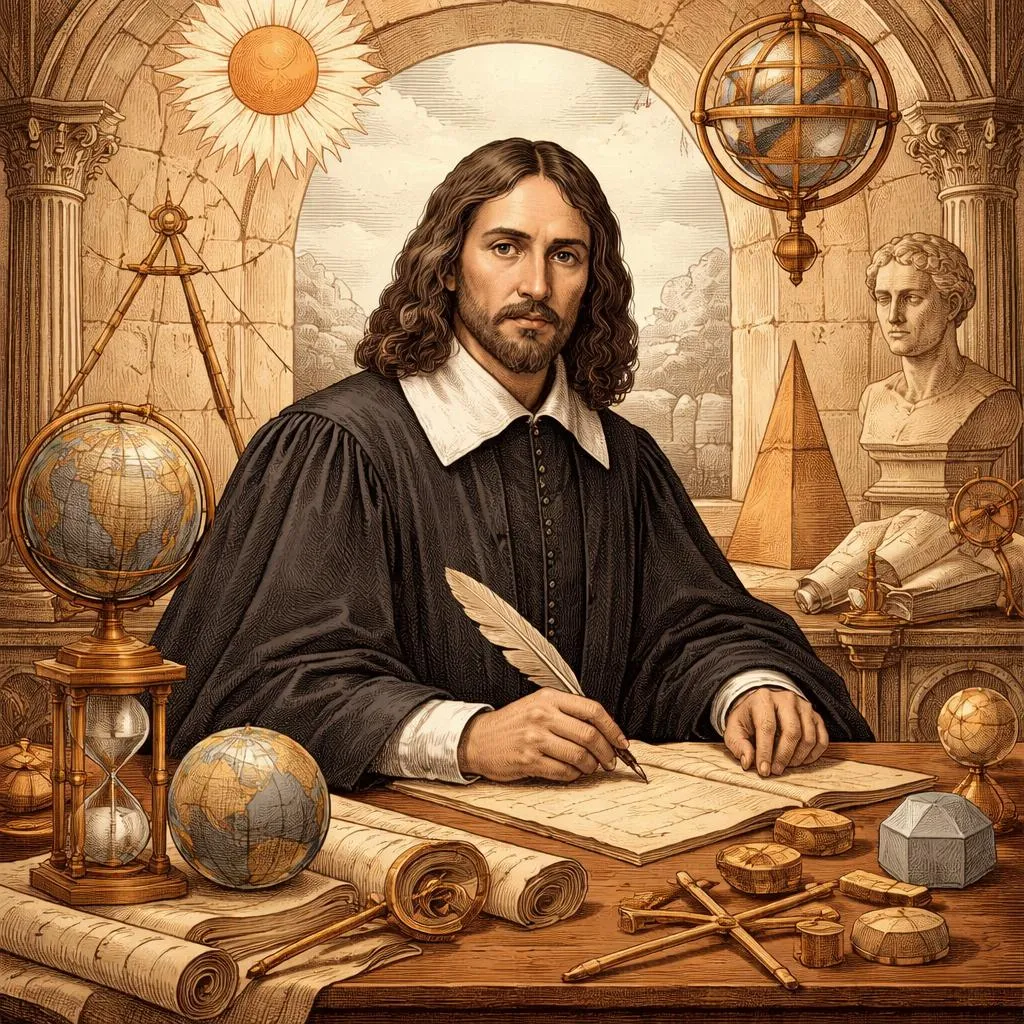

Isaac Barrow was born in London in 1630, and died at Cambridge in 1677. He went to school first at Charterhouse (where he was so troublesome that his father was heard to pray that if it pleased God to take any of his children he could best spare Isaac), and subsequently to Felstead. He completed his education at Trinity College, Cambridge; after taking his degree in 1648, he was elected to a fellowship in 1649; he then resided for a few years in college, but in 1655 he was driven out by the persecution of the Independents. He spent the next four years in the East of Europe, and after many adventures returned to England in 1659. He was ordained the next year, and appointed to the professorship of Greek at Cambridge. In 1662 he was made professor of geometry at Gresham College, and in 1663 was selected as the first occupier of the Lucasian chair at Cambridge. He resigned the latter to his pupil Newton in 1669, whose superior abilities he recognized and frankly acknowledged. For the remainder of his life he devoted himself to the study of divinity. He was appointed master of Trinity College in 1672, and held the post until his death.
He is described as "low in stature, lean, and of a pale complexion," slovenly in his dress, and an inveterate smoker. He was noted for his strength and courage, and once when travelling in the East he saved the ship by his own prowess from capture by pirates. A ready and caustic wit made him a favourite of Charles II., and induced the courtiers to respect even if they did not appreciate him. He wrote with a sustained and somewhat stately eloquence, and with his blameless life and scrupulous conscientiousness was an impressive personage of the time.
His earliest work was a complete edition of the Elements of Euclid, which he issued in Latin in 1655, and in English in 1660; in 1657 he published an edition of the Data. His lectures, delivered in 1664, 1665, and 1666, were published in 1683 under the title Lectiones Mathematicae; these are mostly on the metaphysical basis for mathematical truths. His lectures for 1667 were published in the same year, and suggest the analysis by which Archimedes was led to his chief results. In 1669 he issued his Lectiones Opticae et Geometricae. It is said in the preface that Newton revised and corrected these lectures, adding matter of his own, but it seems probable from Newton's remarks in the fluxional controversy that the additions were confined to the parts which dealt with optics. This, which is his most important work in mathematics, was republished with a few minor alterations in 1674. In 1675 he published an edition with numerous comments of the first four books of the Conics of Apollonius, and of the extant works of Archimedes and Theodosius.
In the optical lectures many problems connected with the reflexion and refraction of light are treated with ingenuity. The geometrical focus of a point seen by reflexion or refraction is defined; and it is explained that the image of an object is the locus of the geometrical foci of every point on it. Barrow also worked out a few of the easier properties of thin lenses, and considerably simplified the Cartesian explanation of the rainbow.
The geometrical lectures contain some new ways of determining the areas and tangents of curves. The most celebrated of these is the method given for the determination of tangents to curves, and this is sufficiently important to require a detailed notice, because it illustrates the way in which Barrow, Hudde and Sluze were working on the lines suggested by Fermat towards the methods of the differential calculus.
Fermat had observed that the tangent at a point P on a curve was determined if one other point besides P on it were known; hence, if the length of the subtangent MT could be found (thus determining the point T), then the line TP would be the required tangent. Now Barrow remarked that if the abscissa and ordinate at a point Q adjacent to P were drawn, he got a small triangle PQR (which he called the differential triangle, because its sides PR and PQ were the differences of the abscissae and ordinates of P and Q), so that
TM : MP = QR : RP.
To find QR : RP he supposed that x, y were the co-ordinates of P, and x - e, y - a those of Q (Barrow actually used p for x and m for y, but I alter these to agree with modern practice). Substituting the co-ordinates of Q in the equation of the curve, and neglecting the squares and higher powers of e and a as compared with their first powers, he obtained e : a. The ratio a/e was subsequently (in accordance with a suggestion made by Sluze) termed the angular coefficient of the tangent at the point. Barrow applied this method to the curves (i) x² (x² + y²) = r²y²;(ii) x³ + y³ = r³; (iii) x³ + y³ = rxy, called la galande; (iv) y = (r - x) tan πx/2r, the quadratrix; and (v) y = r tan πx/2r. It will be sufficient here if I take as an illustration the simpler case of the parabola y² = px. Using the notation given above, we have for the point P, y² = px; and for the point Q, (y - a)² = p(x - e). Subtracting we get 2ay - a² = pe. But, if a be an infinitesimal quantity, a² must be infinitely smaller and therefore may be neglected when compared with the quantities 2ay and pe. Hence 2ay = pe, that is, e : a = 2y : p. Therefore TP : y = e : a = 2y : p. Hence TM = 2y²/p = 2x. This is exactly the procedure of the differential calculus, except that there we have a rule by which we can get the ratio a/e or dy/dx directly without the labour of going through a calculation similar to the above for every separate case.
Contexte et introduction de l'auteur
Isaac Barrow était un mathématicien et théologien remarquable du XVIIe siècle. Né à Londres en 1630, il a vécu à une époque de grandes découvertes scientifiques et de changements intellectuels. Barrow n'était pas seulement un érudit, mais aussi un aventurier courageux, connu pour sa force et son esprit. Malgré sa jeunesse quelque peu indisciplinée, il est devenu l'un des principaux mathématiciens de son époque, occupant des postes universitaires prestigieux à l'université de Cambridge. Les travaux de Barrow ont jeté des bases importantes pour le calcul, une branche des mathématiques qui serait plus tard développée par son célèbre étudiant, Isaac Newton.
L'histoire de la vie de Barrow nous enseigne la persévérance, la curiosité intellectuelle et l'importance de reconnaître et d'encourager les talents chez les autres. Sa décision de démissionner de sa prestigieuse chaire lucasienne au profit de Newton témoigne d'humilité et d'un engagement en faveur de l'avancement des connaissances au-delà de l'ambition personnelle.
Explication détaillée et importance
Le texte ci-dessus décrit les contributions de Barrow aux mathématiques, en particulier en géométrie et en optique. Il a travaillé sur des problèmes liés à la réflexion et à la réfraction de la lumière, expliquant comment les images sont formées à travers des lentilles - un sujet toujours fondamental en physique et en optique aujourd'hui. Ses cours de géométrie ont introduit de nouvelles méthodes pour trouver les tangentes aux courbes, ce qui est un concept clé du calcul.
L'approche de Barrow concernant les tangentes impliquait ce que nous appelons aujourd'hui le "triangle différentiel", un outil géométrique ingénieux qui l'a aidé à approximer les pentes des courbes avant le développement formel du calcul. Cette méthode a été une étape vers les techniques puissantes que Newton et Leibniz formaliseraient plus tard. Les travaux de Barrow sur les sections coniques et ses commentaires sur les mathématiciens de l'Antiquité comme Apollonius et Archimède ont également contribué à préserver et à faire progresser les connaissances mathématiques classiques.
Ce que les étudiants peuvent apprendre
-
Contexte historique des mathématiques : Comprendre le travail de Barrow aide les étudiants à apprécier comment les idées mathématiques évoluent au fil du temps. Cela montre que le calcul, un sujet souvent considéré comme difficile, a été développé étape par étape par de nombreux penseurs qui se sont appuyés sur les découvertes des uns et des autres.
-
Apprentissage interdisciplinaire : Barrow a combiné ses intérêts pour les mathématiques, la théologie et la philosophie, démontrant la valeur d'une éducation large et l'interconnexion de différents domaines.
-
Pensée critique et résolution de problèmes : La méthode de Barrow pour analyser les courbes et la lumière enseigne aux étudiants à aborder les problèmes de manière créative et logique, en décomposant les idées complexes en parties plus simples.
-
Humilité et mentorat : La reconnaissance par Barrow du talent supérieur de Newton et sa volonté de s'effacer est une leçon puissante d'humilité et de l'importance de soutenir la croissance des autres.
Applications dans la vie et l'apprentissage
-
À l'école : Les étudiants peuvent appliquer l'exemple de Barrow en étant curieux et persévérants dans leurs études, en particulier dans les matières difficiles comme les mathématiques et les sciences. Apprendre l'histoire derrière les concepts peut les rendre plus intéressants et plus faciles à comprendre.
-
Dans les contextes sociaux : L'histoire de Barrow encourage le respect des talents des autres et l'importance du mentorat. Aider les camarades de classe et reconnaître leurs points forts peut créer une communauté d'apprentissage positive.
-
Dans le développement personnel : La vie de Barrow montre que les premières erreurs ou difficultés ne définissent pas l'avenir d'une personne. Avec des efforts et du dévouement, n'importe qui peut accomplir de grandes choses.
Comment cultiver des traits positifs à partir de l'histoire de Barrow
-
Curiosité : Posez toujours des questions et cherchez à comprendre comment les choses fonctionnent, tout comme Barrow a exploré la nature de la lumière et des courbes.
-
Courage : N'ayez pas peur d'affronter les défis ou les nouvelles expériences, comme Barrow l'a fait en voyageant et en affrontant les pirates.
-
Humilité : Reconnaissez quand les autres ont de meilleures idées et soyez prêt à apprendre d'eux.
-
Conscience : Visez l'intégrité et un travail soigné, comme Barrow l'a fait dans sa vie scolaire et personnelle.
Réflexion et appréciation
La lecture sur Isaac Barrow peut inciter les étudiants à valoriser à la fois les connaissances et le caractère. Son mélange de brillance intellectuelle et de courage personnel fait de lui un modèle non seulement pour les scientifiques et les mathématiciens en herbe, mais aussi pour tous ceux qui veulent grandir en tant qu'individus réfléchis, respectueux et courageux. En étudiant sa vie et son œuvre, les jeunes apprenants peuvent voir comment le dévouement à l'apprentissage et la gentillesse envers les autres vont de pair pour avoir un impact significatif sur le monde.
