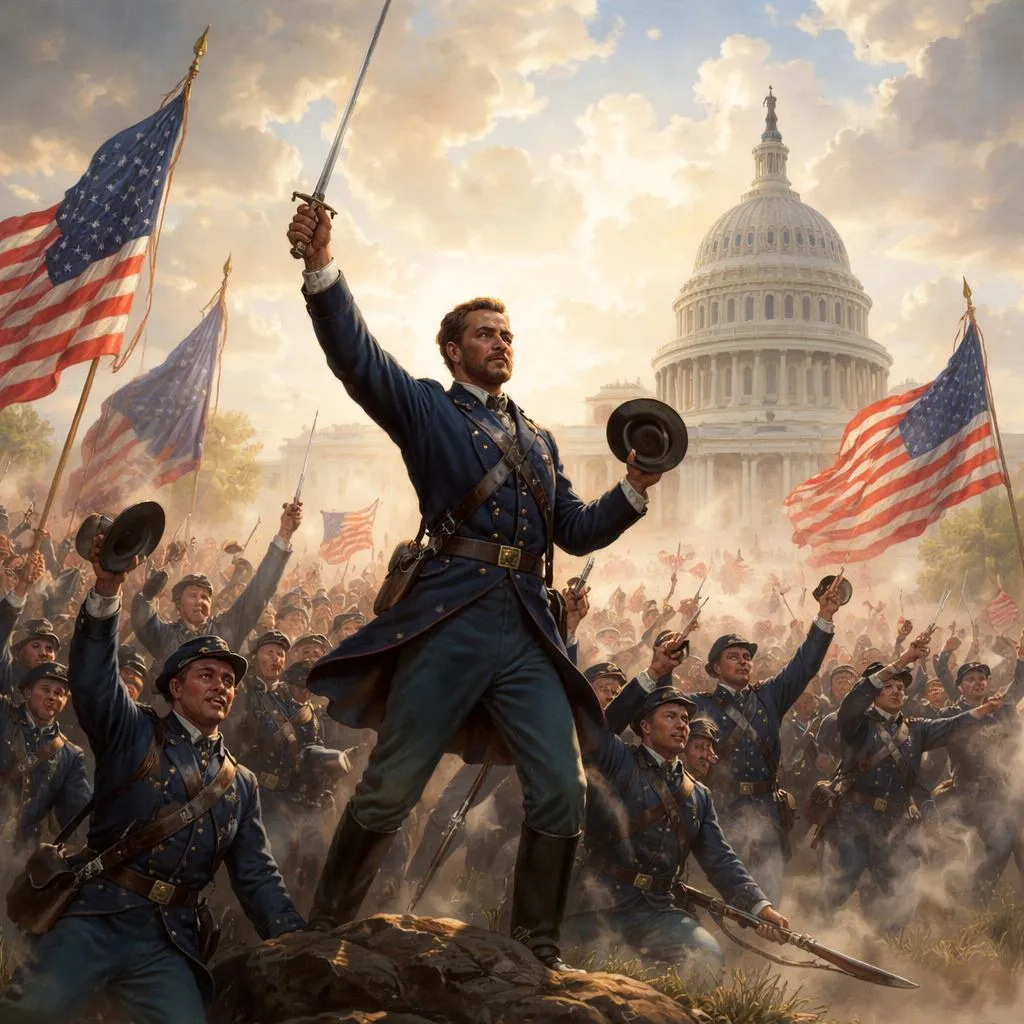

A Victorious Union is the sixth and last of The Blue and the Gray Series. While the volume is not intended to be a connected historical narrative of the particular period of the War of the Rebellion in which its scenes are laid, the incidents accurately conform to the facts, and especially to the spirit, of the eventful years in which they are placed, as recorded in the chronicles of the great struggle, and as they exist in the memory of the writer. It is more than thirty years since the war began, and thousands upon thousands of the active participants in the strife as soldiers and sailors, including nearly all the great commanders, have passed on to their eternal reward. Thousands upon thousands of men and women have been born and reached their maturity since the most tremendous war of modern times ended in A Victorious Union. The knowledge of the stirring events of those four years of conflict, and of the patriotic spirit which inspired and underlaid them, has come, or will come, to at least one-half the population of this vast nation of sixty-five millions from the printed page or through the listening ear. The other moiety, more or less, either as children or adults, lived in the period of action, saw the gathering battalions, and heard or read the daily reports from the ensanguined battle-fields.
In some of the States that remained loyal to the Union throughout the long struggle, a military parade had been regarded by many as something very much in the nature of a circus display, as “fuss and feathers,” such as tickled the vanity of both officer and private. Military organizations, except in our small regular army, were disparaged and ridiculed. When the war came, the Northern people were unprepared for it to a very great degree. The change of public opinion was as sudden as the mighty event was precipitate. Then the soldier became the most prominent and honored member of the community, and existing military bodies became the nucleus of the armies that were to fight the battles of the Republic.
During the last thirty years the military spirit has been kept alive as a constituent element of patriotism itself. The love of country has been diligently fostered and nurtured in the young, and public opinion has been voiced and energized in the statutes of many States, and in the educational machinery of many municipalities. Over vast numbers of school houses in our land floats theAmerican flag, the symbol of the Union and the principles that underlie it.
The flag, the banner now of a reunited nation, means something more than the sentiment of loyalty to the Union as the home of freedom; for it implies the duty of defending the honor of that flag, the representative idea of all we hold dear in Fatherland. In the East and the West a considerable proportion of the high schools make military tactics a part of their educational course. Companies, battalions, and regiments of young men in their teens parade the streets of some of our cities, showing in what manner the military spirit is kept alive, and, at the same time, how the flag floating over our educational institutions, which means so much more than ever before to our people, is to be defended and perpetuated in the future.
The author of the six volumes of The Blue and the Gray Series, as well as of The Army and Navy Series, the latter begun in the heat of the war thirty years ago, earnestly believes in keeping active in the minds of the young the spirit of patriotism. In the present volume, as in those which have preceded it, he has endeavored to present to his readers, not only a hero who is brave, skilful, and ready to give his life for his country, but one who is unselfishly patriotic; one who is not fighting for promotion and prize-money, but to save the Union in whose integrity and necessity he believes as the safeguard and substance of American liberty.
Peace has reigned in our land for nearly thirty years, and the asperities of a relentless war have been supplanted by better and more brotherly relations between the North and the South. The writer would not print a word that would disturb these improving conditions; and if he has erred at all in picturing the intercourse between Americans as enemies, he has made sure to do so in the interests of justice and magnanimity on both sides.
In the series of which this volume is the last, the author has confined his narrative of adventures to the navy. It has been suggested to him that another series, relating exclusively to incidents in the army, should follow. After forty years of labor in this particular field, and having already exhausted the three score and ten of human life, he cannot be assured that he will live long enough to complete such a series, though still in excellent health; but he intends to make a beginning of the work as soon as other engagements will permit.
William T. Adams. Dorchester, March 16, 1893.
Contexte et Introduction de l'Auteur
"Une Union Victorieuse" est le dernier volume de la série Le Bleu et le Gris, écrit par William T. Adams, un auteur prolifique connu pour son dévouement à inspirer le patriotisme et les valeurs morales à travers la narration. Écrit près de trente ans après la guerre de Sécession américaine, ce livre réfléchit sur le conflit avec un esprit de respect et de réconciliation. Adams était profondément engagé à éduquer les jeunes lecteurs sur les sacrifices faits pendant la guerre et l'importance de l'unité et du patriotisme. Ses œuvres mettent souvent l'accent sur le courage, l'honneur et l'altruisme, dans le but d'inculquer ces vertus à la jeunesse de son époque.
Interprétation Détaillée et Importance
Ce volume, comme les autres de la série, n'est pas seulement un récit historique, mais un récit qui capture l'essence émotionnelle et morale de la période de la guerre de Sécession. L'histoire se concentre sur le rôle de la marine dans la guerre, soulignant la bravoure et le dévouement des individus qui se sont battus non pas pour un gain personnel, mais pour la préservation de l'Union et des idéaux qu'elle représentait. Adams dépeint le soldat comme un symbole de patriotisme, dont la loyauté et le courage servent de modèle pour les lecteurs.
Le livre aborde également la transformation de la perception publique de l'armée — passant d'un simple spectacle à une institution respectée et vitale. Ce changement reflète les changements sociétaux plus larges qui se sont produits pendant et après la guerre, soulignant l'importance du devoir, de l'honneur et de la fierté nationale.
Leçons et Aperçus pour les Étudiants
Les étudiants qui lisent "Une Union Victorieuse" peuvent tirer de nombreuses leçons précieuses :
- Patriotisme et Altruisme : L'histoire encourage les jeunes lecteurs à comprendre le patriotisme comme étant plus qu'un simple amour pour son pays ; il s'agit d'un service désintéressé et d'un engagement envers une cause plus grande.
- Courage et Honneur : Les personnages font preuve de bravoure non pas pour la gloire ou la récompense, mais parce qu'ils croient profondément aux valeurs qu'ils défendent.
- Conscience Historique : Le livre donne un aperçu d'une période critique de l'histoire américaine, aidant les étudiants à apprécier les sacrifices qui ont façonné leur nation.
- Respect et Réconciliation : En montrant la paix et la guérison d'après-guerre entre le Nord et le Sud, l'histoire enseigne l'importance du pardon et de l'unité.
Application dans la Vie Quotidienne
Les vertus mises en évidence dans l'histoire peuvent être appliquées par les étudiants dans divers domaines de leur vie :
- À l'École : Émuler le courage et le dévouement des personnages peut inspirer les étudiants à relever les défis scolaires avec détermination et intégrité.
- Dans les Cadres Sociaux : Les thèmes du respect et de l'unité encouragent les étudiants à nouer des amitiés par-delà les différences et à résoudre les conflits pacifiquement.
- Dans le Développement Personnel : L'accent mis par l'histoire sur l'altruisme et le patriotisme peut motiver les jeunes à contribuer positivement à leurs communautés et à comprendre leur rôle dans la société.
Cultiver un Esprit et un Comportement Positifs
Pour nourrir les qualités positives trouvées dans l'histoire, les étudiants peuvent :
- Participer à des activités de service communautaire ou scolaires qui favorisent le travail d'équipe et la responsabilité.
- En apprendre davantage sur l'histoire et les sacrifices faits par les générations précédentes afin de favoriser un sens plus profond de la gratitude et du devoir civique.
- Pratiquer l'empathie et le respect dans les interactions quotidiennes, reflétant la magnanimité dont l'auteur a fait preuve envers toutes les parties du conflit.
- Participer à des discussions sur le patriotisme et ce qu'il signifie dans le monde d'aujourd'hui, encourageant une réflexion approfondie sur les valeurs et l'identité.
Conclusion
"Une Union Victorieuse" est plus qu'un roman historique ; c'est un guide pour les jeunes lecteurs afin de comprendre l'importance du patriotisme, du courage et de l'unité. Grâce à sa représentation vivante de la guerre de Sécession et de ses conséquences, le livre invite les étudiants à réfléchir à leurs propres valeurs et à la manière dont ils peuvent contribuer à une société meilleure. En étudiant cette œuvre, les étudiants acquièrent non seulement des connaissances sur l'histoire, mais aussi l'inspiration pour développer des traits de caractère qui leur seront utiles tout au long de leur vie.
