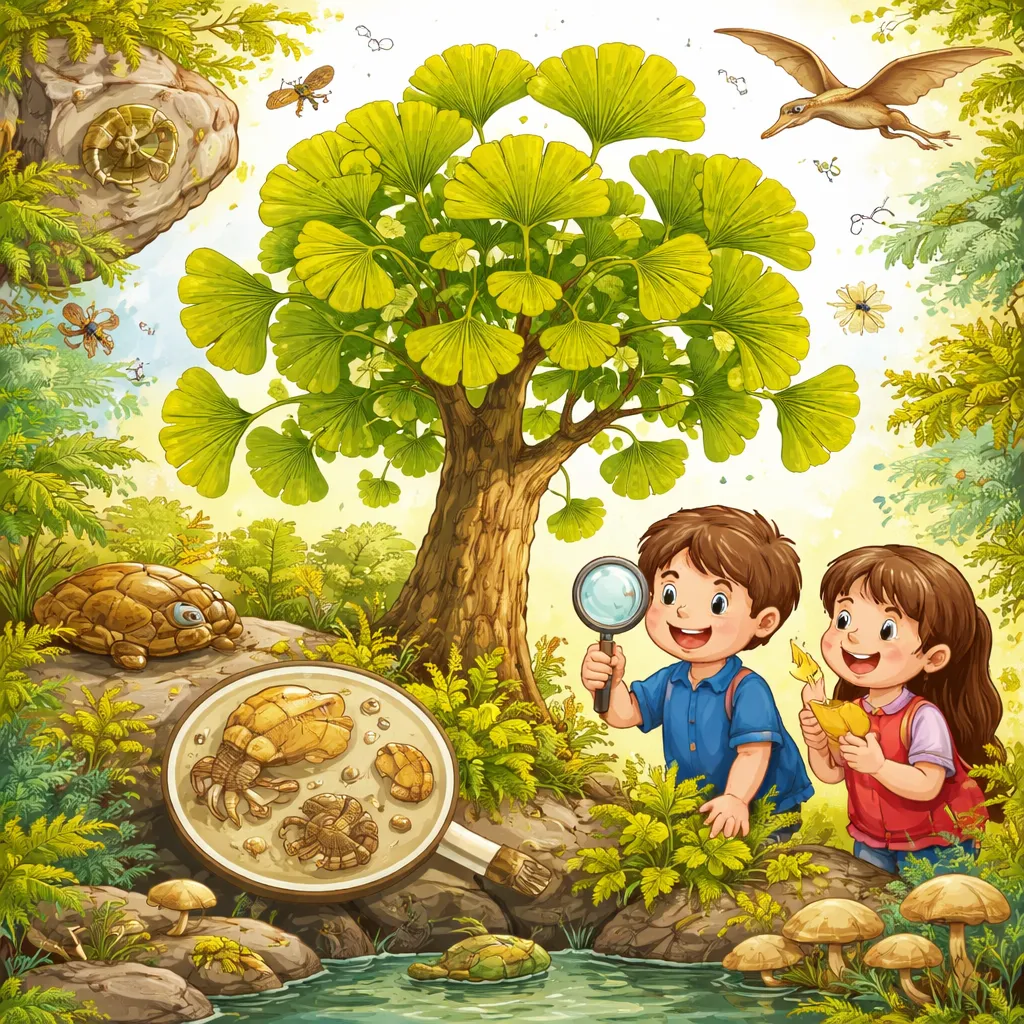

Have you ever seen a tree whose leaves look like little green fans? In the autumn, this tree turns into a dazzling waterfall of pure gold. Its leaves cover the ground in a shiny, yellow carpet. Sometimes, it drops funny-looking fruits that smell a bit… interesting, like old cheese or butter! This tree is a living piece of history. Its family is so old, it saw the dinosaurs walk the Earth. Let’s go on a time-travel adventure to learn about the incredible Ginkgo plant.
Let’s Learn the Word! – Open the Treasure Box of Language
Formal Name and Pronunciation This special tree is called the Ginkgo. Sometimes we use its full scientific name, Ginkgo biloba. Let’s say it together: /ˈɡɪŋ.koʊ/ (GINK-go). The “Gink” part is short and strong, and “go” rhymes with “dough.” Say it: GINK-go! Its full name, Ginkgo biloba, is fun to say: GINK-go bye-LO-ba.
The Etymology Tale Its name comes from a long journey! Long ago, in China, it was called “yín xìng,” which means “silver apricot,” because the seed inside the fruit looks like a silver nut. German scientists long ago wrote down the name from Japanese, and it became “Ginkgo.” The “biloba” part means “two-lobed,” describing its leaf that often looks like two parts or a fan split in the middle.
Nicknames and Friendly Aliases People love to give the Ginkgo fun names. Many call it the “Maidenhair Tree” because its pretty, fan-shaped leaves look like the fronds of a maidenhair fern. Its most famous nickname is the “Living Fossil.” This is because it is the last member of its ancient plant family, a real-life dinosaur among trees!
Building Your Word Web: Core Parts Let’s learn the parts of the Ginkgo. The Leaf is the most special part. It is shaped like a perfect little fan with veins that spread out like open fingers. The Seed is inside a soft, smelly fruit. The clean seed itself looks like a pale nut or a silver pistachio. The Trunk is tall, straight, and has rough, gray bark with deep ridges. The Bark looks like it has thick, corky skin. The Branch grows in a unique way, with short, knobby spurs where the leaves cluster. A Male Tree makes pollen. A Female Tree grows the smelly fruits that hold the seeds.
Action and State Words The Ginkgo is famous for its grand actions. In autumn, it puts on a spectacular golden show. It loses all its leaves at once in a beautiful golden rain. The tree survives in busy, polluted cities where other trees struggle. It is ancient, resilient, and deciduous, meaning it loses its leaves in fall.
Ecosystem Friends Vocabulary Not many animals eat the smelly Ginkgo fruit, but some creatures are friends with the tree. Squirrels sometimes collect and bury the clean seeds to eat later. Insects usually leave the tough leaves alone. The tree is a quiet, strong friend to city animals, providing shade and a place to rest for birds.
Cultural Imprint in Language A famous writer, Johann Wolfgang von Goethe, wrote a love poem comparing two lovers to the two-lobed leaf of a Ginkgo. He wrote: “Is it one single living thing, That has itself in two parts split?” The leaf looks like one thing made of two parts, just like close friends. In China, a poet named Du Fu wrote about the Ginkgo as a noble scholar. The tree stands for longevity, hope, and resilience across many cultures.
Ready for Discovery Now that we know its name and its stories, are you ready to uncover the secrets of this golden time machine? Let’s discover the Ginkgo plant’s amazing history.
Discover the Plant’s Secrets! – A Nature Detective’s Notebook
The Plant Passport The Ginkgo is in a family all by itself, called Ginkgoaceae. It is the only living species in its entire group! It is a tall, elegant tree that looks like it’s reaching for the sky. Its leaves are its superstar feature—beautiful green fans in summer that turn brilliant, uniform gold in autumn. Female trees produce a small, plum-like fruit that holds the seed inside. The fruit smells quite strong when it falls and gets squished. It grows slowly and can live for over a thousand years, watching the seasons change for centuries.
Survival Smarts The Ginkgo is a superhero of survival. It is incredibly tough against pollution, pests, and even disease. Its leaves and wood have special chemicals that make them very resistant. This is why it thrives in busy cities. Another cool fact: Ginkgo trees are either male or female. Only the female trees grow the smelly fruits. People often plant male trees in cities to avoid the messy fruit. It is a true living fossil, looking almost the same as it did millions of years ago.
Its Role and Gifts The Ginkgo is a bit of a lonely giant. Not many modern animals rely on it for food. But it is a fantastic friend to people in cities! It acts as a powerful air cleaner, soaking up pollution and giving us clean oxygen. Its wide, shady canopy provides a cool resting spot on hot days. Its deep roots help hold the soil. It is a calm, green monument that makes our streets beautiful.
Stories and Symbols In East Asia, the Ginkgo is a sacred symbol of longevity, hope, and resilience. It is often planted near temples, palaces, and schools. A famous story tells of Ginkgo trees that survived the atomic bomb in Hiroshima, Japan, sprouting new life from their burned trunks. This made it a worldwide symbol of peace and survival. People use extracts from its leaves for memory and health. The roasted seed inside the fruit is a special, traditional food.
Fun “Wow!” Facts Get ready for a cool secret! The Ginkgo is so old, its ancestors were eaten by dinosaurs like Stegosaurus and Triceratops! And here is a beautiful autumn mystery: when the first frost comes, a Ginkgo tree can drop all of its golden leaves in just one or two hours, creating a sudden, magical golden carpet.
From History to Your Home These secrets are from a deep, deep past. But you can grow a piece of this history today. Would you like to be a guardian for a baby dinosaur tree? Let’s learn how.
Let’s Grow It Together! – A Little Guardian’s Action Guide
Good for Home Growing? Yes, you can! You can grow a Ginkgo in a large pot on a sunny balcony or patio for many years. Because it grows slowly, it makes a beautiful, living sculpture. If you have a garden with lots of space, it can one day become a big, beautiful tree. Remember, it will need room for its roots to spread.
Little Gardener’s Toolkit You will need a cleaned Ginkgo seed (called a nut) from a garden store. Find a medium-sized pot with good drainage holes. Get some well-draining potting soil. Have a small watering can and a spray bottle ready. A clear plastic bag can help create a mini-greenhouse.
Step-by-Step Growing Guide
Planting Your Dinosaur Seed The best time to plant is in the fall or early spring. First, soak your clean Ginkgo seed in water for a full day. Then, plant it about 1 inch deep in the soil. You can plant a few seeds in one pot. Cover the pot with the clear plastic bag to keep it warm and moist, and place it in a warm spot.
Care Calendar Keep the soil slightly damp, but not soggy. Use the spray bottle to mist it gently. Once you see a green sprout, remove the plastic bag. Your baby Ginkgo loves lots of sunshine. In the growing season, you can give it a little bit of liquid plant food every month. In winter, let it rest and water it much less.
Watch and Be Friends This is a slow, wonderful watch. Be patient! The seed may take many weeks to sprout. When it does, draw the first little leaves. Notice how the first leaves might not look like perfect fans yet. Measure its height every season. Talk to your little “living fossil” and tell it about your day.
Problem Patrol If leaves turn yellow in summer, it might need more water or less direct, hot sun. Move it to a spot with bright, indirect light. If it grows very, very slowly, don’t worry! Ginkgos are famous for being slow and steady. Just make sure it has enough light and is not too wet.
Your Rewards and Gifts Your gift is patience and connection. You are caring for a tree whose family is millions of years old. Watching it teaches you that some of the best things in nature take time. You will feel proud knowing you helped a piece of ancient history grow. It teaches responsibility and the quiet joy of nurturing life.
Creative Fun Start a Millennium Journal. Draw your Ginkgo each year on its “birthday.” Press a golden autumn leaf in a book. Make beautiful leaf rubbings with crayons and paper. Write a short poem about your tree, imagining what the world was like when its great-great-grandparents grew. Draw a picture of a dinosaur next to your baby tree!
A Friendship Across Time By growing a Ginkgo, you are not just planting a seed. You are planting a living bridge that connects the age of dinosaurs to your world today. You are a keeper of deep time.
Conclusion and Forever Curiosity What an amazing journey through time! You started by learning the word “Ginkgo,” you discovered its secrets as a resilient, golden, living fossil, and you learned how to help a tiny one start its long, long life. You now know the Ginkgo is not just a pretty tree; it is a survivor, a symbol of hope, a cleaner of our air, and a gentle giant from another age. Remember, every time you see its fan-shaped leaf, you are holding a shape that dinosaurs saw. Keep looking for these living stories all around you. Your curiosity is the key to unlocking millions of years of secrets. The adventure to learn about the Ginkgo plant shows us that the most amazing stories are rooted in nature, waiting for you to discover them.