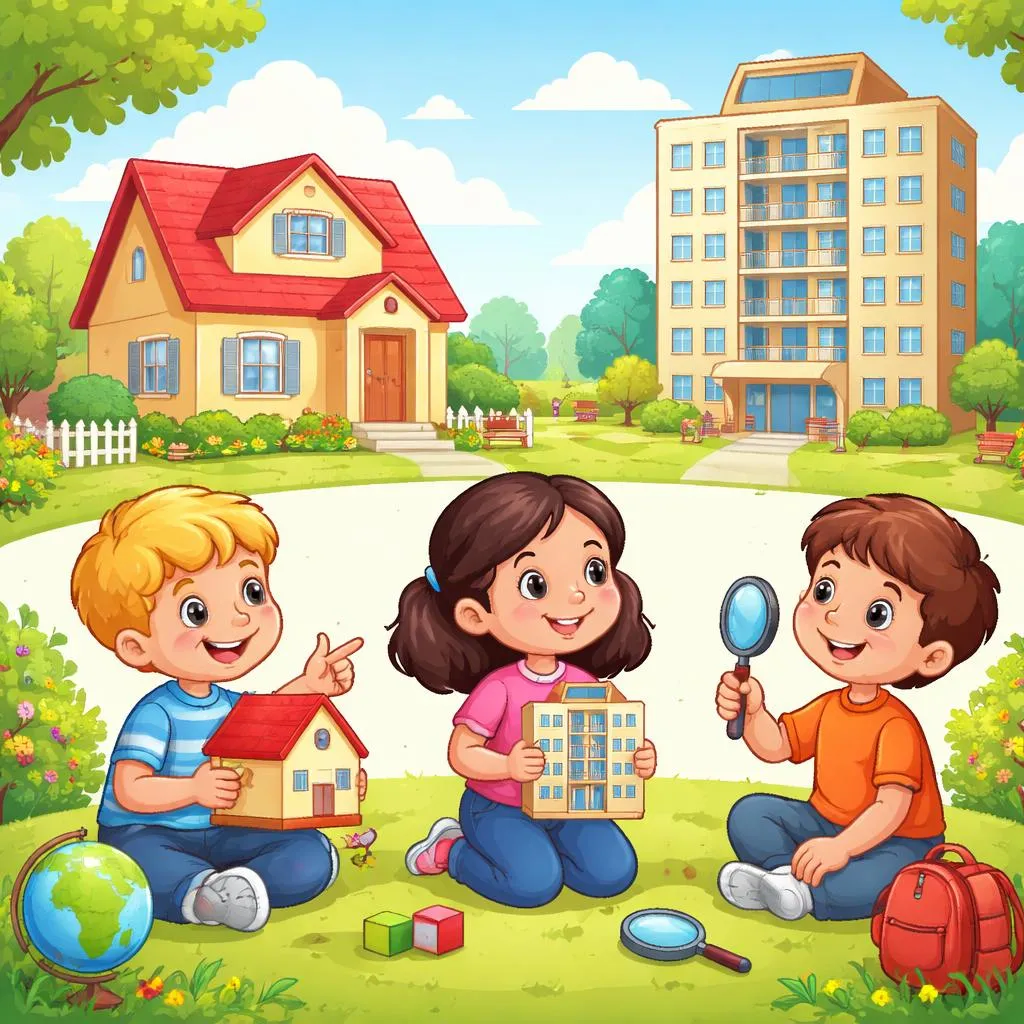

Children often learn place-related vocabulary early in English study. Words like “house,” “school,” and “building” appear in books, cartoons, and classroom conversations. As vocabulary grows, learners begin noticing that some words seem similar but carry different meanings.
The expressions “house to” and “building to” can confuse young learners because both connect to structures and places. However, native speakers use these words differently depending on meaning and situation.
One word describes a specific kind of place for living. The other describes many kinds of structures. Understanding this difference helps children read more accurately and communicate more naturally.
What Do These Expressions Mean?
The phrase “house to” comes from the word “house.” A house is a building where people live.
For example:
“The children walked house to house.” “Their house stands near the river.”
A house usually includes:
bedrooms a kitchen living spaces family areas
The phrase “building to” comes from the word “building.” A building is any structure with walls and a roof.
For example:
“Workers traveled building to building.” “The tall building has many offices.”
A building can be:
a school a hospital a library an apartment tower a house
A child-friendly explanation is simple:
“House” means a place where people live. “Building” means any large structure people use.
The expressions seem similar because every house is also a building. Still, not every building is a house.
What’s the Difference?
The biggest difference comes from size of meaning.
“House” has a narrower meaning.
“Building” has a broader meaning.
One word describes a home for living. The other describes many kinds of structures.
Here is a simple comparison:
Expression Main Meaning Feeling Common Usage house to a place where people live personal and everyday homes and neighborhoods building to any large structure general and practical cities and construction
Another important difference is emotional feeling.
“House” often sounds more personal because families live there.
For example:
“They painted their house.”
Readers may imagine family life.
“Building” sounds more general and practical.
For example:
“The building opened last year.”
This sentence focuses on the structure itself.
When Do We Use Each One?
Children hear “house to” often in daily conversations.
At home:
“We walked house to house during the holiday.” “That blue house belongs to my friend.”
At school:
“Students drew pictures of their houses.” “The class learned about different house styles.”
The word “house” appears often in family and neighborhood discussions.
“Building to” appears more often in cities, schools, and construction topics.
For example:
“The workers moved building to building.” “The city has many tall buildings.”
News reports and science lessons also use “building” because it sounds broader and more technical.
Children should remember this idea:
“House” focuses on living spaces. “Building” focuses on structures in general. Why Broad and Narrow Words Matter
English often uses broad and narrow vocabulary groups.
For example:
animal → broad dog → narrow
The same pattern appears here:
building → broad house → narrow
Every house is a building.
However, schools, stores, and offices are buildings too.
Understanding these word groups helps children organize vocabulary more clearly.
This skill also improves reading comprehension.
Example Sentences for Kids
Here are simple examples using “house to.”
“The kids walked house to house.” “Our house has a small garden.” “She invited friends to her house.”
Now look at examples using “building to.”
“The firefighters moved building to building.” “That building has twenty floors.” “Many buildings stand near the station.”
Children may notice that “house” sounds more personal and home-related.
“Building” sounds broader and more practical.
How Cities and Maps Use “Building”
Maps and city guides often use “building.”
For example:
“office building” “school building” “historic building”
The word helps describe many kinds of structures quickly.
Architects and engineers also use “building” because it sounds professional and technical.
Children may hear:
“building safety” “building design” “building materials”
In these cases, the focus stays on structure rather than home life.
How Families Use “House”
The word “house” appears often in daily family conversations.
Children hear phrases like:
“clean the house” “go back to the house” “our new house”
The word connects strongly to home life and comfort.
Storybooks also use “house” because children easily imagine family spaces.
For example:
“The little house stood beside the forest.”
This creates a warm and familiar image.
Common Mistakes to Avoid
One common mistake is thinking “building” and “house” always mean exactly the same thing.
Incorrect:
“Every building is a house.”
Correct:
“Some buildings are houses.”
Another mistake is using “house” for large public structures.
Incorrect:
“The hospital house is very tall.”
Correct:
“The hospital building is very tall.”
Children should also avoid using “building” when talking warmly about home life.
Incorrect:
“I love our family building.”
Better:
“I love our family house.”
The correct word depends on meaning and feeling.
Easy Memory Tips
A simple trick can help children remember the difference.
Think about this:
“House” = home life “Building” = all structures
Another fun memory idea:
A house is one kind of building.
This means “building” is the bigger category word.
Children can also remember:
families live in houses cities contain buildings
Simple memory connections make vocabulary easier to organize.
Why Word Categories Improve English Skills
Children learn vocabulary faster when they understand categories.
For example:
building → broad category house → one specific type
This skill helps learners understand reading passages more quickly.
It also helps children speak more accurately.
Strong vocabulary organization improves communication, writing, and listening at the same time.
Children become more confident when they notice how English groups ideas together.
Quick Practice Time Choose the Correct Word My grandparents live in a small _____.
A. house B. airplane
Correct answer: A
The office _____ has many windows.
A. building B. sandwich
Correct answer: A
Fill in the Blank A school is a kind of _____.
Answer: building
Families usually live in a _____.
Answer: house
How Children Can Practice These Words Naturally
Children can practice these words through books, games, and daily conversations.
Storybooks often help learners understand “house.”
City maps and school lessons help learners understand “building.”
Watching cartoons and listening to native speakers also helps children notice natural vocabulary patterns.
Children do not need to memorize difficult rules immediately. Instead, they should focus on examples and context.
Over time, the differences become clear and natural.
Vocabulary learning grows best through reading, listening, and real communication experiences.
Wrap-up
“House” usually describes a place where people live, while “building” describes any kind of structure with walls and a roof.