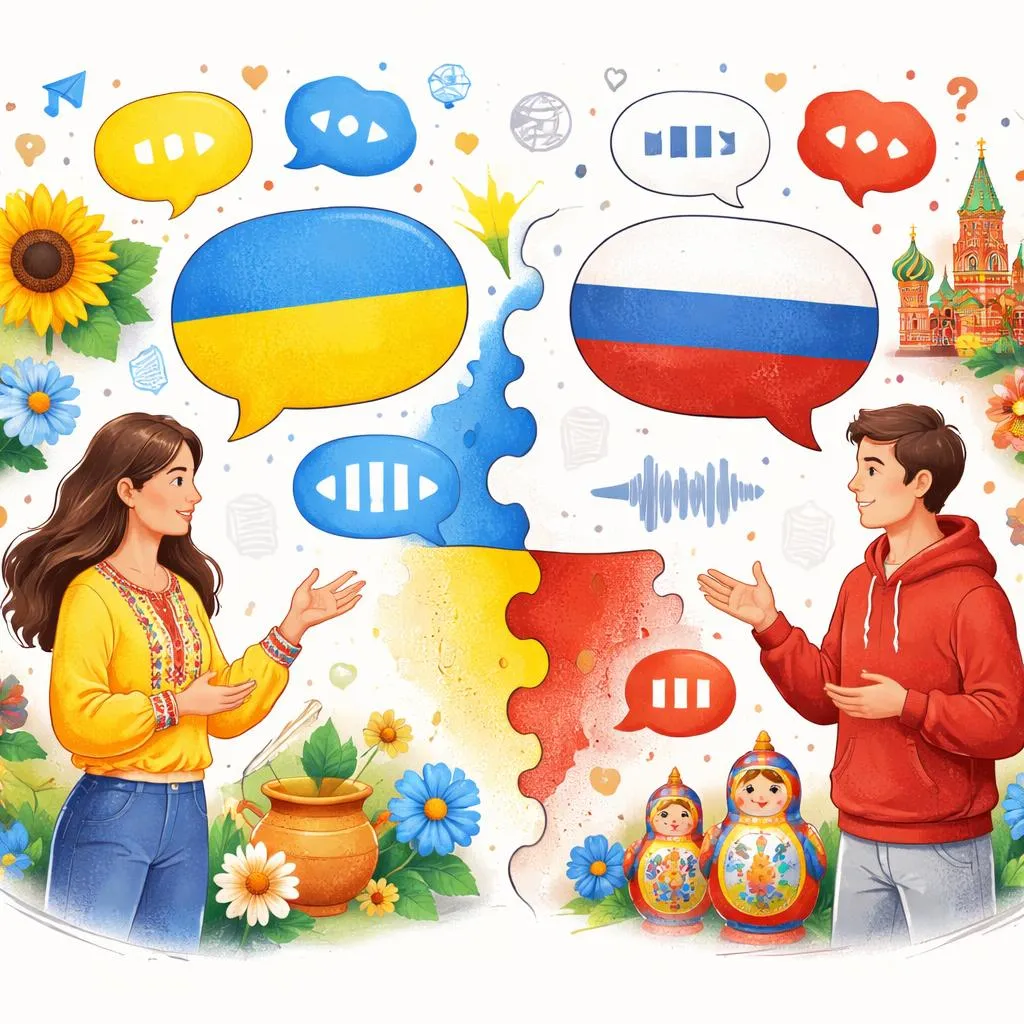

Are Ukrainian and Russian the Same Language? Ukrainian and Russian are different languages, though they share similarities. Both belong to the East Slavic language family. However, there are important differences in vocabulary, pronunciation, and grammar.
Ukrainian and Russian are separate languages.
The Alphabet: Ukrainian vs Russian Both Ukrainian and Russian use the Cyrillic alphabet. However, some letters are different in Ukrainian. For example, “і” is used in Ukrainian, while Russian uses “и” for the same sound.
Ukrainian and Russian have different letters.
Pronunciation Differences Pronunciation in Ukrainian and Russian can sound quite different. For example, Ukrainian has softer consonants, while Russian has harder ones. The vowel sounds in Ukrainian are also different from Russian.
Ukrainian has softer sounds than Russian.
Vocabulary: Similar but Different Ukrainian and Russian have many words that are similar, but not the same. For example, the word for “bread” is “хліб” (khlib) in Ukrainian and “хлеб” (khleb) in Russian. Though they look and sound similar, they are distinct words in each language.
Many words in Ukrainian and Russian look alike, but are different.
Grammar Differences While Ukrainian and Russian share some grammatical structures, there are differences. For example, Ukrainian uses the word “є” (ye) for “there is,” while Russian uses “есть” (yest’). There are also differences in verb conjugations and noun cases.
Grammar rules differ between Ukrainian and Russian.
The Influence of Polish on Ukrainian Ukrainian has been influenced by Polish, especially in vocabulary. For example, Ukrainian words like “парк” (park) come from Polish, while Russian uses the word “сад” (sad) for “garden.” This makes Ukrainian sound different from Russian in some cases.
Ukrainian has Polish influences.
The Use of “Ye” in Ukrainian In Ukrainian, the word “є” (ye) is used to mean “there is,” which does not exist in Russian. For example, “Є книга на столі” means “There is a book on the table.” Russian uses “есть” (yest’) in this context, which is not used in Ukrainian.
“Є” in Ukrainian means “there is.”
Word Order Differences While both Ukrainian and Russian usually follow the Subject-Verb-Object word order, Ukrainian is more flexible. For example, in Ukrainian, “Я бачу машину” (Ya bachu mashynu) means “I see a car,” but the word order can be changed for emphasis. Russian, on the other hand, is more rigid in its word order.
Ukrainian has more flexible word order.
Ukrainian Influence from Other Languages In addition to Polish, Ukrainian has been influenced by other languages like Hungarian, Turkish, and Romanian. For example, the Ukrainian word for “window” is “вікно” (vikno), which has influences from other European languages. Russian has had less influence from these languages.
Ukrainian has influences from many languages.
Russian Influence on Ukrainian During the time of the Soviet Union, Russian influenced Ukrainian significantly. Many Ukrainian speakers were taught Russian, and some words in Ukrainian today come from Russian. However, efforts are being made to return to the use of purely Ukrainian vocabulary.
Russian influenced Ukrainian during the Soviet period.
The Role of Ukrainian in Ukraine Ukrainian is the official language of Ukraine. It is used in government, schools, and most media. In some areas of Ukraine, Russian is still spoken, but Ukrainian is the primary language for communication.
Ukrainian is the official language in Ukraine.
The Role of Russian in Russia and Beyond Russian is the official language of Russia and is widely spoken in many other countries, including parts of Eastern Europe and Central Asia. It is the most spoken Slavic language in the world, with over 150 million native speakers.
Russian is widely spoken in Russia and neighboring countries.
The Use of Russian and Ukrainian in Daily Life In Ukraine, both Ukrainian and Russian are spoken, especially in urban areas where Russian may be more common. However, Ukrainian is growing in use, and many Ukrainians are now switching to their native language. In Russia, only Russian is spoken in daily life, with very few people speaking Ukrainian.
Ukrainian and Russian are used differently in daily life.
Similarities in Writing Both Ukrainian and Russian use the Cyrillic alphabet, so their written forms look quite similar. However, because of pronunciation and vocabulary differences, the written texts may sound different when spoken aloud.
Both languages use Cyrillic but differ in sounds.
Which Language is More Difficult to Learn? For English speakers, both Ukrainian and Russian can be challenging to learn. Russian may be easier for some because it is more widely studied. However, if you have a background in Polish or other Slavic languages, Ukrainian might be easier to pick up.
Russian may be easier to learn for some people.
The Future of Ukrainian and Russian The future of both languages is tied to their countries. In Ukraine, efforts are being made to promote and preserve Ukrainian. In Russia, the Russian language remains strong, but the number of non-Russian speakers is increasing.
Both languages are important for their countries’ futures.
The Cultural Significance of Ukrainian and Russian Both languages are a reflection of the cultures in which they are spoken. Ukrainian is a symbol of national identity and pride for Ukrainians. Russian has deep cultural roots in Russia and many former Soviet countries.
Both languages reflect rich cultural histories.
Learning Ukrainian or Russian Learning either Ukrainian or Russian can be a rewarding experience. Understanding the differences between them helps learners choose which language to study. Both languages are fascinating and offer insight into their respective cultures.
Choosing between Ukrainian and Russian depends on your interest.
Understanding Ukrainian Grammar Ukrainian grammar is similar to Russian in many ways, but there are differences. For example, Ukrainian has different verb conjugations, and certain endings are unique to Ukrainian. These differences in grammar make Ukrainian a distinct language from Russian.
Ukrainian grammar has unique features.
Verb Conjugation Differences While both languages conjugate verbs, Ukrainian verbs often have different endings. For example, in Russian, “я говорю” (I speak) uses the verb “говорить,” but in Ukrainian, it’s “я говорю” as well, but the conjugation follows a different pattern in the future tense.
Verb conjugations differ in Ukrainian and Russian.
Noun Cases in Ukrainian and Russian Both Ukrainian and Russian use noun cases to show the role of nouns in sentences. However, the declension of some nouns and adjectives differs. For example, the instrumental case in Russian is “с другом” (with a friend), while in Ukrainian it’s “з другом.”
Cases are used differently in both languages.
Pronunciation of “G” in Ukrainian and Russian In Ukrainian, the letter “Г” (G) is pronounced as a soft “h” sound, similar to the “h” in English. In Russian, the same letter “Г” is pronounced as a hard “g” sound, as in “go.” This difference in pronunciation is one of the key features that distinguish the two languages.
Pronunciation of “Г” is different in both languages.
Spelling Differences Although both languages use Cyrillic, some letters are pronounced differently, leading to different spellings. For example, “и” in Russian is often replaced by “і” in Ukrainian. This change in spelling can make Ukrainian text look visually different from Russian text.
Spelling changes set Ukrainian apart from Russian.
Vocabulary Differences Beyond Common Words Though many words are shared, there are words unique to each language. For example, Ukrainian has many words borrowed from Polish, while Russian includes more borrowings from French and English. This makes vocabulary in each language unique and tailored to its history.
Ukrainian and Russian have distinct vocabularies.
The Influence of Historical Events on Language Historical events, such as the Soviet Union’s policies, shaped both languages. During the Soviet era, Russian was widely promoted, affecting language use in Ukraine. Despite this, Ukrainian survived and was reestablished as the official language after Ukraine gained independence.
History has shaped the development of both languages.
Ukrainian in Literature and Media Ukrainian literature and media are distinct and often reflect the culture and history of Ukraine. Many famous Ukrainian writers and poets, like Taras Shevchenko, helped shape the language’s literary tradition. Ukrainian TV shows, movies, and books often use the language to promote national identity.
Ukrainian literature reflects the country’s culture.
Russian as a Global Language Russian, with its large number of speakers, is the most widely spoken Slavic language. It is not only spoken in Russia but also in Belarus, Kazakhstan, and parts of Ukraine. Russian media and literature are also influential worldwide, making the language more globally recognized.
Russian has a global influence.
Understanding the Role of Both Languages Today In modern times, Ukrainian is the official language of Ukraine, while Russian is still widely spoken, especially in eastern Ukraine. The political and cultural context has influenced the use of both languages. In Russia, Russian is the dominant language in everyday life and official settings.
Both languages have important roles today.
Ukrainian and Russian in Education In Ukraine, the government has been working to promote Ukrainian in schools and public life. While Russian is still spoken in many areas, Ukrainian is increasingly used in education and government. In Russia, Russian is the language of instruction in schools.
Ukrainian is promoted in Ukraine’s education system.
Language as a Cultural Identity Language plays a key role in shaping cultural identity. For Ukrainians, speaking Ukrainian is a way to connect with their heritage and history. For Russians, speaking Russian ties them to the cultural and political history of Russia.
Language is a part of cultural identity.
The Future of Ukrainian and Russian The future of both languages depends on their countries’ political and cultural developments. Ukrainian continues to grow in use in Ukraine, while Russian remains dominant in Russia and surrounding countries. However, both languages are vital for the countries where they are spoken.
The future of both languages is connected to their countries’ paths.
Studying Ukrainian or Russian Choosing between Ukrainian and Russian depends on personal interests or travel plans. Both languages are rich in history and culture. Learning either language opens up a deeper understanding of the country, literature, and people.
Learning either language opens cultural doors.