
Fun Introduction
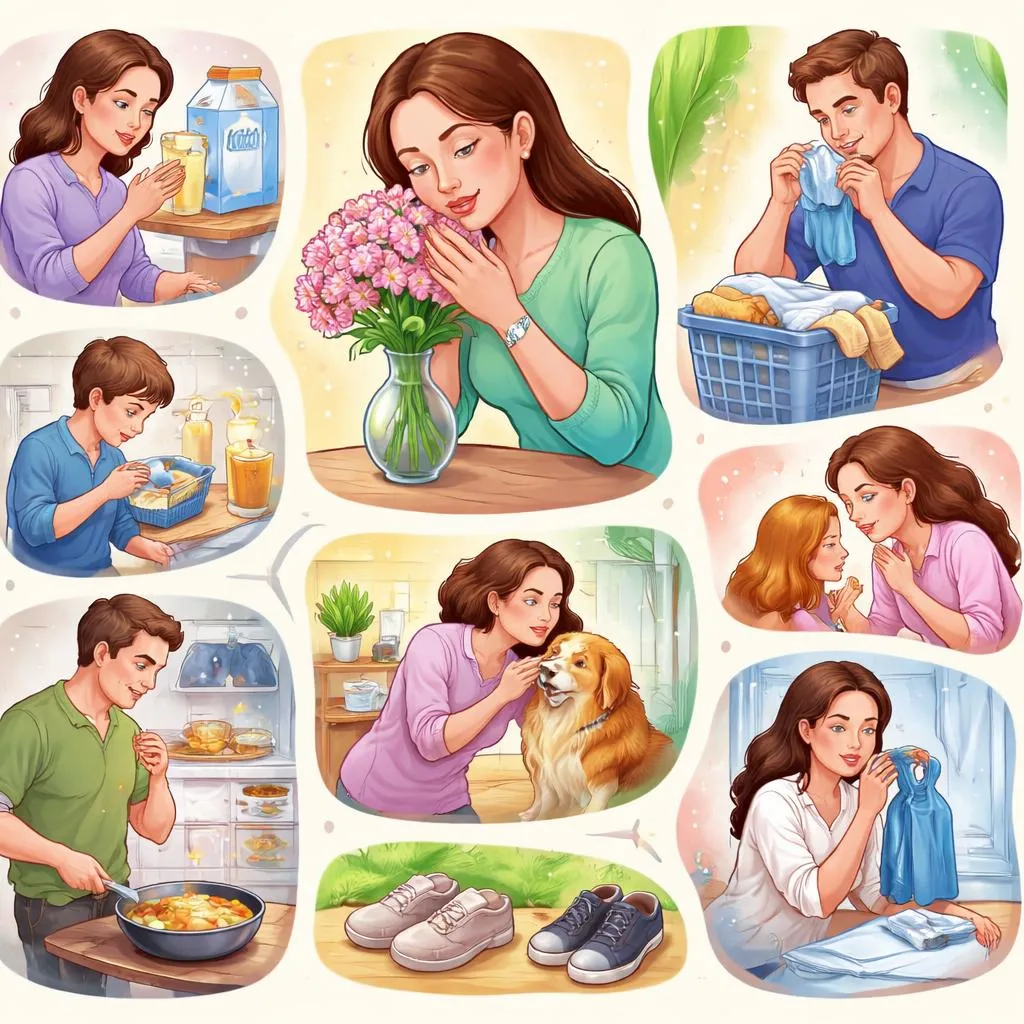
Last Saturday, Mia helped her mom bake cookies. She smelled the sweet vanilla. It made her mouth water. Later, Mia found a tiny flower. She sniffed it gently. Both used her nose. But one was slow and steady. The other was quick and sharp. Let’s learn the difference.
Word Breakdown
Core Principle
We reject boring dictionary definitions. We use pictures in your mind. We add functions and memory hooks. This helps you remember forever.
Smell To Do
Image: Imagine walking past a bakery. Warm bread scent reaches you. That is smell to do. It means noticing an odor in the air.
Function: It is for general sensing. Like smell cookies baking. Or smell fresh rain.
Sensory Description: You breathe in slowly. You notice a scent. Your nose tingles softly.
Memory Anchor: A bakery window with steam. See the aroma? That is smell to do.
Sniff To Do
Image: Think of a dog sniffing a new toy. Quick sniffs in and out. That is sniff to do. It means taking a fast, sharp breath through your nose.
Function: It is for investigating or clearing. Like sniff a flower. Or sniff when you have a cold.
Sensory Description: You hear a soft snuff. You feel air rush. Your nose twitches.
Memory Anchor: A puppy sniffing the ground. See the quick sniffs? That is sniff to do.
Advanced Comparison
Smell is passive and relaxed. Sniff is active and quick. Smell lets scent come to you. Sniff pulls scent in fast. Use smell for general odors. Use sniff for curious checks.
Scene Comparison
Scene One happens in the kitchen. Leo lifts the lid off soup. He smells the warm broth. He smiles at the aroma. This is smell to do—noticing a scent.
Scene Two takes place in the garden. Emma finds a bright flower. She sniffs it to check its fragrance. Her nose wrinkles slightly. This is sniff to do—a quick investigation.
Scene Three occurs during a cold. Ben feels stuffy. He sniffs hard to clear his nose. Air rushes in loudly. This is sniff to do—trying to breathe.
Pitfalls Deep Reminder
Mistake One is saying “I sniffed the cookies from across the room.” Why wrong? Cookies are smelled, not sniffed from afar. Sniffing is for close checks. Funny result? Friends imagine you inhaling cookies like a vacuum. Correct phrase is smell the cookies. Memory trick: Smell is for distant scents.
Mistake Two is saying “I smelled the flower up close.” Why wrong? Flowers are sniffed to check fragrance. Smelling is too passive. Funny result? You miss the scent entirely. Correct phrase is sniff the flower. Memory trick: Sniff is for close investigation.
Mistake Three is saying “I sniffed the fresh rain.” Why wrong? Rain is smelled in the air. Sniffing is too forceful. Funny result? You inhale bugs by accident. Correct phrase is smell the rain. Memory trick: Smell is for nature scents.
Mistake Four is saying “I smelled when I had a cold.” Why wrong? Colds require sniffing to clear. Smelling is ineffective. Funny result? You stay stuffy and miserable. Correct phrase is sniff to clear your nose. Memory trick: Sniff is for clearing.
Interactive Exercises
Choose the Right Phrase
Read each sentence. Pick smell or sniff.
I ___ the fresh bread at the store. (smell/sniff)
She ___ the flower curiously. (smell/sniff)
We ___ the soup to check spices. (smell/sniff)
He ___ hard to stop a sneeze. (smell/sniff)
They ___ the pine trees on the hike. (smell/sniff)
Mini Theater
Act with a friend. Use the phrases.
Scene A: Bakery Visit
A: Wow, what is that amazing scent?
B: I can ___ the cinnamon rolls.
Scene B: Curious Investigation
A: This herb is unusual. I will ___ it.
B: Careful, it might be strong.
Spot the Mistake
Which sentence sounds odd? Explain why.
Sentence: I sniffed the ocean breeze.
Reason: Breeze is smelled gently. Use smell instead.
Sentence: I smelled the perfume sample.
Reason: Perfume is sniffed up close. Use sniff instead.
Sentence: We sniffed the campfire smoke.
Reason: Smoke is smelled from afar. Use smell instead.
Create Sentences
Use both phrases.
Smell to do: I smell fresh grass after mowing.
Sniff to do: I sniff a new candle to test scent.
Bonus Challenge
You walk past a bakery. Do you smell or sniff the air? Answer: Smell. The scent comes to you.
Rhyme Time
Smell it soft, sniff it quick.
One lets scent drift, one gives a flick.
Gentle breeze? Choose smell.
Curious check? Sniff to tell.
Homework Task
Pick one activity. Complete it this week. Share with family.
Option One: Drawing Journal. Get a small notebook. Draw three pictures. Write a sentence under each.
Picture One: You smell something. Sentence: I smelled the roses in the garden.
Picture Two: You sniff something. Sentence: I sniffed the new markers.
Picture Three: You smell something else. Sentence: I smelled the soup cooking.
Show your journal to a parent. Explain the differences.
Option Two: Role Play. With a parent, act out moments. Use phrases correctly.
You: Mom, I can smell the cookies baking.
Parent: Good. They will be ready soon.
You: Dad, I need to sniff this spice.
Parent: Go ahead, but don’t sneeze.
Practice until it feels natural.
Option Three: Sharing Time. Tomorrow at school, tell a friend. Describe one smell and one sniff. Say: Yesterday I smelled fresh bread. I sniffed a lavender sachet. Ask your friend about theirs.
Life Practice
Week Challenge: Try one task. Complete within seven days. Share your success.
Task One: Observation Log. For three days, note smell and sniff moments. Draw icons.
Day One: Smell bread. Draw a bread loaf icon.
Day Two: Sniff flower. Draw a flower icon.
Day Three: Smell rain. Draw a raindrop icon.
Show your log to your teacher. Place it on the classroom wall.
Task Two: Action Demo. Use both phrases in real actions.
Step One: Walk past a bakery. Say: I smell the treats.
Step Two: Pick up a flower. Say: I sniff this gently.
Demonstrate to a sibling. Explain the difference.
Task Three: Social Mission. Use phrases with others.
Smell a friend’s new perfume. Say: I smell your lovely scent!
Sniff a classmate’s scratch-and-sniff sticker. Say: I sniffed your sticker!
Record a short voice message. Send it to your teacher.
Task Four: Creative Story. Write a short tale. Include both phrases.
Title: The Nose Detective.
Story: I smelled something sweet. Then I sniffed a mystery cookie. What a fun case!
Share your story in class.
Remember, practice makes perfect. Use these phrases often. Soon they will feel easy.