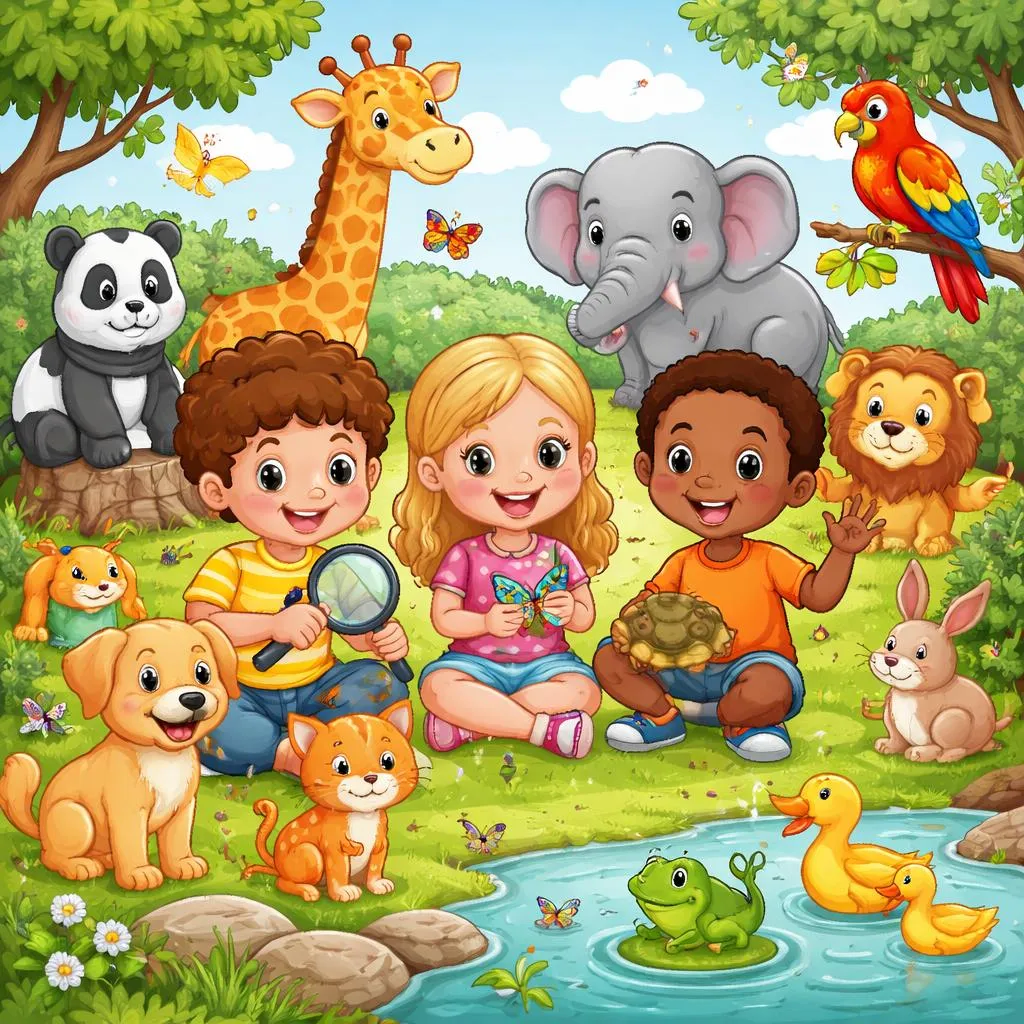

What is animals vocabulary?
Hello, animal adventurers. Today, we are going to build a very special collection. We are going to build our animals vocabulary. Vocabulary means all the words you know. So, animals vocabulary is all the wonderful words we use to talk about animals.
Learning animals vocabulary is like getting a key. This key unlocks the amazing world of nature. When you know the word "butterfly," you can point to it and name it. When you know the word "habitat," you can talk about where an animal lives. The more animal words you know, the better you can tell stories, ask questions, and share what you see. Let's start collecting these important words together.
Meaning and explanation
So, what do we mean by animals vocabulary. It is not just the names of animals. It is all the words connected to them. It is the words for their homes, their babies, their body parts, their sounds, and what they do.
Think about a dog. You know the word "dog." That is the animal's name. But what about the word "puppy"? That is the word for a baby dog. The word "bark" is the sound a dog makes. The word "fur" describes its hairy coat. The word "kennel" can be its home. All these words together are your animals vocabulary for dogs.
Building a big animals vocabulary helps you understand and describe the world. It makes you a better reader, a better storyteller, and a keen observer of the living world around you. Every new word is a new tool for your brain.
Categories or lists
Let's organize our animals vocabulary into helpful groups. This makes the words easier to learn and remember.
Group 1: Animal Names by Home. Where an animal lives is called its habitat. Here are animal names for different homes. Farm: cow, pig, sheep, goat, horse, chicken, duck, rooster.
Forest: bear, fox, owl, squirrel, deer, raccoon, wolf.
Ocean: fish, shark, whale, dolphin, octopus, jellyfish, crab.
Jungle: tiger, monkey, parrot, snake, frog, toucan, gorilla.
Group 2: Animal Types. Scientists group animals by their bodies. Here are the main group names. Mammals: Animals with fur or hair. Mothers feed their babies milk. Examples: human, dog, cat, elephant, bat.
Birds: Animals with feathers and wings. Most can fly. Examples: eagle, penguin, hummingbird, owl.
Fish: Animals that live in water. They have gills and fins. Examples: goldfish, shark, clownfish, seahorse.
Reptiles: Animals with dry, scaly skin. Examples: snake, lizard, turtle, crocodile.
Insects: Small animals with six legs. Examples: butterfly, ant, bee, ladybug, grasshopper.
Group 3: Special Animal Words. These are the cool describing words for animals vocabulary. Baby Animals: puppy (dog), kitten (cat), calf (cow), chick (chicken), cub (bear, lion), tadpole (frog).
Animal Sounds: A dog barks. A cat meows. A lion roars. A bird chirps. A cow moos. A duck quacks.
Animal Groups: A pack of wolves. A herd of elephants. A flock of birds. A school of fish. A pride of lions.
Daily life examples
You can practice your animals vocabulary every day. Here are three easy places to look and learn.
At Home with Pets or Books: If you have a pet, use your animals vocabulary. "My pet rabbit has soft fur. It lives in a hutch. It likes to hop." Look at picture books. Point and name the animals. "I see a green frog. It is an amphibian. The frog says 'ribbit.'" This daily practice at home builds strong word connections.
On a Walk in the Park or Neighborhood: Be a nature detective. What do you see. "I see a squirrel with a bushy tail. It is climbing a tree. I hear a bird chirping in the nest." Try to use specific words. Not just "bird," but maybe "a small brown sparrow." This turns a simple walk into a vocabulary adventure.
During a Visit to the Zoo or Farm: This is a perfect animals vocabulary field trip. Read the signs. They teach you new words like "savanna" for the lions or "nocturnal" for the owls. Watch the animals and describe their actions. "The penguin is waddling. The monkey is swinging. The giraffe is using its long neck to reach leaves." You will learn so many new words in one trip.
Printable flashcards
Printable flashcards are a super tool for building animals vocabulary. You can make different sets for different themes.
Make a "Habitats" set. One card has a picture of a forest. The word on the back is "Forest." Other cards in the set have forest animals like "Bear" and "Owl." This groups words together logically.
Make a "Baby Animals" matching set. One card shows a dog. Another card shows a puppy. The child matches the parent to the baby. Write the words "dog" and "puppy" on the cards. This teaches the specific vocabulary for young animals.
You can also make "Guess Who" cards. On the front, write three clues using animals vocabulary. "1. I have black and white stripes. 2. I live in Africa. 3. I am in the horse family." On the back, have the answer ("Zebra") and a picture. This game builds reading comprehension and vocabulary at the same time.
Learning activities or games
Let's play some active games to use our new animals vocabulary.
Play "Animal Sound Bingo." Make bingo cards with pictures of different animals. The caller does not say the animal's name. Instead, they make the animal's sound. "Oink!" The players must find the pig on their card and mark it. This links the vocabulary word directly to the sound.
Try the "Habitat Sort" game. Draw or print pictures of four habitats: Farm, Ocean, Forest, Jungle. Tape them to four different boxes or corners of the room. Then, take a big pile of toy animals or animal picture cards. The mission is to sort all the animals into their correct home. Does the shark go in the farm box. No. It belongs in the ocean. This hands-on sorting cements the vocabulary for where animals live.
Create an "Animal Charades" game. Write animal names on slips of paper. Players take turns picking a slip and acting out the animal without words. Can the others guess "elephant" from the trunk motion and big ears. Can they guess "butterfly" from the flapping arms. This game gets everyone moving, laughing, and using the animals vocabulary in a fun, memorable way.