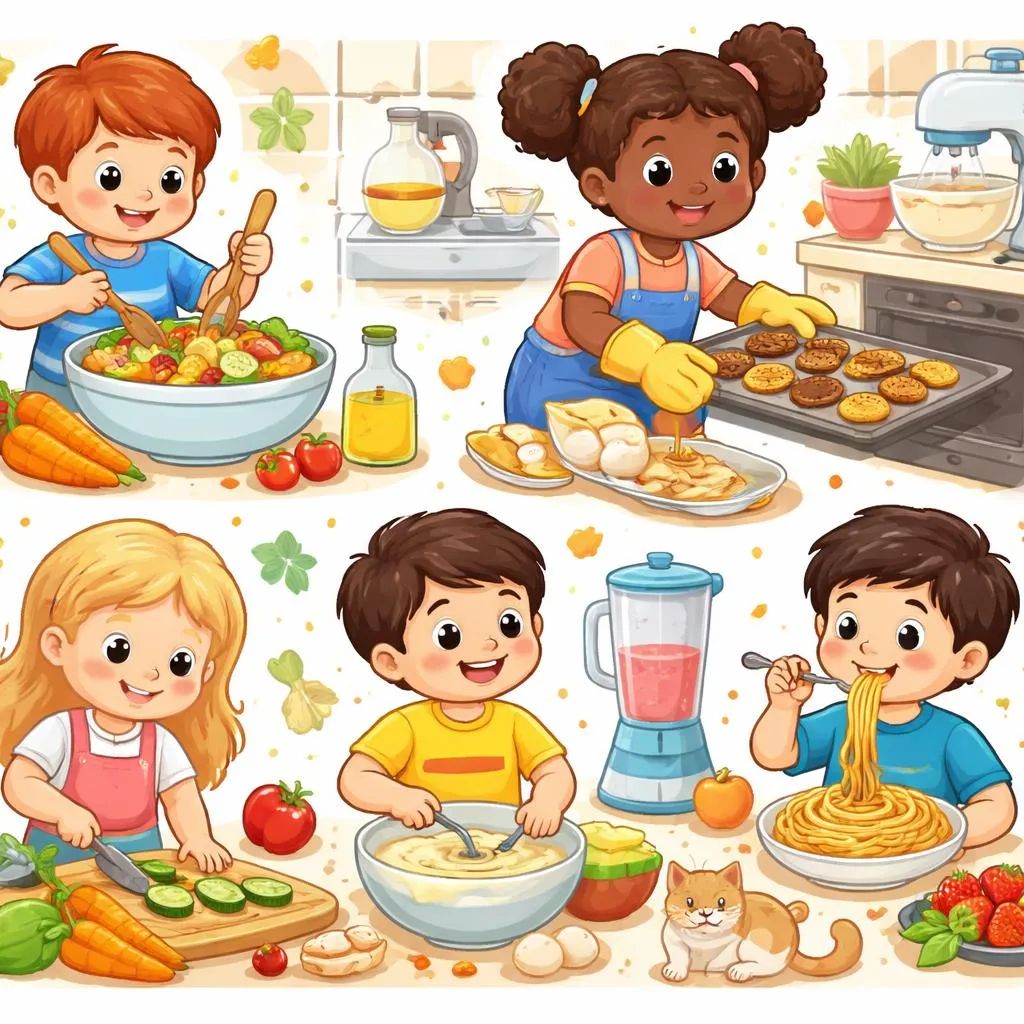

Hello, hungry learners and wonderful teachers! Today we explore the language of the kitchen. Food is part of everyday life. We talk about it at breakfast, lunch, and dinner. We describe how we prepare it. We explain how we eat it. We share recipes and favorites. All of this requires special words. We need verbs about food. These action words help children talk about cooking and eating. They build vocabulary for real-life situations. Let us discover these delicious verbs together. Let us learn how to use them in sentences. Get ready for some tasty language practice!
Meaning of Verbs About Food Verbs about food are action words that describe everything we do with food. Some verbs describe preparing food. Some describe cooking food. Some describe eating food. Each verb has a special meaning. Each one helps us be more precise.
Think about an apple. What can we do with it? We can wash it to make it clean. We can peel it to remove the skin. We can cut it into pieces. We can eat it when it is ready. Each of these is a different verb. Each shows a different action.
Learning these verbs helps children describe their world. They can tell you what they are doing in the kitchen. They can tell you how they like their food prepared. These verbs make language come alive. They connect words to real experiences.
Conjugation of Food Verbs Like all verbs, food verbs change form. They change to match the subject and the time. Let us look at a common food verb: "cook." This will show us how conjugation works.
For the present tense with I, you, we, they, we use cook. For he, she, it, we use cooks. For the past tense, we use cooked with all subjects. For the future, we use will cook with all subjects.
Let us see these forms in action.
Today: I cook dinner.
Today: She cooks dinner.
Yesterday: I cooked dinner.
Tomorrow: I will cook dinner.
Many food verbs are regular. They add -ed for the past tense. "Bake" becomes "baked." "Chop" becomes "chopped." "Fry" becomes "fried" (with a y change). Some are irregular, like "eat" becoming "ate." Learning both patterns helps children use these verbs correctly.
Present Tense of Food Verbs The present tense talks about now. We use it for actions happening at this moment. We also use it for habits and routines.
Let us look at some food verbs in the present tense.
I cook dinner every night.
You cut the vegetables very well.
We eat breakfast at 7 o'clock.
They bake cookies on Sundays.
For he, she, and it, we add -s or -es.
He fries an egg for breakfast.
She peels the potatoes carefully.
The recipe calls for two cups of flour.
We can describe what is happening right now using present continuous.
I am stirring the soup.
She is tasting the sauce.
They are setting the table.
These present tense forms help children talk about daily meals and current actions. They can describe their favorite foods and how they prepare them.
Past Tense of Food Verbs The past tense talks about finished actions. We use it for meals we already ate. We use it for cooking we already did.
Regular food verbs add -ed.
Yesterday, I cooked spaghetti.
We baked a cake for the party.
She chopped the onions finely.
They grilled hamburgers outside.
He fried the chicken for dinner.
Irregular food verbs change in special ways.
I ate pizza for dinner last night.
He drank all his milk.
We made cookies together.
She bought fresh bread at the store.
They had breakfast early.
Using past tense verbs allows children to share stories. They can tell you about a special meal. They can describe what they had for lunch. They can talk about a time they helped in the kitchen. These personal stories build language skills naturally.
Future Tense of Food Verbs The future tense talks about actions that have not happened yet. We use it for plans and predictions about food.
For all subjects, we use will plus the base verb.
I will cook dinner tonight.
You will love this soup.
He will bake bread tomorrow.
We will eat at a restaurant.
They will bring dessert.
We can also use "going to" for future plans.
I am going to make pancakes.
She is going to try the new recipe.
We are going to have a picnic.
These future forms help children talk about upcoming meals. They can discuss what they will eat for dinner. They can make plans for a party. They can predict what someone will like. This makes conversations richer and more varied.
Questions Using Food Verbs Asking questions about food is very common. We ask about preferences. We ask about meals. We ask about cooking.
For present tense questions, we use "do" or "does."
Do you like pizza?
Does she eat meat?
Do they cook dinner together?
For past tense questions, we use "did."
Did you enjoy the meal?
Did he bake this cake?
Did they have enough food?
For future questions, we use "will."
Will you make dessert?
Will she bring a salad?
Will we eat outside?
We also ask questions with question words.
What do you want to eat?
When will we have dinner?
How do you cook this vegetable?
Asking questions helps children get information. It helps them participate in conversations about food. It gives them confidence to express their needs and preferences.
Other Uses of Food Verbs Food verbs appear in many interesting places. We use them in idioms and expressions. These are phrases where the words mean something different from their usual meaning.
Consider the verb "eat." We have many expressions with it.
"I am so hungry I could eat a horse." This means very hungry.
"She had to eat her words." This means she had to admit she was wrong.
"What's eating him?" This means what is bothering him.
Consider the verb "cook."
"He is cooking up a plan." This means he is creating a plan.
"Things are really cooking now." This means things are going well.
Consider the verb "cut."
"Please cut it out." This means stop doing that.
"She is a cut above the rest." This means she is better than others.
Consider the verb "stir."
"Let's stir things up." This means cause excitement or trouble.
Learning these expressions adds color to language. It helps children understand native speakers better. It makes their own English more natural and interesting.
Learning Tips for Food Verbs Learning food verbs can be fun and natural. Here are some helpful tips.
First, cook together. The kitchen is a perfect classroom. While preparing a meal, talk about each action. "Now we wash the apple. Now we cut the apple. Now we eat the apple." This connects the word to the real action. It makes learning concrete and memorable.
Second, use picture books about food. Many children's books show cooking and eating. Point to the pictures and ask questions. "What is she doing? She is stirring the pot." This builds vocabulary in a natural context.
Third, practice with meals. During breakfast, lunch, and dinner, talk about the food. "We are eating cereal. You drank all your milk. I will cut your sandwich." This makes language part of daily routine.
Fourth, focus on a few verbs at a time. Start with basic ones like eat, drink, cook. Add more as children become comfortable. Bake, fry, boil, peel, chop. Building slowly prevents overwhelm.
Educational Games for Food Verbs Games make learning food verbs exciting and interactive.
Cooking Charades: Write food verbs on cards. Stir, chop, peel, bake, fry, taste, pour, mix. One child picks a card and acts out the action. Others guess the verb. "Are you stirring?" "Are you peeling?" This gets children moving and speaking.
Recipe Game: Find a simple recipe. Remove all the verbs. Read the recipe with blanks. Children must fill in the correct verb. "First, ______ the onions. Then, ______ them in oil. Finally, ______ the pasta." This practices verbs in a real context.
What Am I Doing?: Describe an action without saying the verb. "I am in the kitchen. I have a knife. I am making the carrot smaller. What am I doing?" The answer is "cutting." This builds listening and reasoning skills.
Restaurant Play: Set up a pretend restaurant. One child is the customer. One is the waiter. One is the chef. They must use food verbs in their conversation. "What would you like to eat?" "I will have the pasta." "The chef is cooking it now." This imaginative play uses language naturally and joyfully.
Food Verb Bingo: Create bingo cards with different food verbs. Bake, fry, boil, chop, peel, stir, pour, mix, taste, eat, drink. Call out sentences using the verbs. "The chef is making soup." Children cover "stir" or "cook." This builds listening and verb recognition.
Through these activities, verbs about food become familiar tools. Children use them confidently. They describe their world with precision. They share meals and memories in English. The language of food becomes a delicious part of their learning journey.