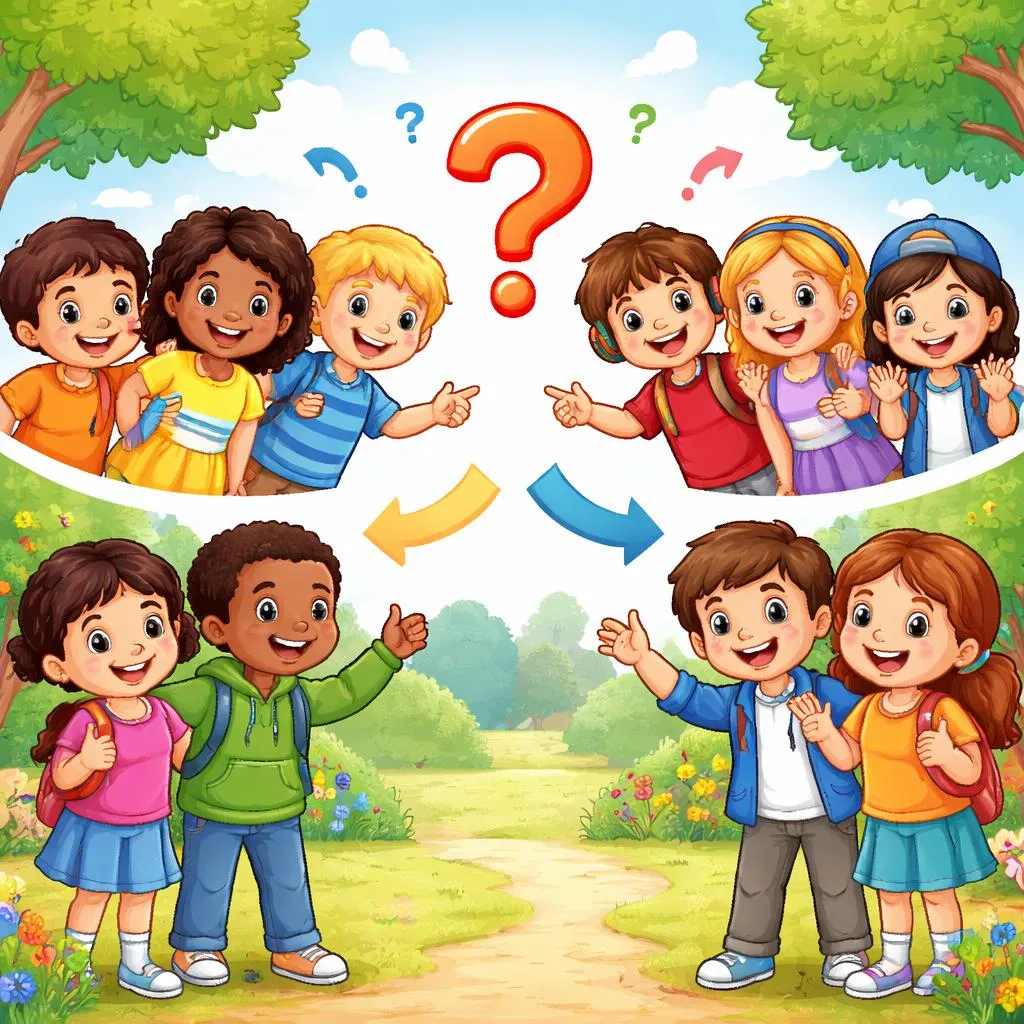

Hola, young language explorers. Are you ready for a adventure. Today, we are going to meet two very important word teams. Their names are "nosotros" and "vosotros." They sound a bit similar. But they are used for different groups of people. Do not worry. It is not hard. Think of it like choosing the right word for your team. Is it a "we" team or a "you all" team. Let us find out together. This will help you talk about groups in . Vamos. Let us go.
Meaning
First, what do these words mean. The word "nosotros" means "we" in English. It talks about a group that includes you. You are part of the "nosotros" group. For example, you and your friend are playing. You can say "nosotros jugamos." This means "we play." The word "vosotros" means "you all" in English. It talks about a group of people you are speaking to. You are not part of the "vosotros" group. You are talking to them. For example, you are talking to two friends. You can say "vosotros jugáis." This means "you all play." So, "nosotros" includes me. "Vosotros" does not include me. I am talking to you.
Conjugation
This is a big word. Conjugation. It means changing the verb. The verb is the action word. It changes to match the subject. The subject is "nosotros" or "vosotros." In , verbs have special endings. For "nosotros," the ending is often "-amos" or "-emos" or "-imos." Let us use the verb "comer." It means "to eat." For "nosotros," we say "nosotros comemos." This means "we eat." For "vosotros," the ending is often "-áis" or "-éis" or "-ís." For the same verb "comer," we say "vosotros coméis." This means "you all eat." See the pattern. The verb changes its tail to fit the subject.
Present tense
We use these words to talk about now. This is the present tense. Let us look at examples. For "nosotros," we talk about what our group does now. "Nosotros cantamos." We sing. "Nosotros leemos." We read. "Nosotros corremos." We run. For "vosotros," we talk about what the other group does now. "Vosotros cantáis." You all sing. "Vosotros leéis." You all read. "Vosotros corréis." You all run. Practice saying these. Feel the different endings. The "amos" sound for us. The "áis" sound for you all.
Past tense
We can also talk about yesterday. This is the past tense. It tells about actions that are finished. For "nosotros," we add a different ending. Let us use the verb "hablar." It means "to talk." In a simple past, we say "nosotros hablamos." This can mean "we talked." For "vosotros," we say "vosotros hablasteis." This means "you all talked." Another example. "Nosotros comimos." We ate. "Vosotros comisteis." You all ate. The endings are different. "imos" for us. "isteis" for you all. Past tense has its own set of rules. But the idea is the same. The verb changes for "nosotros" and "vosotros."
Future tense
We can dream about tomorrow. This is the future tense. We talk about what will happen. In , we can use the word "vamos a" for near future. For "nosotros," we say "nosotros vamos a jugar." We are going to play. For "vosotros," we say "vosotros vais a jugar." You all are going to play. For the simple future, we add endings to the whole verb. For "jugar" (to play), it becomes "nosotros jugaremos." We will play. "Vosotros jugaréis." You all will play. The future is full of possibilities. And our words "nosotros" and "vosotros" are ready for it.
Questions
We can ask questions using these words. It is easy. You just change your voice tone. Or you switch the word order. For example, to ask "Do we eat?" you can say "¿Nosotros comemos?" To ask "Do you all eat?" you say "¿Vosotros coméis?" You can also ask "What do we do?" "¿Qué hacemos nosotros?" "What do you all do?" "¿Qué hacéis vosotros?" Questions are fun. They start conversations. Just remember who is in the group. Are you asking about your own group? Use "nosotros." Are you asking the people in front of you? Use "vosotros."
Other uses
These words are not just for verbs. They can be used in other ways. They can come after a preposition. For example, "con nosotros" means "with us." "Para vosotros" means "for you all." They can also be used for emphasis. You might say "Nosotros sí queremos." We do want to. This stresses that it is your group. "Vosotros no sabéis." You all do not know. This stresses the other group. Also, remember the feminine forms. If the group is all girls, we use "nosotras" and "vosotras." "Nosotras cantamos." We (girls) sing. "Vosotras cantáis." You all (girls) sing. This is an important detail in .
Learning tips
How can you remember the difference between nosotros and vosotros. Here are some tips. First, use a memory trick. Think of the "no" in "nosotros." It reminds you that it includes "yo" which means "I." The "I" is in the "we." Think of the "vo" in "vosotros." It sounds like "you" in a way. It is the group you are talking TO. Second, practice with a friend. Stand face to face. Point to yourself and your friend. Say "nosotros." Then point just to your friend. Say "vosotros." Do this many times.
Third, listen to songs for kids. Many songs use these words. Sing along. Your ear will learn the sound. Fourth, make simple flashcards. On one card, write "NOSOTROS = WE (includes me)". On the other, write "VOSOTROS = YOU ALL (not me)". Draw a picture. For nosotros, draw a circle with you and two friends inside. For vosotros, draw you outside a circle, talking to friends inside. Look at these cards every day. Soon, it will feel natural.
Educational games
Let us play games to learn nosotros vs vosotros. Game one is "The Group Switch." Gather a few friends. One person is the caller. The caller gives a command using a verb. For example, "¡Corred!" (Run!). If the caller says "nosotros," everyone runs together. If the caller says "vosotros," only the other kids run. The caller does not run. This is a lively game. It teaches the meaning through action. Game two is "Sentence Builder." Have verb cards and subject cards. Subject cards say "nosotros" and "vosotros." Verb cards say "comer," "saltar," "dormir." Pick one of each. Make a sentence. Say it out loud. "Nosotros comemos." "Vosotros saltáis."
Game three is "Two Circles." Use hula hoops or draw circles. Label one circle "nosotros." Label the other "vosotros." The teacher says a sentence. "We are happy." The kids must jump into the "nosotros" circle. The teacher says "You all are tall." The kids jump into the "vosotros" circle. Whoever jumps into the wrong circle sits down. It is fast and fun. Game four is "Create a Dialog." With a partner, write a short conversation. Use "nosotros" and "vosotros" at least two times each. Then act it out. For example: "Hola. ¿Vosotros queréis jugar fútbol?" "Sí. ¿Nosotros jugamos ahora?" This puts the words into a real talk. Play these games often. You will be a master of nosotros and vosotros.