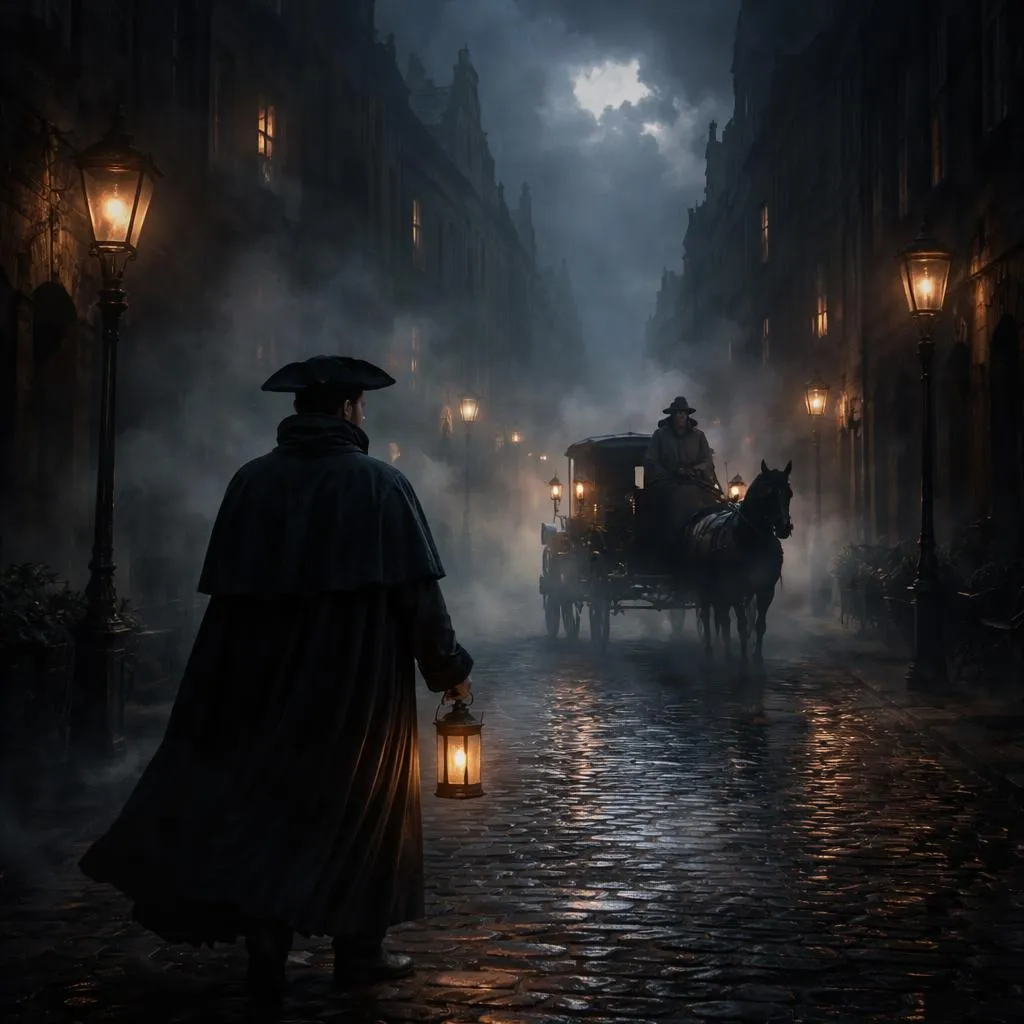

A Wonderful fact to reflect upon, that every human creature is constituted to be that profound secret and mystery to every other. A solemn consideration, when I enter a great city by night, that every one of those darkly clustered houses encloses its own secret; that every room in every one of them encloses its own secret; that every beating heart in the hundreds of thousands of breasts there, is, in some of its imaginings, a secret to the heart nearest it! Something of the awfulness, even of Death itself, is referable to this. No more can I turn the leaves of this dear book that I loved, and vainly hope in time to read it all. No more can I look into the depths of this unfathomable water, wherein, as momentary lights glanced into it, I have had glimpses of buried treasure and other things submerged. It was appointed that the book should shut with a a spring, for ever and for ever, when I had read but a page. It was appointed that the water should be locked in an eternal frost, when the light was playing on its surface, and I stood in ignorance on the shore. My friend is dead, my neighbour is dead, my love, the darling of my soul, is dead; it is the inexorable consolidation and perpetuation of the secret that was always in that individuality, and which I shall carry in mine to my life’s end. In any of the burial-places of this city through which I pass, is there a sleeper more inscrutable than its busy inhabitants are, in their innermost personality, to me, or than I am to them?
As to this, his natural and not to be alienated inheritance, the messenger on horseback had exactly the same possessions as the King, the first Minister of State, or the richest merchant in London. So with the three passengers shut up in the narrow compass of one lumbering old mail coach; they were mysteries to one another, as complete as if each had been in his own coach and six, or his own coach and sixty, with the breadth of a county between him and the next.
The messenger rode back at an easy trot, stopping pretty often at ale-houses by the way to drink, but evincing a tendency to keep his own counsel, and to keep his hat cocked over his eyes. He had eyes that assorted very well with that decoration, being of a surface black, with no depth in the colour or form, and much too near together—as if they were afraid of being found out in something, singly, if they kept too far apart. They had a sinister expression, under an old cocked-hat like a three-cornered spittoon, and over a great muffler for the chin and throat, which descended nearly to the wearer’s knees. When he stopped for drink, he moved this muffler with his left hand, only while he poured his liquor in with his right; as soon as that was done, he muffled again.
“No, Jerry, no!” said the messenger, harping on one theme as he rode. “It wouldn’t do for you, Jerry. Jerry, you honest tradesman, it wouldn’t suit YOUR line of business! Recalled—! Bust me if I don’t think he’d been a drinking!”
His message perplexed his mind to that degree that he was fain, several times, to take off his hat to scratch his head. Except on the crown, which was raggedly bald, he had stiff, black hair, standing jaggedly all over it, and growing down hill almost to his broad, blunt nose. It was so like Smith’s work, so much more like the top of a strongly spiked wall than a head of hair, that the best of players at leap-frog might have declined him, as the most dangerous man in the world to go over.
While he trotted back with the message he was to deliver to the night watchman in his box at the door of Tellson’s Bank, by Temple Bar, who was to deliver it to greater authorities within, the shadows of the night took such shapes to him as arose out of the message, and took such shapes to the mare as arose out of HER private topics of uneasiness. They seemed to be numerous, for she shied at every shadow on the road.
What time, the mail-coach lumbered, jolted, rattled, and bumped upon its tedious way, with its three fellow-inscrutables inside. To whom, likewise, the shadows of the night revealed themselves, in the forms their dozing eyes and wandering thoughts suggested.
Tellson’s Bank had a run upon it in the mail. As the bank passenger— with an arm drawn through the leathern strap, which did what lay in it to keep him from pounding against the next passenger, and driving him into his corner, whenever the coach got a special jolt—nodded in his place, with half-shut eyes, the little coach-windows, and the coach-lamp dimly gleaming through them, and the bulky bundle of opposite passenger, became the bank, and did a great stroke of business. The rattle of the harness was the chink of money, and more drafts were honoured in five minutes than even Tellson’s, with all its foreign and home connection, ever paid in thrice the time. Then the strong-rooms underground, at Tellson’s, with such of their valuable stores and secrets as were known to the passenger (and it was not a little that he knew about them), opened before him, and he went in among them with the great keys and the feebly-burning candle, and found them safe, and strong, and sound, and still, just as he had last seen them.
But, though the bank was almost always with him, and though the coach (in a confused way, like the presence of pain under an opiate) was always with him, there was another current of impression that never ceased to run, all through the night. He was on his way to dig some one out of a grave.
Now, which of the multitude of faces that showed themselves before him was the true face of the buried person, the shadows of the night did not indicate; but they were all the faces of a man of five-and- forty by years, and they differed principally in the passions they expressed, and in the ghastliness of their worn and wasted state. Pride, contempt, defiance, stubbornness, submission, lamentation, succeeded one another; so did varieties of sunken cheek, cadaverous colour, emaciated hands and figures. But the face was in the main one face, and every head was prematurely white. A hundred times the dozing passenger inquired of this spectre:
“Buried how long?”
The answer was always the same: “Almost eighteen years.”
“You had abandoned all hope of being dug out?”
“Long ago.”
“You know that you are recalled to life?”
“They tell me so.”
“I hope you care to live?”
“I can’t say.”
“Shall I show her to you? Will you come and see her?”
The answers to this question were various and contradictory. Sometimes the broken reply was, “Wait! It would kill me if I saw her too soon.” Sometimes, it was given in a tender rain of tears, and then it was, “Take me to her.” Sometimes it was staring and bewildered, and then it was, “I don’t know her. I don’t understand.”
After such imaginary discourse, the passenger in his fancy would dig, and dig, dig—now with a spade, now with a great key, now with his hands—to dig this wretched creature out. Got out at last, with earth hanging about his face and hair, he would suddenly fan away to dust. The passenger would then start to himself, and lower the window, to get the reality of mist and rain on his cheek.
Yet even when his eyes were opened on the mist and rain, on the moving patch of light from the lamps, and the hedge at the roadside retreating by jerks, the night shadows outside the coach would fall into the train of the night shadows within. The real Banking-house by Temple Bar, the real business of the past day, the real strong rooms, the real express sent after him, and the real message returned, would all be there. Out of the midst of them, the ghostly face would rise, and he would accost it again.
“Buried how long?”
“Almost eighteen years.”
“I hope you care to live?”
“I can’t say.”
Dig—dig—dig—until an impatient movement from one of the two passengers would admonish him to pull up the window, draw his arm securely through the leathern strap, and speculate upon the two slumbering forms, until his mind lost its hold of them, and they again slid away into the bank and the grave.
“Buried how long?”
“Almost eighteen years.”
“You had abandoned all hope of being dug out?”
“Long ago.”
The words were still in his hearing as just spoken—distinctly in his hearing as ever spoken words had been in his life—when the weary passenger started to the consciousness of daylight, and found that the shadows of the night were gone.
He lowered the window, and looked out at the rising sun. There was a ridge of ploughed land, with a plough upon it where it had been left last night when the horses were unyoked; beyond, a quiet coppice-wood, in which many leaves of burning red and golden yellow still remained upon the trees. Though the earth was cold and wet, the sky was clear, and the sun rose bright, placid, and beautiful.
“Eighteen years!” said the passenger, looking at the sun. “Gracious Creator of day! To be buried alive for eighteen years!”
背景介绍和作者介绍
这段文字出自查尔斯·狄更斯的小说《双城记》,该书于1859年首次出版。狄更斯是维多利亚时代最著名的英国作家之一,以其生动的人物、社会批判和错综复杂的叙事而闻名。《双城记》的背景设定在法国大革命的动荡时期,探讨了复活、牺牲和人性的二元性等主题。小说对比了伦敦和巴黎的生活,揭示了隐藏在社会表象下的挣扎和秘密。
详细解读和意义
这段摘录反映了每个人身上蕴含的深刻的神秘感——每个人对他人来说都是一个秘密,即使是对他们最亲近的人来说也是如此。叙述者思考着人生的孤独和不可捉摸,将人比作上了锁的书或隐藏着宝藏和秘密的深水。信使、邮车和银行乘客的意象都象征着繁华都市中隐藏的神秘和隐秘的生活。
“活埋”十八年的反复出现的主题,隐喻着情感或精神上的囚禁——一种绝望、孤立或失去希望的状态。乘客与幽灵般的形象之间的梦幻般的对话,代表着对过去遗憾和复活或更新的希望的内心挣扎。这与小说更广泛的救赎和转变主题相一致。
给学生的启示和见解
-
理解人类的复杂性: 这段话告诉学生,每个人都有一个独特的内心世界,可能不为他人所见。它鼓励在人际关系中保持同情和耐心,提醒我们无法完全了解他人的挣扎或感受。
-
希望和复活的力量: 经过多年后“重返人间”的想法象征着希望和改变的可能性,无论一个人在绝望或困境中挣扎了多久。学生可以学会永不放弃自己或他人。
-
对死亡和生命的思考: 对死亡和生命之谜的思考,邀请年轻读者深入思考他们自己的存在和生命的价值,鼓励正念和对现在的欣赏。
-
秘密和隐私的重要性: 认识到每个人都有秘密,可以培养对个人界限的尊重,并鼓励深思熟虑的沟通。
在日常生活中应用这些启示
-
在学校: 学生可以通过理解同学可能面临的看不见的挑战来练习同情心。这可以促进善良,减少欺凌。
-
在社交场合: 尊重他人的隐私,并在人们分享他们的感受时保持耐心,有助于建立更牢固的友谊。
-
在个人成长中: 接受复活的想法,鼓励学生将失败或挫折视为新的开始的机会。
从故事中培养积极的特质
-
好奇心和反思: 就像叙述者思考生命的奥秘一样,学生应该培养对人和周围世界的好奇心,并辅以反思性思考。
-
韧性: “从坟墓中挖出来”的主题,隐喻地教导韧性——在困难之后再次站起来的力量。
-
同情心: 了解每个人都背负着隐藏的挣扎,鼓励同情和支持行为。
结论
《双城记》的这段摘录为年轻读者提供了丰富的材料,让他们探索人性、希望的重要性以及同情心的价值。通过思考这些主题,学生可以培养更深的情商和对生活的更富有同情心的看法,这将使他们在学习、友谊和未来的挑战中受益。
