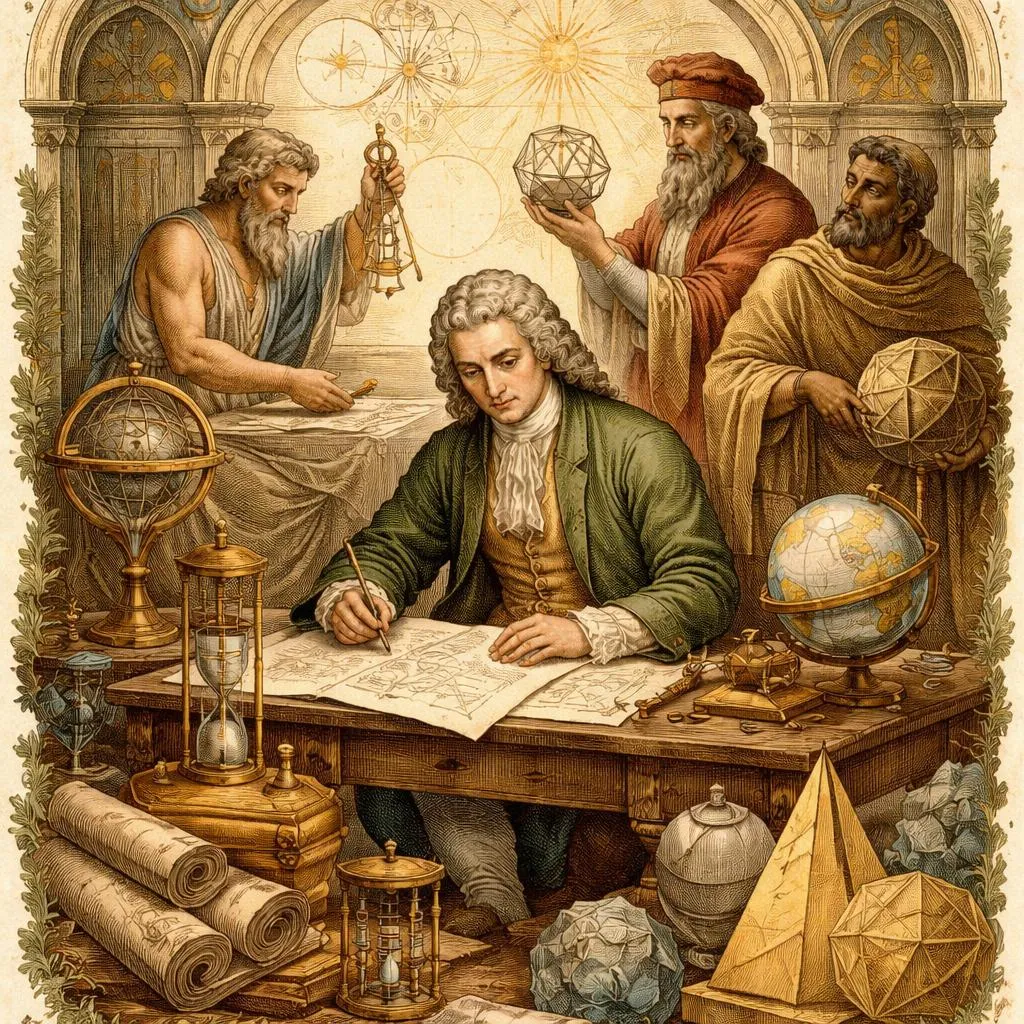

Brook Taylor, born at Edmonton on August 18, 1685, and died in London on December 29, 1731, was educated at St. John's College, Cambridge, and was among the most enthusiastic of Newton's admirers. From the year 1712 onwards he wrote numerous papers in the Philosophical Transactions , in which, among other things, he discussed the motion of projectiles, the centre of oscillation, and the forms taken by liquids when raised by capillarity. In 1719 he resigned the secretaryship of the Royal Society and abandoned the study of mathematics. His earliest work, and that by which he is generally known, is his Methodus Incrementorum Directa et Inversa , published in London in 1715. This contains [prop. 7] a proof of the well-known theorem
f ( x + h ) = f ( x ) + hf′ ( x ) + h 2 /2! f ″( x ) + ... ,
by which a function of a single variable can be expanded in powers of it. He does not consider the convergency of the series, and the proof which involves numerous assumptions is not worth reproducing. The work also includes several theorems on interpolation. Taylor was the earliest writer to deal with theorems on the change of the independent variable; he was perhaps the first to realize the possibility of a calculus of operation, and just as he denotes the n th differential coefficient of y by y n so he uses y -1 to represent the integral of y ; lastly, he is usually recognized as the creator of the theory of finite differences.
The applications of the calculus to various questions given in the Methodus have hardly received that attention they deserve. The most important of them is the theory of the transverse vibrations of strings, a problem which had baffled previous investigators. In this investigation Taylor shews that the number of half-vibrations executed in a second is
where L is the length of the string, N its weight, P the weight which stretches it, and D the length of a seconds pendulum. This is correct, but in arriving at it he assumes that every point of the string will pass through its position of equilibrium at the same instant, a restriction which D'Alembert subsequently shewed to be unnecessary. Taylor also found the form which the string assumes at any instant.
The Methodus also contains the earliest determination of the differential equation of the path of a ray of light when traversing a heterogeneous medium; and, assuming that the density of the air depends only in its distance from the earth's surface, Taylor obtained by means of quadratures the approximate form of the curve. The form of the catenary and the determination of the centres of oscillation and percussion are also discussed.
A treatise on perspective by Taylor, published in 1719, contains the earliest general enunciation of the principle of vanishing points; though the idea of vanishing points for horizontal and parallel lines in a picture hung in a vertical plane had been enunciated by Guido Ubaldi in his Perspectivae Libri , Pisa, 1600, and by Stevinus in his Sciagraphia , Leyden, 1608.
介绍布鲁克·泰勒及其作品
布鲁克·泰勒是一位杰出的数学家,于1685年出生于英国埃德蒙顿。 他曾在剑桥大学学习,并且是艾萨克·牛顿爵士的仰慕者,牛顿是历史上最著名的科学家之一。 泰勒对数学做出了重要贡献,尤其是在微积分领域,微积分是研究变化和运动的数学分支。 他最著名的著作《Methodus Incrementorum Directa et Inversa》(1715年)介绍了我们现在称之为泰勒级数的内容——一种将函数表示为由函数的导数计算出的无穷项之和的方法。
泰勒作品的背景和创作
在18世纪初期,数学发展迅速。 科学家和数学家渴望通过精确的计算和公式来了解自然世界。 泰勒的作品出现在微积分仍然是新事物,并由牛顿和莱布尼茨等伟人发展的时候。 泰勒通过形式化思想做出了贡献,帮助数学家和科学家解决了涉及运动、光和振动的复杂问题。
理解泰勒的贡献
泰勒定理允许我们用更简单的多项式表达式来逼近复杂的函数。 这在物理学、工程学和计算机科学中非常有用,因为它使计算更容易、更易于管理。 例如,在研究乐器琴弦的振动或光线穿过不同材料的路径时,泰勒的公式有助于准确预测行为。
他还研究了有限差分理论,这是一种用于研究序列和函数变化的 方法,为当今计算机中使用的数值分析奠定了基础。
泰勒发现的意义
泰勒的重要成就之一是分析了琴弦的振动,这有助于解释乐器如何产生声音。 他表明振动的频率取决于琴弦的长度、重量和张力。 这种理解是声学和乐器设计的基础。
泰勒还探索了光线如何穿过不同密度的空气,为光学(光的研究)做出了贡献。 他在艺术透视方面的研究介绍了消失点的原理,艺术家用它在平面上创建逼真的三维图像。
给学生的经验教训和启发
学习泰勒的生平和作品教会了我们几个宝贵的经验教训:
- 好奇心和毅力: 泰勒致力于理解复杂问题的奉献精神表明了在学习中保持好奇心和坚持不懈的重要性。
- 跨学科思维: 他的作品结合了数学、物理学,甚至艺术,展示了在一个领域的知识如何增强对另一个领域的理解。
- 现代科学的基础: 泰勒的发现是许多现代技术的基础,提醒我们基础知识对创新至关重要。
学生如何应用这些经验教训
- 在学习中: 面对困难的科目时,学生应该记住泰勒的例子,并不断探索不同的方法,直到找到解决方案。
- 在解决问题中: 使用泰勒级数等逐步方法可以帮助将复杂的问题分解成可管理的部分。
- 在创造力中: 理解透视等原理可以提高艺术技能,而数学思维可以增强逻辑推理能力。
培养积极的态度和技能
泰勒的生活鼓励学生培养:
- 分析性思维: 逻辑地、仔细地分解问题。
- 开放的心态: 愿意探索新想法并挑战假设。
- 注重细节: 精确性在数学和日常任务中都很重要。
结论
布鲁克·泰勒的贡献超越了数学;它们激发了一种探索、创造力和韧性的心态。 通过学习他的作品,学生不仅获得知识,还获得宝贵的技能和态度,这些技能和态度可以帮助他们在学校、社交生活和未来的职业生涯中取得成功。 拥抱发现的精神和学习的乐趣可以带来伟大的成就,就像泰勒一样。
