
“Well, how do you like them?” said Marilla.
Anne was standing in the gable room, looking solemnly at three new dresses spread out on the bed. One was of snuffy colored gingham which Marilla had been tempted to buy from a peddler the preceding summer because it looked so serviceable; one was of black-and-white checkered sateen which she had picked up at a bargain counter in the winter; and one was a stiff print of an ugly blue shade which she had purchased that week at a Carmody store.
She had made them up herself, and they were all made alike—plain skirts fulled tightly to plain waists, with sleeves as plain as waist and skirt and tight as sleeves could be.
“I’ll imagine that I like them,” said Anne soberly.
“I don’t want you to imagine it,” said Marilla, offended. “Oh, I can see you don’t like the dresses! What is the matter with them? Aren’t they neat and clean and new?”
“Yes.”
“Then why don’t you like them?”
“They’re—they’re not—pretty,” said Anne reluctantly.
“Pretty!” Marilla sniffed. “I didn’t trouble my head about getting pretty dresses for you. I don’t believe in pampering vanity, Anne, I’ll tell you that right off. Those dresses are good, sensible, serviceable dresses, without any frills or furbelows about them, and they’re all you’ll get this summer. The brown gingham and the blue print will do you for school when you begin to go. The sateen is for church and Sunday school. I’ll expect you to keep them neat and clean and not to tear them. I should think you’d be grateful to get most anything after those skimpy wincey things you’ve been wearing.”
“Oh, I AM grateful,” protested Anne. “But I’d be ever so much gratefuller if—if you’d made just one of them with puffed sleeves. Puffed sleeves are so fashionable now. It would give me such a thrill, Marilla, just to wear a dress with puffed sleeves.”
“Well, you’ll have to do without your thrill. I hadn’t any material to waste on puffed sleeves. I think they are ridiculous-looking things anyhow. I prefer the plain, sensible ones.”
“But I’d rather look ridiculous when everybody else does than plain and sensible all by myself,” persisted Anne mournfully.
“Trust you for that! Well, hang those dresses carefully up in your closet, and then sit down and learn the Sunday school lesson. I got a quarterly from Mr. Bell for you and you’ll go to Sunday school tomorrow,” said Marilla, disappearing downstairs in high dudgeon.
Anne clasped her hands and looked at the dresses.
“I did hope there would be a white one with puffed sleeves,” she whispered disconsolately. “I prayed for one, but I didn’t much expect it on that account. I didn’t suppose God would have time to bother about a little orphan girl’s dress. I knew I’d just have to depend on Marilla for it. Well, fortunately I can imagine that one of them is of snow-white muslin with lovely lace frills and three-puffed sleeves.”
The next morning warnings of a sick headache prevented Marilla from going to Sunday-school with Anne.
“You’ll have to go down and call for Mrs. Lynde, Anne.” she said. “She’ll see that you get into the right class. Now, mind you behave yourself properly. Stay to preaching afterwards and ask Mrs. Lynde to show you our pew. Here’s a cent for collection. Don’t stare at people and don’t fidget. I shall expect you to tell me the text when you come home.”
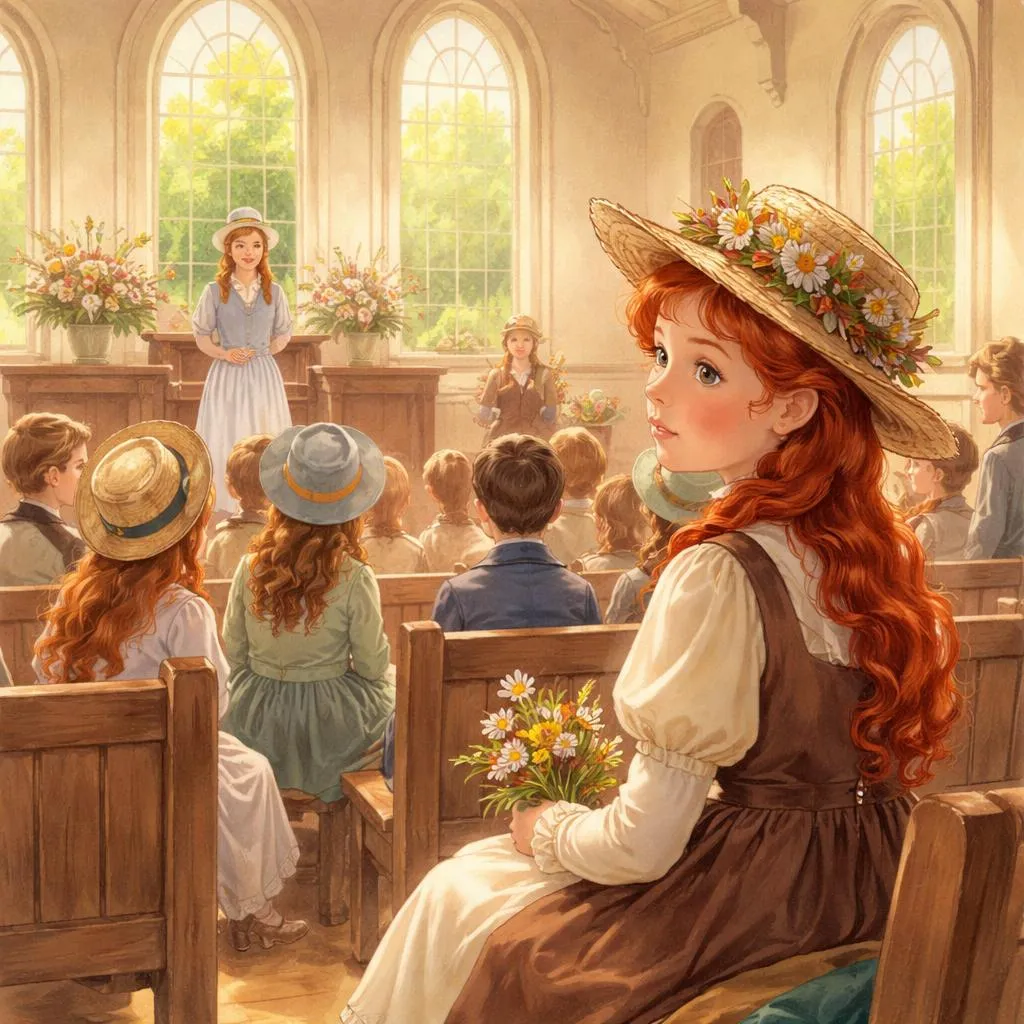
Anne started off irreproachable, arrayed in the stiff black-and-white sateen, which, while decent as regards length and certainly not open to the charge of skimpiness, contrived to emphasize every corner and angle of her thin figure. Her hat was a little, flat, glossy, new sailor, the extreme plainness of which had likewise much disappointed Anne, who had permitted herself secret visions of ribbon and flowers. The latter, however, were supplied before Anne reached the main road, for being confronted halfway down the lane with a golden frenzy of wind-stirred buttercups and a glory of wild roses, Anne promptly and liberally garlanded her hat with a heavy wreath of them. Whatever other people might have thought of the result it satisfied Anne, and she tripped gaily down the road, holding her ruddy head with its decoration of pink and yellow very proudly.
When she had reached Mrs. Lynde’s house she found that lady gone. Nothing daunted, Anne proceeded onward to the church alone. In the porch she found a crowd of little girls, all more or less gaily attired in whites and blues and pinks, and all staring with curious eyes at this stranger in their midst, with her extraordinary head adornment. Avonlea little girls had already heard queer stories about Anne. Mrs. Lynde said she had an awful temper; Jerry Buote, the hired boy at Green Gables, said she talked all the time to herself or to the trees and flowers like a crazy girl. They looked at her and whispered to each other behind their quarterlies. Nobody made any friendly advances, then or later on when the opening exercises were over and Anne found herself in Miss Rogerson’s class.
Miss Rogerson was a middle-aged lady who had taught a Sunday-school class for twenty years. Her method of teaching was to ask the printed questions from the quarterly and look sternly over its edge at the particular little girl she thought ought to answer the question. She looked very often at Anne, and Anne, thanks to Marilla’s drilling, answered promptly; but it may be questioned if she understood very much about either question or answer.
She did not think she liked Miss Rogerson, and she felt very miserable; every other little girl in the class had puffed sleeves. Anne felt that life was really not worth living without puffed sleeves.
“Well, how did you like Sunday school?” Marilla wanted to know when Anne came home. Her wreath having faded, Anne had discarded it in the lane, so Marilla was spared the knowledge of that for a time.
“I didn’t like it a bit. It was horrid.”
“Anne Shirley!” said Marilla rebukingly.
Anne sat down on the rocker with a long sigh, kissed one of Bonny’s leaves, and waved her hand to a blossoming fuchsia.
“They might have been lonesome while I was away,” she explained. “And now about the Sunday school. I behaved well, just as you told me. Mrs. Lynde was gone, but I went right on myself. I went into the church, with a lot of other little girls, and I sat in the corner of a pew by the window while the opening exercises went on. Mr. Bell made an awfully long prayer. I would have been dreadfully tired before he got through if I hadn’t been sitting by that window. But it looked right out on the Lake of Shining Waters, so I just gazed at that and imagined all sorts of splendid things.”
“You shouldn’t have done anything of the sort. You should have listened to Mr. Bell.”
“But he wasn’t talking to me,” protested Anne. “He was talking to God and he didn’t seem to be very much inter-ested in it, either. I think he thought God was too far off though. There was a long row of white birches hanging over the lake and the sunshine fell down through them, ‘way, ‘way down, deep into the water. Oh, Marilla, it was like a beautiful dream! It gave me a thrill and I just said, ‘Thank you for it, God,’ two or three times.”
“Not out loud, I hope,” said Marilla anxiously.
“Oh, no, just under my breath. Well, Mr. Bell did get through at last and they told me to go into the classroom with Miss Rogerson’s class. There were nine other girls in it. They all had puffed sleeves. I tried to imagine mine were puffed, too, but I couldn’t. Why couldn’t I? It was as easy as could be to imagine they were puffed when I was alone in the east gable, but it was awfully hard there among the others who had really truly puffs.”
“You shouldn’t have been thinking about your sleeves in Sunday school. You should have been attending to the lesson. I hope you knew it.”
“Oh, yes; and I answered a lot of questions. Miss Rogerson asked ever so many. I don’t think it was fair for her to do all the asking. There were lots I wanted to ask her, but I didn’t like to because I didn’t think she was a kindred spirit. Then all the other little girls recited a paraphrase. She asked me if I knew any. I told her I didn’t, but I could recite, ‘The Dog at His Master’s Grave’ if she liked. That’s in the Third Royal Reader. It isn’t a really truly religious piece of poetry, but it’s so sad and melancholy that it might as well be. She said it wouldn’t do and she told me to learn the nineteenth paraphrase for next Sunday. I read it over in church afterwards and it’s splendid. There are two lines in particular that just thrill me.
"'Quick as the slaughtered squadrons fell In Midian's evil day.'"
“I don’t know what ‘squadrons’ means nor ‘Midian,’ either, but it sounds SO tragical. I can hardly wait until next Sunday to recite it. I’ll practice it all the week. After Sunday school I asked Miss Rogerson—because Mrs. Lynde was too far away—to show me your pew. I sat just as still as I could and the text was Revelations, third chapter, second and third verses. It was a very long text. If I was a minister I’d pick the short, snappy ones. The sermon was awfully long, too. I suppose the minister had to match it to the text. I didn’t think he was a bit interesting. The trouble with him seems to be that he hasn’t enough imagination. I didn’t listen to him very much. I just let my thoughts run and I thought of the most surprising things.”
Marilla felt helplessly that all this should be sternly reproved, but she was hampered by the undeniable fact that some of the things Anne had said, especially about the minister’s sermons and Mr. Bell’s prayers, were what she herself had really thought deep down in her heart for years, but had never given expression to. It almost seemed to her that those secret, unuttered, critical thoughts had suddenly taken visible and accusing shape and form in the person of this outspoken morsel of neglected humanity.
背景和作者介绍
这段摘录选自《绿山墙的安妮》,这是一部由加拿大作家露西·莫德·蒙哥马利于1908年创作的经典小说。故事讲述了安妮·雪莉,一个富有想象力和活力的孤儿女孩,她被误送到玛丽拉和马修·卡斯伯特那里,这对兄妹原本打算收养一个男孩来帮助他们在爱德华王子岛艾凡里农场上的工作。这部小说因其对乡村生活的生动描写、安妮丰富的内心世界,以及关于归属感、个性和个人成长的主题而备受赞誉。
露西·莫德·蒙哥马利本人于1874年出生于爱德华王子岛。她在乡村环境中的成长经历深深地影响了她的写作。她以温暖和幽默的方式描写了童年的快乐和挑战,以及大自然的美丽,赢得了全世界读者的心。
详细解读和意义
这段话突出了安妮对美的渴望和在玛丽拉所施加的朴素和实用主义之间的对比,玛丽拉代表了一种更保守和务实的世界观。安妮对泡泡袖——一种时尚且略带轻浮的细节——的渴望象征着她对自我表达和生活中一丝魔力的渴望。玛丽拉的拒绝反映了当时的经济现实和社会期望,强调责任、谦逊和实用性,而不是虚荣。
安妮的想象力在她将朴素的连衣裙转化为美丽的服装时闪耀出来,展现了她的韧性和创造力。她在主日学校的经历进一步突显了她作为局外人的地位——她与众不同,被误解,渴望融入,但她仍然忠于自己。她在布道期间的思考揭示了一个富有思想、敏感的头脑,即使在正式的宗教似乎沉闷或遥远时,也能发现奇迹。
这一幕也探讨了孤独、接纳以及顺从与个性的冲突等主题。安妮生动的想象力和情感深度与她周围僵化的社会规范形成了对比,使她成为青春希望和想象力力量的永恒象征。
给学生的教训和启示
-
**拥抱你的个性:**安妮的故事鼓励年轻读者珍视他们独特的品质和梦想,即使这些品质和梦想与他人的期望不符。忠于自我并在想象力和创造力中找到快乐是很重要的。
-
**逆境中的韧性:**尽管安妮经历了失望和挑战,但她仍然充满希望和足智多谋。这教会学生在面对困难时坚持不懈和积极思考的价值。
-
**对简单和实用的欣赏:**玛丽拉的观点提醒我们,生活常常需要实用性和责任感。平衡梦想与现实世界的需要是一项重要的生活技能。
-
**同情和理解:**这个故事邀请读者超越外表和判断。安妮的同学对她窃窃私语,但她的内心世界是丰富而复杂的。这鼓励了对他人的善良和开放心态,即使他们看起来与众不同。
-
**在日常生活中发现美:**安妮在自然世界中,甚至在冗长的布道中都能发现奇迹,这表明了正念和欣赏小而美的时刻的重要性。
在日常生活中的应用
-
**在学校:**学生可以从安妮的好奇心和渴望回答问题中学习,即使她没有完全理解。这表明了参与和学习的意愿的重要性,这可以增强自信和知识。
-
**在社交场合:**安妮感到自己像个局外人的经历提醒学生们要包容和欢迎新的或不同的同学。练习同情心和友谊可以创造一个支持性的环境。
-
**在个人成长中:**像安妮一样,学生可以通过阅读、写作或艺术来培养他们的想象力和创造力。这培养了情商和解决问题的能力。
-
**在家庭生活中:**安妮和玛丽拉之间的互动突出了沟通和妥协在人际关系中的重要性。理解不同的观点可以帮助解决冲突。
从故事中培养积极的特质
-
**想象力和创造力:**鼓励学生不仅将他们的想象力用于娱乐,而且将其作为解决问题和情感表达的工具。
-
**感恩和知足:**安妮对她的连衣裙的感激之情,尽管它们很朴素,但教会了人们对所拥有的东西的欣赏。
-
**勇气和自信:**安妮愿意做自己,即使别人评判她,也激励学生培养自信并坚持自己的价值观。
-
**尊重他人:**玛丽拉对安妮的照顾,虽然严格,但表现出一种爱和责任。学生可以学会尊重权威并感谢那些关心他们的人。
结论
《绿山墙的安妮》不仅仅是一个儿童故事;它对人类情感、社会价值观和想象力的变革力量进行了丰富的探索。通过安妮的冒险和挑战,学生可以学到关于身份、韧性、善良和生活简单时刻之美的宝贵教训。通过反思安妮的经历,年轻读者被鼓励拥抱他们的独特性,充满希望地面对生活的艰辛,并在自己的生活中培养同情心和创造力。
