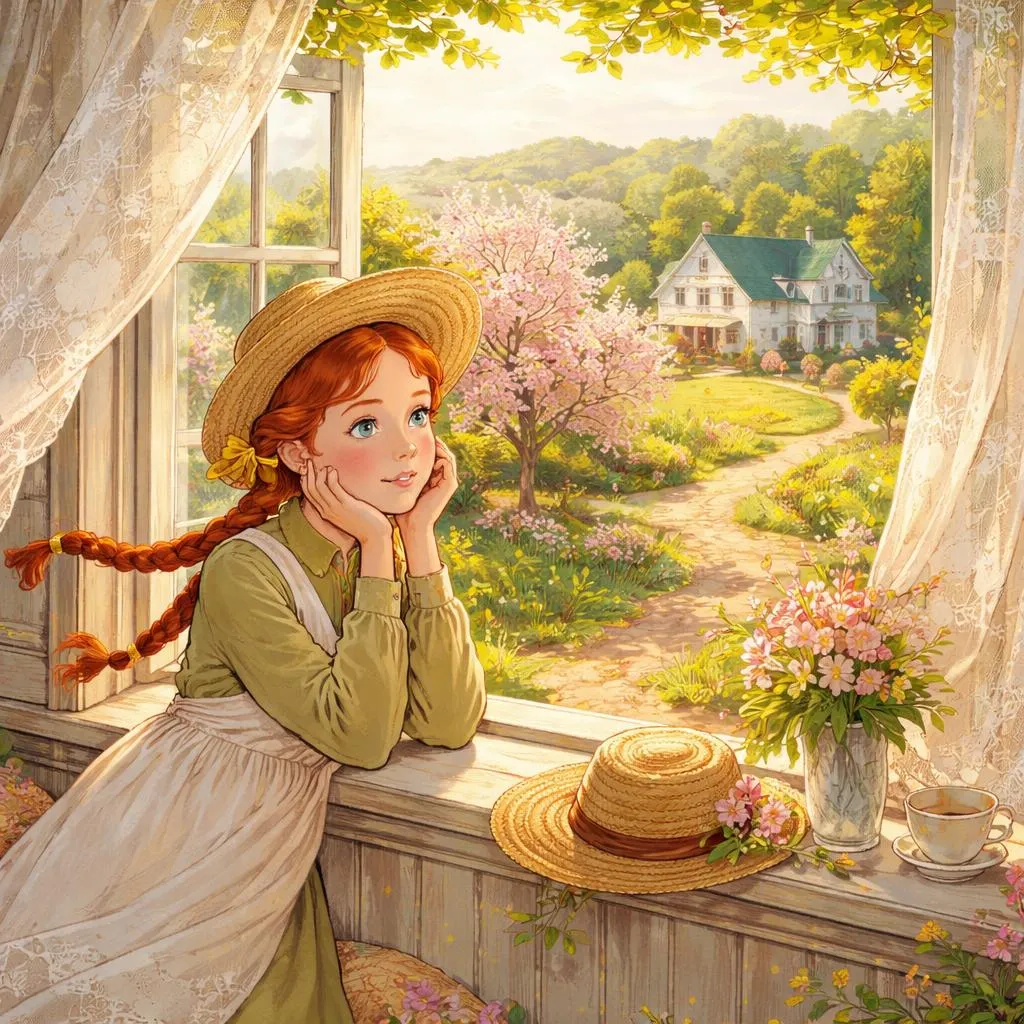

“It’s time Anne was in to do her sewing,” said Marilla, glancing at the clock and then out into the yellow August afternoon where everything drowsed in the heat. “She stayed playing with Diana more than half an hour more’n I gave her leave to; and now she’s perched out there on the woodpile talking to Matthew, nineteen to the dozen, when she knows perfectly well she ought to be at her work. And of course he’s listening to her like a perfect ninny. I never saw such an infatuated man. The more she talks and the odder the things she says, the more he’s delighted evidently. Anne Shirley, you come right in here this minute, do you hear me!”
A series of staccato taps on the west window brought Anne flying in from the yard, eyes shining, cheeks faintly flushed with pink, unbraided hair streaming behind her in a torrent of brightness.
“Oh, Marilla,” she exclaimed breathlessly, “there’s going to be a Sunday-school picnic next week—in Mr. Harmon Andrews’s field, right near the lake of Shining Waters. And Mrs. Superintendent Bell and Mrs. Rachel Lynde are going to make ice cream—think of it, Marilla—ICE CREAM! And, oh, Marilla, can I go to it?”
“Just look at the clock, if you please, Anne. What time did I tell you to come in?”
“Two o’clock—but isn’t it splendid about the picnic, Marilla? Please can I go? Oh, I’ve never been to a picnic—I’ve dreamed of picnics, but I’ve never—”
“Yes, I told you to come at two o’clock. And it’s a quarter to three. I’d like to know why you didn’t obey me, Anne.”
“Why, I meant to, Marilla, as much as could be. But you have no idea how fascinating Idlewild is. And then, of course, I had to tell Matthew about the picnic. Matthew is such a sympathetic listener. Please can I go?”
“You’ll have to learn to resist the fascination of Idle-whatever-you-call-it. When I tell you to come in at a certain time I mean that time and not half an hour later. And you needn’t stop to discourse with sympathetic listeners on your way, either. As for the picnic, of course you can go. You’re a Sunday-school scholar, and it’s not likely I’d refuse to let you go when all the other little girls are going.”
“But—but,” faltered Anne, “Diana says that everybody must take a basket of things to eat. I can’t cook, as you know, Marilla, and—and—I don’t mind going to a picnic without puffed sleeves so much, but I’d feel terribly humiliated if I had to go without a basket. It’s been preying on my mind ever since Diana told me.”
“Well, it needn’t prey any longer. I’ll bake you a basket.”
“Oh, you dear good Marilla. Oh, you are so kind to me. Oh, I’m so much obliged to you.”
Getting through with her “ohs” Anne cast herself into Marilla’s arms and rapturously kissed her sallow cheek. It was the first time in her whole life that childish lips had voluntarily touched Marilla’s face. Again that sudden sensation of startling sweetness thrilled her. She was secretly vastly pleased at Anne’s impulsive caress, which was probably the reason why she said brusquely:
“There, there, never mind your kissing nonsense. I’d sooner see you doing strictly as you’re told. As for cooking, I mean to begin giving you lessons in that some of these days. But you’re so featherbrained, Anne, I’ve been waiting to see if you’d sober down a little and learn to be steady before I begin. You’ve got to keep your wits about you in cooking and not stop in the middle of things to let your thoughts rove all over creation. Now, get out your patchwork and have your square done before teatime.”
“I do NOT like patchwork,” said Anne dolefully, hunting out her workbasket and sitting down before a little heap of red and white diamonds with a sigh. “I think some kinds of sewing would be nice; but there’s no scope for imagination in patchwork. It’s just one little seam after another and you never seem to be getting anywhere. But of course I’d rather be Anne of Green Gables sewing patchwork than Anne of any other place with nothing to do but play. I wish time went as quick sewing patches as it does when I’m playing with Diana, though. Oh, we do have such elegant times, Marilla. I have to furnish most of the imagination, but I’m well able to do that. Diana is simply perfect in every other way. You know that little piece of land across the brook that runs up between our farm and Mr. Barry’s. It belongs to Mr. William Bell, and right in the corner there is a little ring of white birch trees—the most romantic spot, Marilla. Diana and I have our playhouse there. We call it Idlewild. Isn’t that a poetical name? I assure you it took me some time to think it out. I stayed awake nearly a whole night before I invented it. Then, just as I was dropping off to sleep, it came like an inspiration. Diana was ENRAPTURED when she heard it. We have got our house fixed up elegantly. You must come and see it, Marilla—won’t you? We have great big stones, all covered with moss, for seats, and boards from tree to tree for shelves. And we have all our dishes on them. Of course, they’re all broken but it’s the easiest thing in the world to imagine that they are whole. There’s a piece of a plate with a spray of red and yellow ivy on it that is especially beautiful. We keep it in the parlor and we have the fairy glass there, too. The fairy glass is as lovely as a dream. Diana found it out in the woods behind their chicken house. It’s all full of rainbows—just little young rainbows that haven’t grown big yet—and Diana’s mother told her it was broken off a hanging lamp they once had. But it’s nice to imagine the fairies lost it one night when they had a ball, so we call it the fairy glass. Matthew is going to make us a table. Oh, we have named that little round pool over in Mr. Barry’s field Willowmere. I got that name out of the book Diana lent me. That was a thrilling book, Marilla. The heroine had five lovers. I’d be satisfied with one, wouldn’t you? She was very handsome and she went through great tribulations. She could faint as easy as anything. I’d love to be able to faint, wouldn’t you, Marilla? It’s so romantic. But I’m really very healthy for all I’m so thin. I believe I’m getting fatter, though. Don’t you think I am? I look at my elbows every morning when I get up to see if any dimples are coming. Diana is having a new dress made with elbow sleeves. She is going to wear it to the picnic. Oh, I do hope it will be fine next Wednesday. I don’t feel that I could endure the disappointment if anything happened to prevent me from getting to the picnic. I suppose I’d live through it, but I’m certain it would be a lifelong sorrow. It wouldn’t matter if I got to a hundred picnics in after years; they wouldn’t make up for missing this one. They’re going to have boats on the Lake of Shining Waters—and ice cream, as I told you. I have never tasted ice cream. Diana tried to explain what it was like, but I guess ice cream is one of those things that are beyond imagination.”
“Anne, you have talked even on for ten minutes by the clock,” said Marilla. “Now, just for curiosity’s sake, see if you can hold your tongue for the same length of time.”
Anne held her tongue as desired. But for the rest of the week she talked picnic and thought picnic and dreamed picnic. On Saturday it rained and she worked herself up into such a frantic state lest it should keep on raining until and over Wednesday that Marilla made her sew an extra patchwork square by way of steadying her nerves.
On Sunday Anne confided to Marilla on the way home from church that she grew actually cold all over with excitement when the minister announced the picnic from the pulpit.
“Such a thrill as went up and down my back, Marilla! I don’t think I’d ever really believed until then that there was honestly going to be a picnic. I couldn’t help fearing I’d only imagined it. But when a minister says a thing in the pulpit you just have to believe it.”
“You set your heart too much on things, Anne,” said Marilla, with a sigh. “I’m afraid there’ll be a great many disappointments in store for you through life.”
“Oh, Marilla, looking forward to things is half the pleasure of them,” exclaimed Anne. “You mayn’t get the things themselves; but nothing can prevent you from having the fun of looking forward to them. Mrs. Lynde says, ‘Blessed are they who expect nothing for they shall not be disappointed.’ But I think it would be worse to expect nothing than to be disappointed.”
Marilla wore her amethyst brooch to church that day as usual. Marilla always wore her amethyst brooch to church. She would have thought it rather sacrilegious to leave it off—as bad as forgetting her Bible or her collection dime. That amethyst brooch was Marilla’s most treasured possession. A seafaring uncle had given it to her mother who in turn had bequeathed it to Marilla. It was an old-fashioned oval, containing a braid of her mother’s hair, surrounded by a border of very fine amethysts. Marilla knew too little about precious stones to realize how fine the amethysts actually were; but she thought them very beautiful and was always pleasantly conscious of their violet shimmer at her throat, above her good brown satin dress, even although she could not see it.
Anne had been smitten with delighted admiration when she first saw that brooch.
“Oh, Marilla, it’s a perfectly elegant brooch. I don’t know how you can pay attention to the sermon or the prayers when you have it on. I couldn’t, I know. I think amethysts are just sweet. They are what I used to think diamonds were like. Long ago, before I had ever seen a diamond, I read about them and I tried to imagine what they would be like. I thought they would be lovely glimmering purple stones. When I saw a real diamond in a lady’s ring one day I was so disappointed I cried. Of course, it was very lovely but it wasn’t my idea of a diamond. Will you let me hold the brooch for one minute, Marilla? Do you think amethysts can be the souls of good violets?”
背景介绍和作者简介
这段摘录选自《绿山墙的安妮》,这是一部备受喜爱的经典小说,由加拿大作家露西·莫德·蒙哥马利创作。该故事于1908年出版,讲述了安妮·雪莉的故事,她是一位富有想象力和活力的孤儿,被误送到玛丽拉和马修·卡斯伯特那里,这对兄妹原本打算收养一个男孩来帮助他们的农场。故事发生在爱德华王子岛上的虚构村庄艾凡利,小说生动地描绘了乡村生活和童年的冒险。
露西·莫德·蒙哥马利从她自己的生活和周围环境中汲取灵感,将大自然的生动描写和丰富的人物塑造融入故事中。《绿山墙的安妮》此后成为世界各地备受珍爱的作品,因其温暖、幽默和永恒的主题而受到赞誉。
详细解读和意义
这段话突出了安妮活泼的想象力以及她对归属感和快乐的渴望。她对主日学校野餐的兴奋,以及她对“闲暇乐园”(她和朋友戴安娜共用的游戏屋)的生动描述,展现了她的创造精神和对友谊的渴望。玛丽拉作为监护人的角色引入了纪律和责任的主题,这与安妮冲动的性格形成了对比。
安妮对野餐的反思,她对融入其中的担忧,以及她对冰淇淋和仙女玻璃等简单快乐的喜悦,揭示了成长的普遍经历——平衡梦想与现实。这个故事也触及了接纳、个人成长和社区重要性的主题。
给学生的启示和见解
-
想象力和创造力:安妮将普通地方变成神奇世界的能力鼓励学生培养他们的创造力。想象力可以丰富日常生活,并帮助以创新方式解决问题。
-
责任和纪律:玛丽拉坚持准时和完成缝纫任务,这教导了纪律和遵守规则的价值,这对于在学校和生活中取得成功至关重要。
-
友谊和同情心:安妮与戴安娜和马修的关系表明了善良、倾听和支持他人的重要性,这些都是社交互动的重要技能。
-
处理失望:安妮对野餐的兴奋和她对失望的恐惧反映了每个人都会面临的情绪起伏。学会管理期望并在期待中找到快乐是一堂宝贵的感情课。
-
欣赏简单的快乐:这个故事提醒读者在小事中寻找幸福——野餐、自制篮子或珍爱的胸针——这可以培养感恩和满足感。
在日常生活中的应用
-
在学校:学生可以从安妮的好奇心和渴望探索新体验中学习,同时也了解平衡乐趣与责任(如家庭作业和家务)的重要性。
-
在社交场合:安妮的开放和热情鼓励年轻读者友好和包容,结交新朋友并欣赏不同的个性。
-
个人成长:这个故事激发了自我反思,鼓励学生拥抱他们独特的品质,同时努力实现成熟和稳重,正如玛丽拉所建议的那样。
从故事中培养积极的特质
-
想象力:参与写作、绘画或角色扮演等创造性活动,培养像安妮一样的想象力。
-
耐心和专注:练习不分心完成任务,正如玛丽拉希望安妮学习的那样,以建立专注力和可靠性。
-
善良和倾听:对朋友和家人给予关注和支持,效仿马修的同情倾听。
-
韧性:理解失望是生活的一部分,但期待事件并保持希望会带来快乐和力量。
反思与欣赏
《绿山墙的安妮》提供了一个对童年欢乐和挑战的永恒探索。安妮充满活力的个性和她与玛丽拉等人的互动邀请读者欣赏日常生活中的美丽、想象力的力量以及在善良和勇气中成长的重要性。学生们可以从安妮的故事中找到灵感,拥抱他们自己的独特性,并以乐观和热情面对生活的冒险。
