
I paid three pennies for my breakfast, and a most extravagant price it was, too, seeing that one could have breakfasted a dozen persons for that money; but I was feeling good by this time, and I had always been a kind of spendthrift anyway; and then these people had wanted to give me the food for nothing, scant as their provision was, and so it was a grateful pleasure to emphasize my appreciation and sincere thankfulness with a good big financial lift where the money would do so much more good than it would in my helmet, where, these pennies being made of iron and not stinted in weight, my half-dollar’s worth was a good deal of a burden to me. I spent money rather too freely in those days, it is true; but one reason for it was that I hadn’t got the proportions of things entirely adjusted, even yet, after so long a sojourn in Britain—hadn’t got along to where I was able to absolutely realize that a penny in Arthur’s land and a couple of dollars in Connecticut were about one and the same thing: just twins, as you may say, in purchasing power. If my start from Camelot could have been delayed a very few days I could have paid these people in beautiful new coins from our own mint, and that would have pleased me; and them, too, not less. I had adopted the American values exclusively. In a week or two now, cents, nickels, dimes, quarters, and half-dollars, and also a trifle of gold, would be trickling in thin but steady streams all through the commercial veins of the kingdom, and I looked to see this new blood freshen up its life.
The farmers were bound to throw in something, to sort of offset my liberality, whether I would or no; so I let them give me a flint and steel; and as soon as they had comfortably bestowed Sandy and me on our horse, I lit my pipe. When the first blast of smoke shot out through the bars of my helmet, all those people broke for the woods, and Sandy went over backwards and struck the ground with a dull thud. They thought I was one of those fire-belching dragons they had heard so much about from knights and other professional liars. I had infinite trouble to persuade those people to venture back within explaining distance. Then I told them that this was only a bit of enchantment which would work harm to none but my enemies. And I promised, with my hand on my heart, that if all who felt no enmity toward me would come forward and pass before me they should see that only those who remained behind would be struck dead. The procession moved with a good deal of promptness. There were no casualties to report, for nobody had curiosity enough to remain behind to see what would happen.
I lost some time, now, for these big children, their fears gone, became so ravished with wonder over my awe-compelling fireworks that I had to stay there and smoke a couple of pipes out before they would let me go. Still the delay was not wholly unproductive, for it took all that time to get Sandy thoroughly wonted to the new thing, she being so close to it, you know. It plugged up her conversation mill, too, for a considerable while, and that was a gain. But above all other benefits accruing, I had learned something. I was ready for any giant or any ogre that might come along, now.
We tarried with a holy hermit, that night, and my opportunity came about the middle of the next afternoon. We were crossing a vast meadow by way of short-cut, and I was musing absently, hearing nothing, seeing nothing, when Sandy suddenly interrupted a remark which she had begun that morning, with the cry:
“Defend thee, lord!—peril of life is toward!”
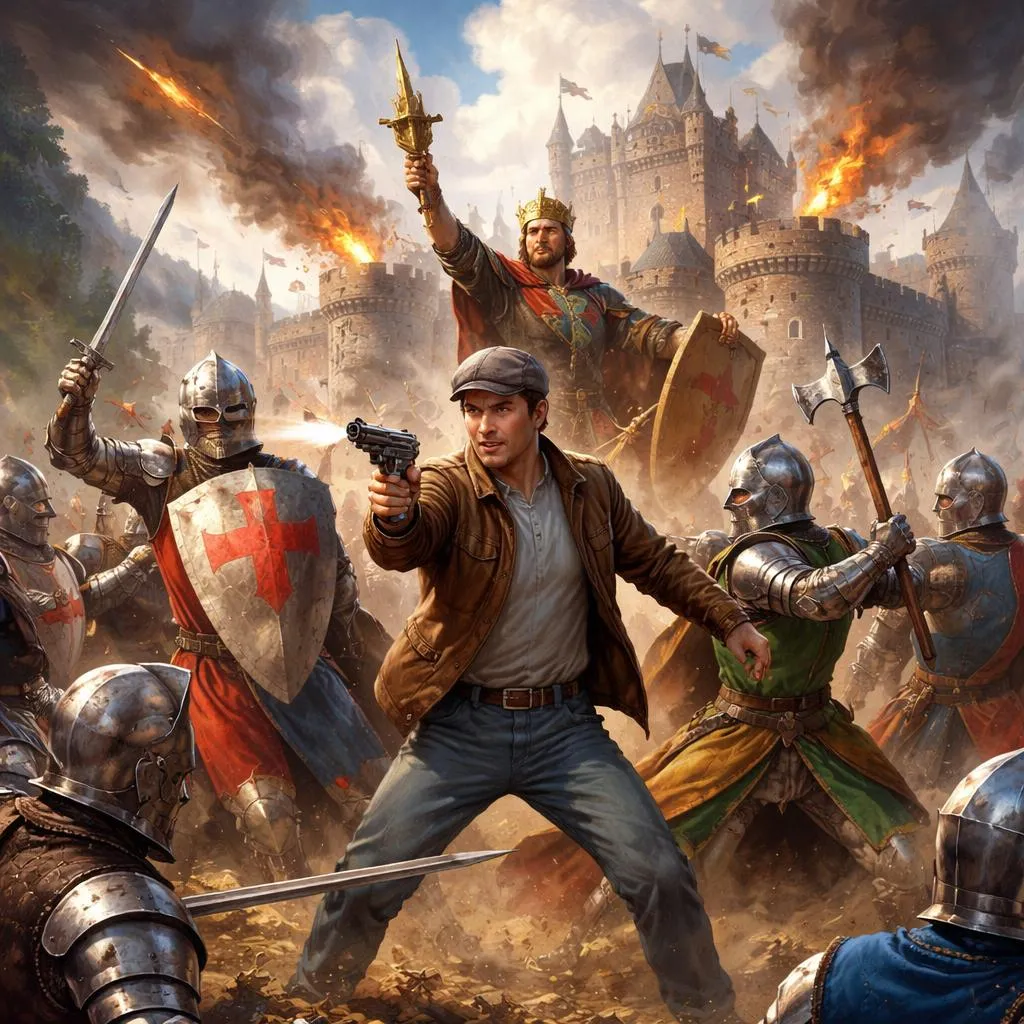
And she slipped down from the horse and ran a little way and stood. I looked up and saw, far off in the shade of a tree, half a dozen armed knights and their squires; and straightway there was bustle among them and tightening of saddle-girths for the mount. My pipe was ready and would have been lit, if I had not been lost in thinking about how to banish oppression from this land and restore to all its people their stolen rights and manhood without disobliging anybody. I lit up at once, and by the time I had got a good head of reserved steam on, here they came. All together, too; none of those chivalrous magnanimities which one reads so much about —one courtly rascal at a time, and the rest standing by to see fair play. No, they came in a body, they came with a whirr and a rush, they came like a volley from a battery; came with heads low down, plumes streaming out behind, lances advanced at a level. It was a handsome sight, a beautiful sight—for a man up a tree. I laid my lance in rest and waited, with my heart beating, till the iron wave was just ready to break over me, then spouted a column of white smoke through the bars of my helmet. You should have seen the wave go to pieces and scatter! This was a finer sight than the other one.
But these people stopped, two or three hundred yards away, and this troubled me. My satisfaction collapsed, and fear came; I judged I was a lost man. But Sandy was radiant; and was going to be eloquent—but I stopped her, and told her my magic had miscarried, somehow or other, and she must mount, with all despatch, and we must ride for life. No, she wouldn’t. She said that my enchantment had disabled those knights; they were not riding on, because they couldn’t; wait, they would drop out of their saddles presently, and we would get their horses and harness. I could not deceive such trusting simplicity, so I said it was a mistake; that when my fireworks killed at all, they killed instantly; no, the men would not die, there was something wrong about my apparatus, I couldn’t tell what; but we must hurry and get away, for those people would attack us again, in a minute. Sandy laughed, and said:
“Lack-a-day, sir, they be not of that breed! Sir Launcelot will give battle to dragons, and will abide by them, and will assail them again, and yet again, and still again, until he do conquer and destroy them; and so likewise will Sir Pellinore and Sir Aglovale and Sir Carados, and mayhap others, but there be none else that will venture it, let the idle say what the idle will. And, la, as to yonder base rufflers, think ye they have not their fill, but yet desire more?”
“Well, then, what are they waiting for? Why don’t they leave? Nobody’s hindering. Good land, I’m willing to let bygones be bygones, I’m sure.”
“Leave, is it? Oh, give thyself easement as to that. They dream not of it, no, not they. They wait to yield them.”
“Come—really, is that ‘sooth’—as you people say? If they want to, why don’t they?”
“It would like them much; but an ye wot how dragons are esteemed, ye would not hold them blamable. They fear to come.”
“Well, then, suppose I go to them instead, and—”
“Ah, wit ye well they would not abide your coming. I will go.”
And she did. She was a handy person to have along on a raid. I would have considered this a doubtful errand, myself. I presently saw the knights riding away, and Sandy coming back. That was a relief. I judged she had somehow failed to get the first innings —I mean in the conversation; otherwise the interview wouldn’t have been so short. But it turned out that she had managed the business well; in fact, admirably. She said that when she told those people I was The Boss, it hit them where they lived: “smote them sore with fear and dread” was her word; and then they were ready to put up with anything she might require. So she swore them to appear at Arthur’s court within two days and yield them, with horse and harness, and be my knights henceforth, and subject to my command. How much better she managed that thing than I should have done it myself! She was a daisy.
背景介绍和作者介绍
这段摘录出自一个故事,它融合了亚瑟王传说的元素,并带有一个独特而富有想象力的转折。叙述者发现自己身处一个中世纪的环境中,与骑士、农民和神话生物互动,同时将现代的视角和价值观带入这个古老的世界。这个故事让人想起马克·吐温的《亚瑟王朝的康涅狄格州美国佬》,这是一部经典小说,探讨了现代科技与中世纪迷信之间的冲突。
马克·吐温,他的真名是塞缪尔·兰霍恩·克莱门斯,是一位著名的美国作家,以其智慧、幽默和社会批判而闻名。在19世纪后期写作时,吐温经常使用讽刺来挑战社会规范,并突出人类的愚蠢。《亚瑟王朝的康涅狄格州美国佬》是他最著名的作品之一,它融合了幻想和讽刺,质疑了对骑士精神和君主制的浪漫化观点。
详细解读和意义
这段话描述了叙述者在中世纪世界中的经历,他利用来自现代的知识和资源。他以高昂的价格购买早餐象征着他的世界和中世纪世界之间的文化和经济差异。叙述者的慷慨与他周围的匮乏形成了对比,他的互动揭示了对价值、货币和人类善良的幽默而深刻的评论。
叙述者用烟雾“烟花”击退骑士的事件,展示了知识和创造力胜过蛮力的力量。它也突出了不同文化和时代之间的误解主题。叙述者的同伴桑迪扮演着调解人和谈判者的重要角色,展现了勇气和外交。
这个故事邀请读者思考正义、权力和进步。它挑战了强权即真理的观念,并表明智慧、善良和公平是变革的更强大力量。它还探讨了如何在不造成伤害或不尊重的情况下带来积极的改变。
给学生的教训和启发
-
欣赏不同的文化和时代
这个故事鼓励年轻读者尊重和理解与他们自己不同的文化和历史。它表明,即使习俗和外表发生变化,善良和公平等价值观也是普遍的。 -
创造力和知识的力量
叙述者使用烟雾和巧妙的策略来保护自己,这教导学生创造性地思考和利用知识来解决问题的重要性,而不是诉诸暴力。 -
勇气和领导力
桑迪的勇敢和外交技巧突出了坚持正义和以智慧和同情心领导的价值。学生可以学习领导力不仅仅是力量,还包括沟通和信任。 -
慷慨和感恩
尽管财富和货币存在差异,但叙述者表现出慷慨和感恩,提醒读者善良和感激在任何情况下都很重要。
在日常生活中应用这些教训
-
**在学校:**学生可以使用创造性思维来应对挑战,无论是在解决问题还是在小组项目中。他们还可以通过倾听他人和鼓励团队合作来练习领导力。
-
**在社交场合:**理解和尊重不同的背景有助于建立友谊和和平的社区。表现出感激和慷慨可以加强人际关系。
-
**在个人成长中:**面对恐惧和坚持公平的勇气有助于建立品格。从历史和故事中学习可以激发更好的决策和同情心。
从故事中培养积极的价值观
为了培养故事中展现的积极特质,学生可以:
- 每天练习善良,即使是小小的行为。
- 广泛阅读以了解不同的观点和历史。
- 面对问题时进行批判性和创造性地思考。
- 与他人清晰而尊重地沟通。
- 反思自己的行为,努力做到公平和公正。
这个故事,融合了幻想、幽默和道德教训,为年轻读者提供了丰富的体验,在娱乐的同时传授重要的生活技能和价值观。它提醒我们,勇气、善良和智慧是永恒的品质,可以改变世界,使其变得更好。
