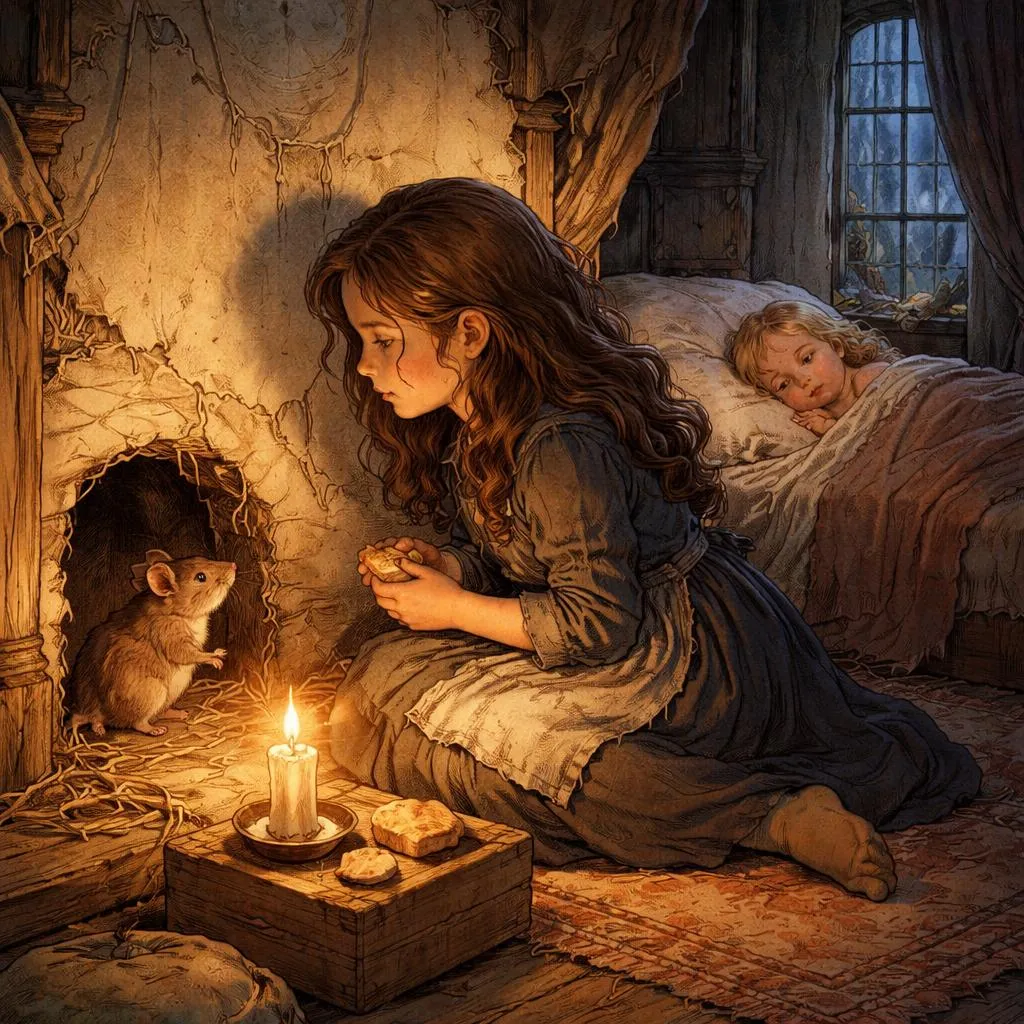

On this very afternoon, while Sara was out, a strange thing happened in the attic. Only Melchisedec saw and heard it; and he was so much alarmed and mystified that he scuttled back to his hole and hid there, and really quaked and trembled as he peeped out furtively and with great caution to watch what was going on.
The attic had been very still all the day after Sara had left it in the early morning. The stillness had only been broken by the pattering of the rain upon the slates and the skylight. Melchisedec had, in fact, found it rather dull; and when the rain ceased to patter and perfect silence reigned, he decided to come out and reconnoiter, though experience taught him that Sara would not return for some time. He had been rambling and sniffing about, and had just found a totally unexpected and unexplained crumb left from his last meal, when his attention was attracted by a sound on the roof. He stopped to listen with a palpitating heart. The sound suggested that something was moving on the roof. It was approaching the skylight; it reached the skylight. The skylight was being mysteriously opened. A dark face peered into the attic; then another face appeared behind it, and both looked in with signs of caution and interest. Two men were outside on the roof, and were making silent preparations to enter through the skylight itself. One was Ram Dass and the other was a young man who was the Indian gentleman’s secretary; but of course Melchisedec did not know this. He only knew that the men were invading the silence and privacy of the attic; and as the one with the dark face let himself down through the aperture with such lightness and dexterity that he did not make the slightest sound, Melchisedec turned tail and fled precipitately back to his hole. He was frightened to death. He had ceased to be timid with Sara, and knew she would never throw anything but crumbs, and would never make any sound other than the soft, low, coaxing whistling; but strange men were dangerous things to remain near. He lay close and flat near the entrance of his home, just managing to peep through the crack with a bright, alarmed eye. How much he understood of the talk he heard I am not in the least able to say; but, even if he had understood it all, he would probably have remained greatly mystified.
The secretary, who was light and young, slipped through the skylight as noiselessly as Ram Dass had done; and he caught a last glimpse of Melchisedec’s vanishing tail.
“Was that a rat?” he asked Ram Dass in a whisper.
“Yes; a rat, Sahib,” answered Ram Dass, also whispering. “There are many in the walls.”
“Ugh!” exclaimed the young man. “It is a wonder the child is not terrified of them.”
Ram Dass made a gesture with his hands. He also smiled respectfully. He was in this place as the intimate exponent of Sara, though she had only spoken to him once.
“The child is the little friend of all things, Sahib,” he answered. “She is not as other children. I see her when she does not see me. I slip across the slates and look at her many nights to see that she is safe. I watch her from my window when she does not know I am near. She stands on the table there and looks out at the sky as if it spoke to her. The sparrows come at her call. The rat she has fed and tamed in her loneliness. The poor slave of the house comes to her for comfort. There is a little child who comes to her in secret; there is one older who worships her and would listen to her forever if she might. This I have seen when I have crept across the roof. By the mistress of the house—who is an evil woman—she is treated like a pariah; but she has the bearing of a child who is of the blood of kings!”
“You seem to know a great deal about her,” the secretary said.
“All her life each day I know,” answered Ram Dass. “Her going out I know, and her coming in; her sadness and her poor joys; her coldness and her hunger. I know when she is alone until midnight, learning from her books; I know when her secret friends steal to her and she is happier—as children can be, even in the midst of poverty—because they come and she may laugh and talk with them in whispers. If she were ill I should know, and I would come and serve her if it might be done.”
“You are sure no one comes near this place but herself, and that she will not return and surprise us. She would be frightened if she found us here, and the Sahib Carrisford’s plan would be spoiled.”
Ram Dass crossed noiselessly to the door and stood close to it.
“None mount here but herself, Sahib,” he said. “She has gone out with her basket and may be gone for hours. If I stand here I can hear any step before it reaches the last flight of the stairs.”
The secretary took a pencil and a tablet from his breast pocket.
“Keep your ears open,” he said; and he began to walk slowly and softly round the miserable little room, making rapid notes on his tablet as he looked at things.
First he went to the narrow bed. He pressed his hand upon the mattress and uttered an exclamation.
“As hard as a stone,” he said. “That will have to be altered some day when she is out. A special journey can be made to bring it across. It cannot be done tonight.” He lifted the covering and examined the one thin pillow.
“Coverlet dingy and worn, blanket thin, sheets patched and ragged,” he said. “What a bed for a child to sleep in—and in a house which calls itself respectable! There has not been a fire in that grate for many a day,” glancing at the rusty fireplace.
“Never since I have seen it,” said Ram Dass. “The mistress of the house is not one who remembers that another than herself may be cold.”
The secretary was writing quickly on his tablet. He looked up from it as he tore off a leaf and slipped it into his breast pocket.
“It is a strange way of doing the thing,” he said. “Who planned it?”
Ram Dass made a modestly apologetic obeisance.
“It is true that the first thought was mine, Sahib,” he said; “though it was naught but a fancy. I am fond of this child; we are both lonely. It is her way to relate her visions to her secret friends. Being sad one night, I lay close to the open skylight and listened. The vision she related told what this miserable room might be if it had comforts in it. She seemed to see it as she talked, and she grew cheered and warmed as she spoke. Then she came to this fancy; and the next day, the Sahib being ill and wretched, I told him of the thing to amuse him. It seemed then but a dream, but it pleased the Sahib. To hear of the child’s doings gave him entertainment. He became interested in her and asked questions. At last he began to please himself with the thought of making her visions real things.”
“You think that it can be done while she sleeps? Suppose she awakened,” suggested the secretary; and it was evident that whatsoever the plan referred to was, it had caught and pleased his fancy as well as the Sahib Carrisford’s.
“I can move as if my feet were of velvet,” Ram Dass replied; “and children sleep soundly—even the unhappy ones. I could have entered this room in the night many times, and without causing her to turn upon her pillow. If the other bearer passes to me the things through the window, I can do all and she will not stir. When she awakens she will think a magician has been here.”
He smiled as if his heart warmed under his white robe, and the secretary smiled back at him.
“It will be like a story from the Arabian Nights,” he said. “Only an Oriental could have planned it. It does not belong to London fogs.”
They did not remain very long, to the great relief of Melchisedec, who, as he probably did not comprehend their conversation, felt their movements and whispers ominous. The young secretary seemed interested in everything. He wrote down things about the floor, the fireplace, the broken footstool, the old table, the walls—which last he touched with his hand again and again, seeming much pleased when he found that a number of old nails had been driven in various places.
“You can hang things on them,” he said.
Ram Dass smiled mysteriously.
“Yesterday, when she was out,” he said, “I entered, bringing with me small, sharp nails which can be pressed into the wall without blows from a hammer. I placed many in the plaster where I may need them. They are ready.”
The Indian gentleman’s secretary stood still and looked round him as he thrust his tablets back into his pocket.
“I think I have made notes enough; we can go now,” he said. “The Sahib Carrisford has a warm heart. It is a thousand pities that he has not found the lost child.”
“If he should find her his strength would be restored to him,” said Ram Dass. “His God may lead her to him yet.”
Then they slipped through the skylight as noiselessly as they had entered it. And, after he was quite sure they had gone, Melchisedec was greatly relieved, and in the course of a few minutes felt it safe to emerge from his hole again and scuffle about in the hope that even such alarming human beings as these might have chanced to carry crumbs in their pockets and drop one or two.
背景和作者介绍
这段文字选自《小公主》,这是一部由弗朗西丝·霍奇森·伯内特创作的经典儿童小说,于1905年首次出版。伯内特是一位英裔美国作家,以其永恒的故事而闻名,这些故事经常探讨善良、韧性和想象力等主题。《小公主》讲述了萨拉·克鲁的故事,她是一位富有且富有想象力的女孩,在失去财富后,被迫在寄宿学校里当仆人,但在逆境中保持了尊严和善良。
故事的详细解读
在这段摘录中,叙述是通过住在萨拉居住的阁楼里的小老鼠麦基洗德的视角来呈现的。场景揭示了两个男人——拉姆·达斯和他的年轻秘书——秘密访问,他们在萨拉外出时悄悄地检查萨拉的阁楼房间。拉姆·达斯是萨拉忠诚的仆人和保护者,默默地从阴影中守护着她。这两个人计划改善萨拉凄凉的生活条件,受到她对更美好生活的梦想和愿景的启发。他们对萨拉表现出的秘密关怀和尊重与她所面临的来自学校女校长的残酷形成了鲜明对比。
这段文字突出了善良、保护和希望的主题。尽管萨拉处境艰难,但她并不孤单;看不见的朋友们守护着她,并且有一个计划要给她带来安慰和快乐。老鼠麦基洗德象征着默默的观察者,他们注意到并关心弱势群体,即使其他人忽视了他们。
给学生的教训和见解
-
韧性和善良: 萨拉的性格教会我们即使在逆境中也要保持善良和希望。她结交了动物和人,表现出超越自身困境的同情心。
-
想象力的力量: 萨拉对更好房间和生活的愿景激励着他人采取行动。这提醒学生,想象力和梦想可以激发真正的改变。
-
同情和保护: 拉姆·达斯的角色说明了关心他人的重要性,尤其是那些弱势群体。学生可以学会成为细心和支持的朋友。
-
面对恐惧时的勇气: 即使是麦基洗德,虽然害怕,但仍然继续观察和希望。这鼓励年轻读者勇敢而好奇地面对他们的恐惧。
将这些教训应用于日常生活
- 在学习中: 像萨拉一样,学生可以培养好奇心和对书籍的热爱,利用想象力探索新的想法和可能性。
- 在人际关系中: 对同学和朋友表现出善良和同情心,尤其是那些可能感到孤独或挣扎的人,可以带来很大的不同。
- 在挑战中: 面对困难时,学生可以记住萨拉的榜样,保持希望和韧性,明白艰难的时期是可以克服的。
- 在创造力中: 鼓励创造性思维和梦想可以带来创新的解决方案和个人成长。
从故事中培养积极的特质
- 同情心: 每天练习小的善行,例如帮助同伴或照顾动物。
- 观察: 像麦基洗德一样,学会仔细观察周围环境并理解他人的感受。
- 希望: 即使情况看起来很糟糕,也要保持积极的态度,相信改变是可能的。
- 责任: 成为你社区中的保护者和支持者,为需要帮助的人挺身而出。
结论
《小公主》不仅仅是一个关于苦难的故事;它颂扬内在的力量、善良和希望的魔力。阅读这个故事的学生可以获得关于同情心、勇气和培养梦想的重要性的宝贵教训。通过运用这些教训,他们可以成长为有思想、有韧性的人,为他们的社区和人际关系做出积极的贡献。
