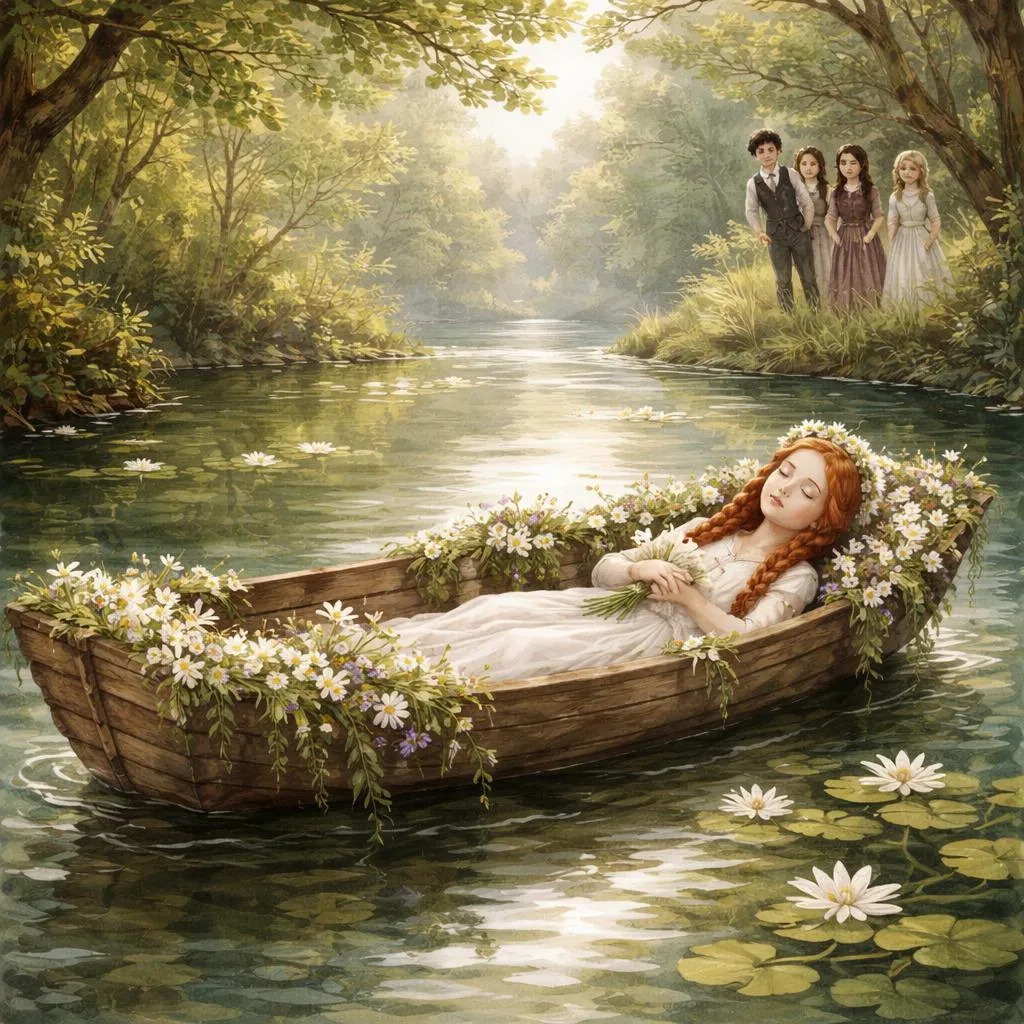

“OF course you must be Elaine, Anne,” said Diana. “I could never have the courage to float down there.”
“Nor I,” said Ruby Gillis, with a shiver. “I don’t mind floating down when there’s two or three of us in the flat and we can sit up. It’s fun then. But to lie down and pretend I was dead—I just couldn’t. I’d die really of fright.”
“Of course it would be romantic,” conceded Jane Andrews, “but I know I couldn’t keep still. I’d be popping up every minute or so to see where I was and if I wasn’t drifting too far out. And you know, Anne, that would spoil the effect.”
“But it’s so ridiculous to have a redheaded Elaine,” mourned Anne. “I’m not afraid to float down and I’d love to be Elaine. But it’s ridiculous just the same. Ruby ought to be Elaine because she is so fair and has such lovely long golden hair—Elaine had ‘all her bright hair streaming down,’ you know. And Elaine was the lily maid. Now, a red-haired person cannot be a lily maid.”
“Your complexion is just as fair as Ruby’s,” said Diana earnestly, “and your hair is ever so much darker than it used to be before you cut it.”
“Oh, do you really think so?” exclaimed Anne, flushing sensitively with delight. “I’ve sometimes thought it was myself—but I never dared to ask anyone for fear she would tell me it wasn’t. Do you think it could be called auburn now, Diana?”
“Yes, and I think it is real pretty,” said Diana, looking admiringly at the short, silky curls that clustered over Anne’s head and were held in place by a very jaunty black velvet ribbon and bow.
They were standing on the bank of the pond, below Orchard Slope, where a little headland fringed with birches ran out from the bank; at its tip was a small wooden platform built out into the water for the convenience of fishermen and duck hunters. Ruby and Jane were spending the midsummer afternoon with Diana, and Anne had come over to play with them.
Anne and Diana had spent most of their playtime that summer on and about the pond. Idlewild was a thing of the past, Mr. Bell having ruthlessly cut down the little circle of trees in his back pasture in the spring. Anne had sat among the stumps and wept, not without an eye to the romance of it; but she was speedily consoled, for, after all, as she and Diana said, big girls of thirteen, going on fourteen, were too old for such childish amusements as playhouses, and there were more fascinating sports to be found about the pond. It was splendid to fish for trout over the bridge and the two girls learned to row themselves about in the little flat-bottomed dory Mr. Barry kept for duck shooting.
It was Anne’s idea that they dramatize Elaine. They had studied Tennyson’s poem in school the preceding winter, the Superintendent of Education having prescribed it in the English course for the Prince Edward Island schools. They had analyzed and parsed it and torn it to pieces in general until it was a wonder there was any meaning at all left in it for them, but at least the fair lily maid and Lancelot and Guinevere and King Arthur had become very real people to them, and Anne was devoured by secret regret that she had not been born in Camelot. Those days, she said, were so much more romantic than the present.
Anne’s plan was hailed with enthusiasm. The girls had discovered that if the flat were pushed off from the landing place it would drift down with the current under the bridge and finally strand itself on another headland lower down which ran out at a curve in the pond. They had often gone down like this and nothing could be more convenient for playing Elaine.
“Well, I’ll be Elaine,” said Anne, yielding reluctantly, for, although she would have been delighted to play the principal character, yet her artistic sense demanded fitness for it and this, she felt, her limitations made impossible. “Ruby, you must be King Arthur and Jane will be Guinevere and Diana must be Lancelot. But first you must be the brothers and the father. We can’t have the old dumb servitor because there isn’t room for two in the flat when one is lying down. We must pall the barge all its length in blackest samite. That old black shawl of your mother’s will be just the thing, Diana.”
The black shawl having been procured, Anne spread it over the flat and then lay down on the bottom, with closed eyes and hands folded over her breast.
“Oh, she does look really dead,” whispered Ruby Gillis nervously, watching the still, white little face under the flickering shadows of the birches. “It makes me feel frightened, girls. Do you suppose it’s really right to act like this? Mrs. Lynde says that all play-acting is abominably wicked.”
“Ruby, you shouldn’t talk about Mrs. Lynde,” said Anne severely. “It spoils the effect because this is hundreds of years before Mrs. Lynde was born. Jane, you arrange this. It’s silly for Elaine to be talking when she’s dead.”
Jane rose to the occasion. Cloth of gold for coverlet there was none, but an old piano scarf of yellow Japanese crepe was an excellent substitute. A white lily was not obtainable just then, but the effect of a tall blue iris placed in one of Anne’s folded hands was all that could be desired.
“Now, she’s all ready,” said Jane. “We must kiss her quiet brows and, Diana, you say, ‘Sister, farewell forever,’ and Ruby, you say, ‘Farewell, sweet sister,’ both of you as sorrowfully as you possibly can. Anne, for goodness sake smile a little. You know Elaine ‘lay as though she smiled.’ That’s better. Now push the flat off.”
The flat was accordingly pushed off, scraping roughly over an old embedded stake in the process. Diana and Jane and Ruby only waited long enough to see it caught in the current and headed for the bridge before scampering up through the woods, across the road, and down to the lower headland where, as Lancelot and Guinevere and the King, they were to be in readiness to receive the lily maid.
For a few minutes Anne, drifting slowly down, enjoyed the romance of her situation to the full. Then something happened not at all romantic. The flat began to leak. In a very few moments it was necessary for Elaine to scramble to her feet, pick up her cloth of gold coverlet and pall of blackest samite and gaze blankly at a big crack in the bottom of her barge through which the water was literally pouring. That sharp stake at the landing had torn off the strip of batting nailed on the flat. Anne did not know this, but it did not take her long to realize that she was in a dangerous plight. At this rate the flat would fill and sink long before it could drift to the lower headland. Where were the oars? Left behind at the landing!
Anne gave one gasping little scream which nobody ever heard; she was white to the lips, but she did not lose her self-possession. There was one chance—just one.
“I was horribly frightened,” she told Mrs. Allan the next day, “and it seemed like years while the flat was drifting down to the bridge and the water rising in it every moment. I prayed, Mrs. Allan, most earnestly, but I didn’t shut my eyes to pray, for I knew the only way God could save me was to let the flat float close enough to one of the bridge piles for me to climb up on it. You know the piles are just old tree trunks and there are lots of knots and old branch stubs on them. It was proper to pray, but I had to do my part by watching out and right well I knew it. I just said, ‘Dear God, please take the flat close to a pile and I’ll do the rest,’ over and over again. Under such circumstances you don’t think much about making a flowery prayer. But mine was answered, for the flat bumped right into a pile for a minute and I flung the scarf and the shawl over my shoulder and scrambled up on a big providential stub. And there I was, Mrs. Allan, clinging to that slippery old pile with no way of getting up or down. It was a very unromantic position, but I didn’t think about that at the time. You don’t think much about romance when you have just escaped from a watery grave. I said a grateful prayer at once and then I gave all my attention to holding on tight, for I knew I should probably have to depend on human aid to get back to dry land.”
The flat drifted under the bridge and then promptly sank in midstream. Ruby, Jane, and Diana, already awaiting it on the lower headland, saw it disappear before their very eyes and had not a doubt but that Anne had gone down with it. For a moment they stood still, white as sheets, frozen with horror at the tragedy; then, shrieking at the tops of their voices, they started on a frantic run up through the woods, never pausing as they crossed the main road to glance the way of the bridge. Anne, clinging desperately to her precarious foothold, saw their flying forms and heard their shrieks. Help would soon come, but meanwhile her position was a very uncomfortable one.
The minutes passed by, each seeming an hour to the unfortunate lily maid. Why didn’t somebody come? Where had the girls gone? Suppose they had fainted, one and all! Suppose nobody ever came! Suppose she grew so tired and cramped that she could hold on no longer! Anne looked at the wicked green depths below her, wavering with long, oily shadows, and shivered. Her imagination began to suggest all manner of gruesome possibilities to her.
Then, just as she thought she really could not endure the ache in her arms and wrists another moment, Gilbert Blythe came rowing under the bridge in Harmon Andrews’s dory!
Gilbert glanced up and, much to his amazement, beheld a little white scornful face looking down upon him with big, frightened but also scornful gray eyes.
“Anne Shirley! How on earth did you get there?” he exclaimed.
Without waiting for an answer he pulled close to the pile and extended his hand. There was no help for it; Anne, clinging to Gilbert Blythe’s hand, scrambled down into the dory, where she sat, drabbled and furious, in the stern with her arms full of dripping shawl and wet crepe. It was certainly extremely difficult to be dignified under the circumstances!
“What has happened, Anne?” asked Gilbert, taking up his oars. “We were playing Elaine” explained Anne frigidly, without even looking at her rescuer, “and I had to drift down to Camelot in the barge—I mean the flat. The flat began to leak and I climbed out on the pile. The girls went for help. Will you be kind enough to row me to the landing?”
Gilbert obligingly rowed to the landing and Anne, disdaining assistance, sprang nimbly on shore.
“I’m very much obliged to you,” she said haughtily as she turned away. But Gilbert had also sprung from the boat and now laid a detaining hand on her arm.
“Anne,” he said hurriedly, “look here. Can’t we be good friends? I’m awfully sorry I made fun of your hair that time. I didn’t mean to vex you and I only meant it for a joke. Besides, it’s so long ago. I think your hair is awfully pretty now—honest I do. Let’s be friends.”
For a moment Anne hesitated. She had an odd, newly awakened consciousness under all her outraged dignity that the half-shy, half-eager expression in Gilbert’s hazel eyes was something that was very good to see. Her heart gave a quick, queer little beat. But the bitterness of her old grievance promptly stiffened up her wavering determination. That scene of two years before flashed back into her recollection as vividly as if it had taken place yesterday. Gilbert had called her “carrots” and had brought about her disgrace before the whole school. Her resentment, which to other and older people might be as laughable as its cause, was in no whit allayed and softened by time seemingly. She hated Gilbert Blythe! She would never forgive him!
“No,” she said coldly, “I shall never be friends with you, Gilbert Blythe; and I don’t want to be!”
“All right!” Gilbert sprang into his skiff with an angry color in his cheeks. “I’ll never ask you to be friends again, Anne Shirley. And I don’t care either!”
He pulled away with swift defiant strokes, and Anne went up the steep, ferny little path under the maples. She held her head very high, but she was conscious of an odd feeling of regret. She almost wished she had answered Gilbert differently. Of course, he had insulted her terribly, but still—! Altogether, Anne rather thought it would be a relief to sit down and have a good cry. She was really quite unstrung, for the reaction from her fright and cramped clinging was making itself felt.
Halfway up the path she met Jane and Diana rushing back to the pond in a state narrowly removed from positive frenzy. They had found nobody at Orchard Slope, both Mr. and Mrs. Barry being away. Here Ruby Gillis had succumbed to hysterics, and was left to recover from them as best she might, while Jane and Diana flew through the Haunted Wood and across the brook to Green Gables. There they had found nobody either, for Marilla had gone to Carmody and Matthew was making hay in the back field.
“Oh, Anne,” gasped Diana, fairly falling on the former’s neck and weeping with relief and delight, “oh, Anne—we thought—you were—drowned—and we felt like murderers—because we had made—you be—Elaine. And Ruby is in hysterics—oh, Anne, how did you escape?”
“I climbed up on one of the piles,” explained Anne wearily, “and Gilbert Blythe came along in Mr. Andrews’s dory and brought me to land.”
“Oh, Anne, how splendid of him! Why, it’s so romantic!” said Jane, finding breath enough for utterance at last. “Of course you’ll speak to him after this.”
“Of course I won’t,” flashed Anne, with a momentary return of her old spirit. “And I don’t want ever to hear the word ‘romantic’ again, Jane Andrews. I’m awfully sorry you were so frightened, girls. It is all my fault. I feel sure I was born under an unlucky star. Everything I do gets me or my dearest friends into a scrape. We’ve gone and lost your father’s flat, Diana, and I have a presentiment that we’ll not be allowed to row on the pond any more.”
Anne’s presentiment proved more trustworthy than presentiments are apt to do. Great was the consternation in the Barry and Cuthbert households when the events of the afternoon became known.
“Will you ever have any sense, Anne?” groaned Marilla.
“Oh, yes, I think I will, Marilla,” returned Anne optimistically. A good cry, indulged in the grateful solitude of the east gable, had soothed her nerves and restored her to her wonted cheerfulness. “I think my prospects of becoming sensible are brighter now than ever.”
“I don’t see how,” said Marilla.
“Well,” explained Anne, “I’ve learned a new and valuable lesson today. Ever since I came to Green Gables I’ve been making mistakes, and each mistake has helped to cure me of some great shortcoming. The affair of the amethyst brooch cured me of meddling with things that didn’t belong to me. The Haunted Wood mistake cured me of letting my imagination run away with me. The liniment cake mistake cured me of carelessness in cooking. Dyeing my hair cured me of vanity. I never think about my hair and nose now—at least, very seldom. And today’s mistake is going to cure me of being too romantic. I have come to the conclusion that it is no use trying to be romantic in Avonlea. It was probably easy enough in towered Camelot hundreds of years ago, but romance is not appreciated now. I feel quite sure that you will soon see a great improvement in me in this respect, Marilla.”
“I’m sure I hope so,” said Marilla skeptically.
But Matthew, who had been sitting mutely in his corner, laid a hand on Anne’s shoulder when Marilla had gone out.
“Don’t give up all your romance, Anne,” he whispered shyly, “a little of it is a good thing—not too much, of course—but keep a little of it, Anne, keep a little of it.”
背景介绍和作者介绍
这段摘录出自加拿大作家露西·莫德·蒙哥马利创作的经典小说《绿山墙的安妮》,该小说于1908年首次出版。故事发生在爱德华王子岛上的虚构村庄艾凡利,讲述了安妮·雪莉的冒险经历,她是一个富有想象力和活力的孤儿女孩,被误送到玛丽拉和马修·卡斯伯特那里,这对兄妹原本打算收养一个男孩来帮助他们在农场工作。蒙哥马利对乡村生活的生动描写,她对人性的深刻理解,以及她对一个年轻女孩成长和自我发现的刻画,使这部小说成为了儿童和成人的永恒最爱。
故事的详细解读和意义
在这段文字中,安妮和她的朋友们将阿尔弗雷德·丁尼生的诗歌《伊莱恩》戏剧化,反映了安妮浪漫的想象力和对更具魔幻色彩的中世纪世界的向往。这一幕捕捉了安妮的冒险精神、创造力以及她不畏惧挑战的意愿。与漏水的平底船有关的事件以及后来吉尔伯特·布莱斯对安妮的营救,引入了勇气、友谊和宽恕的重要主题。
这个故事突出了安妮复杂的性格:她火爆的脾气、她的骄傲和她的脆弱。她拒绝立即原谅吉尔伯特,表明了她强烈的正义感和受伤感,但也表明了她潜在的成长。马修的建议,即在她生活中保留一些浪漫,暗示了想象与现实之间的平衡,这是小说中的一个关键信息。
给学生的教训和见解
-
想象力的力量: 安妮对戏剧化和浪漫故事的热爱鼓励年轻读者珍惜他们的创造力。想象力可以丰富生活,并在困难时期提供安慰和快乐。
-
勇气和韧性: 安妮在危险情况下的冷静教会了我们,在面对挑战时保持镇定和清晰思考的重要性。她的祈祷和实际行动表明,信仰和努力如何共同帮助克服逆境。
-
友谊与宽恕: 安妮和吉尔伯特之间的紧张关系和最终的和解表明,误解和受伤的感觉是人际关系的一部分,但善良和开放可以治愈伤口。
-
从错误中学习: 安妮对过去错误的思考揭示了错误是如何成为宝贵的学习经验,帮助我们变得更明智和成熟。
-
平衡浪漫与现实: 小说表明,虽然想象力是美好的,但活得实际并接受世界本来的样子也很重要,在幻想和日常生活中找到快乐。
在生活中应用这些教训
-
在学校: 学生可以受到安妮的好奇心和对学习的热爱的启发。在写作、戏剧和艺术中拥抱创造力可以使学习更愉快和有意义。
-
在社交场合: 安妮的故事鼓励对情感的诚实,以及为自己挺身而出的勇气,同时也对宽恕和友谊持开放态度。
-
在个人成长中: 将错误视为改进的机会有助于建立韧性和自我意识。像安妮一样,学生可以培养耐心,并学会平衡梦想与现实。
从故事中培养积极的特质
-
想象力: 鼓励创意游戏、讲故事和阅读,以培养想象力。
-
勇敢: 逐步练习面对恐惧,并在困难时刻保持冷静。
-
同情心和宽恕: 反思他人的观点,并尝试以善良的方式解决冲突。
-
自我反思: 记日记或谈论经历以了解个人成长。
-
平衡: 学会欣赏梦想和实际责任。
《绿山墙的安妮》仍然是年轻读者的丰富灵感来源,邀请他们探索想象力的美丽、性格的力量和人际关系的温暖。
