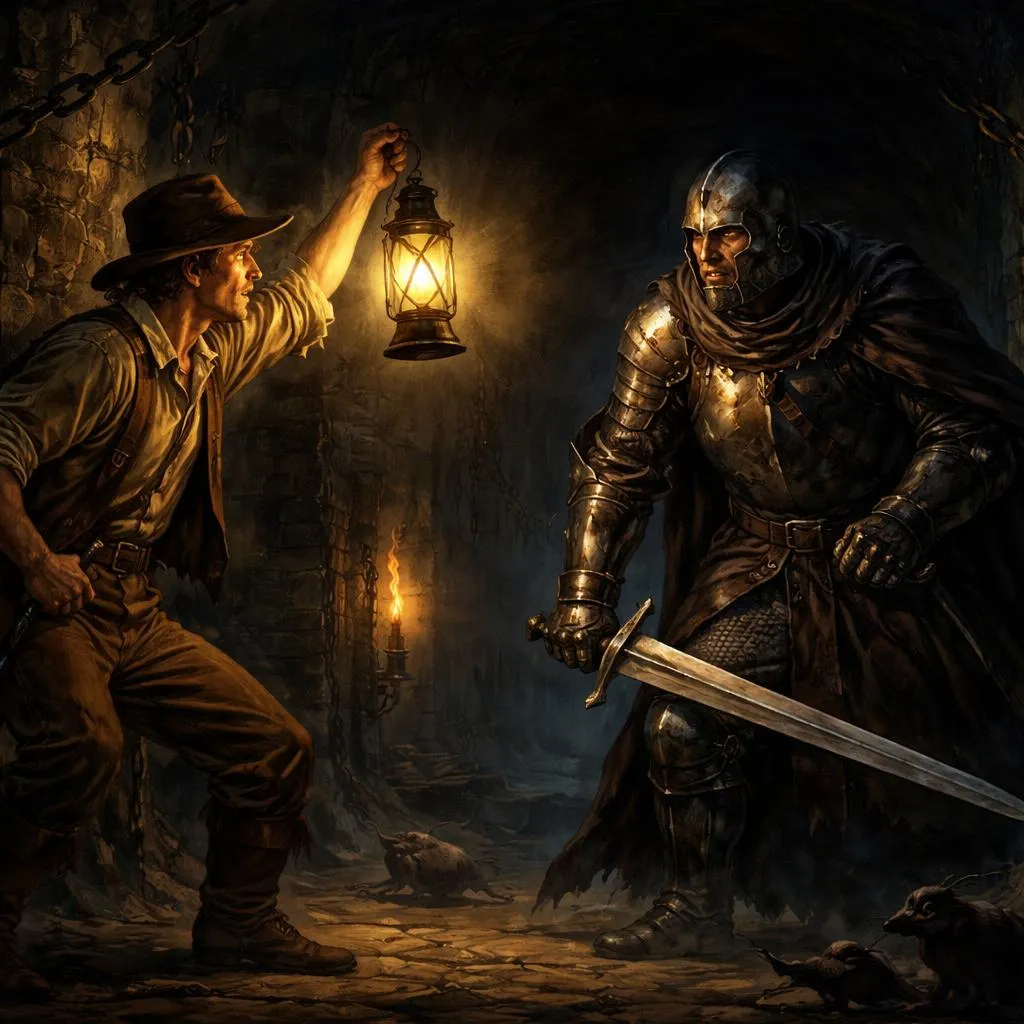

London—to a slave—was a sufficiently interesting place. It was merely a great big village; and mainly mud and thatch. The streets were muddy, crooked, unpaved. The populace was an ever flocking and drifting swarm of rags, and splendors, of nodding plumes and shining armor. The king had a palace there; he saw the outside of it. It made him sigh; yes, and swear a little, in a poor juvenile sixth century way. We saw knights and grandees whom we knew, but they didn’t know us in our rags and dirt and raw welts and bruises, and wouldn’t have recognized us if we had hailed them, nor stopped to answer, either, it being unlawful to speak with slaves on a chain. Sandy passed within ten yards of me on a mule—hunting for me, I imagined. But the thing which clean broke my heart was something which happened in front of our old barrack in a square, while we were enduring the spectacle of a man being boiled to death in oil for counterfeiting pennies. It was the sight of a newsboy—and I couldn’t get at him! Still, I had one comfort—here was proof that Clarence was still alive and banging away. I meant to be with him before long; the thought was full of cheer.
I had one little glimpse of another thing, one day, which gave me a great uplift. It was a wire stretching from housetop to housetop. Telegraph or telephone, sure. I did very much wish I had a little piece of it. It was just what I needed, in order to carry out my project of escape. My idea was to get loose some night, along with the king, then gag and bind our master, change clothes with him, batter him into the aspect of a stranger, hitch him to the slave-chain, assume possession of the property, march to Camelot, and—
But you get my idea; you see what a stunning dramatic surprise I would wind up with at the palace. It was all feasible, if I could only get hold of a slender piece of iron which I could shape into a lock-pick. I could then undo the lumbering padlocks with which our chains were fastened, whenever I might choose. But I never had any luck; no such thing ever happened to fall in my way. However, my chance came at last. A gentleman who had come twice before to dicker for me, without result, or indeed any approach to a result, came again. I was far from expecting ever to belong to him, for the price asked for me from the time I was first enslaved was exorbitant, and always provoked either anger or derision, yet my master stuck stubbornly to it—twenty-two dollars. He wouldn’t bate a cent. The king was greatly admired, because of his grand physique, but his kingly style was against him, and he wasn’t salable; nobody wanted that kind of a slave. I considered myself safe from parting from him because of my extravagant price. No, I was not expecting to ever belong to this gentleman whom I have spoken of, but he had something which I expected would belong to me eventually, if he would but visit us often enough. It was a steel thing with a long pin to it, with which his long cloth outside garment was fastened together in front. There were three of them. He had disappointed me twice, because he did not come quite close enough to me to make my project entirely safe; but this time I succeeded; I captured the lower clasp of the three, and when he missed it he thought he had lost it on the way.
I had a chance to be glad about a minute, then straightway a chance to be sad again. For when the purchase was about to fail, as usual, the master suddenly spoke up and said what would be worded thus —in modern English:
“I’ll tell you what I’ll do. I’m tired supporting these two for no good. Give me twenty-two dollars for this one, and I’ll throw the other one in.”
The king couldn’t get his breath, he was in such a fury. He began to choke and gag, and meantime the master and the gentleman moved away discussing.
“An ye will keep the offer open—”
“’Tis open till the morrow at this hour.”
“Then I will answer you at that time,” said the gentleman, and disappeared, the master following him.
I had a time of it to cool the king down, but I managed it. I whispered in his ear, to this effect:
“Your grace will go for nothing, but after another fashion. And so shall I. To-night we shall both be free.”
“Ah! How is that?”
“With this thing which I have stolen, I will unlock these locks and cast off these chains to-night. When he comes about nine-thirty to inspect us for the night, we will seize him, gag him, batter him, and early in the morning we will march out of this town, proprietors of this caravan of slaves.”
That was as far as I went, but the king was charmed and satisfied. That evening we waited patiently for our fellow-slaves to get to sleep and signify it by the usual sign, for you must not take many chances on those poor fellows if you can avoid it. It is best to keep your own secrets. No doubt they fidgeted only about as usual, but it didn’t seem so to me. It seemed to me that they were going to be forever getting down to their regular snoring. As the time dragged on I got nervously afraid we shouldn’t have enough of it left for our needs; so I made several premature attempts, and merely delayed things by it; for I couldn’t seem to touch a padlock, there in the dark, without starting a rattle out of it which interrupted somebody’s sleep and made him turn over and wake some more of the gang.
But finally I did get my last iron off, and was a free man once more. I took a good breath of relief, and reached for the king’s irons. Too late! in comes the master, with a light in one hand and his heavy walking-staff in the other. I snuggled close among the wallow of snorers, to conceal as nearly as possible that I was naked of irons; and I kept a sharp lookout and prepared to spring for my man the moment he should bend over me.
But he didn’t approach. He stopped, gazed absently toward our dusky mass a minute, evidently thinking about something else; then set down his light, moved musingly toward the door, and before a body could imagine what he was going to do, he was out of the door and had closed it behind him.
“Quick!” said the king. “Fetch him back!”
Of course, it was the thing to do, and I was up and out in a moment. But, dear me, there were no lamps in those days, and it was a dark night. But I glimpsed a dim figure a few steps away. I darted for it, threw myself upon it, and then there was a state of things and lively! We fought and scuffled and struggled, and drew a crowd in no time. They took an immense interest in the fight and encouraged us all they could, and, in fact, couldn’t have been pleasanter or more cordial if it had been their own fight. Then a tremendous row broke out behind us, and as much as half of our audience left us, with a rush, to invest some sympathy in that. Lanterns began to swing in all directions; it was the watch gathering from far and near. Presently a halberd fell across my back, as a reminder, and I knew what it meant. I was in custody. So was my adversary. We were marched off toward prison, one on each side of the watchman. Here was disaster, here was a fine scheme gone to sudden destruction! I tried to imagine what would happen when the master should discover that it was I who had been fighting him; and what would happen if they jailed us together in the general apartment for brawlers and petty law-breakers, as was the custom; and what might—
Just then my antagonist turned his face around in my direction, the freckled light from the watchman’s tin lantern fell on it, and, by George, he was the wrong man!
背景介绍和作者介绍
这个故事设定在一个生动、历史悠久的伦敦,通过一个奴隶的视角来展现。它捕捉了在中世纪般的背景下,在奴役下的严酷现实和挣扎,融合了冒险、希望和韧性的元素。叙事风格表明它可能来自一部针对年轻读者或对勇气和逃生故事感兴趣的人的经典或历史小说。
作者,虽然这里没有提及名字,但他对细节有着敏锐的洞察力,并且对人类情感,特别是对自由和尊严的渴望有着深刻的理解。故事的语气既反思又充满希望,邀请读者同情主人公的困境,并为他的解放而欢呼。
详细解读和意义
从根本上说,这个故事探讨了压迫和不屈不挠的人类精神的主题。主人公,一个奴隶,以智慧和勇气在严酷的囚禁世界中航行。他逃跑的计划,包括巧妙地使用偷来的扣环和大胆的伪装,象征着即使在最黑暗的环境下,希望和创造力的力量。
背景——泥泞的街道,骑士和国王的存在,以及对一个伪造者的残酷惩罚——描绘了一幅严酷的社会景象,在那里正义是严厉的,自由是一个遥远的梦想。然而,主人公争取自由的决心以及国王(他也被奴役)突出了对自由和自决的普遍渴望。
这个故事还触及了奴隶之间的团结、反叛的风险以及秘密和耐心的重要性。主人公的内心独白和互动揭示了他的领导才能和战略思维,这些都是克服逆境的宝贵特质。
给学生的教训和见解
-
勇气和韧性: 尽管条件恶劣,主人公从未放弃。这教导学生在面对生活或学习中的挑战时,坚持不懈的重要性。
-
创造力和解决问题: 他使用一个简单的扣环作为开锁工具的逃生计划鼓励创造性思维和足智多谋,这些都是学习和解决现实世界问题的基本技能。
-
同情和理解: 通过从奴隶的角度看世界,学生们学会了同情那些遭受不公正的人,以及反对压迫的价值。
-
希望和乐观: 即使在可怕的情况下,保持希望也能激发行动和改变。这种积极的心态对于个人成长和实现目标至关重要。
在日常生活和学习中的应用
-
在学校: 学生们可以通过像主人公一样,以耐心和创造性的策略来应对困难的科目,就像他精心计划逃生一样,来运用主人公的决心。
-
在社交场合: 这个故事鼓励为公平而战,并帮助那些可能被边缘化或受到不公平待遇的人,培养善良和领导力。
-
在个人成长中: 效仿主人公的希望和韧性,帮助学生培养精神力量和信心,以应对生活中的不确定性。
从故事中培养积极的特质
-
耐心: 等待合适的时机采取行动是一个关键的教训,教导学生不要仓促行事,而是要充分准备。
-
战略思维: 在采取行动之前仔细计划至关重要,无论是在学术、体育还是社交挑战中。
-
行动的勇气: 当时机到来时,勇敢是追求自由或成功的必要条件,激励学生在他们的抱负中大胆。
结论
这个故事不仅仅是一个逃生故事;它是一堂关于人类尊严、勇气和希望的有力课程。通过学习它,学生可以获得对历史的见解,培养同情心,并学习超越书本的宝贵的生活技能。它鼓励年轻读者在自己的生活中大胆梦想、聪明思考和勇敢行动。
