
The circumstances under which this telegraphic dispatch about Phileas Fogg was sent were as follows:
The steamer Mongolia, belonging to the Peninsular and Oriental Company, built of iron, of two thousand eight hundred tons burden, and five hundred horse–power, was due at eleven o'clock a.m. on Wednesday, the 9th of October, at Suez. The Mongolia plied regularly between Brindisi and Bombay via the Suez Canal, and was one of the fastest steamers belonging to the company, always making more than ten knots an hour between Brindisi and Suez, and nine and a half between Suez and Bombay.
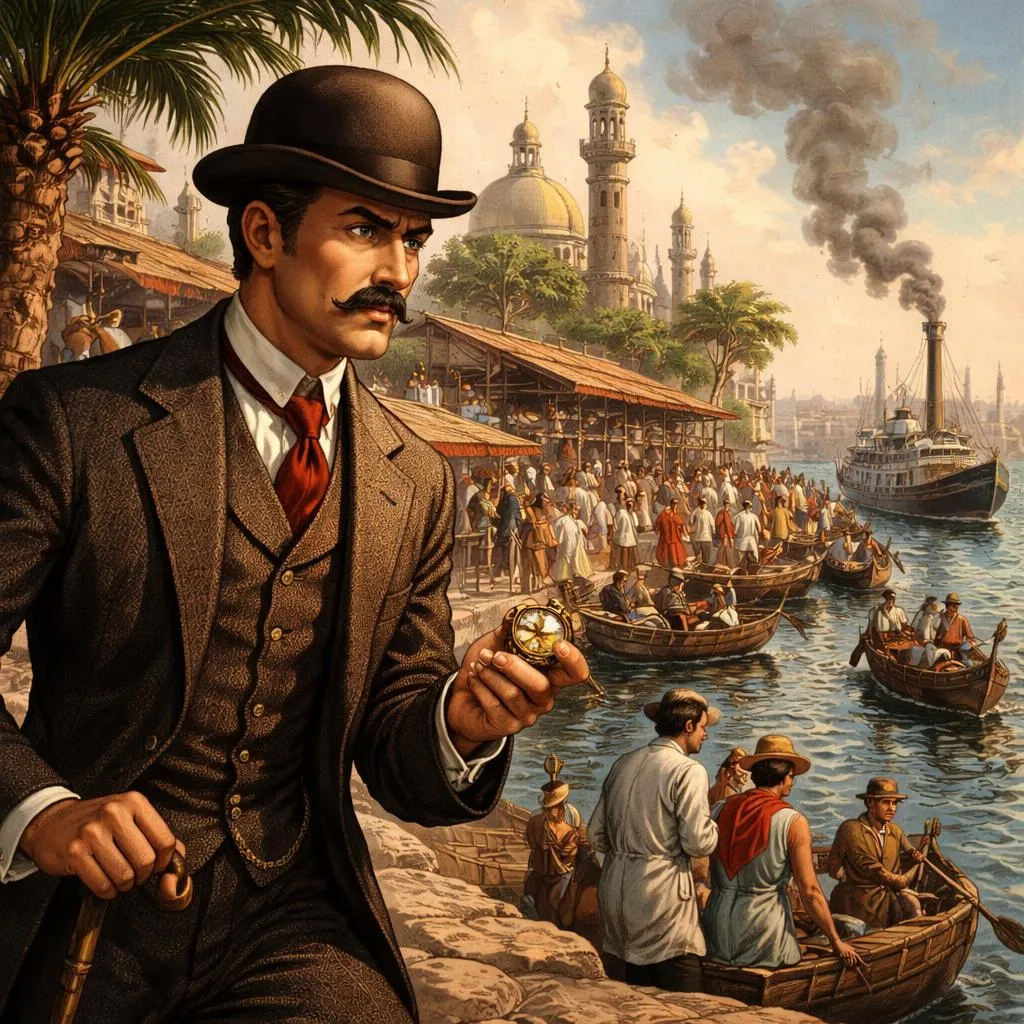
Two men were promenading up and down the wharves, among the crowd of natives and strangers who were sojourning at this once straggling village—now, thanks to the enterprise of M. Lesseps, a fast–growing town. One was the British consul at Suez, who, despite the prophecies of the English Government, and the unfavourable predictions of Stephenson, was in the habit of seeing, from his office window, English ships daily passing to and fro on the great canal, by which the old roundabout route from England to India by the Cape of Good Hope was abridged by at least a half. The other was a small, slight–built personage, with a nervous, intelligent face, and bright eyes peering out from under eyebrows which he was incessantly twitching. He was just now manifesting unmistakable signs of impatience, nervously pacing up and down, and unable to stand still for a moment. This was Fix, one of the detectives who had been dispatched from England in search of the bank robber; it was his task to narrowly watch every passenger who arrived at Suez, and to follow up all who seemed to be suspicious characters, or bore a resemblance to the description of the criminal, which he had received two days before from the police headquarters at London. The detective was evidently inspired by the hope of obtaining the splendid reward which would be the prize of success, and awaited with a feverish impatience, easy to understand, the arrival of the steamer Mongolia.
"So you say, consul," asked he for the twentieth time, "that this steamer is never behind time?"
"No, Mr. Fix," replied the consul. "She was bespoken yesterday at Port Said, and the rest of the way is of no account to such a craft. I repeat that the Mongolia has been in advance of the time required by the company's regulations, and gained the prize awarded for excess of speed."
"Does she come directly from Brindisi?"
"Directly from Brindisi; she takes on the Indian mails there, and she left there Saturday at five p.m. Have patience, Mr. Fix; she will not be late. But really, I don't see how, from the description you have, you will be able to recognise your man, even if he is on board the Mongolia."
"A man rather feels the presence of these fellows, consul, than recognises them. You must have a scent for them, and a scent is like a sixth sense which combines hearing, seeing, and smelling. I've arrested more than one of these gentlemen in my time, and, if my thief is on board, I'll answer for it; he'll not slip through my fingers."
"I hope so, Mr. Fix, for it was a heavy robbery."
"A magnificent robbery, consul; fifty–five thousand pounds! We don't often have such windfalls. Burglars are getting to be so contemptible nowadays! A fellow gets hung for a handful of shillings!"
"Mr. Fix," said the consul, "I like your way of talking, and hope you'll succeed; but I fear you will find it far from easy. Don't you see, the description which you have there has a singular resemblance to an honest man?"
"Consul," remarked the detective, dogmatically, "great robbers always resemble honest folks. Fellows who have rascally faces have only one course to take, and that is to remain honest; otherwise they would be arrested off–hand. The artistic thing is, to unmask honest countenances; it's no light task, I admit, but a real art."
Mr. Fix evidently was not wanting in a tinge of self–conceit.
Little by little the scene on the quay became more animated; sailors of various nations, merchants, ship–brokers, porters, fellahs, bustled to and fro as if the steamer were immediately expected. The weather was clear, and slightly chilly. The minarets of the town loomed above the houses in the pale rays of the sun. A jetty pier, some two thousand yards along, extended into the roadstead. A number of fishing–smacks and coasting boats, some retaining the fantastic fashion of ancient galleys, were discernible on the Red Sea.
As he passed among the busy crowd, Fix, according to habit, scrutinised the passers–by with a keen, rapid glance.
It was now half–past ten.
"The steamer doesn't come!" he exclaimed, as the port clock struck.
"She can't be far off now," returned his companion.
"How long will she stop at Suez?"
"Four hours; long enough to get in her coal. It is thirteen hundred and ten miles from Suez to Aden, at the other end of the Red Sea, and she has to take in a fresh coal supply."
"And does she go from Suez directly to Bombay?"
"Without putting in anywhere."
"Good!" said Fix. "If the robber is on board he will no doubt get off at Suez, so as to reach the Dutch or French colonies in Asia by some other route. He ought to know that he would not be safe an hour in India, which is English soil."
"Unless," objected the consul, "he is exceptionally shrewd. An English criminal, you know, is always better concealed in London than anywhere else."
This observation furnished the detective food for thought, and meanwhile the consul went away to his office. Fix, left alone, was more impatient than ever, having a presentiment that the robber was on board the Mongolia. If he had indeed left London intending to reach the New World, he would naturally take the route via India, which was less watched and more difficult to watch than that of the Atlantic. But Fix's reflections were soon interrupted by a succession of sharp whistles, which announced the arrival of the Mongolia. The porters and fellahs rushed down the quay, and a dozen boats pushed off from the shore to go and meet the steamer. Soon her gigantic hull appeared passing along between the banks, and eleven o'clock struck as she anchored in the road. She brought an unusual number of passengers, some of whom remained on deck to scan the picturesque panorama of the town, while the greater part disembarked in the boats, and landed on the quay.
Fix took up a position, and carefully examined each face and figure which made its appearance. Presently one of the passengers, after vigorously pushing his way through the importunate crowd of porters, came up to him and politely asked if he could point out the English consulate, at the same time showing a passport which he wished to have visaed. Fix instinctively took the passport, and with a rapid glance read the description of its bearer. An involuntary motion of surprise nearly escaped him, for the description in the passport was identical with that of the bank robber which he had received from Scotland Yard.
"Is this your passport?" asked he.
"No, it's my master's."
"And your master is—"
"He stayed on board."
"But he must go to the consul's in person, so as to establish his identity."
"Oh, is that necessary?"
"Quite indispensable."
"And where is the consulate?"
"There, on the corner of the square," said Fix, pointing to a house two hundred steps off.
"I'll go and fetch my master, who won't be much pleased, however, to be disturbed."
The passenger bowed to Fix, and returned to the steamer.
背景和作者介绍
这段摘录选自法国作家儒勒·凡尔纳于1873年创作的经典冒险小说《八十天环游地球》。凡尔纳被誉为科幻小说和冒险文学的先驱之一。他的作品常常将详细的科学知识与引人入胜的叙事相结合,激励了一代又一代的读者去探索世界,并想象新的可能性。《八十天环游地球》捕捉了19世纪对旅行、技术和探索的迷恋,故事围绕着一位一丝不苟的英国绅士福格展开,他打赌自己能在短短八十天内环游地球。
详细的故事解读和意义
在这段文字中,我们看到侦探费克斯焦急地等待着“蒙古号”汽船抵达苏伊士运河,希望抓住一名据信在船上的银行劫匪。场景生动而热闹,展现了苏伊士运河作为连接欧洲和亚洲的战略要地的地位。费克斯和英国领事之间的对话突出了怀疑、身份以及区分真相和表象的挑战等主题。费克斯认为大罪犯往往看起来像诚实的人,这为故事增添了一层讽刺和复杂性,提醒读者外表可能具有欺骗性。
故事的这一部分为福格的旅程展开后的悬念和阴谋埋下了伏笔。它也反映了当时的科技进步——汽船、电报和全球通讯——这些使得这样的旅程成为可能,并激发了世界各地读者的想象力。
给学生的启示和见解
-
批判性思维和感知: 费克斯难以仅凭外表识别罪犯,这告诉我们不应该仅仅根据外表来评判人。相反,我们应该培养批判性思维能力,深入研究事实和行为,然后再形成自己的观点。
-
耐心和观察: 费克斯的等待和对乘客的仔细观察表明了耐心和注重细节的重要性——这些技能在学术研究和日常生活中都很有价值。
-
勇气和决心: 福格的旅程,在这段文字中有所暗示,证明了人类的勇气和决心。学生们可以学会设定雄心勃勃的目标,并坚持不懈地追求它们,即使面临不确定性。
-
技术和创新的价值: 这部小说赞美了汽船和电报等新技术的力量,鼓励学生欣赏科学进步及其对社会的影响。
在生活、学习和社会交往中的应用
-
在学习中: 就像费克斯仔细分析线索一样,学生们应该培养强大的观察和分析能力,以解决问题和理解复杂的主题。
-
在社交互动中: 故事告诫人们不要对他人妄下判断。学生们可以通过了解人们的真实情况,而不是仅仅通过第一印象来练习同情心和开放的心态。
-
在个人成长中: 福格所展现的冒险精神和韧性鼓励学生们拥抱挑战,并在压力下保持冷静,这些品质将帮助他们在考试、项目和未来的职业生涯中取得成功。
从故事中培养积极的价值观
-
诚实和正直: 尽管侦探有所怀疑,但小说最终颂扬了诚实。学生们应该努力在他们的行动中做到值得信赖和真诚。
-
好奇心和开放的心态: 凡尔纳的作品激发了对世界的好奇心。学生们可以通过探索新的文化、科学和思想来培养对学习的热爱。
-
毅力: 福格对目标的坚定承诺教会了我们坚持不懈的重要性,即使遇到障碍。
结论
《八十天环游地球》不仅仅是一场激动人心的冒险;它还是关于人性、技术和探索精神的丰富教训的来源。通过阅读和思考这个故事,学生们可以培养有价值的技能和态度,这些将使他们在学校和生活中受益。拥抱小说中体现的好奇心、耐心和决心,可以帮助年轻读者成为有思想、勇敢和开放的人,准备好在世界上开启自己的旅程。
