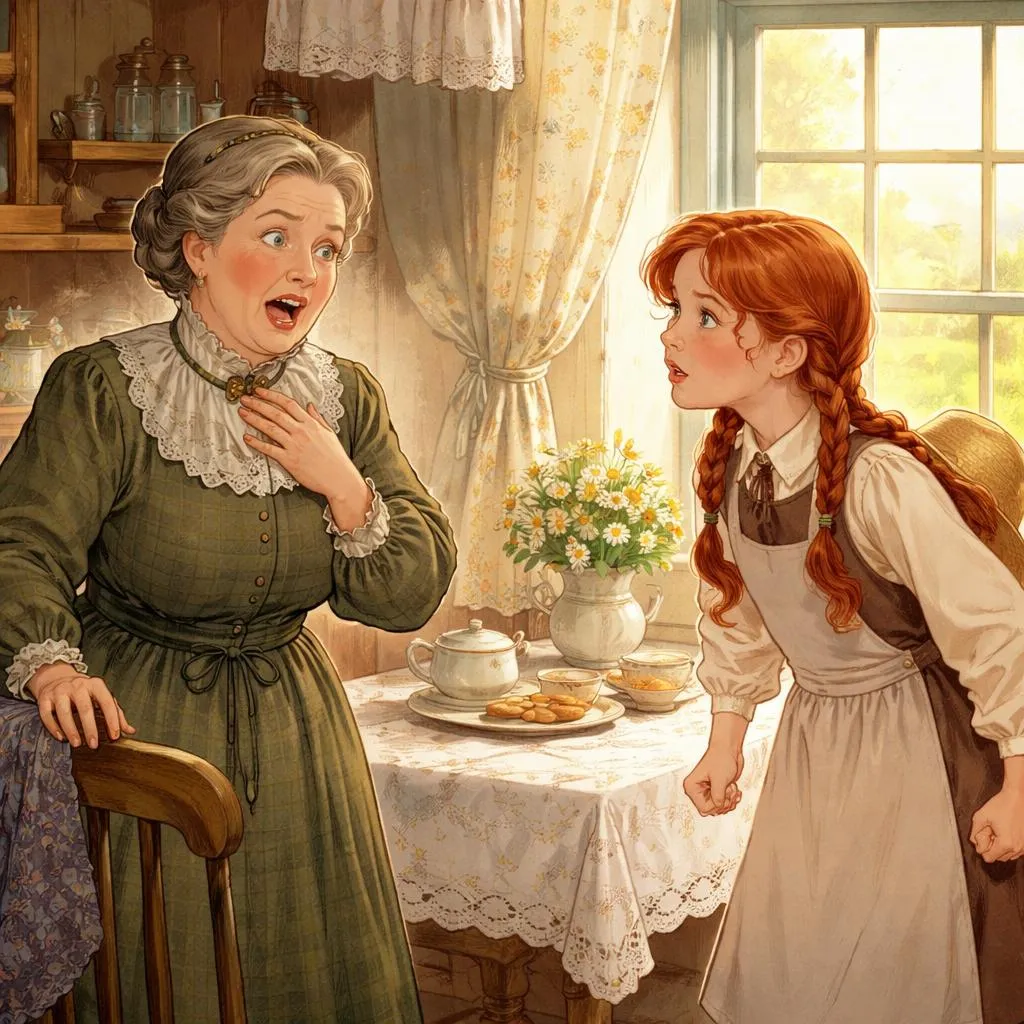

Anne had been a fortnight at Green Gables before Mrs. Lynde arrived to inspect her. Mrs. Rachel, to do her justice, was not to blame for this. A severe and unseasonable attack of grippe had confined that good lady to her house ever since the occasion of her last visit to Green Gables. Mrs. Rachel was not often sick and had a well-defined contempt for people who were; but grippe, she asserted, was like no other illness on earth and could only be interpreted as one of the special visitations of Providence. As soon as her doctor allowed her to put her foot out-of-doors she hurried up to Green Gables, bursting with curiosity to see Matthew and Marilla’s orphan, concerning whom all sorts of stories and suppositions had gone abroad in Avonlea.
Anne had made good use of every waking moment of that fortnight. Already she was acquainted with every tree and shrub about the place. She had discovered that a lane opened out below the apple orchard and ran up through a belt of woodland; and she had explored it to its furthest end in all its delicious vagaries of brook and bridge, fir coppice and wild cherry arch, corners thick with fern, and branching byways of maple and mountain ash.
She had made friends with the spring down in the hollow—that wonderful deep, clear icy-cold spring; it was set about with smooth red sandstones and rimmed in by great palm-like clumps of water fern; and beyond it was a log bridge over the brook.
That bridge led Anne’s dancing feet up over a wooded hill beyond, where perpetual twilight reigned under the straight, thick-growing firs and spruces; the only flowers there were myriads of delicate “June bells,” those shyest and sweetest of woodland blooms, and a few pale, aerial starflowers, like the spirits of last year’s blossoms. Gossamers glimmered like threads of silver among the trees and the fir boughs and tassels seemed to utter friendly speech.
All these raptured voyages of exploration were made in the odd half hours which she was allowed for play, and Anne talked Matthew and Marilla half-deaf over her discoveries. Not that Matthew complained, to be sure; he listened to it all with a wordless smile of enjoyment on his face; Marilla permitted the “chatter” until she found herself becoming too interested in it, whereupon she always promptly quenched Anne by a curt command to hold her tongue.
Anne was out in the orchard when Mrs. Rachel came, wandering at her own sweet will through the lush, tremulous grasses splashed with ruddy evening sunshine; so that good lady had an excellent chance to talk her illness fully over, describing every ache and pulse beat with such evident enjoyment that Marilla thought even grippe must bring its compensations. When details were exhausted Mrs. Rachel introduced the real reason of her call.
“I’ve been hearing some surprising things about you and Matthew.”
“I don’t suppose you are any more surprised than I am myself,” said Marilla. “I’m getting over my surprise now.”
“It was too bad there was such a mistake,” said Mrs. Rachel sympathetically. “Couldn’t you have sent her back?”
“I suppose we could, but we decided not to. Matthew took a fancy to her. And I must say I like her myself—although I admit she has her faults. The house seems a different place already. She’s a real bright little thing.”
Marilla said more than she had intended to say when she began, for she read disapproval in Mrs. Rachel’s expression.
“It’s a great responsibility you’ve taken on yourself,” said that lady gloomily, “especially when you’ve never had any experience with children. You don’t know much about her or her real disposition, I suppose, and there’s no guessing how a child like that will turn out. But I don’t want to discourage you I’m sure, Marilla.”
“I’m not feeling discouraged,” was Marilla’s dry response, “when I make up my mind to do a thing it stays made up. I suppose you’d like to see Anne. I’ll call her in.”
Anne came running in presently, her face sparkling with the delight of her orchard rovings; but, abashed at finding the delight herself in the unexpected presence of a stranger, she halted confusedly inside the door. She certainly was an odd-looking little creature in the short tight wincey dress she had worn from the asylum, below which her thin legs seemed ungracefully long. Her freckles were more numerous and obtrusive than ever; the wind had ruffled her hatless hair into over-brilliant disorder; it had never looked redder than at that moment.
“Well, they didn’t pick you for your looks, that’s sure and certain,” was Mrs. Rachel Lynde’s emphatic comment. Mrs. Rachel was one of those delightful and popular people who pride themselves on speaking their mind without fear or favor. “She’s terrible skinny and homely, Marilla. Come here, child, and let me have a look at you. Lawful heart, did any one ever see such freckles? And hair as red as carrots! Come here, child, I say.”
Anne “came there,” but not exactly as Mrs. Rachel expected. With one bound she crossed the kitchen floor and stood before Mrs. Rachel, her face scarlet with anger, her lips quivering, and her whole slender form trembling from head to foot.
“I hate you,” she cried in a choked voice, stamping her foot on the floor. “I hate you—I hate you—I hate you—” a louder stamp with each assertion of hatred. “How dare you call me skinny and ugly? How dare you say I’m freckled and redheaded? You are a rude, impolite, unfeeling woman!”
“Anne!” exclaimed Marilla in consternation.
But Anne continued to face Mrs. Rachel undauntedly, head up, eyes blazing, hands clenched, passionate indignation exhaling from her like an atmosphere.
“How dare you say such things about me?” she repeated vehemently. “How would you like to have such things said about you? How would you like to be told that you are fat and clumsy and probably hadn’t a spark of imagination in you? I don’t care if I do hurt your feelings by saying so! I hope I hurt them. You have hurt mine worse than they were ever hurt before even by Mrs. Thomas’ intoxicated husband. And I’ll NEVER forgive you for it, never, never!”
Stamp! Stamp!
“Did anybody ever see such a temper!” exclaimed the horrified Mrs. Rachel.
“Anne go to your room and stay there until I come up,” said Marilla, recovering her powers of speech with difficulty.
Anne, bursting into tears, rushed to the hall door, slammed it until the tins on the porch wall outside rattled in sympathy, and fled through the hall and up the stairs like a whirlwind. A subdued slam above told that the door of the east gable had been shut with equal vehemence.
“Well, I don’t envy you your job bringing THAT up, Marilla,” said Mrs. Rachel with unspeakable solemnity.
Marilla opened her lips to say she knew not what of apology or deprecation. What she did say was a surprise to herself then and ever afterwards.
“You shouldn’t have twitted her about her looks, Rachel.”
“Marilla Cuthbert, you don’t mean to say that you are upholding her in such a terrible display of temper as we’ve just seen?” demanded Mrs. Rachel indignantly.
“No,” said Marilla slowly, “I’m not trying to excuse her. She’s been very naughty and I’ll have to give her a talking to about it. But we must make allowances for her. She’s never been taught what is right. And you WERE too hard on her, Rachel.”
Marilla could not help tacking on that last sentence, although she was again surprised at herself for doing it. Mrs. Rachel got up with an air of offended dignity.
“Well, I see that I’ll have to be very careful what I say after this, Marilla, since the fine feelings of orphans, brought from goodness knows where, have to be considered before anything else. Oh, no, I’m not vexed—don’t worry yourself. I’m too sorry for you to leave any room for anger in my mind. You’ll have your own troubles with that child. But if you’ll take my advice—which I suppose you won’t do, although I’ve brought up ten children and buried two—you’ll do that ‘talking to’ you mention with a fair-sized birch switch. I should think THAT would be the most effective language for that kind of a child. Her temper matches her hair I guess. Well, good evening, Marilla. I hope you’ll come down to see me often as usual. But you can’t expect me to visit here again in a hurry, if I’m liable to be flown at and insulted in such a fashion. It’s something new in MY experience.”
Whereat Mrs. Rachel swept out and away—if a fat woman who always waddled COULD be said to sweep away—and Marilla with a very solemn face betook herself to the east gable.
On the way upstairs she pondered uneasily as to what she ought to do. She felt no little dismay over the scene that had just been enacted. How unfortunate that Anne should have displayed such temper before Mrs. Rachel Lynde, of all people! Then Marilla suddenly became aware of an uncomfortable and rebuking consciousness that she felt more humiliation over this than sorrow over the discovery of such a serious defect in Anne’s disposition. And how was she to punish her? The amiable suggestion of the birch switch—to the efficiency of which all of Mrs. Rachel’s own children could have borne smarting testimony—did not appeal to Marilla. She did not believe she could whip a child. No, some other method of punishment must be found to bring Anne to a proper realization of the enormity of her offense.
Marilla found Anne face downward on her bed, crying bitterly, quite oblivious of muddy boots on a clean counterpane.
“Anne,” she said not ungently.
No answer.
“Anne,” with greater severity, “get off that bed this minute and listen to what I have to say to you.”
Anne squirmed off the bed and sat rigidly on a chair beside it, her face swollen and tear-stained and her eyes fixed stubbornly on the floor.
“This is a nice way for you to behave. Anne! Aren’t you ashamed of yourself?”
“She hadn’t any right to call me ugly and redheaded,” retorted Anne, evasive and defiant.
“You hadn’t any right to fly into such a fury and talk the way you did to her, Anne. I was ashamed of you—thoroughly ashamed of you. I wanted you to behave nicely to Mrs. Lynde, and instead of that you have disgraced me. I’m sure I don’t know why you should lose your temper like that just because Mrs. Lynde said you were red-haired and homely. You say it yourself often enough.”
“Oh, but there’s such a difference between saying a thing yourself and hearing other people say it,” wailed Anne. “You may know a thing is so, but you can’t help hoping other people don’t quite think it is. I suppose you think I have an awful temper, but I couldn’t help it. When she said those things something just rose right up in me and choked me. I HAD to fly out at her.”
“Well, you made a fine exhibition of yourself I must say. Mrs. Lynde will have a nice story to tell about you everywhere—and she’ll tell it, too. It was a dreadful thing for you to lose your temper like that, Anne.”
“Just imagine how you would feel if somebody told you to your face that you were skinny and ugly,” pleaded Anne tearfully.
An old remembrance suddenly rose up before Marilla. She had been a very small child when she had heard one aunt say of her to another, “What a pity she is such a dark, homely little thing.” Marilla was every day of fifty before the sting had gone out of that memory.
“I don’t say that I think Mrs. Lynde was exactly right in saying what she did to you, Anne,” she admitted in a softer tone. “Rachel is too outspoken. But that is no excuse for such behavior on your part. She was a stranger and an elderly person and my visitor—all three very good reasons why you should have been respectful to her. You were rude and saucy and”—Marilla had a saving inspiration of punishment—”you must go to her and tell her you are very sorry for your bad temper and ask her to forgive you.”
“I can never do that,” said Anne determinedly and darkly. “You can punish me in any way you like, Marilla. You can shut me up in a dark, damp dungeon inhabited by snakes and toads and feed me only on bread and water and I shall not complain. But I cannot ask Mrs. Lynde to forgive me.”
“We’re not in the habit of shutting people up in dark damp dungeons,” said Marilla drily, “especially as they’re rather scarce in Avonlea. But apologize to Mrs. Lynde you must and shall and you’ll stay here in your room until you can tell me you’re willing to do it.”
“I shall have to stay here forever then,” said Anne mournfully, “because I can’t tell Mrs. Lynde I’m sorry I said those things to her. How can I? I’m NOT sorry. I’m sorry I’ve vexed you; but I’m GLAD I told her just what I did. It was a great satisfaction. I can’t say I’m sorry when I’m not, can I? I can’t even IMAGINE I’m sorry.”
“Perhaps your imagination will be in better working order by the morning,” said Marilla, rising to depart. “You’ll have the night to think over your conduct in and come to a better frame of mind. You said you would try to be a very good girl if we kept you at Green Gables, but I must say it hasn’t seemed very much like it this evening.”
Leaving this Parthian shaft to rankle in Anne’s stormy bosom, Marilla descended to the kitchen, grievously troubled in mind and vexed in soul. She was as angry with herself as with Anne, because, whenever she recalled Mrs. Rachel’s dumbfounded countenance her lips twitched with amusement and she felt a most reprehensible desire to laugh.
背景介绍和作者介绍
这段摘录出自加拿大作家露西·莫德·蒙哥马利所著的经典小说《绿山墙的安妮》,该书于1908年首次出版。故事发生在加拿大爱德华王子岛虚构的埃文利村。它讲述了安妮·雪莉的冒险和成长,她是一位充满想象力和活力的孤儿,被误送到与马修和玛丽拉·卡斯伯特一起生活,这对兄妹原本打算收养一个男孩来帮助他们打理农场。
露西·莫德·蒙哥马利从她自己的童年经历和爱德华王子岛美丽的风景中汲取灵感。《绿山墙的安妮》已成为世界各地儿童文学中最受欢迎的作品之一,因其生动的人物、丰富的描写以及关于归属感、身份认同和韧性的主题而广受赞誉。
详细解读和意义
这段话捕捉了安妮在绿山墙生活的早期和关键时刻,揭示了她火热的性格和敏感。瑞秋·林德太太对安妮外貌的直率批评引发了安妮的强烈爆发,尽管她还年轻且脆弱,但她还是激烈地为自己辩护。这一幕突出了安妮的复杂性:她既骄傲又缺乏安全感,富有想象力又急躁。
玛丽拉的反应表明了抚养像安妮这样的孩子所面临的挑战,尤其是对于一个在社交行为方面没有任何指导的孩子。安妮的情感诚实与礼貌社会期望之间的紧张关系是贯穿整部小说的主题。它也引出了一个观点,即真正的理解和耐心对于培养孩子的成长是必要的。
这个故事探讨了善良、接纳和想象力的力量的重要性。安妮生动的内心世界帮助她应对孤独和拒绝,而她在绿山墙的旅程象征着对家和身份的普遍追求。
给学生的教训和见解
-
**情感表达和自我控制:**安妮的强烈反应告诉学生,感到受伤和愤怒是正常的,但学会以建设性的方式表达情绪很重要。在不让情绪控制行为的情况下认识到情绪是个人成长中的一项宝贵技能。
-
**同情和理解:**玛丽拉努力管教安妮,同时表现出同情心,这鼓励读者在评判他人的行为之前,先考虑他人的背景和挑战。这培养了人际关系中的同情心和耐心。
-
**韧性和乐观:**尽管困难重重,安妮的精神依然不屈不挠。学生可以学会勇敢而充满希望地面对逆境,理解挫折是人生旅程的一部分。
-
**想象力的价值:**安妮富有想象力的天性丰富了她的生活,并帮助她在别人可能看不到的地方看到美。鼓励创造力可以激发学生的解决问题能力和情感韧性。
将这些教训应用于日常生活
-
**在学校:**学生可以像玛丽拉学会理解安妮一样,对看起来与众不同或难以相处的同学练习耐心和善良。在冲突期间管理情绪有助于维持友谊和积极的学习环境。
-
**在社交场合:**安妮的故事提醒年轻人要接纳自己和他人,拥抱个性,而不是遵循像外貌这样的肤浅标准。
-
**在个人成长中:**培养同情心和韧性可以帮助学生应对挑战,无论是学业压力还是社交斗争,都要保持乐观和开放的心态。
从故事中培养积极的品质
-
**耐心:**像玛丽拉一样,成年人和学生都可以学会对别人的不完美和错误保持耐心,理解成长需要时间。
-
**尊重的沟通:**安妮的经历表明了诚实而尊重地说话的重要性,以及在自己的言语或行为伤害到他人时道歉的重要性。
-
**自我接纳:**安妮与外貌的斗争教会了我们完全接纳自己的价值,包括感知到的缺陷,并在外部判断之外找到自信。
-
**想象力和好奇心:**鼓励探索和创造力,就像安妮在周围环境中做的那样,可以培养对学习和发现的终生热爱。
《绿山墙的安妮》仍然是一个永恒的故事,引起了所有年龄段读者的共鸣,提供了关于人性、善良和想象力力量的丰富教训。参与安妮冒险的学生不仅可以获得文学鉴赏力,还可以获得指导自己生活的实用智慧。
