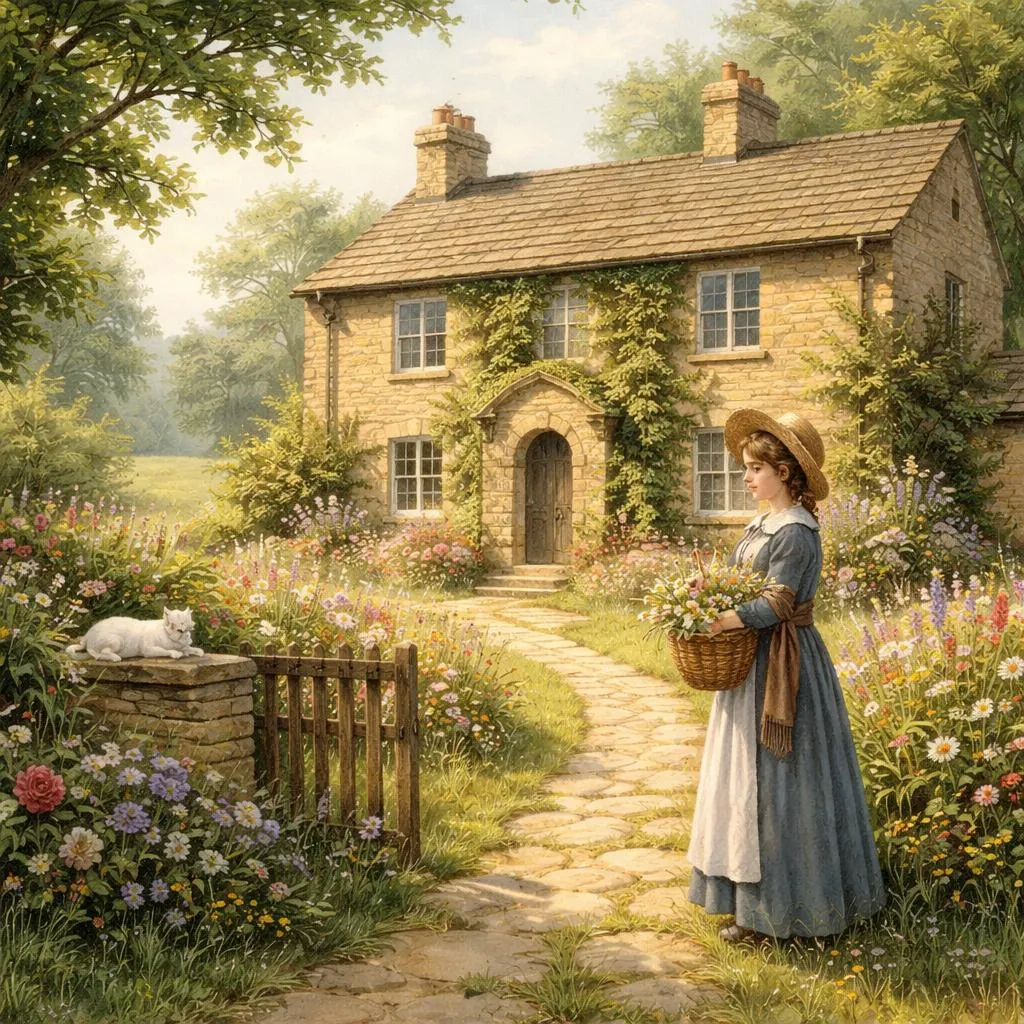

All true histories contain instruction; though, in some, the treasure may be hard to find, and when found, so trivial in quantity, that the dry, shrivelled kernel scarcely compensates for the trouble of cracking the nut. Whether this be the case with my history or not, I am hardly competent to judge. I sometimes think it might prove useful to some, and entertaining to others; but the world may judge for itself. Shielded by my own obscurity, and by the lapse of years, and a few fictitious names, I do not fear to venture; and will candidly lay before the public what I would not disclose to the most intimate friend.
My father was a clergyman of the north of England, who was deservedly respected by all who knew him; and, in his younger days, lived pretty comfortably on the joint income of a small incumbency and a snug little property of his own. My mother, who married him against the wishes of her friends, was a squire’s daughter, and a woman of spirit. In vain it was represented to her, that if she became the poor parson’s wife, she must relinquish her carriage and her lady’s–maid, and all the luxuries and elegancies of affluence; which to her were little less than the necessaries of life. A carriage and a lady’s–maid were great conveniences; but, thank heaven, she had feet to carry her, and hands to minister to her own necessities. An elegant house and spacious grounds were not to be despised; but she would rather live in a cottage with Richard Grey than in a palace with any other man in the world.
Finding arguments of no avail, her father, at length, told the lovers they might marry if they pleased; but, in so doing, his daughter would forfeit every fraction of her fortune. He expected this would cool the ardour of both; but he was mistaken. My father knew too well my mother’s superior worth not to be sensible that she was a valuable fortune in herself: and if she would but consent to embellish his humble hearth he should be happy to take her on any terms; while she, on her part, would rather labour with her own hands than be divided from the man she loved, whose happiness it would be her joy to make, and who was already one with her in heart and soul. So her fortune went to swell the purse of a wiser sister, who had married a rich nabob; and she, to the wonder and compassionate regret of all who knew her, went to bury herself in the homely village parsonage among the hills of —. And yet, in spite of all this, and in spite of my mother’s high spirit and my father’s whims, I believe you might search all England through, and fail to find a happier couple.
Of six children, my sister Mary and myself were the only two that survived the perils of infancy and early childhood. I, being the younger by five or six years, was always regarded as THE child, and the pet of the family: father, mother, and sister, all combined to spoil me—not by foolish indulgence, to render me fractious and ungovernable, but by ceaseless kindness, to make me too helpless and dependent—too unfit for buffeting with the cares and turmoils of life.
Mary and I were brought up in the strictest seclusion. My mother, being at once highly accomplished, well informed, and fond of employment, took the whole charge of our education on herself, with the exception of Latin—which my father undertook to teach us—so that we never even went to school; and, as there was no society in the neighbourhood, our only intercourse with the world consisted in a stately tea–party, now and then, with the principal farmers and tradespeople of the vicinity (just to avoid being stigmatized as too proud to consort with our neighbours), and an annual visit to our paternal grandfather’s; where himself, our kind grandmamma, a maiden aunt, and two or three elderly ladies and gentlemen, were the only persons we ever saw. Sometimes our mother would amuse us with stories and anecdotes of her younger days, which, while they entertained us amazingly, frequently awoke—in ME, at least—a secret wish to see a little more of the world.
I thought she must have been very happy: but she never seemed to regret past times. My father, however, whose temper was neither tranquil nor cheerful by nature, often unduly vexed himself with thinking of the sacrifices his dear wife had made for him; and troubled his head with revolving endless schemes for the augmentation of his little fortune, for her sake and ours. In vain my mother assured him she was quite satisfied; and if he would but lay by a little for the children, we should all have plenty, both for time present and to come: but saving was not my father’s forte. He would not run in debt (at least, my mother took good care he should not), but while he had money he must spend it: he liked to see his house comfortable, and his wife and daughters well clothed, and well attended; and besides, he was charitably disposed, and liked to give to the poor, according to his means: or, as some might think, beyond them.
At length, however, a kind friend suggested to him a means of doubling his private property at one stroke; and further increasing it, hereafter, to an untold amount. This friend was a merchant, a man of enterprising spirit and undoubted talent, who was somewhat straitened in his mercantile pursuits for want of capital; but generously proposed to give my father a fair share of his profits, if he would only entrust him with what he could spare; and he thought he might safely promise that whatever sum the latter chose to put into his hands, it should bring him in cent. per cent. The small patrimony was speedily sold, and the whole of its price was deposited in the hands of the friendly merchant; who as promptly proceeded to ship his cargo, and prepare for his voyage.
My father was delighted, so were we all, with our brightening prospects. For the present, it is true, we were reduced to the narrow income of the curacy; but my father seemed to think there was no necessity for scrupulously restricting our expenditure to that; so, with a standing bill at Mr. Jackson’s, another at Smith’s, and a third at Hobson’s, we got along even more comfortably than before: though my mother affirmed we had better keep within bounds, for our prospects of wealth were but precarious, after all; and if my father would only trust everything to her management, he should never feel himself stinted: but he, for once, was incorrigible.
What happy hours Mary and I have passed while sitting at our work by the fire, or wandering on the heath–clad hills, or idling under the weeping birch (the only considerable tree in the garden), talking of future happiness to ourselves and our parents, of what we would do, and see, and possess; with no firmer foundation for our goodly superstructure than the riches that were expected to flow in upon us from the success of the worthy merchant’s speculations. Our father was nearly as bad as ourselves; only that he affected not to be so much in earnest: expressing his bright hopes and sanguine expectations in jests and playful sallies, that always struck me as being exceedingly witty and pleasant. Our mother laughed with delight to see him so hopeful and happy: but still she feared he was setting his heart too much upon the matter; and once I heard her whisper as she left the room, ‘God grant he be not disappointed! I know not how he would bear it.’
Disappointed he was; and bitterly, too. It came like a thunder–clap on us all, that the vessel which contained our fortune had been wrecked, and gone to the bottom with all its stores, together with several of the crew, and the unfortunate merchant himself. I was grieved for him; I was grieved for the overthrow of all our air–built castles: but, with the elasticity of youth, I soon recovered the shook.
Though riches had charms, poverty had no terrors for an inexperienced girl like me. Indeed, to say the truth, there was something exhilarating in the idea of being driven to straits, and thrown upon our own resources. I only wished papa, mamma, and Mary were all of the same mind as myself; and then, instead of lamenting past calamities we might all cheerfully set to work to remedy them; and the greater the difficulties, the harder our present privations, the greater should be our cheerfulness to endure the latter, and our vigour to contend against the former.
Mary did not lament, but she brooded continually over the misfortune, and sank into a state of dejection from which no effort of mine could rouse her. I could not possibly bring her to regard the matter on its bright side as I did: and indeed I was so fearful of being charged with childish frivolity, or stupid insensibility, that I carefully kept most of my bright ideas and cheering notions to myself; well knowing they could not be appreciated.
My mother thought only of consoling my father, and paying our debts and retrenching our expenditure by every available means; but my father was completely overwhelmed by the calamity: health, strength, and spirits sank beneath the blow, and he never wholly recovered them. In vain my mother strove to cheer him, by appealing to his piety, to his courage, to his affection for herself and us. That very affection was his greatest torment: it was for our sakes he had so ardently longed to increase his fortune—it was our interest that had lent such brightness to his hopes, and that imparted such bitterness to his present distress. He now tormented himself with remorse at having neglected my mother’s advice; which would at least have saved him from the additional burden of debt—he vainly reproached himself for having brought her from the dignity, the ease, the luxury of her former station to toil with him through the cares and toils of poverty. It was gall and wormwood to his soul to see that splendid, highly–accomplished woman, once so courted and admired, transformed into an active managing housewife, with hands and head continually occupied with household labours and household economy. The very willingness with which she performed these duties, the cheerfulness with which she bore her reverses, and the kindness which withheld her from imputing the smallest blame to him, were all perverted by this ingenious self–tormentor into further aggravations of his sufferings. And thus the mind preyed upon the body, and disordered the system of the nerves, and they in turn increased the troubles of the mind, till by action and reaction his health was seriously impaired; and not one of us could convince him that the aspect of our affairs was not half so gloomy, so utterly hopeless, as his morbid imagination represented it to be.
The useful pony phaeton was sold, together with the stout, well–fed pony—the old favourite that we had fully determined should end its days in peace, and never pass from our hands; the little coach–house and stable were let; the servant boy, and the more efficient (being the more expensive) of the two maid–servants, were dismissed. Our clothes were mended, turned, and darned to the utmost verge of decency; our food, always plain, was now simplified to an unprecedented degree—except my father’s favourite dishes; our coals and candles were painfully economized—the pair of candles reduced to one, and that most sparingly used; the coals carefully husbanded in the half–empty grate: especially when my father was out on his parish duties, or confined to bed through illness—then we sat with our feet on the fender, scraping the perishing embers together from time to time, and occasionally adding a slight scattering of the dust and fragments of coal, just to keep them alive. As for our carpets, they in time were worn threadbare, and patched and darned even to a greater extent than our garments. To save the expense of a gardener, Mary and I undertook to keep the garden in order; and all the cooking and household work that could not easily be managed by one servant–girl, was done by my mother and sister, with a little occasional help from me: only a little, because, though a woman in my own estimation, I was still a child in theirs; and my mother, like most active, managing women, was not gifted with very active daughters: for this reason—that being so clever and diligent herself, she was never tempted to trust her affairs to a deputy, but, on the contrary, was willing to act and think for others as well as for number one; and whatever was the business in hand, she was apt to think that no one could do it so well as herself: so that whenever I offered to assist her, I received such an answer as—’No, love, you cannot indeed—there’s nothing here you can do. Go and help your sister, or get her to take a walk with you—tell her she must not sit so much, and stay so constantly in the house as she does— she may well look thin and dejected.’
‘Mary, mamma says I’m to help you; or get you to take a walk with me; she says you may well look thin and dejected, if you sit so constantly in the house.’
‘Help me you cannot, Agnes; and I cannot go out with YOU—I have far too much to do.’
‘Then let me help you.’
‘You cannot, indeed, dear child. Go and practise your music, or play with the kitten.’
There was always plenty of sewing on hand; but I had not been taught to cut out a single garment, and except plain hemming and seaming, there was little I could do, even in that line; for they both asserted that it was far easier to do the work themselves than to prepare it for me: and besides, they liked better to see me prosecuting my studies, or amusing myself—it was time enough for me to sit bending over my work, like a grave matron, when my favourite little pussy was become a steady old cat. Under such circumstances, although I was not many degrees more useful than the kitten, my idleness was not entirely without excuse.
Through all our troubles, I never but once heard my mother complain of our want of money. As summer was coming on she observed to Mary and me, ‘What a desirable thing it would be for your papa to spend a few weeks at a watering–place. I am convinced the sea–air and the change of scene would be of incalculable service to him. But then, you see, there’s no money,’ she added, with a sigh. We both wished exceedingly that the thing might be done, and lamented greatly that it could not. ‘Well, well!’ said she, ‘it’s no use complaining. Possibly something might be done to further the project after all. Mary, you are a beautiful drawer. What do you say to doing a few more pictures in your best style, and getting them framed, with the water–coloured drawings you have already done, and trying to dispose of them to some liberal picture–dealer, who has the sense to discern their merits?’
‘Mamma, I should be delighted if you think they COULD be sold; and for anything worth while.’
‘It’s worth while trying, however, my dear: do you procure the drawings, and I’ll endeavour to find a purchaser.’
‘I wish I could do something,’ said I.
‘You, Agnes! well, who knows? You draw pretty well, too: if you choose some simple piece for your subject, I daresay you will be able to produce something we shall all be proud to exhibit.’
‘But I have another scheme in my head, mamma, and have had long, only I did not like to mention it.’
‘Indeed! pray tell us what it is.’
‘I should like to be a governess.’
My mother uttered an exclamation of surprise, and laughed. My sister dropped her work in astonishment, exclaiming, ‘YOU a governess, Agnes! What can you be dreaming of?’
‘Well! I don’t see anything so VERY extraordinary in it. I do not pretend to be able to instruct great girls; but surely I could teach little ones: and I should like it so much: I am so fond of children. Do let me, mamma!’
‘But, my love, you have not learned to take care of YOURSELF yet: and young children require more judgment and experience to manage than elder ones.’
‘But, mamma, I am above eighteen, and quite able to take care of myself, and others too. You do not know half the wisdom and prudence I possess, because I have never been tried.’
‘Only think,’ said Mary, ‘what would you do in a house full of strangers, without me or mamma to speak and act for you—with a parcel of children, besides yourself, to attend to; and no one to look to for advice? You would not even know what clothes to put on.’
‘You think, because I always do as you bid me, I have no judgment of my own: but only try me—that is all I ask—and you shall see what I can do.’
At that moment my father entered and the subject of our discussion was explained to him.
‘What, my little Agnes a governess!’ cried he, and, in spite of his dejection, he laughed at the idea.
‘Yes, papa, don’t YOU say anything against it: I should like it so much; and I am sure I could manage delightfully.’
‘But, my darling, we could not spare you.’ And a tear glistened in his eye as he added—’No, no! afflicted as we are, surely we are not brought to that pass yet.’
‘Oh, no!’ said my mother. ‘There is no necessity whatever for such a step; it is merely a whim of her own. So you must hold your tongue, you naughty girl; for, though you are so ready to leave us, you know very well we cannot part with YOU.’
I was silenced for that day, and for many succeeding ones; but still I did not wholly relinquish my darling scheme. Mary got her drawing materials, and steadily set to work. I got mine too; but while I drew, I thought of other things. How delightful it would be to be a governess! To go out into the world; to enter upon a new life; to act for myself; to exercise my unused faculties; to try my unknown powers; to earn my own maintenance, and something to comfort and help my father, mother, and sister, besides exonerating them from the provision of my food and clothing; to show papa what his little Agnes could do; to convince mamma and Mary that I was not quite the helpless, thoughtless being they supposed. And then, how charming to be entrusted with the care and education of children! Whatever others said, I felt I was fully competent to the task: the clear remembrance of my own thoughts in early childhood would be a surer guide than the instructions of the most mature adviser. I had but to turn from my little pupils to myself at their age, and I should know, at once, how to win their confidence and affections: how to waken the contrition of the erring; how to embolden the timid and console the afflicted; how to make Virtue practicable, Instruction desirable, and Religion lovely and comprehensible.
– Delightful task! To teach the young idea how to shoot!
To train the tender plants, and watch their buds unfolding day by day!
Influenced by so many inducements, I determined still to persevere; though the fear of displeasing my mother, or distressing my father’s feelings, prevented me from resuming the subject for several days. At length, again, I mentioned it to my mother in private; and, with some difficulty, got her to promise to assist me with her endeavours. My father’s reluctant consent was next obtained, and then, though Mary still sighed her disapproval, my dear, kind mother began to look out for a situation for me. She wrote to my father’s relations, and consulted the newspaper advertisements—her own relations she had long dropped all communication with: a formal interchange of occasional letters was all she had ever had since her marriage, and she would not at any time have applied to them in a case of this nature. But so long and so entire had been my parents’ seclusion from the world, that many weeks elapsed before a suitable situation could be procured. At last, to my great joy, it was decreed that I should take charge of the young family of a certain Mrs. Bloomfield; whom my kind, prim aunt Grey had known in her youth, and asserted to be a very nice woman. Her husband was a retired tradesman, who had realized a very comfortable fortune; but could not be prevailed upon to give a greater salary than twenty–five pounds to the instructress of his children. I, however, was glad to accept this, rather than refuse the situation—which my parents were inclined to think the better plan.
But some weeks more were yet to be devoted to preparation. How long, how tedious those weeks appeared to me! Yet they were happy ones in the main—full of bright hopes and ardent expectations. With what peculiar pleasure I assisted at the making of my new clothes, and, subsequently, the packing of my trunks! But there was a feeling of bitterness mingling with the latter occupation too; and when it was done—when all was ready for my departure on the morrow, and the last night at home approached—a sudden anguish seemed to swell my heart. My dear friends looked so sad, and spoke so very kindly, that I could scarcely keep my eyes from overflowing: but I still affected to be gay. I had taken my last ramble with Mary on the moors, my last walk in the garden, and round the house; I had fed, with her, our pet pigeons for the last time—the pretty creatures that we had tamed to peck their food from our hands: I had given a farewell stroke to all their silky backs as they crowded in my lap. I had tenderly kissed my own peculiar favourites, the pair of snow–white fantails; I had played my last tune on the old familiar piano, and sung my last song to papa: not the last, I hoped, but the last for what appeared to me a very long time. And, perhaps, when I did these things again it would be with different feelings: circumstances might be changed, and this house might never be my settled home again. My dear little friend, the kitten, would certainly be changed: she was already growing a fine cat; and when I returned, even for a hasty visit at Christmas, would, most likely, have forgotten both her playmate and her merry pranks. I had romped with her for the last time; and when I stroked her soft bright fur, while she lay purring herself to sleep in my lap, it was with a feeling of sadness I could not easily disguise. Then at bed–time, when I retired with Mary to our quiet little chamber, where already my drawers were cleared out and my share of the bookcase was empty—and where, hereafter, she would have to sleep alone, in dreary solitude, as she expressed it—my heart sank more than ever: I felt as if I had been selfish and wrong to persist in leaving her; and when I knelt once more beside our little bed, I prayed for a blessing on her and on my parents more fervently than ever I had done before. To conceal my emotion, I buried my face in my hands, and they were presently bathed in tears. I perceived, on rising, that she had been crying too: but neither of us spoke; and in silence we betook ourselves to our repose, creeping more closely together from the consciousness that we were to part so soon.
But the morning brought a renewal of hope and spirits. I was to depart early; that the conveyance which took me (a gig, hired from Mr. Smith, the draper, grocer, and tea–dealer of the village) might return the same day. I rose, washed, dressed, swallowed a hasty breakfast, received the fond embraces of my father, mother, and sister, kissed the cat—to the great scandal of Sally, the maid— shook hands with her, mounted the gig, drew my veil over my face, and then, but not till then, burst into a flood of tears. The gig rolled on; I looked back; my dear mother and sister were still standing at the door, looking after me, and waving their adieux. I returned their salute, and prayed God to bless them from my heart: we descended the hill, and I could see them no more.
‘It’s a coldish mornin’ for you, Miss Agnes,’ observed Smith; ‘and a darksome ‘un too; but we’s happen get to yon spot afore there come much rain to signify.’
‘Yes, I hope so,’ replied I, as calmly as I could.
‘It’s comed a good sup last night too.’
‘Yes.’
‘But this cold wind will happen keep it off.’
‘Perhaps it will.’
Here ended our colloquy. We crossed the valley, and began to ascend the opposite hill. As we were toiling up, I looked back again; there was the village spire, and the old grey parsonage beyond it, basking in a slanting beam of sunshine—it was but a sickly ray, but the village and surrounding hills were all in sombre shade, and I hailed the wandering beam as a propitious omen to my home. With clasped hands I fervently implored a blessing on its inhabitants, and hastily turned away; for I saw the sunshine was departing; and I carefully avoided another glance, lest I should see it in gloomy shadow, like the rest of the landscape.
背景和作者介绍
这个故事是来自一位名叫艾格尼丝的年轻女性的反思性叙述,她讲述了她家庭经历繁荣、失去和韧性的旅程。故事发生在英国乡村,详细地展现了19世纪的生活,特别是普通家庭面临的挑战。作者以坦诚和真挚的语气写作,探讨了爱、牺牲、希望和追求独立的主题。
虽然这里没有具体说明作者是谁,但这种风格和主题与维多利亚时代的文学相似,其中道德教训和个人成长往往是核心。故事的丰富细节和情感深度表明作者对家庭动态和当时的社会期望有着深刻的理解。
详细解读和意义
从根本上说,这个故事讲述了家庭纽带的力量和面对逆境的勇气。艾格尼丝的父母不顾社会压力和经济牺牲而结婚,体现了个人价值观高于物质财富的主题。叙事还突出了经济破产对家庭生活方式和情感健康的影响,展示了每个家庭成员如何以不同的方式应对。
艾格尼丝想成为一名家庭教师,象征着一位年轻女性在传统家庭角色之外寻求自立和目标。她的决心反映了那个时代女性通过教育和工作为社会做出有意义贡献的意识日益增强。
这个故事还触及了教育的重要性,不仅仅是正规的学校教育,还有通过生活经验和家庭指导来学习。艾格尼丝的母亲负责女儿们的教育,强调知识和实用技能的价值。
给学生的教训和见解
-
面对困境时的韧性: 艾格尼丝的家庭经历了突如其来的经济损失,这极大地改变了他们的生活。然而,他们通过简化生活方式并寻找新的方式来互相支持而适应。这教会学生在面对挑战时保持韧性和灵活性。
-
家庭和爱的价值: 尽管面临困难,家庭的爱和相互支持依然强大。学生们可以了解到情感纽带和善良是力量的重要来源。
-
追求独立: 艾格尼丝想成为一名家庭教师的愿望表明了设定个人目标和争取独立的重要性。它鼓励年轻读者探索他们的才能并寻求成长的机会。
-
实用教育: 故事强调了教育在赋权中的作用。学生们可以认识到学习不仅限于学校,也来自于生活经验和自律。
-
管理期望和现实: 艾格尼丝一家最初对财富的希望破灭了,但他们学会了量入为出。这是一个关于管理期望、财务谨慎和优雅地接受现实的教训。
将故事的精神应用于日常生活
-
在学习中: 像艾格尼丝一样,学生们应该对他们的教育充满好奇心和主动性,在课本之外寻求知识。他们可以培养为应对现实世界挑战做好准备的技能。
-
在社交互动中: 故事鼓励同情和理解。认识到每个人都会面临挣扎,可以帮助学生们成为更有支持力的朋友和家人。
-
在面对困难时: 学生们可以对挫折采取积极的态度,将它们视为变得更强大和更有创造力的机会。
-
在设定目标时: 艾格尼丝的例子激励年轻人去梦想并努力工作,即使在环境看起来令人沮丧的时候。
从故事中培养积极的品质
-
勇气: 艾格尼丝不顾他人的怀疑,勇敢地追求自己的抱负。
-
善良: 家人在艰难时期对彼此的关怀,展现了同情心。
-
责任感: 艾格尼丝承担家务并为自己的未来做计划,表现出成熟。
-
乐观: 在逆境中保持希望是一个关键的信息。
-
自律: 对资源的谨慎管理和对教育的承诺反映了自律。
结论
这个故事是学生和年轻读者的丰富资源,提供了关于爱、困境和个人成长的永恒教训。通过反思艾格尼丝的经历,读者可以学会以韧性和希望面对自己的挑战,珍视他们的家庭,并以决心和善良追求他们的梦想。
