
'Curiouser and curiouser!' cried Alice (she was so much surprised, that for the moment she quite forgot how to speak good English); 'now I'm opening out like the largest telescope that ever was! Good–bye, feet!' (for when she looked down at her feet, they seemed to be almost out of sight, they were getting so far off). 'Oh, my poor little feet, I wonder who will put on your shoes and stockings for you now, dears? I'm sure I shan't be able! I shall be a great deal too far off to trouble myself about you: you must manage the best way you can;—but I must be kind to them,' thought Alice, 'or perhaps they won't walk the way I want to go! Let me see: I'll give them a new pair of boots every Christmas.'
And she went on planning to herself how she would manage it. 'They must go by the carrier,' she thought; 'and how funny it'll seem, sending presents to one's own feet! And how odd the directions will look!
ALICE'S RIGHT FOOT, ESQ. HEARTHRUG, NEAR THE FENDER, (WITH ALICE'S LOVE).
Oh dear, what nonsense I'm talking!'
Just then her head struck against the roof of the hall: in fact she was now more than nine feet high, and she at once took up the little golden key and hurried off to the garden door.
Poor Alice! It was as much as she could do, lying down on one side, to look through into the garden with one eye; but to get through was more hopeless than ever: she sat down and began to cry again.
'You ought to be ashamed of yourself,' said Alice, 'a great girl like you,' (she might well say this), 'to go on crying in this way! Stop this moment, I tell you!' But she went on all the same, shedding gallons of tears, until there was a large pool all round her, about four inches deep and reaching half down the hall.
After a time she heard a little pattering of feet in the distance, and she hastily dried her eyes to see what was coming. It was the White Rabbit returning, splendidly dressed, with a pair of white kid gloves in one hand and a large fan in the other: he came trotting along in a great hurry, muttering to himself as he came, 'Oh! the Duchess, the Duchess! Oh! won't she be savage if I've kept her waiting!' Alice felt so desperate that she was ready to ask help of any one; so, when the Rabbit came near her, she began, in a low, timid voice, 'If you please, sir—' The Rabbit started violently, dropped the white kid gloves and the fan, and skurried away into the darkness as hard as he could go.
Alice took up the fan and gloves, and, as the hall was very hot, she kept fanning herself all the time she went on talking: 'Dear, dear! How queer everything is to–day! And yesterday things went on just as usual. I wonder if I've been changed in the night? Let me think: was I the same when I got up this morning? I almost think I can remember feeling a little different. But if I'm not the same, the next question is, Who in the world am I? Ah, THAT'S the great puzzle!' And she began thinking over all the children she knew that were of the same age as herself, to see if she could have been changed for any of them.
'I'm sure I'm not Ada,' she said, 'for her hair goes in such long ringlets, and mine doesn't go in ringlets at all; and I'm sure I can't be Mabel, for I know all sorts of things, and she, oh! she knows such a very little! Besides, SHE'S she, and I'm I, and—oh dear, how puzzling it all is! I'll try if I know all the things I used to know. Let me see: four times five is twelve, and four times six is thirteen, and four times seven is—oh dear! I shall never get to twenty at that rate! However, the Multiplication Table doesn't signify: let's try Geography. London is the capital of Paris, and Paris is the capital of Rome, and Rome—no, THAT'S all wrong, I'm certain! I must have been changed for Mabel! I'll try and say "How doth the little—"' and she crossed her hands on her lap as if she were saying lessons, and began to repeat it, but her voice sounded hoarse and strange, and the words did not come the same as they used to do:—
'How doth the little crocodile Improve his shining tail, And pour the waters of the Nile On every golden scale!<
'How cheerfully he seems to grin, How neatly spread his claws, And welcome little fishes in With gently smiling jaws!'
'I'm sure those are not the right words,' said poor Alice, and her eyes filled with tears again as she went on, 'I must be Mabel after all, and I shall have to go and live in that poky little house, and have next to no toys to play with, and oh! ever so many lessons to learn! No, I've made up my mind about it; if I'm Mabel, I'll stay down here! It'll be no use their putting their heads down and saying "Come up again, dear!" I shall only look up and say "Who am I then? Tell me that first, and then, if I like being that person, I'll come up: if not, I'll stay down here till I'm somebody else"—but, oh dear!' cried Alice, with a sudden burst of tears, 'I do wish they WOULD put their heads down! I am so VERY tired of being all alone here!'
As she said this she looked down at her hands, and was surprised to see that she had put on one of the Rabbit's little white kid gloves while she was talking. 'How CAN I have done that?' she thought. 'I must be growing small again.' She got up and went to the table to measure herself by it, and found that, as nearly as she could guess, she was now about two feet high, and was going on shrinking rapidly: she soon found out that the cause of this was the fan she was holding, and she dropped it hastily, just in time to avoid shrinking away altogether.
'That WAS a narrow escape!' said Alice, a good deal frightened at the sudden change, but very glad to find herself still in existence; 'and now for the garden!' and she ran with all speed back to the little door: but, alas! the little door was shut again, and the little golden key was lying on the glass table as before, 'and things are worse than ever,' thought the poor child, 'for I never was so small as this before, never! And I declare it's too bad, that it is!'
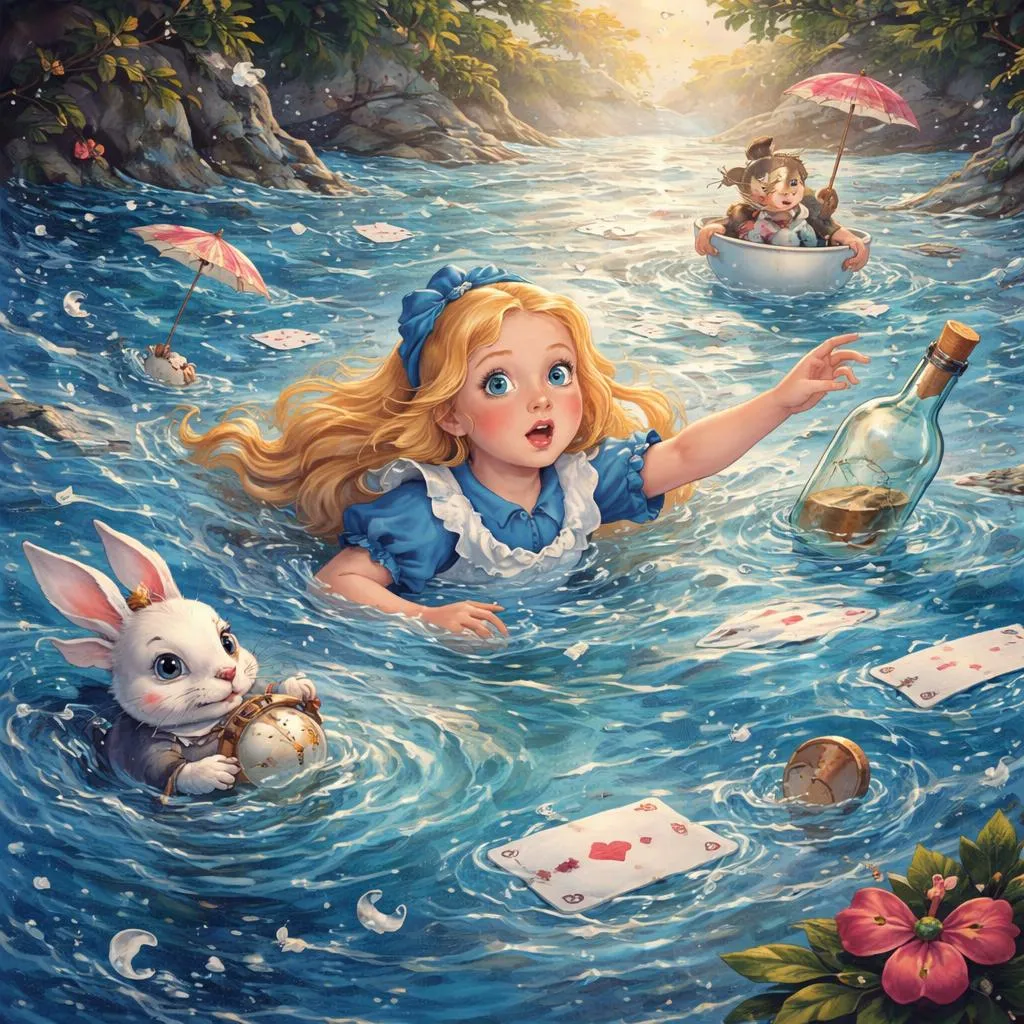
As she said these words her foot slipped, and in another moment, splash! she was up to her chin in salt water. Her first idea was that she had somehow fallen into the sea, 'and in that case I can go back by railway,' she said to herself. (Alice had been to the seaside once in her life, and had come to the general conclusion, that wherever you go to on the English coast you find a number of bathing machines in the sea, some children digging in the sand with wooden spades, then a row of lodging houses, and behind them a railway station.) However, she soon made out that she was in the pool of tears which she had wept when she was nine feet high.
'I wish I hadn't cried so much!' said Alice, as she swam about, trying to find her way out. 'I shall be punished for it now, I suppose, by being drowned in my own tears! That WILL be a queer thing, to be sure! However, everything is queer to–day.'
Just then she heard something splashing about in the pool a little way off, and she swam nearer to make out what it was: at first she thought it must be a walrus or hippopotamus, but then she remembered how small she was now, and she soon made out that it was only a mouse that had slipped in like herself.
'Would it be of any use, now,' thought Alice, 'to speak to this mouse? Everything is so out–of–the–way down here, that I should think very likely it can talk: at any rate, there's no harm in trying.' So she began: 'O Mouse, do you know the way out of this pool? I am very tired of swimming about here, O Mouse!' (Alice thought this must be the right way of speaking to a mouse: she had never done such a thing before, but she remembered having seen in her brother's Latin Grammar, 'A mouse—of a mouse—to a mouse—a mouse—O mouse!') The Mouse looked at her rather inquisitively, and seemed to her to wink with one of its little eyes, but it said nothing.
'Perhaps it doesn't understand English,' thought Alice; 'I daresay it's a French mouse, come over with William the Conqueror.' (For, with all her knowledge of history, Alice had no very clear notion how long ago anything had happened.) So she began again: 'Ou est ma chatte?' which was the first sentence in her French lesson–book. The Mouse gave a sudden leap out of the water, and seemed to quiver all over with fright. 'Oh, I beg your pardon!' cried Alice hastily, afraid that she had hurt the poor animal's feelings. 'I quite forgot you didn't like cats.'
'Not like cats!' cried the Mouse, in a shrill, passionate voice. 'Would YOU like cats if you were me?'
'Well, perhaps not,' said Alice in a soothing tone: 'don't be angry about it. And yet I wish I could show you our cat Dinah: I think you'd take a fancy to cats if you could only see her. She is such a dear quiet thing,' Alice went on, half to herself, as she swam lazily about in the pool, 'and she sits purring so nicely by the fire, licking her paws and washing her face—and she is such a nice soft thing to nurse—and she's such a capital one for catching mice—oh, I beg your pardon!' cried Alice again, for this time the Mouse was bristling all over, and she felt certain it must be really offended. 'We won't talk about her any more if you'd rather not.'
'We indeed!' cried the Mouse, who was trembling down to the end of his tail. 'As if I would talk on such a subject! Our family always HATED cats: nasty, low, vulgar things! Don't let me hear the name again!'
'I won't indeed!' said Alice, in a great hurry to change the subject of conversation. 'Are you—are you fond—of—of dogs?' The Mouse did not answer, so Alice went on eagerly: 'There is such a nice little dog near our house I should like to show you! A little bright–eyed terrier, you know, with oh, such long curly brown hair! And it'll fetch things when you throw them, and it'll sit up and beg for its dinner, and all sorts of things—I can't remember half of them—and it belongs to a farmer, you know, and he says it's so useful, it's worth a hundred pounds! He says it kills all the rats and—oh dear!' cried Alice in a sorrowful tone, 'I'm afraid I've offended it again!' For the Mouse was swimming away from her as hard as it could go, and making quite a commotion in the pool as it went.
So she called softly after it, 'Mouse dear! Do come back again, and we won't talk about cats or dogs either, if you don't like them!' When the Mouse heard this, it turned round and swam slowly back to her: its face was quite pale (with passion, Alice thought), and it said in a low trembling voice, 'Let us get to the shore, and then I'll tell you my history, and you'll understand why it is I hate cats and dogs.'
It was high time to go, for the pool was getting quite crowded with the birds and animals that had fallen into it: there were a Duck and a Dodo, a Lory and an Eaglet, and several other curious creatures. Alice led the way, and the whole party swam to the shore.
背景介绍与作者简介
这段摘录出自刘易斯·卡罗尔(Charles Lutwidge Dodgson的笔名)所著的《爱丽丝漫游仙境》。这部深受喜爱的儿童小说于1865年出版,以其异想天开的人物、富有想象力的场景和对语言的巧妙运用,吸引了读者一个多世纪。卡罗尔是一位数学家和逻辑学家,他的背景体现在故事中穿插的逻辑谜题和文字游戏中。这个故事源于卡罗尔与利德尔姐妹的一次乘船旅行,在旅途中,他给她们讲述了一个关于一个名叫爱丽丝的女孩掉进兔子洞进入神奇世界的故事。
详细解读与意义
在这段文字中,爱丽丝经历了一系列的身体变化——变得很高,然后变得很小——这象征着成长的困惑和常常令人困惑的经历。她对身份的挣扎,例如质疑“我到底是谁?”,反映了孩子们在试图了解自己和自己在世界上的位置时所面临的挑战。
那些异想天开和荒诞的元素,比如把礼物寄到自己的脚上,或者混淆乘法表和地理事实,说明了仙境颠倒的逻辑,在那里,正常的规则不适用。这挑战读者进行创造性思考并拥抱不确定性。
与白兔和老鼠的互动引入了沟通和误解的主题。爱丽丝试图与老鼠交谈,包括使用法语短语,表明了她的好奇心和连接的意愿,即使事情看起来很奇怪或令人困惑。
给学生的启示和见解
-
拥抱变化和成长: 爱丽丝的身体变化反映了年轻人所经历的情感和心理变化。学生们可以了解到,感到困惑或与众不同是成长过程中自然的一部分,并且可以质疑自己是谁。
-
好奇心和想象力: 爱丽丝的冒险鼓励读者保持好奇心和想象力。这些品质对于在学校和生活中学习和解决问题至关重要。
-
沟通和同理心: 爱丽丝试图理解老鼠的感受和观点,即使它们与她自己的不同。这教会了同理心和在社交互动中进行尊重沟通的重要性。
-
韧性和适应性: 尽管情况令人困惑,有时甚至令人恐惧,但爱丽丝仍然不断尝试找到自己的出路。这种韧性对于学生们应对挑战来说是一个宝贵的教训。
将这些教训应用于日常生活
-
在学习中: 学生们可以用好奇心而不是恐惧来对待困难的科目,就像爱丽丝探索仙境一样。当事情看起来令人困惑时,耐心和提问有助于加深理解。
-
在社交场合: 就像爱丽丝试图理解老鼠对猫的厌恶一样,学生们可以通过倾听和尊重他人的感受和观点来练习同理心。
-
在个人成长中: 认识到变化是生活的一部分,可以帮助学生们管理过渡,例如转到一所新学校或结交新朋友。
从故事中培养积极的特质
- 好奇心: 鼓励在课堂之外提问和探索新想法。
- 想象力: 使用创造性思维来解决问题或通过艺术、写作或游戏来表达自己。
- 同理心: 练习从他人的角度看问题,以建立更牢固的友谊。
- 韧性: 培养应对挫折的应对技巧并不断尝试。
结论
《爱丽丝漫游仙境》不仅仅是一个虚构的故事;它是一个充满幽默和幻想的生活教训的丰富来源。对于年轻读者来说,它为他们自己的成长和变化经历提供了一面镜子,同时也激励他们拥抱好奇心、善良和勇气。当学生们在他们自己的学习和生活的“仙境”中旅行时,爱丽丝的故事提醒他们,感到困惑、提出问题并带着好奇和希望继续前进是可以的。
