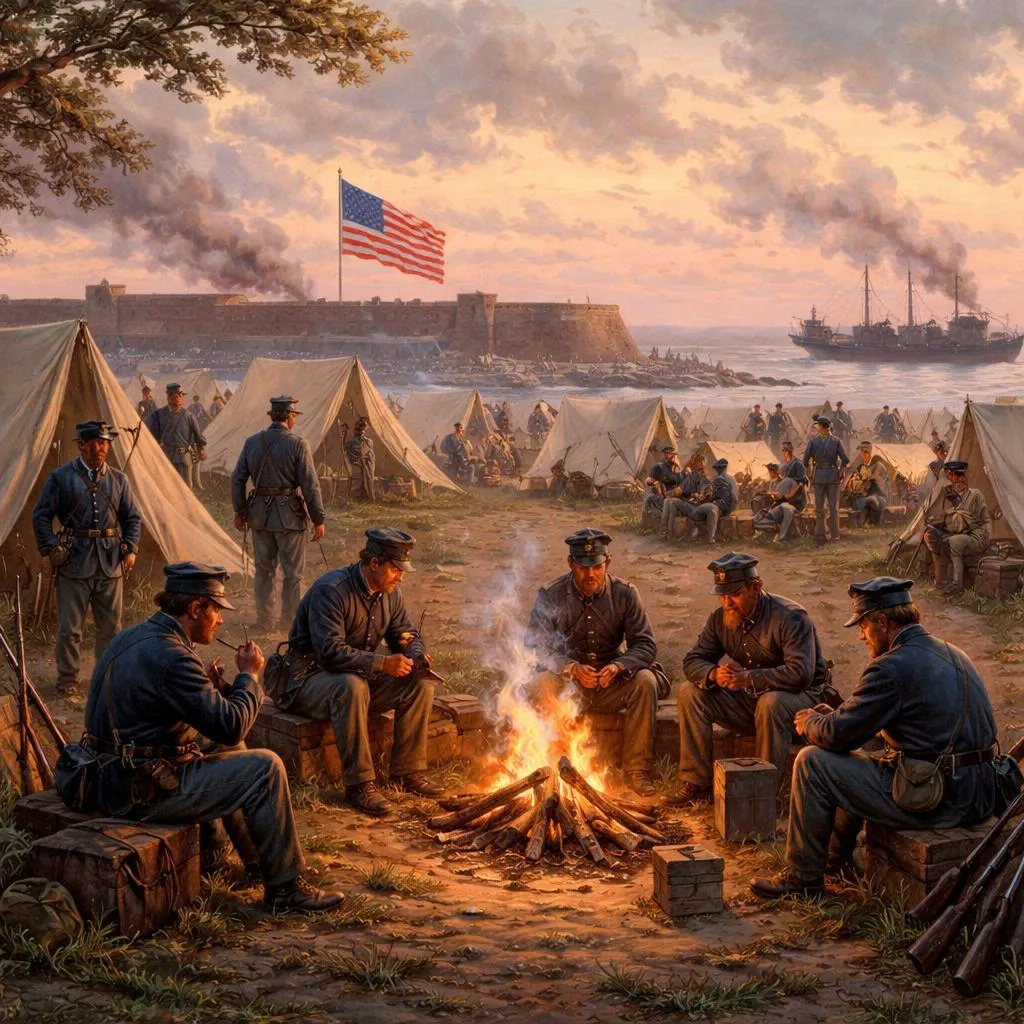

The expedition landed about two miles east of Fort Morgan. The sea was not heavy, as it sometimes is on these sand islands, and the debarkation was effected without any difficulty. At this distance from the defences of the bay not a person was to be seen. The fog banks still swept over the waters of the gulf as during the latter part of the afternoon, and if any number of persons had been near the shore, they could hardly have been seen.
“We are all right so far, Mr. Graines,” said Christy, as the bowmen hauled up the boat on the beach.
“It is as quiet as a tomb in this vicinity,” replied the engineer, as he led the way to the shore.
“Now, my men, haul the boat out of the water. I think we need not use any of our small force as boat-keepers, for we can hardly spare them for this purpose, Mr. Graines,” Christy proceeded very promptly.
“It does not look as though the boat, or anything else, would ever be molested in this lonely locality,” replied Graines, as the men lifted it from the water.
“Now carry it back about half a cable from the shore,” continued the principal of the party. “If one or two strollers should happen this way, they would not be able to put it into the water, though four men can carry it very easily.”
The whale boat was borne to a spot indicated by the lieutenant, and left as it had been taken from the surf. Everything in it was arranged in order, so that it could be hastily put into the water if circumstance demanded a hurried retreat from the scene of operations. Near the spot was a post set up in the sand, which might have been one of the corners of a shanty, or have been used years before by fishermen drying their nets or other gear.
“Do you see that post, my men?” asked Christy, as he pointed to it, not twenty feet from the spot where the boat had been deposited.
“Ay, ay, sir!” the seamen responded, in low tones, for they had been warned not to speak out loud.
“That will be your guide in finding the boat if we should get scattered,” added the officer. “Now, do you see the two stars about half way between the horizon and the zenith?”
“Ay, ay, sir!” answered Weeks, the oiler. “The Band of Orion.”
“Quite right, Weeks,” added Christy. “Fort Morgan lies about west of us; and a course from there in the direction of the two stars will bring you to the coast and the boat. Every man must act for himself to some extent, and you are expected to be prudent, and use your own judgment. It will not be safe for us to keep together, for a dozen men seen all at once would be likely to awaken suspicion.”
“If there is not a crowd of men over by the fort, we can hardly expect to avoid coming together,” suggested Weeks, who proved to be avery intelligent man, with excellent judgment.
“I cannot tell whether or not we shall find any gathering of men in the vicinity of the fort,” replied Christy. “We shall be obliged to govern ourselves according to circumstances. If you find any number of people over there, you can mingle with them. Some of you are very good scholars; but if any of you are disposed to indulge in fine talk, don’t do it. Make your speech correspond with your dress, and let it be rough and rude, for that is the fashion among the laboring class in this region.”
“I suppose sea-slang will not be out of order,” said Weeks.
“Not at all. Simply consider that you are sailors and laborers, and do not forget it,” answered Christy; and he was confident that he had selected only those who were competent to conduct themselves as the occasion might require. “Now, Mr. Graines, tell off five men—any five.”
The engineer called off five of the seamen, whose names he had learned from the list given him by his superior officer.
“Now these five men will each choose his partner, who is to be his companion while we are on shore, and who is to act with him,” continued Christy. “I do not know yet any better than you do what you are to do; but if you are called upon to do any difficult or dangerous work, remember that you are American seamen, and do your best for your country. If you are required to do any fighting, as I do not expect you will, our success depends upon your strong arms and your ready wills. You will do your whole duty, whatever it may be, and do it like true American sailors.”
“Ay, ay, sir!” came in a unanimous voice from the knot of men, though in subdued tones.
“Call the first name again, Mr. Graines,” added Christy.
“Weeks,” replied the engineer.
“Select your man, Weeks.”
“Bingham,” said the oiler.
The names of the other four men who had been selected were called in turn, and each of them selected his partner, each one of course choosing his best friend, if he had not already been appropriated.
“Now, my men, Weeks and Bingham, the first couple, to be called simply ‘One’ when wanted, and they will answer to this designation, will start first. The next couple, to be called ‘Two,’ will follow them; and so on, the other pairs coming in order,” continued Christy, designating each by name and number. “Two will start in ten or fifteen minutes after One, as nearly as you can guess at the time, for it is too dark to see watches if you have them.”
“Are we to choose our own courses?” asked Weeks.
“No; I was coming to that next. Each couple will stroll due north usnearly as he can make it out, till they come to the waters of Mobile Bay. If you see any houses or tents, avoid them, and keep clear of any collection of people before you reach the vicinity of the fort. The bay is the first point you are to reach; then follow the shore to the fort. If you meet any person, talk to him in a friendly way, if necessary, and be as good Confederates as any in this region, even inside of Fort Morgan.”
Weeks and Bingham took up the line of march in the direction indicated, and soon disappeared beyond the rising ground in the middle of the neck of land, which was here about three-eighths of a mile wide. A quarter of an hour later Lane and McGrady followed them. While they were waiting, each of the pairs gave a specimen of the dialect they intended to use. McGrady was an Irishman, educated in the public schools of the North, and his language was as good as that of any ordinary American; but now he used a very rich brogue.
Every man followed his own fancy. Lane had lived in the South, and “mought” and “fotch” came readily to his aid. The Crackers of Florida, the backwoodsmen of North Carolina, the swaggering Kentuckian, the wild Texan, were all represented; and Christy could easily have believed he had a company of comedians under his command, instead of a band of loyal Northerners.
The executive officer and the engineer had decided before this time to keep together; and, as soon as they had seen the second couple depart, they set out on their wandering march to the fort in a direction different from that of the others of the party. They walked directly towards the fort, for Christy intended to make his examination of the ground to the eastward of the fortification, on his way to some spot where he could ascertain what vessels were at anchor between the point and the Middle Ground. He discharged this duty very faithfully; and before he reached his objective point he was confident he could draw a map of the region, with what information he had obtained before, which would meet the requirements of Captain Breaker.
“What’s that?” demanded Graines, suddenly placing his hand on the arm of his companion, and stopping short, as they were approaching the crown of the elevation.
A fire was burning on the ground in a depression of the surface, which doubtless concealed its light from persons in the vicinity of the fort, if there were any there. Around it could be seen four men, as the two officers looked over the crest of the hill, who appeared to be engaged in eating and drinking; and they were doing more of the latter than of the former, for the bottle passed very frequently from one to another.
“It looks like a bivouac on the part of those fellows,” said Christy in a low tone.
“But who and what are they?” asked Graines.
“They may be deserters from Fort Morgan, though if they were they would hardly bivouac so near it,” replied Christy, who did not seem to his companion to be at all disturbed by the discovery of the men. “They are more likely to be sailors from some intending blockade-runner at anchor off the point, who have come on shore to make a night of it; and they appear to have made considerable progress in the debauch.”
“They are not soldiers, for you can see by the light of the fire that they are not dressed in uniform,” added the engineer.
“This is the third year of the war, and uniforms for the soldiers are not particularly abundant in the Confederacy.”
“We can’t see the waters of the bay till we reach the top of the knoll yonder, and we don’t know whether there are any vessels at anchor there or not. But we can easily avoid these fellows by keeping behind the ridge till we get where they cannot see us.”
“I don’t know that we want to avoid them, for I should like very much to know who and what they are. They must be tipsy to a greater or less degree by this time, for they do twice as much drinking as eating,” answered Christy, as he advanced a little way farther up the hill. “They have a basket of food, and I do not believe they are mere tramps. They are more likely to be engaged in some occupation which brought them to this point, and I think we had better fraternize with them. They may be able to give us some valuable information; and it looks as though they were drunk enough to tell all they know without making any difficulty about it.”
“Do you think it is quite prudent, Mr. Passford, to approach them?” asked the engineer.
“When we come on an excursion of this kind we have to take some risk. If I were alone I should not hesitate to join them, and take my chances, for they must know something about affairs in this vicinity,”replied Christy in a quiet tone, so that his answer might not be interpreted as a boast or a reproach to his companion.
“I am ready to follow you, Mr. Passford, wherever you go, and to depend upon your judgment for guidance,” said Graines very promptly. “If it comes to a fight with those fellows, I beg you to understand that I will do my full share of it, and obey your orders to the letter.”
“Of course I have no doubt whatever in regard to your courage and your readiness to do your whole duty, Mr. Graines,” added Christy, as he led the way to the summit of the elevation. “Now lay aside your grammar and rhetoric, and we must be as good fellows as those bivouackers are making themselves. We are simply sailors who have just escaped from a captured blockade-runner.”
“I don’t see anything around the fire that looks like muskets,” said the engineer, as they descended from the elevation.
“I see nothing at all except the provision-basket and the bottles,”replied Christy.
“But they may be armed for all that.”
“We must take our chances. They are so busy eating and drinking that they have not seen us yet. Perhaps we had better be a little hilarious,” continued the lieutenant, as he began tosing, “We won’t go home till morning,” in which he was joined by his companion as vigorously as the circumstances would permit.
Singing as they went, and with a rolling gait, they approached the revellers.
背景介绍和作者介绍
这段摘录来自一部以美国内战为背景的历史冒险小说,重点讲述了在摩根堡附近的一次秘密海军远征,摩根堡是守卫莫比尔湾的邦联要塞。故事捕捉了战时侦察行动中涉及的紧张局势和策略,以及在敌后作战的联邦水兵所面临的挑战。作者很可能是一位熟悉海军战争和内战的 19 世纪作家,他使用生动的描述和对话,让读者沉浸在秘密、危险和友谊的氛围中。
详细的故事解读和意义
这段描述了一小群联邦水兵秘密登陆敌方领土附近。他们的周密计划——例如隐藏船只、分成小组、采用当地方言——反映了间谍和侦察任务中谨慎和适应性的必要性。水兵们的互动,包括他们对方言的使用以及与可能怀有敌意的当地人混在一起的决定,突出了身份、生存以及战争的复杂性,超越了战场战斗。
军官们在火堆旁遇到一群醉汉的场景,为故事增添了一层人性化的复杂性。这些人可能是逃兵或当地水兵,而谨慎而公开地接近他们的决定说明了战时情报收集所需的风险和判断力。
给学生的经验教训和见解
-
勇气和责任感: 水兵们通过执行危险的任务表现出勇气,并通过充分准备和互相支持来承担责任。学生们可以学习到面对挑战时勇气的重要性以及团队合作的价值。
-
适应性和文化意识: 通过采用当地的语言和行为,水兵们表现出灵活性和文化敏感性,这在沟通和社会互动中是至关重要的技能。这教导学生在新的环境中要善于观察和适应。
-
判断力和谨慎: 军官们强调运用良好的判断力,尤其是在遇到陌生人的时候。这鼓励学生在不确定的情况下进行批判性思考并明智地行动。
-
团队合作和领导力: 结构化的配对和明确的角色展示了有效的团队合作和领导力。学生们可以体会到合作和清晰的沟通如何带来成功。
在日常生活、学习和社会情境中的应用
- 在学校: 学生们可以通过仔细地计划小组项目、分工合作和支持同伴来效仿水兵们的准备和团队合作。
- 在社交场合: 像水兵们一样,调整沟通方式以适应不同的社交群体,可以帮助学生建立更好的人际关系,避免误解。
- 在面对挑战时: 故事鼓励学生们勇敢而谨慎地面对困难,评估风险并做出深思熟虑的决定。
- 在领导力方面: 像克里斯蒂一样,主动并指导他人,可以激励学生培养领导能力和自信心。
从故事中培养积极的品质
- 勇敢: 鼓励学生们走出舒适区,尽管害怕也要尝试新事物。
- 谨慎: 传授知道何时说话、何时倾听的重要性,尊重隐私和保密。
- 同情心: 像水兵们通过融入环境一样,理解他人的观点,培养同情心和社会和谐。
- 足智多谋: 创造性地利用现有资源来解决问题,就像水兵们利用星星导航一样,是一项宝贵的生活技能。
通过思考这个故事,学生们不仅可以获得历史知识,还可以获得关于性格、社交技能和解决问题的实用经验教训,这些经验教训适用于他们的一生。
