
'You can't think how glad I am to see you again, you dear old thing!' said the Duchess, as she tucked her arm affectionately into Alice's, and they walked off together.
Alice was very glad to find her in such a pleasant temper, and thought to herself that perhaps it was only the pepper that had made her so savage when they met in the kitchen.
'When I'M a Duchess,' she said to herself, (not in a very hopeful tone though), 'I won't have any pepper in my kitchen AT ALL. Soup does very well without—Maybe it's always pepper that makes people hot–tempered,' she went on, very much pleased at having found out a new kind of rule, 'and vinegar that makes them sour—and camomile that makes them bitter—and—and barley–sugar and such things that make children sweet–tempered. I only wish people knew that: then they wouldn't be so stingy about it, you know—'
She had quite forgotten the Duchess by this time, and was a little startled when she heard her voice close to her ear. 'You're thinking about something, my dear, and that makes you forget to talk. I can't tell you just now what the moral of that is, but I shall remember it in a bit.'
'Perhaps it hasn't one,' Alice ventured to remark.
'Tut, tut, child!' said the Duchess. 'Everything's got a moral, if only you can find it.' And she squeezed herself up closer to Alice's side as she spoke.
Alice did not much like keeping so close to her: first, because the Duchess was VERY ugly; and secondly, because she was exactly the right height to rest her chin upon Alice's shoulder, and it was an uncomfortably sharp chin. However, she did not like to be rude, so she bore it as well as she could.
'The game's going on rather better now,' she said, by way of keeping up the conversation a little.
''Tis so,' said the Duchess: 'and the moral of that is—"Oh, 'tis love, 'tis love, that makes the world go round!"'
'Somebody said,' Alice whispered, 'that it's done by everybody minding their own business!'
'Ah, well! It means much the same thing,' said the Duchess, digging her sharp little chin into Alice's shoulder as she added, 'and the moral of THAT is—"Take care of the sense, and the sounds will take care of themselves."'
'How fond she is of finding morals in things!' Alice thought to herself.
'I dare say you're wondering why I don't put my arm round your waist,' the Duchess said after a pause: 'the reason is, that I'm doubtful about the temper of your flamingo. Shall I try the experiment?'
'HE might bite,' Alice cautiously replied, not feeling at all anxious to have the experiment tried.
'Very true,' said the Duchess: 'flamingoes and mustard both bite. And the moral of that is—"Birds of a feather flock together."'
'Only mustard isn't a bird,' Alice remarked.
'Right, as usual,' said the Duchess: 'what a clear way you have of putting things!'
'It's a mineral, I THINK,' said Alice.
'Of course it is,' said the Duchess, who seemed ready to agree to everything that Alice said; 'there's a large mustard–mine near here. And the moral of that is—"The more there is of mine, the less there is of yours."'
'Oh, I know!' exclaimed Alice, who had not attended to this last remark, 'it's a vegetable. It doesn't look like one, but it is.'
'I quite agree with you,' said the Duchess; 'and the moral of that is—"Be what you would seem to be"—or if you'd like it put more simply—"Never imagine yourself not to be otherwise than what it might appear to others that what you were or might have been was not otherwise than what you had been would have appeared to them to be otherwise."'
'I think I should understand that better,' Alice said very politely, 'if I had it written down: but I can't quite follow it as you say it.'
'That's nothing to what I could say if I chose,' the Duchess replied, in a pleased tone.
'Pray don't trouble yourself to say it any longer than that,' said Alice.
'Oh, don't talk about trouble!' said the Duchess. 'I make you a present of everything I've said as yet.'
'A cheap sort of present!' thought Alice. 'I'm glad they don't give birthday presents like that!' But she did not venture to say it out loud.
'Thinking again?' the Duchess asked, with another dig of her sharp little chin.
'I've a right to think,' said Alice sharply, for she was beginning to feel a little worried.
'Just about as much right,' said the Duchess, 'as pigs have to fly; and the m—'
But here, to Alice's great surprise, the Duchess's voice died away, even in the middle of her favourite word 'moral,' and the arm that was linked into hers began to tremble. Alice looked up, and there stood the Queen in front of them, with her arms folded, frowning like a thunderstorm.
'A fine day, your Majesty!' the Duchess began in a low, weak voice.
'Now, I give you fair warning,' shouted the Queen, stamping on the ground as she spoke; 'either you or your head must be off, and that in about half no time! Take your choice!'
The Duchess took her choice, and was gone in a moment.
'Let's go on with the game,' the Queen said to Alice; and Alice was too much frightened to say a word, but slowly followed her back to the croquet–ground.
The other guests had taken advantage of the Queen's absence, and were resting in the shade: however, the moment they saw her, they hurried back to the game, the Queen merely remarking that a moment's delay would cost them their lives.
All the time they were playing the Queen never left off quarrelling with the other players, and shouting 'Off with his head!' or 'Off with her head!' Those whom she sentenced were taken into custody by the soldiers, who of course had to leave off being arches to do this, so that by the end of half an hour or so there were no arches left, and all the players, except the King, the Queen, and Alice, were in custody and under sentence of execution.
Then the Queen left off, quite out of breath, and said to Alice, 'Have you seen the Mock Turtle yet?'
'No,' said Alice. 'I don't even know what a Mock Turtle is.'
'It's the thing Mock Turtle Soup is made from,' said the Queen.
'I never saw one, or heard of one,' said Alice.
'Come on, then,' said the Queen, 'and he shall tell you his history,'
As they walked off together, Alice heard the King say in a low voice, to the company generally, 'You are all pardoned.' 'Come, THAT'S a good thing!' she said to herself, for she had felt quite unhappy at the number of executions the Queen had ordered.
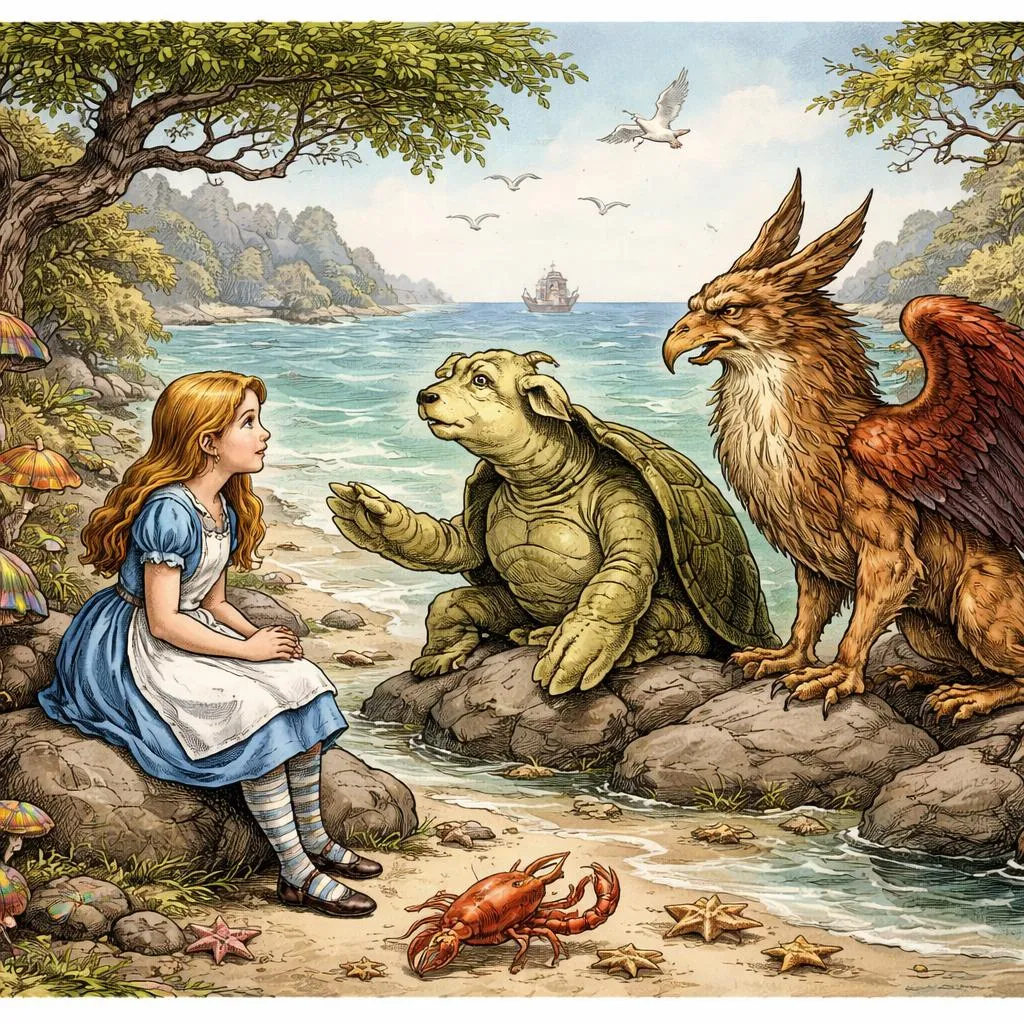
They very soon came upon a Gryphon, lying fast asleep in the sun. (IF you don't know what a Gryphon is, look at the picture.) 'Up, lazy thing!' said the Queen, 'and take this young lady to see the Mock Turtle, and to hear his history. I must go back and see after some executions I have ordered'; and she walked off, leaving Alice alone with the Gryphon. Alice did not quite like the look of the creature, but on the whole she thought it would be quite as safe to stay with it as to go after that savage Queen: so she waited.
The Gryphon sat up and rubbed its eyes: then it watched the Queen till she was out of sight: then it chuckled. 'What fun!' said the Gryphon, half to itself, half to Alice.
'What IS the fun?' said Alice.
'Why, SHE,' said the Gryphon. 'It's all her fancy, that: they never executes nobody, you know. Come on!'
'Everybody says "come on!" here,' thought Alice, as she went slowly after it: 'I never was so ordered about in all my life, never!'
They had not gone far before they saw the Mock Turtle in the distance, sitting sad and lonely on a little ledge of rock, and, as they came nearer, Alice could hear him sighing as if his heart would break. She pitied him deeply. 'What is his sorrow?' she asked the Gryphon, and the Gryphon answered, very nearly in the same words as before, 'It's all his fancy, that: he hasn't got no sorrow, you know. Come on!'
So they went up to the Mock Turtle, who looked at them with large eyes full of tears, but said nothing.
'This here young lady,' said the Gryphon, 'she wants for to know your history, she do.'
'I'll tell it her,' said the Mock Turtle in a deep, hollow tone: 'sit down, both of you, and don't speak a word till I've finished.'
So they sat down, and nobody spoke for some minutes. Alice thought to herself, 'I don't see how he can EVEN finish, if he doesn't begin.' But she waited patiently.
'Once,' said the Mock Turtle at last, with a deep sigh, 'I was a real Turtle.'
These words were followed by a very long silence, broken only by an occasional exclamation of 'Hjckrrh!' from the Gryphon, and the constant heavy sobbing of the Mock Turtle. Alice was very nearly getting up and saying, 'Thank you, sir, for your interesting story,' but she could not help thinking there MUST be more to come, so she sat still and said nothing.
'When we were little,' the Mock Turtle went on at last, more calmly, though still sobbing a little now and then, 'we went to school in the sea. The master was an old Turtle—we used to call him Tortoise—'
'Why did you call him Tortoise, if he wasn't one?' Alice asked.
'We called him Tortoise because he taught us,' said the Mock Turtle angrily: 'really you are very dull!'
'You ought to be ashamed of yourself for asking such a simple question,' added the Gryphon; and then they both sat silent and looked at poor Alice, who felt ready to sink into the earth. At last the Gryphon said to the Mock Turtle, 'Drive on, old fellow! Don't be all day about it!' and he went on in these words:
'Yes, we went to school in the sea, though you mayn't believe it—'
'I never said I didn't!' interrupted Alice.
'You did,' said the Mock Turtle.
'Hold your tongue!' added the Gryphon, before Alice could speak again. The Mock Turtle went on.
'We had the best of educations—in fact, we went to school every day—'
'I'VE been to a day–school, too,' said Alice; 'you needn't be so proud as all that.'
'With extras?' asked the Mock Turtle a little anxiously.
'Yes,' said Alice, 'we learned French and music.'
'And washing?' said the Mock Turtle.
'Certainly not!' said Alice indignantly.
'Ah! then yours wasn't a really good school,' said the Mock Turtle in a tone of great relief. 'Now at OURS they had at the end of the bill, "French, music, AND WASHING—extra."'
'You couldn't have wanted it much,' said Alice; 'living at the bottom of the sea.'
'I couldn't afford to learn it.' said the Mock Turtle with a sigh. 'I only took the regular course.'
'What was that?' inquired Alice.
'Reeling and Writhing, of course, to begin with,' the Mock Turtle replied; 'and then the different branches of Arithmetic—Ambition, Distraction, Uglification, and Derision.'
'I never heard of "Uglification,"' Alice ventured to say. 'What is it?'
The Gryphon lifted up both its paws in surprise. 'What! Never heard of uglifying!' it exclaimed. 'You know what to beautify is, I suppose?'
'Yes,' said Alice doubtfully: 'it means—to—make—anything—prettier.'
'Well, then,' the Gryphon went on, 'if you don't know what to uglify is, you ARE a simpleton.'
Alice did not feel encouraged to ask any more questions about it, so she turned to the Mock Turtle, and said 'What else had you to learn?'
'Well, there was Mystery,' the Mock Turtle replied, counting off the subjects on his flappers, '—Mystery, ancient and modern, with Seaography: then Drawling—the Drawling–master was an old conger–eel, that used to come once a week: HE taught us Drawling, Stretching, and Fainting in Coils.'
'What was THAT like?' said Alice.
'Well, I can't show it you myself,' the Mock Turtle said: 'I'm too stiff. And the Gryphon never learnt it.'
'Hadn't time,' said the Gryphon: 'I went to the Classics master, though. He was an old crab, HE was.'
'I never went to him,' the Mock Turtle said with a sigh: 'he taught Laughing and Grief, they used to say.'
'So he did, so he did,' said the Gryphon, sighing in his turn; and both creatures hid their faces in their paws.
'And how many hours a day did you do lessons?' said Alice, in a hurry to change the subject.
'Ten hours the first day,' said the Mock Turtle: 'nine the next, and so on.'
'What a curious plan!' exclaimed Alice.
'That's the reason they're called lessons,' the Gryphon remarked: 'because they lessen from day to day.'
This was quite a new idea to Alice, and she thought it over a little before she made her next remark. 'Then the eleventh day must have been a holiday?'
'Of course it was,' said the Mock Turtle.
'And how did you manage on the twelfth?' Alice went on eagerly.
'That's enough about lessons,' the Gryphon interrupted in a very decided tone: 'tell her something about the games now.'
背景介绍和作者介绍
这段文字选自刘易斯·卡罗尔(Lewis Carroll)的《爱丽丝漫游仙境》,他是查尔斯·勒特威奇·道奇森(Charles Lutwidge Dodgson)的笔名,是一位英国数学家、逻辑学家和作家。这部小说于1865年出版,是儿童文学的里程碑,融合了幻想、荒诞和讽刺。卡罗尔的作品反映了维多利亚时代的怪癖和挑战,他用异想天开和荒诞的方式来探索逻辑、语言和身份。
详细解读和意义
在这段摘录中,爱丽丝与公爵夫人、女王、狮鹫和假海龟互动——这些角色体现了仙境超现实且常常自相矛盾的本质。公爵夫人对道德的痴迷讽刺了维多利亚时代的说教,展示了人们如何经常将教训强加于故事,有时甚至达到荒谬的程度。女王的严厉和暴躁,与狮鹫和假海龟更温和幽默的性格形成对比,说明了不同类型的权威和个性。
假海龟讲述的关于他学校科目的故事,幽默地嘲笑了教育系统,将真实科目与“丑化”和“绘画”等无稽之谈混合在一起。这反映了卡罗尔对僵化教育和有时学习的任意性的戏谑批评。
给学生的启示和见解
-
批判性思维和质疑: 爱丽丝的好奇心和礼貌的提问鼓励读者批判性地思考他们所听所见,而不是全盘接受。
-
理解道德和观点: 公爵夫人坚持认为一切都有道德意义,这邀请读者寻找更深层的含义,但也认识到这种解释可能被强加或毫无意义。
-
处理权威: 女王的不可预测行为教会了人们如何应对不公平或不合理的权威人物,这在学校和社会生活中都是一个相关的教训。
-
拥抱想象力和幽默: 充满趣味的语言和荒诞的情境鼓励创造力,表明学习可以很有趣,幽默可以成为理解复杂思想的有力工具。
将这些教训应用于生活
-
在学习中: 学生可以像爱丽丝一样,通过提问和探索表面知识之外的科目来培养好奇心。认识到真知和无稽之谈的区别有助于培养辨别力。
-
在社交场合: 了解不同的个性,例如公爵夫人的说教或女王的脾气,有助于以同情和耐心的方式处理友谊和冲突。
-
在个人成长中: 这个故事鼓励拥抱一个人的独特性和想象力,培养面对生活挑战的信心和韧性。
从故事中培养积极的特质
-
好奇心: 像爱丽丝一样,永远渴望学习和了解你周围的世界。
-
礼貌和尊重: 即使感到困惑或受到挑战,爱丽丝仍然保持礼貌,这是一项宝贵的社交技能。
-
幽默和轻松: 用幽默来应对困难,并与他人建立联系。
-
批判性分析: 学会识别何时信息有意义,何时是无稽之谈,从而帮助做出更明智的决定。
通过学习《爱丽丝漫游仙境》,学生们不仅能获得一个令人愉悦的故事,还能获得在复杂世界中思考、学习和生活得更好的工具。
