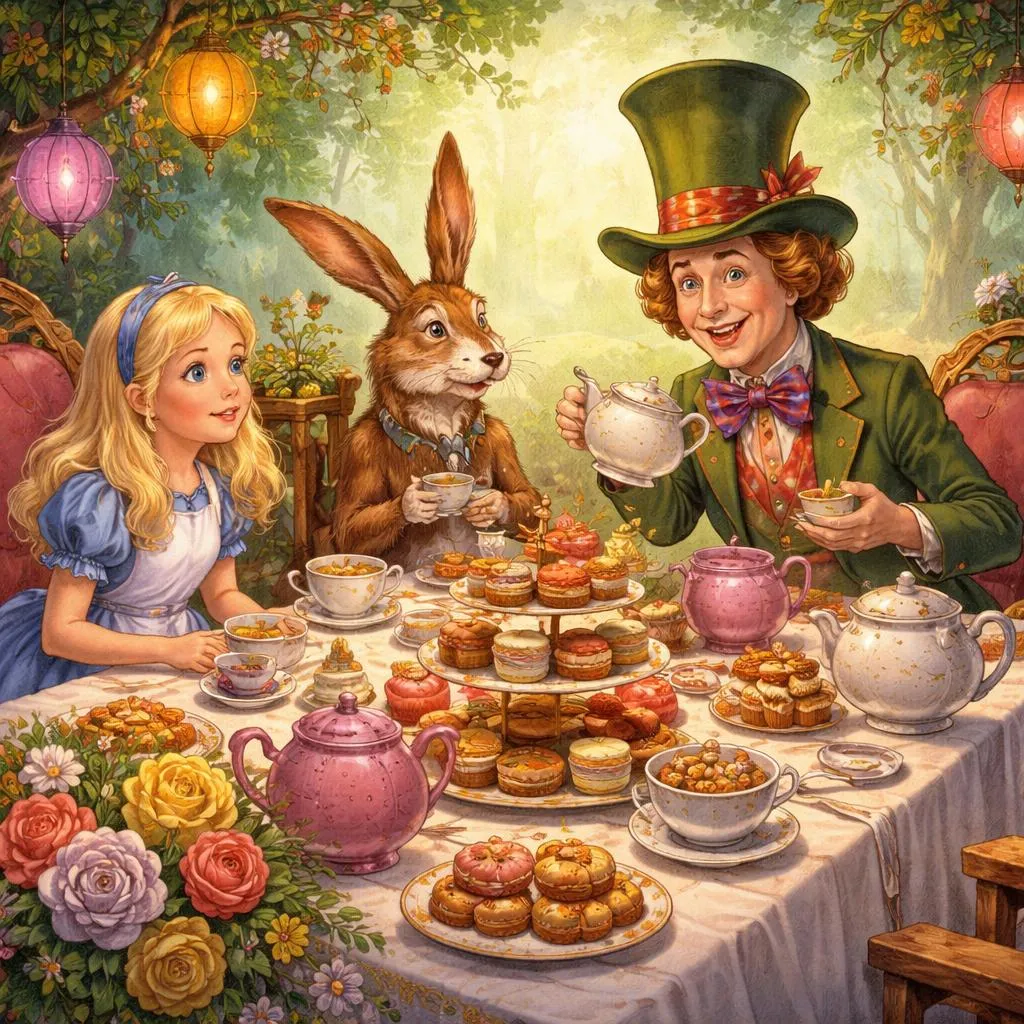

There was a table set out under a tree in front of the house, and the March Hare and the Hatter were having tea at it: a Dormouse was sitting between them, fast asleep, and the other two were using it as a cushion, resting their elbows on it, and talking over its head. 'Very uncomfortable for the Dormouse,' thought Alice; 'only, as it's asleep, I suppose it doesn't mind.'
The table was a large one, but the three were all crowded together at one corner of it: 'No room! No room!' they cried out when they saw Alice coming. 'There's PLENTY of room!' said Alice indignantly, and she sat down in a large arm–chair at one end of the table.
'Have some wine,' the March Hare said in an encouraging tone.
Alice looked all round the table, but there was nothing on it but tea. 'I don't see any wine,' she remarked.
'There isn't any,' said the March Hare.
'Then it wasn't very civil of you to offer it,' said Alice angrily.
'It wasn't very civil of you to sit down without being invited,' said the March Hare.
'I didn't know it was YOUR table,' said Alice; 'it's laid for a great many more than three.'
'Your hair wants cutting,' said the Hatter. He had been looking at Alice for some time with great curiosity, and this was his first speech.
'You should learn not to make personal remarks,' Alice said with some severity; 'it's very rude.'
The Hatter opened his eyes very wide on hearing this; but all he SAID was, 'Why is a raven like a writing–desk?'
'Come, we shall have some fun now!' thought Alice. 'I'm glad they've begun asking riddles.—I believe I can guess that,' she added aloud.
'Do you mean that you think you can find out the answer to it?' said the March Hare.
'Exactly so,' said Alice.
'Then you should say what you mean,' the March Hare went on.
'I do,' Alice hastily replied; 'at least—at least I mean what I say—that's the same thing, you know.'
'Not the same thing a bit!' said the Hatter. 'You might just as well say that "I see what I eat" is the same thing as "I eat what I see"!'
'You might just as well say,' added the March Hare, 'that "I like what I get" is the same thing as "I get what I like"!'
'You might just as well say,' added the Dormouse, who seemed to be talking in his sleep, 'that "I breathe when I sleep" is the same thing as "I sleep when I breathe"!'
'It IS the same thing with you,' said the Hatter, and here the conversation dropped, and the party sat silent for a minute, while Alice thought over all she could remember about ravens and writing–desks, which wasn't much.
The Hatter was the first to break the silence. 'What day of the month is it?' he said, turning to Alice: he had taken his watch out of his pocket, and was looking at it uneasily, shaking it every now and then, and holding it to his ear.
Alice considered a little, and then said 'The fourth.'
'Two days wrong!' sighed the Hatter. 'I told you butter wouldn't suit the works!' he added looking angrily at the March Hare.
'It was the BEST butter,' the March Hare meekly replied.
'Yes, but some crumbs must have got in as well,' the Hatter grumbled: 'you shouldn't have put it in with the bread–knife.'
The March Hare took the watch and looked at it gloomily: then he dipped it into his cup of tea, and looked at it again: but he could think of nothing better to say than his first remark, 'It was the BEST butter, you know.'
Alice had been looking over his shoulder with some curiosity. 'What a funny watch!' she remarked. 'It tells the day of the month, and doesn't tell what o'clock it is!'
'Why should it?' muttered the Hatter. 'Does YOUR watch tell you what year it is?'
'Of course not,' Alice replied very readily: 'but that's because it stays the same year for such a long time together.'
'Which is just the case with MINE,' said the Hatter.
Alice felt dreadfully puzzled. The Hatter's remark seemed to have no sort of meaning in it, and yet it was certainly English. 'I don't quite understand you,' she said, as politely as she could.
'The Dormouse is asleep again,' said the Hatter, and he poured a little hot tea upon its nose.
The Dormouse shook its head impatiently, and said, without opening its eyes, 'Of course, of course; just what I was going to remark myself.'
'Have you guessed the riddle yet?' the Hatter said, turning to Alice again.
'No, I give it up,' Alice replied: 'what's the answer?'
'I haven't the slightest idea,' said the Hatter.
'Nor I,' said the March Hare.
Alice sighed wearily. 'I think you might do something better with the time,' she said, 'than waste it in asking riddles that have no answers.'
'If you knew Time as well as I do,' said the Hatter, 'you wouldn't talk about wasting IT. It's HIM.'
'I don't know what you mean,' said Alice.
'Of course you don't!' the Hatter said, tossing his head contemptuously. 'I dare say you never even spoke to Time!'
'Perhaps not,' Alice cautiously replied: 'but I know I have to beat time when I learn music.'
'Ah! that accounts for it,' said the Hatter. 'He won't stand beating. Now, if you only kept on good terms with him, he'd do almost anything you liked with the clock. For instance, suppose it were nine o'clock in the morning, just time to begin lessons: you'd only have to whisper a hint to Time, and round goes the clock in a twinkling! Half–past one, time for dinner!'
('I only wish it was,' the March Hare said to itself in a whisper.)
'That would be grand, certainly,' said Alice thoughtfully: 'but then—I shouldn't be hungry for it, you know.'
'Not at first, perhaps,' said the Hatter: 'but you could keep it to half–past one as long as you liked.'
'Is that the way YOU manage?' Alice asked.
The Hatter shook his head mournfully. 'Not I!' he replied. 'We quarrelled last March—just before HE went mad, you know—' (pointing with his tea spoon at the March Hare,) '—it was at the great concert given by the Queen of Hearts, and I had to sing
"Twinkle, twinkle, little bat! How I wonder what you're at!"
You know the song, perhaps?'
'I've heard something like it,' said Alice.
'It goes on, you know,' the Hatter continued, 'in this way:—
"Up above the world you fly, Like a tea–tray in the sky. Twinkle, twinkle—"'
Here the Dormouse shook itself, and began singing in its sleep 'Twinkle, twinkle, twinkle, twinkle—' and went on so long that they had to pinch it to make it stop.
'Well, I'd hardly finished the first verse,' said the Hatter, 'when the Queen jumped up and bawled out, "He's murdering the time! Off with his head!"'
'How dreadfully savage!' exclaimed Alice.
'And ever since that,' the Hatter went on in a mournful tone, 'he won't do a thing I ask! It's always six o'clock now.'
A bright idea came into Alice's head. 'Is that the reason so many tea–things are put out here?' she asked.
'Yes, that's it,' said the Hatter with a sigh: 'it's always tea–time, and we've no time to wash the things between whiles.'
'Then you keep moving round, I suppose?' said Alice.
'Exactly so,' said the Hatter: 'as the things get used up.'
'But what happens when you come to the beginning again?' Alice ventured to ask.
'Suppose we change the subject,' the March Hare interrupted, yawning. 'I'm getting tired of this. I vote the young lady tells us a story.'
'I'm afraid I don't know one,' said Alice, rather alarmed at the proposal.
'Then the Dormouse shall!' they both cried. 'Wake up, Dormouse!' And they pinched it on both sides at once.
The Dormouse slowly opened his eyes. 'I wasn't asleep,' he said in a hoarse, feeble voice: 'I heard every word you fellows were saying.'
'Tell us a story!' said the March Hare.
'Yes, please do!' pleaded Alice.
'And be quick about it,' added the Hatter, 'or you'll be asleep again before it's done.'
'Once upon a time there were three little sisters,' the Dormouse began in a great hurry; 'and their names were Elsie, Lacie, and Tillie; and they lived at the bottom of a well—'
'What did they live on?' said Alice, who always took a great interest in questions of eating and drinking.
'They lived on treacle,' said the Dormouse, after thinking a minute or two.
'They couldn't have done that, you know,' Alice gently remarked; 'they'd have been ill.'
'So they were,' said the Dormouse; 'VERY ill.'
Alice tried to fancy to herself what such an extraordinary ways of living would be like, but it puzzled her too much, so she went on: 'But why did they live at the bottom of a well?'
'Take some more tea,' the March Hare said to Alice, very earnestly.
'I've had nothing yet,' Alice replied in an offended tone, 'so I can't take more.'
'You mean you can't take LESS,' said the Hatter: 'it's very easy to take MORE than nothing.'
'Nobody asked YOUR opinion,' said Alice.
'Who's making personal remarks now?' the Hatter asked triumphantly.
Alice did not quite know what to say to this: so she helped herself to some tea and bread–and–butter, and then turned to the Dormouse, and repeated her question. 'Why did they live at the bottom of a well?'
The Dormouse again took a minute or two to think about it, and then said, 'It was a treacle–well.'
'There's no such thing!' Alice was beginning very angrily, but the Hatter and the March Hare went 'Sh! sh!' and the Dormouse sulkily remarked, 'If you can't be civil, you'd better finish the story for yourself.'
'No, please go on!' Alice said very humbly; 'I won't interrupt again. I dare say there may be ONE.'
'One, indeed!' said the Dormouse indignantly. However, he consented to go on. 'And so these three little sisters—they were learning to draw, you know—'
'What did they draw?' said Alice, quite forgetting her promise.
'Treacle,' said the Dormouse, without considering at all this time.
'I want a clean cup,' interrupted the Hatter: 'let's all move one place on.'
He moved on as he spoke, and the Dormouse followed him: the March Hare moved into the Dormouse's place, and Alice rather unwillingly took the place of the March Hare. The Hatter was the only one who got any advantage from the change: and Alice was a good deal worse off than before, as the March Hare had just upset the milk–jug into his plate.
Alice did not wish to offend the Dormouse again, so she began very cautiously: 'But I don't understand. Where did they draw the treacle from?'
'You can draw water out of a water–well,' said the Hatter; 'so I should think you could draw treacle out of a treacle–well—eh, stupid?'
'But they were IN the well,' Alice said to the Dormouse, not choosing to notice this last remark.
'Of course they were', said the Dormouse; '—well in.'
This answer so confused poor Alice, that she let the Dormouse go on for some time without interrupting it.
'They were learning to draw,' the Dormouse went on, yawning and rubbing its eyes, for it was getting very sleepy; 'and they drew all manner of things—everything that begins with an M—'
'Why with an M?' said Alice.
'Why not?' said the March Hare.
Alice was silent.
The Dormouse had closed its eyes by this time, and was going off into a doze; but, on being pinched by the Hatter, it woke up again with a little shriek, and went on: '—that begins with an M, such as mouse–traps, and the moon, and memory, and muchness—you know you say things are "much of a muchness"—did you ever see such a thing as a drawing of a muchness?'
'Really, now you ask me,' said Alice, very much confused, 'I don't think—'
'Then you shouldn't talk,' said the Hatter.
This piece of rudeness was more than Alice could bear: she got up in great disgust, and walked off; the Dormouse fell asleep instantly, and neither of the others took the least notice of her going, though she looked back once or twice, half hoping that they would call after her: the last time she saw them, they were trying to put the Dormouse into the teapot.
'At any rate I'll never go THERE again!' said Alice as she picked her way through the wood. 'It's the stupidest tea–party I ever was at in all my life!'
Just as she said this, she noticed that one of the trees had a door leading right into it. 'That's very curious!' she thought. 'But everything's curious today. I think I may as well go in at once.' And in she went.
Once more she found herself in the long hall, and close to the little glass table. 'Now, I'll manage better this time,' she said to herself, and began by taking the little golden key, and unlocking the door that led into the garden. Then she went to work nibbling at the mushroom (she had kept a piece of it in her pocket) till she was about a foot high: then she walked down the little passage: and THEN—she found herself at last in the beautiful garden, among the bright flower–beds and the cool fountains.
背景介绍和作者介绍
这段内容选自《爱丽丝梦游仙境》,这是一部由刘易斯·卡罗尔(查尔斯·勒特威吉·道奇森的笔名)创作的深受喜爱的经典之作。这部小说于1865年出版,凭借其富有想象力的叙事和异想天开的人物,一百多年来一直吸引着读者。卡罗尔是一位数学家和逻辑学家,他的背景在这部小说中通过对逻辑、语言和谜语的巧妙运用而得以体现。这个故事源于卡罗尔与利德尔姐妹,特别是爱丽丝·利德尔的一次乘船旅行,爱丽丝·利德尔启发了故事中的主要人物。
详细解读和意义
描绘的场景是著名的“疯狂茶会”,爱丽丝在那里遇到了三月兔、疯帽子和睡鼠。这一集充满了荒诞和无稽之谈,反映了爱丽丝所陷入的颠倒世界。人物们进行着不合逻辑的对话和谜语,例如著名的“为什么乌鸦像写字台?”这个问题,没有明确的答案。这挑战读者超越传统的逻辑思维,拥抱创造力和想象力。
茶会也探讨了时间和疯狂的主题。疯帽子的坏掉的怀表象征着时间在仙境中失去了它通常的意义。人物之间的争吵和荒诞的行为突出了这个幻想世界中不可预测性和混乱,这与爱丽丝试图理解这一切形成了对比。
给学生的启示和见解
-
拥抱好奇心和想象力: 爱丽丝的旅程鼓励年轻读者保持好奇心和开放的心态。仙境的奇怪逻辑邀请我们进行创造性思考,并质疑我们周围的世界。
-
理解语言和交流: 茶会场景中对语言、谜语和文字游戏的巧妙运用表明了文字可以具有多种含义,以及交流如何取决于语境。这可以帮助学生欣赏文学作品并提高他们自己的语言技能。
-
处理困惑和不确定性: 爱丽丝经常面临不适用正常规则的混乱情况。这教会了韧性和适应能力——这是应对现实生活挑战的重要技能。
-
质疑权威和社会规范: 茶会人物经常表现出粗鲁或不合逻辑的行为,促使爱丽丝(和读者)质疑社会习俗并独立思考。
将故事的精神应用于生活
- 在学习中: 学生可以通过探索课本以外的科目、提问和批判性思考来运用爱丽丝的好奇心。
- 在社交场合中: 爱丽丝对粗鲁言论的礼貌而坚定的回应提醒我们要有尊严地为自己辩护。
- 在创造力中: 荒诞的谜语和富有想象力的场景鼓励创造性写作、艺术和解决问题。
- 在时间管理中: 疯帽子对时间的痴迷及其扭曲可以启发学生思考如何明智地利用自己的时间。
从故事中培养积极的价值观
- 好奇心: 像爱丽丝一样,永远渴望学习和探索新想法。
- 礼貌: 即使面对胡说八道或粗鲁,也要保持友善和尊重。
- 开放的心态: 接受并非所有事情都会立即变得有意义;有些事情需要耐心和想象力。
- 批判性思维: 质疑你所听到和看到的,并独立思考。
结论
《爱丽丝梦游仙境》中的疯狂茶会场景不仅仅是一个异想天开的故事;它还是一个文学创造力、哲学思想和人生经验的宝库。通过参与这个故事,学生可以培养他们的想象力、语言技能和批判性思维,同时也可以学习如何应对社交互动和个人成长的复杂性。刘易斯·卡罗尔的杰作继续激励着所有年龄段的读者,以一种好奇和玩乐的心态看待世界。
