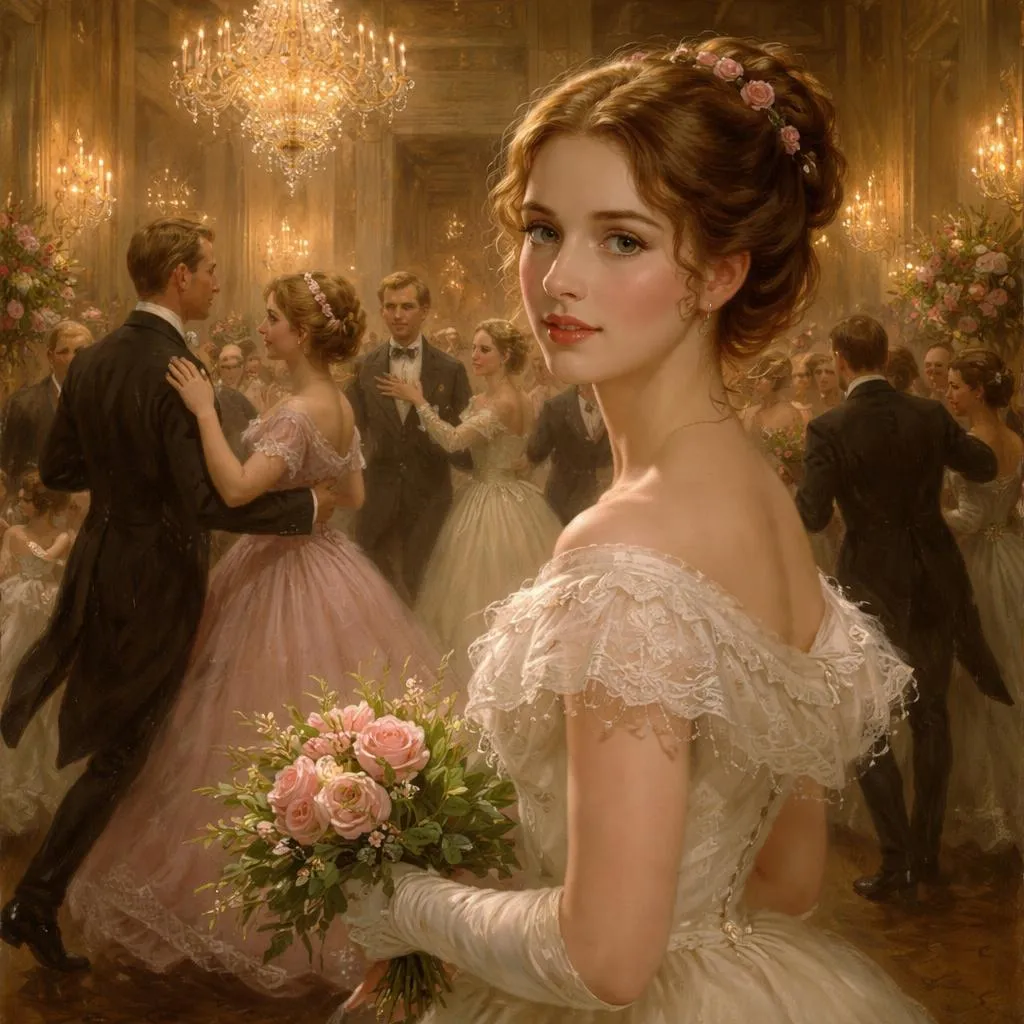

At eighteen, Miss Murray was to emerge from the quiet obscurity of the schoolroom into the full blaze of the fashionable world—as much of it, at least, as could be had out of London; for her papa could not be persuaded to leave his rural pleasures and pursuits, even for a few weeks’ residence in town. She was to make her debut on the third of January, at a magnificent ball, which her mamma proposed to give to all the nobility and choice gentry of O—– and its neighbourhood for twenty miles round. Of course, she looked forward to it with the wildest impatience, and the most extravagant anticipations of delight.
‘Miss Grey,’ said she, one evening, a month before the all–important day, as I was perusing a long and extremely interesting letter of my sister’s—which I had just glanced at in the morning to see that it contained no very bad news, and kept till now, unable before to find a quiet moment for reading it,—’Miss Grey, do put away that dull, stupid letter, and listen to me! I’m sure my talk must be far more amusing than that.’
She seated herself on the low stool at my feet; and I, suppressing a sigh of vexation, began to fold up the epistle.
‘You should tell the good people at home not to bore you with such long letters,’ said she; ‘and, above all, do bid them write on proper note–paper, and not on those great vulgar sheets. You should see the charming little lady–like notes mamma writes to her friends.’
‘The good people at home,’ replied I, ‘know very well that the longer their letters are, the better I like them. I should be very sorry to receive a charming little lady–like note from any of them; and I thought you were too much of a lady yourself, Miss Murray, to talk about the “vulgarity” of writing on a large sheet of paper.’
‘Well, I only said it to tease you. But now I want to talk about the ball; and to tell you that you positively must put off your holidays till it is over.’
‘Why so?—I shall not be present at the ball.’
‘No, but you will see the rooms decked out before it begins, and hear the music, and, above all, see me in my splendid new dress. I shall be so charming, you’ll be ready to worship me—you really must stay.’
‘I should like to see you very much; but I shall have many opportunities of seeing you equally charming, on the occasion of some of the numberless balls and parties that are to be, and I cannot disappoint my friends by postponing my return so long.’
‘Oh, never mind your friends! Tell them we won’t let you go.’
‘But, to say the truth, it would be a disappointment to myself: I long to see them as much as they to see me—perhaps more.’
‘Well, but it is such a short time.’
‘Nearly a fortnight by my computation; and, besides, I cannot bear the thoughts of a Christmas spent from home: and, moreover, my sister is going to be married.’
‘Is she—when?’
‘Not till next month; but I want to be there to assist her in making preparations, and to make the best of her company while we have her.’
‘Why didn’t you tell me before?’
‘I’ve only got the news in this letter, which you stigmatize as dull and stupid, and won’t let me read.’
‘To whom is she to be married?’
‘To Mr. Richardson, the vicar of a neighbouring parish.’
‘Is he rich?’
‘No; only comfortable.’
‘Is he handsome?’
‘No; only decent.’
‘Young?’
‘No; only middling.’
‘Oh, mercy! what a wretch! What sort of a house is it?’
‘A quiet little vicarage, with an ivy–clad porch, an old–fashioned garden, and—’
‘Oh, stop!—you’ll make me sick. How CAN she bear it?’
‘I expect she’ll not only be able to bear it, but to be very happy. You did not ask me if Mr. Richardson were a good, wise, or amiable man; I could have answered Yes, to all these questions—at least so Mary thinks, and I hope she will not find herself mistaken.’
‘But—miserable creature! how can she think of spending her life there, cooped up with that nasty old man; and no hope of change?’
‘He is not old: he’s only six or seven and thirty; and she herself is twenty–eight, and as sober as if she were fifty.’
‘Oh! that’s better then—they’re well matched; but do they call him the “worthy vicar”?’
‘I don’t know; but if they do, I believe he merits the epithet.’
‘Mercy, how shocking! and will she wear a white apron and make pies and puddings?’
‘I don’t know about the white apron, but I dare say she will make pies and puddings now and then; but that will be no great hardship, as she has done it before.’
‘And will she go about in a plain shawl, and a large straw bonnet, carrying tracts and bone soup to her husband’s poor parishioners?’
‘I’m not clear about that; but I dare say she will do her best to make them comfortable in body and mind, in accordance with our mother’s example.’
背景介绍和作者介绍
这段摘录选自一部经典的19世纪小说,探讨了社会期望、家庭责任和个人成长等主题。故事围绕着默里小姐展开,她是一位年轻女性,正准备通过舞会进入社交圈——这是一个标志着年轻女士进入社会精英阶层的重大事件。叙事捕捉了社交生活的兴奋与家庭和个人责任的平静而务实的现实之间的对比。
作者是维多利亚时代文学中的杰出人物,经常描写女性在当时严格的社会规范中挣扎的生活。他们的作品以对人物和社会的敏锐观察而闻名,将幽默与对人性、社会约束的严肃思考融为一体。
详细解读和意义
这段话突出了年轻的期待与成熟的责任之间的紧张关系。默里小姐热切地期待着她的亮相舞会,象征着她进入时尚界。然而,通过与格雷小姐的对话,我们得以一窥此类活动背后的实际情况——家庭关系、个人牺牲以及对女性的期望。
关于默里小姐的妹妹即将嫁给一位朴素的牧师的对话,引入了社会阶级和个人幸福的主题。妹妹的选择与华丽的亮相舞会形成了鲜明对比,暗示了那个时代的女性可能采取的不同道路。关于牧师的性格和生活方式的讨论挑战了肤浅的判断,强调了善良、智慧和知足等美德,而不是财富或外貌。
给学生的教训和见解
-
理解社会期望: 故事提供了一扇了解历史社会习俗的窗口,帮助学生欣赏社会角色和期望如何塑造个人选择。认识到这些影响鼓励了对当今社会规范的同情和批判性思考。
-
平衡抱负和责任: 默里小姐对舞会的兴奋与她妹妹平静、更有责任感的生活形成了对比。学生可以学习如何在个人梦想与家庭义务之间取得平衡,以及支持亲人的重要性。
-
超越外表判断性格: 关于理查森先生的对话教会了我们超越财富或外貌等表面特征来评估某人真实性格的价值——这是建立有意义关系的重要一课。
-
欣赏不同的人生道路: 故事表明,幸福和满足感可以通过多种形式获得,无论是通过社会成功还是简单、有德行的生活。这拓宽了学生对成功和满足感的看法。
将故事的精神应用于日常生活
-
在学校: 学生可以学会尊重同伴中不同的背景和选择,从而营造一个包容的环境。他们也可能反思如何平衡学业目标与家庭和社会生活。
-
在社交场合: 故事鼓励善良和开放的心态,提醒学生不要根据外貌或社会地位仓促地评判他人。
-
在个人成长中: 拥抱抱负和责任可以帮助学生培养成熟。他们可以追求个人成就,同时保持脚踏实地并体谅他人。
从故事中培养积极的价值观
-
同情和理解: 通过在故事中看到不同的视角,学生可以练习同情心,理解他人面临的挑战和快乐。
-
尊重传统和变革: 叙事展现了对家庭和传统的尊重,同时也暗示了超越社会期望的个人选择和幸福的可能性。
-
判断中的智慧: 鼓励学生深入了解表面印象,从而培养智慧,并在友谊和未来的关系中做出更好的决策。
-
感恩和知足: 妹妹对朴素但幸福的生活的接受,引发了对拥有的事物的感恩之情,以及在简单事物中寻找快乐的思考。
结论
这个故事不仅仅是一个关于亮相舞会的故事;它对社会生活、家庭纽带和个人价值观进行了丰富的探索。对于年轻读者来说,它提供了关于性格、同情心以及人们找到幸福的各种方式的永恒教训。通过参与这些主题,学生可以加深对自我和周围世界的理解,为他们过上深思熟虑、富有同情心的生活做好准备。
