
Miss Murray now always went twice to church, for she so loved admiration that she could not bear to lose a single opportunity of obtaining it; and she was so sure of it wherever she showed herself, that, whether Harry Meltham and Mr. Green were there or not, there was certain to be somebody present who would not be insensible to her charms, besides the Rector, whose official capacity generally obliged him to attend. Usually, also, if the weather permitted, both she and her sister would walk home; Matilda, because she hated the confinement of the carriage; she, because she disliked the privacy of it, and enjoyed the company that generally enlivened the first mile of the journey in walking from the church to Mr. Green’s park–gates: near which commenced the private road to Horton Lodge, which lay in the opposite direction, while the highway conducted in a straightforward course to the still more distant mansion of Sir Hugh Meltham. Thus there was always a chance of being accompanied, so far, either by Harry Meltham, with or without Miss Meltham, or Mr. Green, with perhaps one or both of his sisters, and any gentlemen visitors they might have.
Whether I walked with the young ladies or rode with their parents, depended upon their own capricious will: if they chose to ‘take’ me, I went; if, for reasons best known to themselves, they chose to go alone, I took my seat in the carriage. I liked walking better, but a sense of reluctance to obtrude my presence on anyone who did not desire it, always kept me passive on these and similar occasions; and I never inquired into the causes of their varying whims. Indeed, this was the best policy—for to submit and oblige was the governess’s part, to consult their own pleasure was that of the pupils. But when I did walk, the first half of journey was generally a great nuisance to me. As none of the before–mentioned ladies and gentlemen ever noticed me, it was disagreeable to walk beside them, as if listening to what they said, or wishing to be thought one of them, while they talked over me, or across; and if their eyes, in speaking, chanced to fall on me, it seemed as if they looked on vacancy—as if they either did not see me, or were very desirous to make it appear so. It was disagreeable, too, to walk behind, and thus appear to acknowledge my own inferiority; for, in truth, I considered myself pretty nearly as good as the best of them, and wished them to know that I did so, and not to imagine that I looked upon myself as a mere domestic, who knew her own place too well to walk beside such fine ladies and gentlemen as they were—though her young ladies might choose to have her with them, and even condescend to converse with her when no better company were at hand. Thus—I am almost ashamed to confess it—but indeed I gave myself no little trouble in my endeavours (if I did keep up with them) to appear perfectly unconscious or regardless of their presence, as if I were wholly absorbed in my own reflections, or the contemplation of surrounding objects; or, if I lingered behind, it was some bird or insect, some tree or flower, that attracted my attention, and having duly examined that, I would pursue my walk alone, at a leisurely pace, until my pupils had bidden adieu to their companions and turned off into the quiet private road.
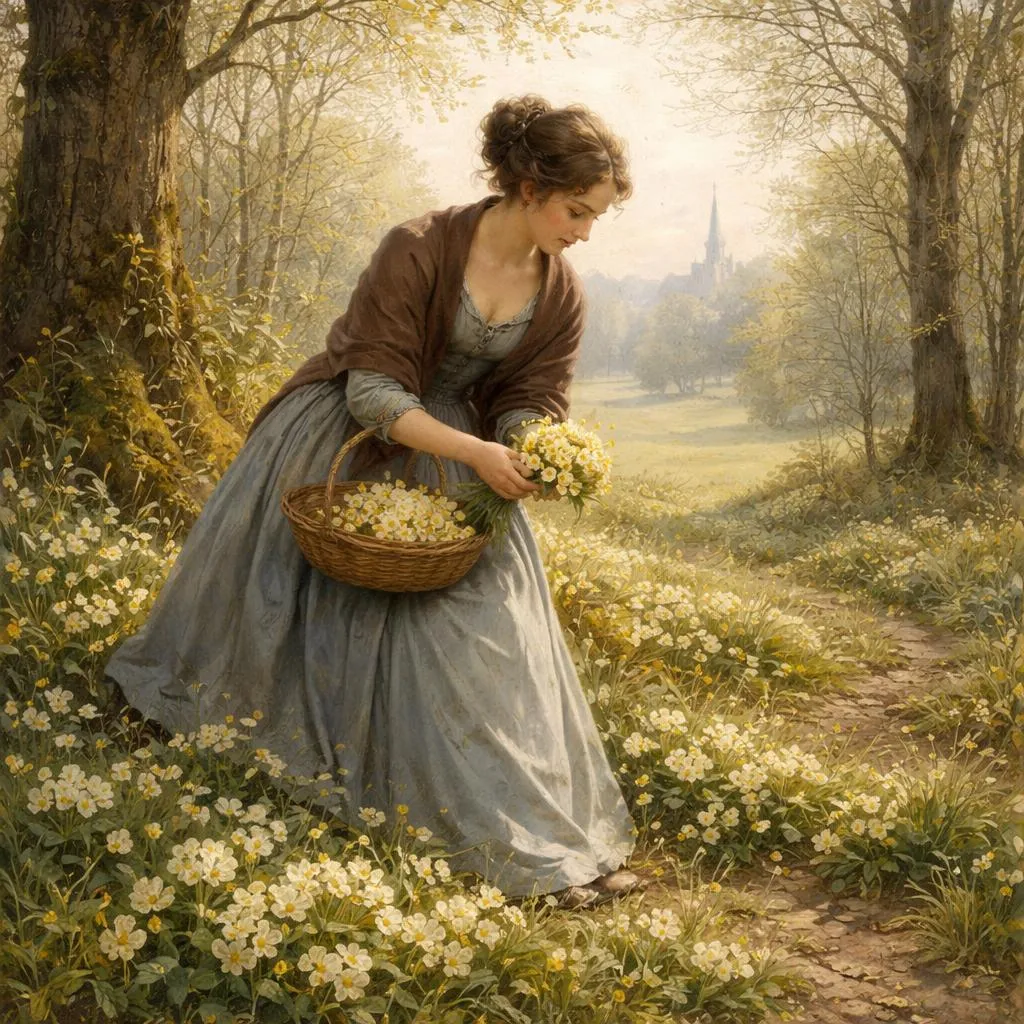
One such occasion I particularly well remember; it was a lovely afternoon about the close of March; Mr. Green and his sisters had sent their carriage back empty, in order to enjoy the bright sunshine and balmy air in a sociable walk home along with their visitors, Captain Somebody and Lieutenant Somebody–else (a couple of military fops), and the Misses Murray, who, of course, contrived to join them. Such a party was highly agreeable to Rosalie; but not finding it equally suitable to my taste, I presently fell back, and began to botanise and entomologise along the green banks and budding hedges, till the company was considerably in advance of me, and I could hear the sweet song of the happy lark; then my spirit of misanthropy began to melt away beneath the soft, pure air and genial sunshine; but sad thoughts of early childhood, and yearnings for departed joys, or for a brighter future lot, arose instead. As my eyes wandered over the steep banks covered with young grass and green–leaved plants, and surmounted by budding hedges, I longed intensely for some familiar flower that might recall the woody dales or green hill–sides of home: the brown moorlands, of course, were out of the question. Such a discovery would make my eyes gush out with water, no doubt; but that was one of my greatest enjoyments now. At length I descried, high up between the twisted roots of an oak, three lovely primroses, peeping so sweetly from their hiding–place that the tears already started at the sight; but they grew so high above me, that I tried in vain to gather one or two, to dream over and to carry with me: I could not reach them unless I climbed the bank, which I was deterred from doing by hearing a footstep at that moment behind me, and was, therefore, about to turn away, when I was startled by the words, ‘Allow me to gather them for you, Miss Grey,’ spoken in the grave, low tones of a well–known voice. Immediately the flowers were gathered, and in my hand. It was Mr. Weston, of course—who else would trouble himself to do so much for ME?
‘I thanked him; whether warmly or coldly, I cannot tell: but certain I am that I did not express half the gratitude I felt. It was foolish, perhaps, to feel any gratitude at all; but it seemed to me, at that moment, as if this were a remarkable instance of his good–nature: an act of kindness, which I could not repay, but never should forget: so utterly unaccustomed was I to receive such civilities, so little prepared to expect them from anyone within fifty miles of Horton Lodge. Yet this did not prevent me from feeling a little uncomfortable in his presence; and I proceeded to follow my pupils at a much quicker pace than before; though, perhaps, if Mr. Weston had taken the hint, and let me pass without another word, I might have repeated it an hour after: but he did not. A somewhat rapid walk for me was but an ordinary pace for him.
‘Your young ladies have left you alone,’ said he.
‘Yes, they are occupied with more agreeable company.’
‘Then don’t trouble yourself to overtake them.’ I slackened my pace; but next moment regretted having done so: my companion did not speak; and I had nothing in the world to say, and feared he might be in the same predicament. At length, however, he broke the pause by asking, with a certain quiet abruptness peculiar to himself, if I liked flowers.
‘Yes; very much,’ I answered, ‘wild–flowers especially.’
‘I like wild–flowers,’ said he; ‘others I don’t care about, because I have no particular associations connected with them— except one or two. What are your favourite flowers?’
‘Primroses, bluebells, and heath–blossoms.’
‘Not violets?’
‘No; because, as you say, I have no particular associations connected with them; for there are no sweet violets among the hills and valleys round my home.’
‘It must be a great consolation to you to have a home, Miss Grey,’ observed my companion after a short pause: ‘however remote, or however seldom visited, still it is something to look to.’
‘It is so much that I think I could not live without it,’ replied I, with an enthusiasm of which I immediately repented; for I thought it must have sounded essentially silly.
‘Oh, yes, you could,’ said he, with a thoughtful smile. ‘The ties that bind us to life are tougher than you imagine, or than anyone can who has not felt how roughly they may be pulled without breaking. You might be miserable without a home, but even YOU could live; and not so miserably as you suppose. The human heart is like india–rubber; a little swells it, but a great deal will not burst it. If “little more than nothing will disturb it, little less than all things will suffice” to break it. As in the outer members of our frame, there is a vital power inherent in itself that strengthens it against external violence. Every blow that shakes it will serve to harden it against a future stroke; as constant labour thickens the skin of the hand, and strengthens its muscles instead of wasting them away: so that a day of arduous toil, that might excoriate a lady’s palm, would make no sensible impression on that of a hardy ploughman.
‘I speak from experience—partly my own. There was a time when I thought as you do—at least, I was fully persuaded that home and its affections were the only things that made life tolerable: that, if deprived of these, existence would become a burden hard to be endured; but now I have no home—unless you would dignify my two hired rooms at Horton by such a name;—and not twelve months ago I lost the last and dearest of my early friends; and yet, not only I live, but I am not wholly destitute of hope and comfort, even for this life: though I must acknowledge that I can seldom enter even an humble cottage at the close of day, and see its inhabitants peaceably gathered around their cheerful hearth, without a feeling ALMOST of envy at their domestic enjoyment.’
‘You don’t know what happiness lies before you yet,’ said I: ‘you are now only in the commencement of your journey.’
‘The best of happiness,’ replied he, ‘is mine already—the power and the will to be useful.’
We now approached a stile communicating with a footpath that conducted to a farm–house, where, I suppose, Mr. Weston purposed to make himself ‘useful;’ for he presently took leave of me, crossed the stile, and traversed the path with his usual firm, elastic tread, leaving me to ponder his words as I continued my course alone. I had heard before that he had lost his mother not many months before he came. She then was the last and dearest of his early friends; and he had NO HOME. I pitied him from my heart: I almost wept for sympathy. And this, I thought, accounted for the shade of premature thoughtfulness that so frequently clouded his brow, and obtained for him the reputation of a morose and sullen disposition with the charitable Miss Murray and all her kin. ‘But,’ thought I, ‘he is not so miserable as I should be under such a deprivation: he leads an active life; and a wide field for useful exertion lies before him. He can MAKE friends; and he can make a home too, if he pleases; and, doubtless, he will please some time. God grant the partner of that home may be worthy of his choice, and make it a happy one—such a home as he deserves to have! And how delightful it would be to—’ But no matter what I thought.
I began this book with the intention of concealing nothing; that those who liked might have the benefit of perusing a fellow–creature’s heart: but we have some thoughts that all the angels in heaven are welcome to behold, but not our brother–men—not even the best and kindest amongst them.
By this time the Greens had taken themselves to their own abode, and the Murrays had turned down the private road, whither I hastened to follow them. I found the two girls warm in an animated discussion on the respective merits of the two young officers; but on seeing me Rosalie broke off in the middle of a sentence to exclaim, with malicious glee—
‘Oh–ho, Miss Grey! you’re come at last, are you? No WONDER you lingered so long behind; and no WONDER you always stand up so vigorously for Mr. Weston when I abuse him. Ah–ha! I see it all now!’
‘Now, come, Miss Murray, don’t be foolish,’ said I, attempting a good–natured laugh; ‘you know such nonsense can make no impression on me.’
But she still went on talking such intolerable stuff—her sister helping her with appropriate fiction coined for the occasion—that I thought it necessary to say something in my own justification.
‘What folly all this is!’ I exclaimed. ‘If Mr. Weston’s road happened to be the same as mine for a few yards, and if he chose to exchange a word or two in passing, what is there so remarkable in that? I assure you, I never spoke to him before: except once.’
‘Where? where? and when?’ cried they eagerly.
‘In Nancy’s cottage.’
‘Ah–ha! you’ve met him there, have you?’ exclaimed Rosalie, with exultant laughter. ‘Ah! now, Matilda, I’ve found out why she’s so fond of going to Nancy Brown’s! She goes there to flirt with Mr. Weston.’
‘Really, that is not worth contradicting—I only saw him there once, I tell you—and how could I know he was coming?’
Irritated as I was at their foolish mirth and vexatious imputations, the uneasiness did not continue long: when they had had their laugh out, they returned again to the captain and lieutenant; and, while they disputed and commented upon them, my indignation rapidly cooled; the cause of it was quickly forgotten, and I turned my thoughts into a pleasanter channel. Thus we proceeded up the park, and entered the hall; and as I ascended the stairs to my own chamber, I had but one thought within me: my heart was filled to overflowing with one single earnest wish. Having entered the room, and shut the door, I fell upon my knees and offered up a fervent but not impetuous prayer: ‘Thy will be done,’ I strove to say throughout; but, ‘Father, all things are possible with Thee, and may it be Thy will,’ was sure to follow. That wish—that prayer—both men and women would have scorned me for—’But, Father, THOU wilt NOT despise!’ I said, and felt that it was true. It seemed to me that another’s welfare was at least as ardently implored for as my own; nay, even THAT was the principal object of my heart’s desire. I might have been deceiving myself; but that idea gave me confidence to ask, and power to hope I did not ask in vain. As for the primroses, I kept two of them in a glass in my room until they were completely withered, and the housemaid threw them out; and the petals of the other I pressed between the leaves of my Bible—I have them still, and mean to keep them always.
背景介绍和作者介绍
这段文字选自一部经典的19世纪小说,探讨了一位名叫格雷小姐的家庭女教师的生活和内心想法。故事发生在英国乡村,在那里,社会阶级和人际关系在塑造人物的生活中起着重要作用。作者是一位维多利亚时代的作家,她经常关注社会等级制度、个人尊严以及生活在社会边缘的女性的默默奋斗等主题。通过详细的描述和内省的叙述,作者邀请读者去理解一位家庭女教师的情感世界,她是一个介于服侍和陪伴之间的人物。
详细解读和意义
摘录揭示了格雷小姐对她的社会地位以及她与他人的互动所产生的复杂情感。她意识到默里小姐所寻求的仰慕以及上层社会所玩弄的社交游戏。格雷小姐对与年轻女士散步或乘坐马车的反思,突出了她对社会排斥的敏感性,以及她渴望被视为平等的人,而不是一个简单的仆人。与韦斯顿先生一起为她采摘报春花的时刻,标志着一种罕见的善良和联系,这深深地打动了她,反映了她的孤独和对真正友谊的渴望。
关于鲜花的对话象征着更深层的主题:野花代表了格雷小姐与她遥远的家乡和更简单的快乐的联系,而韦斯顿先生对韧性和人心的反思揭示了一种关于苦难和希望的哲学观点。他的话语鼓励人们即使在困境中也能找到力量和目标。结尾的场景,格雷小姐祈祷并珍惜报春花,强调了她内心的信仰和对更美好未来的希望。
给学生的教训和见解
-
理解社会敏感性和同情心: 格雷小姐的经历教会我们同情心和对他人的感受的意识的重要性,尤其是在社会差异造成障碍时。学生们可以学习在他们的友谊和社会互动中更加包容和体贴。
-
韧性和希望: 韦斯顿先生的反思提供了一个关于韧性的有力教训。生活可能会带来困难,但凭借内在的力量和积极的态度,人们可以忍受并找到意义。这对面临自身挑战的年轻读者来说是一个鼓舞人心的信息。
-
对自然的欣赏: 对鲜花和自然的详细关注鼓励学生观察和欣赏周围的自然世界。这可以培养正念和安宁感。
-
善良的价值: 像韦斯顿先生的姿态这样的小小的善举,可以产生深远的影响。学生们可以受到启发,在日常生活中表现出善良,理解它对提升他人的力量。
在生活中应用这些教训
- 在学校: 学生们可以通过包容可能感到被排斥的同学来练习同情心,认识到每个人都有独特的感觉和挣扎。
- 在友谊中: 建立真正的联系,就像格雷小姐所经历的那样,需要善良、倾听和尊重他人。
- 在个人成长中: 培养韧性意味着学习以勇气和希望面对困难,就像韦斯顿先生的哲学一样。
- 在自然和正念中: 花时间去注意和享受大自然可以帮助减轻压力和提高注意力,这有利于身心健康和学业表现。
从故事中培养积极的品质
- 自尊: 像格雷小姐一样,学生们应该认识到自己的价值,而不管他人的看法如何。
- 耐心和理解: 社会动态可能很复杂,但耐心有助于以善良的方式处理人际关系。
- 感恩: 欣赏小小的善举和美丽的时刻可以丰富生活,建立积极的心态。
- 信仰和希望: 无论是精神上的还是个人的,保持希望都能在困难时期提供力量。
这个故事鼓励年轻读者超越外表和社会角色,重视内在的品质和联系,并在善良和希望中找到力量。这是一个永恒的提醒,即每个人的故事都很重要,同情心可以弥合最宽的鸿沟。
