
French ascended the gangway followed by Captain Sullendine. The seaman who had acted as prize-master of the West Wind touched his cap very respectfully to the first officer he met when he came on board. Christy had asked the chief engineer to send Mr. Graines to him, and he was talking to him about the prize and the chief prisoner when French presented himself before them.
“I have come on board to report, sir,” said the prize-master of the West Wind.
“Is all well on board, French?” asked the wounded lieutenant.
“All well now, sir,” replied the seaman, with a suggestive emphasis on the last word. “I am very sorry to learn that you have been wounded, Mr. Passford.”
“Not severely, French,” replied Christy. “I am ready to hear your report.”
“I have something to say about this business, Jerry Sandman,” interposed the captain of the West Wind, whose wrath had suddenly got the better of his judgment, interlarding his brief remark with a couple of ringing oaths.
“I will hear the prize-master first,” replied Christy very quietly.
The discomfited master of the schooner called down a shocking malediction upon the prize-master just as Captain Breaker presented himself before the group assembled at the arm-chair of the lieutenant, and had heard the last oaths of the angry man.
“Who is this man, Mr. Passford?” asked the commander.
“I’ll let you know who I am!” exclaimed Captain Sullendine, with another couplet of oaths.
“I do not permit any profane language on the deck of this ship,” said Captain Breaker. “Pass the word for the master-at-arms,” he added to the nearest officer.
“Oh, you are the cap’n of this hooker,” added the master of the West Wind, this time without any expletives. “I have somethin’ to say to you, Cap’n, and I want to complain of your officers.”
“When you have learned how to behave yourself, I will hear you,” replied the commander, as the master-at-arms, who is the chief of police on board a ship of war, presented himself, touching his cap to the supreme authority of the steamer. “What is the trouble here, Mr. Passford?” asked Captain Breaker in a very gentle tone, in contrast with the quiet sternness with which he had spoken to Captain Sullendine.
“No trouble at all, sir; I was about to hear the report of French, the prize-master of the schooner, when the captain of her interfered,” replied Christy.
“My story comes in before the prize-master’s, as you call him, though he ain’t nothin’ but a common sailor,” interposed Captain Sullendine again.
“Will you be silent?” demanded the commander.
“No, I will not! This is an outrage!” stormed the captain of the West Wind, with a liberal spicing of oaths in his speech.
“Put this man in irons, master-at-arms, and commit him to the brig,” added Captain Breaker.
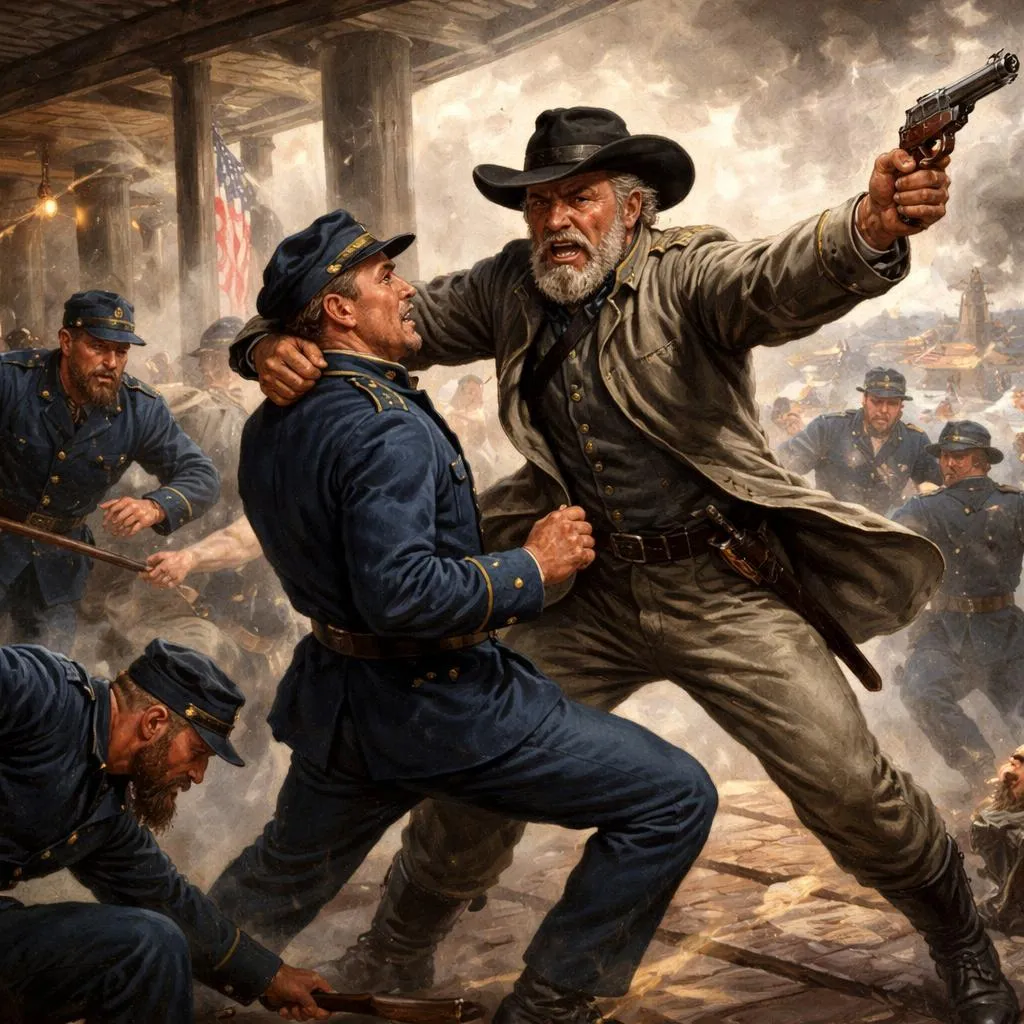
The petty officer called upon the ship’s corporal, whom he had brought with him, and placed his hand on the arm of the rebellious master, who showed fight. A couple of seamen were called to assist the police force, and Captain Sullendine was dragged below with his wrists ironed behind him.
“Now you can proceed, French,” said the captain.
“When I left you, all was quiet on board of the West Wind,” added Christy, beginning to make a slight explanation for the benefit of the commander. “Captain Sullendine was very drunk, asleep in his berth, with the door of his stateroom securely fastened upon him. Bokes the seaman and Sopsy the cook were in the same condition. Go on, French.”
“I picked up the boat you set adrift, Mr. Passford, and then headed for the eastward of Sand Island lighthouse, where you ordered me to anchor. The Holyoke followed the schooner, and came to anchor near the West Wind. She sent a boat on board, and I told my story to the second lieutenant. We did not need any assistance, and he left us.
“About four bells in the forenoon watch I heard a tremendous racket in the cabin, and I went below. Captain Sullendine was doing his best to break down the door of his stateroom, cursing hard enough to make the blood of a Christian run cold. But he had nothing to work with, and I let him kick and pound till he got tired of it. I put Vogel in the cabin to keep watch of him, and went on deck.
“He kept it up for half an hour or more, and then he seemed to have enough of it. Vogel came on deck and told me the prisoner was very humble then, and wanted to come out. I knew you did not mean that I should starve him, and I made Sopsy put his breakfast on the table in the cabin; but I did not do so till I had locked the liquor closet and put the key in my pocket.
“I let him out then, and his first move was to get at his whiskey; but the door was locked. He begged like a child for a drink; but I did not give him a drop. Sopsy and Bokes, who were tied up forward, did the same; but they did not get any. Captain Sullendine ate his breakfast, and I told him his vessel was a prize to the United States steamer Bellevite. Then he was so furious that we had to shut him up in his stateroom again.
“After a while he promised to behave himself, and I let him out again. He declared that his vessel was not a legal prize, and got off a lot of stuff that I did not take any notice of. He wanted to make a protest to the commander of the Bellevite, and when he promised to behave like a gentleman, I let him come on board with me.”
“You acted with very good judgment, French, and Mr. Passford has already commended your good conduct in the expedition last night,” said the commander.
“Thank you, sir,” replied the prize-master, touching his cap, and backing away without another word.
“Loring,” called the captain to the master-at-arms, who had just returned to the quarter-deck, or as near it as etiquette permitted him to go. “How is your prisoner?”
“He broke down completely after he had been in the brig a few minutes, and promised to behave like a gentleman if the commander would hear him.”
“Bring him to the quarter-deck,” added the captain.
In a few minutes, the ship’s corporal conducted him into the presence of the commander. He began with a very lame apology for his previous conduct, and then declared that he was the victim of a “Yankee trick,” and that the West Wind had not been fairly captured.
“Your officers imposed upon me,” he continued. “Mr. Balker and Jerry Sandman”—
“Who are they?” inquired Captain Breaker, interrupting him.
“I was Mr. Balker, engaged as mate of the West Wind, selected for that position by Mr. Passford, while the lieutenant was Jerry Sandman, second mate, which he chose to be himself so that he could be with the men,” interposed Mr. Graines.
“I did not know what their names was, and I reckoned all was honest and square. These men, whoever they were, got me drunk, and got drunk themselves; and while I was taking a nap, waiting for the steamer to get under way, they fastened me into my stateroom so I couldn’t get out.”
“I went through the forms, but I did not take a drop of liquor into my mouth,” said Christy.
“I did not take more than a tablespoonful both on board and at the camp of the runaways,” added Mr. Graines.
“Then you cheated me more’n I thought.”
“Is this all the complaint you have to make, Captain Sullendine?” asked Captain Breaker, turning to the master of the West Wind.
“I reckon that’s enough!” protested the complainant. “I say it was not a fair capture, and you ought to send my vessel back to Mobile Point, where your officers found her.”
“I shall not do that, but I will compromise the matter by sending you to Mobile Point, as I have no further use for you,” replied the commander. “You are a non-combatant, and not a prisoner of war.”
French was ordered to leave Captain Sullendine, Bokes, and Sopsy at the shore where the whaleboat had made a landing, as soon as it was dark. For some reason not apparent, the master of the West Wind protested against this sentence; but no attention was given to his protest. The commander was confident that he had evidence enough to secure the condemnation of the prize, and he regarded such an unreasonable fellow as her late captain as a nuisance. That night the order in regard to him and his companions were carried out.
Captain Breaker asked some questions in regard to French, which Christy and Mr. Graines were able to answer. He was one of those men, of whom there were thousands in the army and navy who had become soldiers and sailors purely from patriotic duty, and at the sacrifice of brighter present prospects. French had been the mate of a large coaster, whose captain had become an ensign in the navy, and he might have had the command of her if he had not shipped as an able seaman in the same service.
He understood navigation, and had been the second mate of an Indiaman. The commander said nothing when he had learned all he could about the prize-master; but it was evident that he had something in view which might be of interest to the subject of his inquiries. He turned his attention to the condition of his first lieutenant then, asking about his arm.
“It does not feel quite so easy as it did,” replied Christy, who had been suffering some pain from his wound for the last two hours, though he was so interested in the proceedings on board, and especially in the report from the West Wind, that he had not been willing to retire to his stateroom.
“Then you must turn in at once, Mr. Passford,” said the commander, with more energy than he had spoken to the lieutenant before. “I am afraid you have delayed it too long.”
“I think not, sir.” replied the wounded officer.
“Mr. Graines shall go with you and assist you,” added the captain. “I will send Dr. Linscott to you as soon as you get into your berth.”
Christy had been sitting so long that he was quite stiff when he attempted to get out of his chair, and the engineer assisted him. He was still very weak, and Mr. Graines supported him, though he presently recovered himself. The ship’s company, by this time relieved of all heavy work, had been observing him with affectionate admiration, and rehearsing the daring exploit in which he had received his wound, gave three rousing cheers as he rose to leave the quarter-deck.
Christy turned his pale face towards them, raised his cap, and bowed to them. Another cheer followed, and then another. The men knew that his prompt action in mounting the mizzen rigging, boarding the Tallahatchie, and firing the thirty-pounder after he had reversed its position, had saved the lives or limbs of a great number of them, and they were extremely grateful to him.
With the assistance of his friend the engineer, Christy was soon between the sheets in his berth. Dr. Linscott came in as soon as he was in his bed, spoke very tenderly to him, and then proceeded to dress his injured arm. He found the member was somewhat swollen, and the patient’s pulse indicated some fever.
“I must send you home, Mr. Passford,” said the surgeon. “You are the hero of the day, you have earned a vacation, and you will need your mother’s care for the next three weeks.”
In spite of Christy’s protest, the doctor insisted, and left him.
背景和作者介绍
这个故事摘自一部海事冒险小说,很可能设定在19世纪,当时海战和私掠船活动很常见。叙事围绕着参与捕获一艘名为“西风”号的船只的海军军官和水手展开。作者的身份在这里没有具体说明,他生动地描写了海军生活、指挥系统以及战时船长和船员之间的紧张关系。这类故事在19世纪和20世纪初很受欢迎,反映了那个时代对海上冒险、荣誉和责任的迷恋。
详细解读和意义
文章探讨了海军舰艇上的权威、纪律和荣誉主题。萨伦丁船长的醉酒和不服从命令与布雷克船长的冷静、公正的领导以及弗伦奇和克里斯蒂的尽职行为形成了鲜明对比。这个故事突出了秩序和对规则的尊重在维护船舶安全和效率方面的重要性。它还触及了战时正义的复杂性,因为对战利品捕获的合法性提出了质疑,但最终由于证据和适当的行为而得到维护。
给学生的教训和见解
-
对权威和纪律的尊重: 故事表明,纪律和对领导的尊重在任何群体环境中都至关重要,尤其是在像海上航行的船只这样高风险的环境中。学生们可以学习遵守规则和理解指挥系统的重要性,以维持和谐并实现共同目标。
-
勇气和责任: 克里斯蒂中尉尽管受伤,仍然致力于他的职责和船员的福祉。这教导年轻读者关于责任、勇敢和面对逆境时的毅力。
-
正义与公平: 叙事表明,即使在冲突中,公平和正义也是必不可少的。布雷克船长在做出决定之前仔细听取了各方的意见,这表明了公正和基于证据的判断的重要性。
-
自制力: 萨伦丁船长的垮台部分是由于他缺乏自制力,尤其是他的醉酒。这作为一个警示故事,讲述了不良行为的后果以及保持冷静的重要性。
在日常生活中应用这些教训
-
在学校: 学生们可以通过听从老师的教导并与同学合作来运用对权威的尊重,理解规则有助于每个人在安全的环境中学习和成长。
-
在社交场合: 故事鼓励平静而尊重地管理情绪和冲突,避免可能损害关系的轻率行为。
-
在个人成长中: 效仿克里斯蒂的勇气和责任感可以激励学生对自己的行为负责,勇敢地面对挑战。
从故事中培养积极的品质
-
纪律: 通过设定目标、管理好时间并履行承诺来练习自律。
-
尊重: 尊重同伴和长辈,重视他们的角色和贡献。
-
公平: 努力在判断和互动中做到公平,在做出决定之前倾听他人。
-
勇气: 迎接挑战并坚持正义,即使这很困难。
结论
这个海事故事虽然惊险刺激,充满动作,但提供了关于领导力、正义和个人品格的丰富教训。阅读它的学生不仅可以享受冒险,还可以反思所描绘的价值观如何在学校、友谊和更广阔的领域指导他们的行为和决定。通过从故事中的正面和负面例子中学习,年轻的读者可以成长为负责任、勇敢和公正的个体。
