
Even with the West Wind in tow, the Tallahatchie could make fifteen knots an hour; for the sea was smooth, with every prospect of continued fine weather. Dr. Davidson was a prisoner of war, but he remained on board in charge of the wounded of both sides. He was very devoted to Christy, and dressed his wound every morning as tenderly as his mother could have done it. He was a gentleman in the highest sense of the word, and belonged to one of the best families in the South.
Captain Rombold was a very agreeable person; and most of the conversation in the cabin was carried on in French, for the commander was delighted when he could obtain an opportunity to practise the language, and Dr. Davidson spoke it as fluently as a Frenchman, though Captain Drake was unable to understand a word of it. If one had looked in upon them he would have supposed they were enjoying a yachting excursion, and could not have told who were prisoners and who were not.
The two wounded officers passed a portion of every day on deck, and the time slipped away very pleasantly. Mr. Graines spent much of his days and some of his nights in the engine-room, and was on the best of terms with the English engineers; but he could discover no signs of treachery on their part. The prisoners forward were well treated and well cared for, and they made no trouble.
The ship made a quick passage to New York, and went into the harbor with the American flag flying over the Confederate; but this was not an uncommon sight, and it did not attract much attention. The pilot brought a file of newspapers, and the lieutenant learned that Grant was still "hammering away” at the Confederate forces in Virginia, though without any decided success. The ship came to anchor at the navy yard, and Captain Drake reported to the commandant.
Lieutenant Passford was well known there, though the intelligence of his latest achievement had not yet reached there. Christy had written out his report of the expedition to Mobile Point, and Captain Drake brought that of Captain Breaker of the action with the Tallahatchie. The lieutenant had no official duty to perform, and he was at liberty to go where he pleased. He procured leave of absence for Mr. Graines; for he was himself still on fever diet, and was rather weak so that he needed his assistance.
“Home again, Charley!” exclaimed Christy, when they had landed at the navy yard.
“That’s so, and my folks at home will not expect to see me,” replied the engineer.
“Neither will any one at Bonnydale anticipate a visit from me,” added Christy. “We know all about the sharp action of the Bellevite with the Tallahatchie; but no one in these parts can have heard a word about it. Now, Charley, see if you can find a carriage for me;” and the wounded officer went into an office to wait for it.
The uniform of the messenger carried him past all sentinels; and in half an hour he returned in a carriage, which was permitted to enter the yard on Mr. Graines’s statement of its intended use. Christy was assisted into it. “Wall Street Ferry,” said the lieutenant to the driver.
“Why do you go there?” asked the engineer. “You wish to go to the railroad station, do you not?”
“I want to find my father if I can, and I think he must be in the city,” replied Christy, as he gave his companion the location of the office where he did his business with the government, though he made frequent visits to Washington for consultation with the officials of the Navy Department.
The carriage was retained, and in another hour they reached the office. Captain Passford was not there; he had gone to Washington three days before, and no one knew when he would return. Christy was prepared for this disappointment, and he had arranged in his mind the wording of a telegraphic message to his father. While he was writing it out a gentleman came out of the office whom the lieutenant had met before.
“I am delighted to see you, Mr. Passford!” exclaimed the gentleman, who was in the uniform of a naval officer, as he extended his hand to the visitor. “One of our people informed me that the son of Captain Passford was at the door, and I hastened out to see you. Won’t you come into the office?”
“No, I thank you; I am not very well, for I was wounded in the left arm in our last action, and I am sent home by the surgeon on a furlough,” replied Christy. “Permit me, Captain Bentwick, to introduce my friend, Mr. Graines, third assistant engineer of the Bellevite.”
“I am very happy to know you, Mr. Graines,” added Captain Bentwick, taking his hand. “I am very sorry you are wounded, Mr. Passford. What can I do for you?”
“Nothing, I thank you, at present. I am writing a message to send to my father. I was just finishing it when you came,” replied Christy, as he added the finishing words, and passed it to the official.
“‘Sent home on furlough, slightly wounded. Wish paroles for Captain George Rombold and Dr. Pierre Davidson,’” Captain Bentwick read from the paper. “I will have it sent at once from this office. But, Mr. Passford, I can parole these officers, and it is not necessary for you to trouble your father with such a matter. Who and what are the officers?”
“Captain Rombold was the commander of the Tallahatchie, prize to the Bellevite,” answered Christy. “When I was in danger of fainting after the action on the deck of his ship, he sent for his surgeon, Dr. Davidson, though his own wound had not been dressed. Both he and the surgeon were extremely kind to me, and I desire to reciprocate their good offices by inviting them to my father’s house.”
“Where are these gentlemen now, Mr. Passford?”
“I left them on board of the prize at the navy yard, sir. I am not sure that they will accept parole, for I have not spoken to them about it; but I am very anxious to serve them.”
“I know what your father would say if he were here, and I will send an officer authorized to take their parole to the navy yard at once. I will instruct him to represent your desire to them in the strongest terms, and if they accept, to conduct them to Bonnydale, for I know you must be in a hurry to get there,” continued Captain Bentwick, as he shook the hands of both officers, and returned to the office.
“That shows what it is to have powerful friends,” said Mr. Graines, when his companion had directed the driver to the railroad station.
“I have not asked anything unreasonable, Charley,” replied Christy, sensitive as usual in regard to influential assistance.
“Certainly not; but if I had asked to have your Confederate friends paroled, a thousand yards of red tape would have to be expended before it could be done,” added the engineer with a laugh.
They reached the station, and discharged the carriage; but they found they had to wait two hours for a train to Bonnydale. As it was after noon, they went to a hotel for dinner, and passed the time very impatiently in waiting for the train. Both of them were burning with the desire to see their friends at home; but the train started in due time, and they left it at the nearest station to Bonnydale, proceeding there in a carriage.
Christy gave the bell a very vigorous pull, and the servant that came to the door was a stranger to him. He wished to see Mrs. Passford; and the man was about to conduct him to the reception room, when he bolted from him.
“Mrs. Passford is engaged just now, sir; but she will be down in a few minutes,” said the servant, laying his hand on his arm for the purpose of detaining him.
“But I cannot wait,” returned the lieutenant very decidedly, and he shook off the man, and began to ascend the stairs.
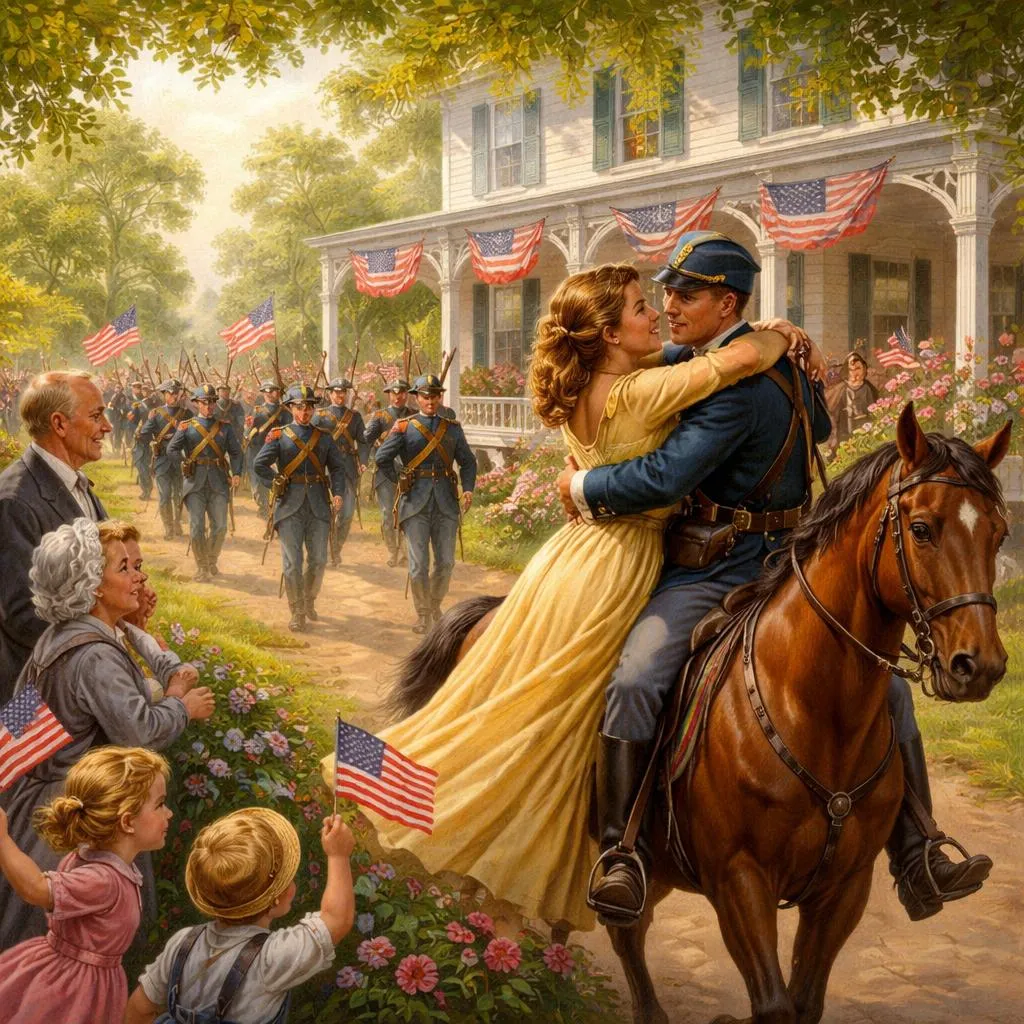
An instant later there was a double scream on the floor above, and Mrs. Passford rushed down the steps, followed by Florry. Christy retreated to the hall, and a moment later he was folded in the arms of his mother and sister, both of whom were kissing him at the same time.
“But, my son, your arm is in a sling!” exclaimed Mrs. Passford, falling back with an expression of consternation on her face.
“You are wounded, Christy!” cried Florry, as a flood of tears came into her eyes.
“Only a scratch, mother; don’t be alarmed,” protested the lieutenant. “It was all nonsense to send me home on a furlough; but it was the commander’s order, at the recommendation of Dr. Linscott.”
“But you are wounded, my son,” persisted his mother.
“You have been shot in the arm, Christy,” added Florry.
“But I was not shot through the head or the heart; it is not a bit of use to make a fuss about it; and Paul Vapoor was not wounded, for he had to stay in the engine room during the action, and he is as hearty as a buck,” rattled the lieutenant, and making his pretty sister blush like a fresh rose.
“I am really worried about it, my son. Where is the wound?” asked his mother.
“Here, Charley, tell them all about it,” called Christy to his companion, who had been forgotten in the excitement of the moment.
“Why, Charley Graines!” exclaimed Florry, rushing to him with an extended hand. “I did not know you were here.”
“I am glad to see you, Charley, especially as you have been a friend and associate of my son, as you were before the war,” added Mrs. Passford.
“I am very glad to see you, Mrs. Passford and Miss Passford,” said he, bowing to both of them. “I have been on duty recently with Christy, and I have been looking out for him on the voyage home.”
“Charley has been a brother to me, and done everything under the canopy for me. I am somewhat fatigued just now,” added the lieutenant, as he seated himself on a sofa in the hall. “He will answer your questions now, and tell you that I am not killed.”
“But come into the sitting-room, my son, for we can make you more comfortable there,” said his mother, taking him by the right arm, and assisting him to rise.
“I don’t need any help, mamma,” added Christy playfully, as he rose from the sofa. “I have not been butchered, and I haven’t anything but a little bullet-hole through the fleshy part of my left arm. Don’t make a baby of me; for a commander in the Confederate navy told me that God made some fully-developed men before they were twenty-one, and that I was one of them. Don’t make me fall from my high estate to that of an overgrown infant, mother.”
“I will not do anything of the kind, my son,” replied Mrs. Passford, as she arranged the cushions on the sofa for him. “Now, Florry, get a wrap for him.”
Christy stretched himself out on the sofa, for he was really fatigued by the movements of the forenoon and the excitement of his return to the scenes of his childhood.
“Tell them what the doctors said about my wound, Charley,” he continued, as he arranged himself for the enjoyment of a period of silence.
“Mr. Passford has had two surgeons,” Mr. Graines began.
“Then he must have been very badly wounded!” ejaculated Florry, leaping to a very hasty conclusion.
“Not at all,” protested the engineer. “Both of them said he was not severely wounded.”
“Why was he sent home on a furlough?” asked Mrs. Passford.
“Because the weather was getting very hot in the Gulf of Mexico, and it was believed that he would do better at home. He has been somewhat feverish; but he is improving every day, and in a couple of weeks he will be as well as ever.”
“Thank God, it is no worse!” exclaimed Mrs. Passford.
Then she insisted that he should be quiet, and they all retired to the library.
背景和作者介绍
这个故事的背景设定在战争时期,捕捉了参与海战的士兵和军官的经历。叙事反映了冲突中复杂的人类情感和关系,突出了荣誉、友谊和同情的主题,即使是在敌人之间。作者的身份鲜为人知,他的写作风格是19世纪战争文学的典型风格,侧重于详细的描述和人物互动,揭示了历史事件的个人层面。
详细解读和意义
这个故事描绘了即使在战争时期也依然存在的人性。戴维森医生尽管是一名囚犯,但他悉心照料双方的伤员,表现出超越政治分歧的同情心。伦博尔德船长用法语进行的友好交谈以及囚犯之间的礼貌对待表明,尊重和友善可以在冲突中幸存下来。帕斯福德中尉带着伤回家象征着战争的个人代价,但也象征着康复和与亲人团聚的希望。
这个叙事也触及了忠诚和友谊的主题。克里斯蒂对他的邦联朋友的关心以及他努力确保他们假释的行为表明了他对荣誉和感激之情的承诺。人物之间的互动揭示了当时的社会规范和价值观,强调了勇气、责任和家庭纽带。
给学生的教训和见解
阅读这个故事的学生可以学习同情心和善良的重要性,即使是对那些被认为是对手的人。这个故事鼓励理解冲突各方的人们有着共同的人类经历和情感。它还突出了在困难时期勇气和韧性的价值,正如克里斯蒂的决心和积极的态度所见。
从历史的角度来看,这个故事提供了对海战和当时社会动态的见解。它可以激发学生欣赏战争期间个人所做的牺牲,并批判性地思考冲突对家庭和社区的影响。
在日常生活中应用故事的价值观
在日常生活中,学生可以通过在与他人的互动中实践同情心和尊重来应用故事的教训,无论彼此之间存在什么差异。戴维森医生对所有伤员的照料鼓励在不带偏见的情况下帮助有需要的人。克里斯蒂的毅力和乐观精神可以激励学生勇敢地面对自己的挑战。
在学校和社会环境中,培养基于相互尊重和支持的友谊反映了故事的精神。学生还可以学习沟通和理解的重要性,正如人物之间的多语言对话和尊重对话所显示的那样。
培养积极的精神和行为
为了培养故事中体现的积极品质,学生应该:
- 在日常互动中实践善良和同情心。
- 对朋友和家人表示感激和忠诚。
- 在面对困难时保持勇气和积极的态度。
- 尊重文化和语言差异,拥抱多样性。
- 反思历史事件,了解其背后的人类故事。
通过拥抱这些价值观,年轻的读者可以成长为有思想、有韧性的人,能够为他们的社区做出积极贡献。
这种扩展的解释旨在加深学生对故事主题的理解,并鼓励他们从中汲取有意义的教训,从而丰富他们的个人成长和社会关系。
