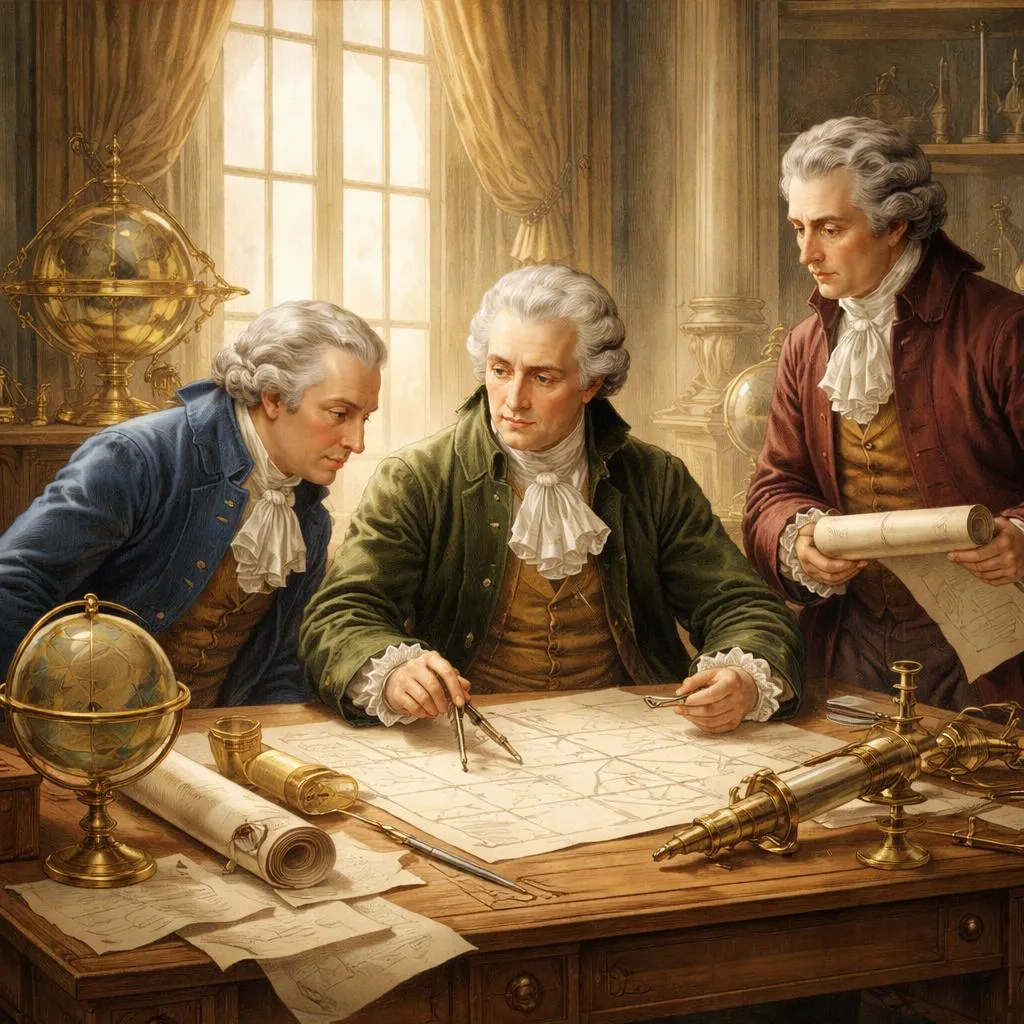

Bézout, Trembley, Arbogast
Étienne Bézout, born at Nemours on March 31, 1730, and died on September 27, 1783, besides numerous minor works, wrote a Théorie générale des équations algébriques , published at Paris in 1779, which in particular contained much new and valuable matter on the theory of elimination and symmetrical functions of the roots of an equation: he used determinants in a paper in the Histoire de l'académie royale , 1764, but did not treat of the general theory. Jean Trembley, born at Geneva in 1749, and died on September 18, 1811, contributed to the development of differential equations, finite differences, and the calculus of probabilities. Louis François Antoine Arbogast, born in Alsace on October 4, 1759, and died at Strassburg, where he was professor, on April 8, 1803, wrote on series and the derivatives known by his name: he was the first writer to separate the symbols of operation from those of quantity.
Carnot
Lazare Nicholas Marguerite Carnot, born at Nolay on May 13, 1753, and died at Magdeburg on Aug. 22, 1823, was educated at Burgundy, and obtained a commission in the engineer corps of Condé. Although in the army, he continued his mathematical studies in which he felt great interest. His first work, published in 1784, was on machines; it contains a statement which foreshadows the principle of energy as applied to a falling weight, and the earliest proof of the fact that kinetic energy is lost in the collision of imperfectly elastic bodies. On the outbreak of the revolution in 1789 he threw himself into politics. In 1793 he was elected on the committee of public safety, and the victories of the French army were largely due to his powers of organization and enforcing discipline. He continued to occupy a prominent place in every successive form of government till 1796 when, having opposed Napoleon's coup d'état , he had to fly from France. He took refuge in Geneva, and there in 1797 issued his La métaphysique du calcul infinitésimal . In 1802 he assisted Napoleon, but his sincere republican convictions were inconsistent with the retention of office. In 1803 he produced his Géométrie de position . This work deals with projective rather than descriptive geometry, it also contains an elaborate discussion of the geometrical meaning of negative roots of an algebraical equation. In 1814 he offered his services to fight for France, though not for the empire; and on the restoration he was exiled.
Poncelet
Jean Victor Poncelet, born at Metz on July 1, 1788, and died at Paris on Dec. 1867, held a commission in the French engineers. Having been made a prisoner in the French retreat from Moscow in 1812 he occupied his enforced leisure by writing the Traité des propriétés projectives des figures , published in 1822, which was long one of the best known text-books on modern geometry. By means of projection, reciprocation, and homologous figures, he established all the chief properties of conics and quadrics. He also treated the theory of polygons. His treatise on practical mechanics in 1826, his memoir on water-mills in 1826, and his report on the English machinery and tools exhibited at the International Exhibition held in London in 1851 deserve mention. He contributed numerous articles to Crelle's journal; the most valuable of these deal with the explanation, by the aid of the doctrine of continuity, of imaginary solutions in geometrical problems.
数学家及其贡献介绍
以上文章向我们介绍了18和19世纪的几位重要数学家:艾蒂安·贝祖、让·特雷姆莱、路易·弗朗索瓦·安托万·阿尔博加斯特、拉扎尔·尼古拉斯·玛格丽特·卡诺和让·维克多·庞塞列。这些人对数学和科学做出了重大贡献,塑造了我们今天理解代数、几何、力学和概率的方式。他们的工作不仅推动了学术知识的发展,还在工程学、军事战略和技术方面有实际应用。
背景和历史背景
在18世纪和19世纪初期,欧洲是科学发现和政治变革的温床。启蒙运动鼓励理性、逻辑和科学探究,这促使许多学者探索复杂的数学理论。与此同时,法国大革命和拿破仑战争等政治动荡影响了这些数学家的生活和事业。例如,卡诺深入参与政治和军事组织,而庞塞列作为战俘的经历促使他撰写了重要的数学论文。
对其工作及其意义的详细解释
-
艾蒂安·贝祖以其代数几何中的贝祖定理而闻名,该定理涉及多项式方程的交点。他对消元理论和对称函数的研究为现代代数奠定了基础。
-
让·特雷姆莱对微分方程和概率论做出了贡献,这些领域对于理解自然现象和根据数据进行预测至关重要。
-
路易·阿尔博加斯特引入了处理数学运算的新方法,将运算符号与数量分开,这澄清了符号,并帮助未来的数学家更有效地发展微积分。
-
拉扎尔·卡诺将他的军事专长与数学相结合。他对能量和力学的研究预示了今天物理学中的基本原理。除了他的科学工作,他在法国大革命期间组织法国军队的作用表明了数学思维如何应用于领导和战略。
-
让·维克多·庞塞列在射影几何方面取得了重大进展,射影几何是研究在投影下保持不变的图形属性的数学分支。他的工作影响了工程学和力学,证明了抽象数学与实用技术之间的深刻联系。
学生可以从这些故事中学到什么
-
好奇心和奉献精神的力量: 这些数学家向我们表明,对世界的求知欲与持续的学习相结合,可以带来突破性的发现。学生可以受到启发,深入追求自己的兴趣,即使主题看起来很困难。
-
跨学科思维: 数学与政治、工程和军事战略的融合说明了在一个领域的知识如何能增强对另一个领域的理解和有效性。学生应该欣赏广泛学习和跨学科联系思想的价值。
-
逆境中的韧性: 庞塞列在战俘期间创作重要作品的能力,以及卡诺的流亡和政治斗争,教会了我们韧性。挑战和挫折不必阻止进步;它们可以成为成长和创造力的机会。
-
清晰沟通的重要性: 阿尔博加斯特对数学符号的贡献提醒学生,我们表达思想的方式很重要。清晰的沟通有助于他人理解并在此基础上构建我们的工作。
在日常生活中应用这些经验教训
-
在学习中: 学生可以应用数学家的奉献精神,设定目标,定期练习,并力求深入理解概念,而不是仅仅记住事实。
-
在社交场合: 卡诺的领导和组织技能的例子可以激励学生在小组活动中培养团队合作、纪律和责任感。
-
在解决问题中: 这些数学家所采取的创新方法鼓励创造性思维。面对挑战时,学生应该尝试不同的视角和方法。
-
在个人成长中: 从他们的韧性中学习,学生可以培养耐心和毅力,理解失败往往是走向成功的一步。
通过数学家的故事鼓励积极的价值观
这些数学家的故事可以帮助学生欣赏好奇心、努力工作、韧性和清晰沟通等价值观。老师可以鼓励学生:
- 提出问题,并在课本之外进行探索。
- 与同伴合作解决问题。
- 将错误视为学习机会进行反思。
- 用书面和口头表达清晰地表达他们的想法。
通过拥抱这些价值观,学生不仅在学业上有所提高,而且培养了在整个生活中对他们有益的技能和态度。
结论
虽然原文侧重于这些数学家的技术成就,但了解他们的生活和工作背景丰富了我们对他们贡献的欣赏。他们的故事不仅仅是关于数字和公式,而是关于人类的好奇心、毅力和对知识的追求。参与这些故事的学生可以找到灵感来探索自己的潜力,并将所学到的经验教训应用于生活的各个方面。
