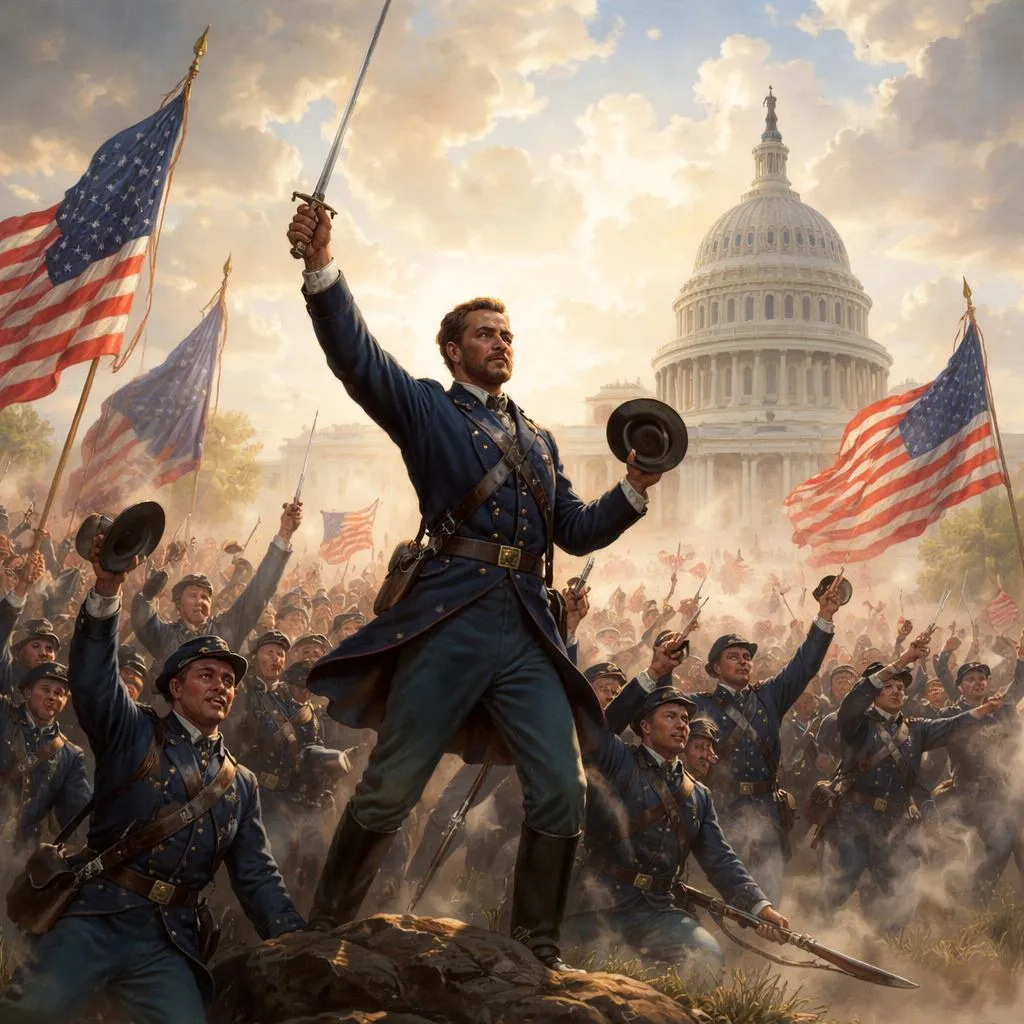

A Victorious Union is the sixth and last of The Blue and the Gray Series. While the volume is not intended to be a connected historical narrative of the particular period of the War of the Rebellion in which its scenes are laid, the incidents accurately conform to the facts, and especially to the spirit, of the eventful years in which they are placed, as recorded in the chronicles of the great struggle, and as they exist in the memory of the writer. It is more than thirty years since the war began, and thousands upon thousands of the active participants in the strife as soldiers and sailors, including nearly all the great commanders, have passed on to their eternal reward. Thousands upon thousands of men and women have been born and reached their maturity since the most tremendous war of modern times ended in A Victorious Union. The knowledge of the stirring events of those four years of conflict, and of the patriotic spirit which inspired and underlaid them, has come, or will come, to at least one-half the population of this vast nation of sixty-five millions from the printed page or through the listening ear. The other moiety, more or less, either as children or adults, lived in the period of action, saw the gathering battalions, and heard or read the daily reports from the ensanguined battle-fields.
In some of the States that remained loyal to the Union throughout the long struggle, a military parade had been regarded by many as something very much in the nature of a circus display, as “fuss and feathers,” such as tickled the vanity of both officer and private. Military organizations, except in our small regular army, were disparaged and ridiculed. When the war came, the Northern people were unprepared for it to a very great degree. The change of public opinion was as sudden as the mighty event was precipitate. Then the soldier became the most prominent and honored member of the community, and existing military bodies became the nucleus of the armies that were to fight the battles of the Republic.
During the last thirty years the military spirit has been kept alive as a constituent element of patriotism itself. The love of country has been diligently fostered and nurtured in the young, and public opinion has been voiced and energized in the statutes of many States, and in the educational machinery of many municipalities. Over vast numbers of school houses in our land floats theAmerican flag, the symbol of the Union and the principles that underlie it.
The flag, the banner now of a reunited nation, means something more than the sentiment of loyalty to the Union as the home of freedom; for it implies the duty of defending the honor of that flag, the representative idea of all we hold dear in Fatherland. In the East and the West a considerable proportion of the high schools make military tactics a part of their educational course. Companies, battalions, and regiments of young men in their teens parade the streets of some of our cities, showing in what manner the military spirit is kept alive, and, at the same time, how the flag floating over our educational institutions, which means so much more than ever before to our people, is to be defended and perpetuated in the future.
The author of the six volumes of The Blue and the Gray Series, as well as of The Army and Navy Series, the latter begun in the heat of the war thirty years ago, earnestly believes in keeping active in the minds of the young the spirit of patriotism. In the present volume, as in those which have preceded it, he has endeavored to present to his readers, not only a hero who is brave, skilful, and ready to give his life for his country, but one who is unselfishly patriotic; one who is not fighting for promotion and prize-money, but to save the Union in whose integrity and necessity he believes as the safeguard and substance of American liberty.
Peace has reigned in our land for nearly thirty years, and the asperities of a relentless war have been supplanted by better and more brotherly relations between the North and the South. The writer would not print a word that would disturb these improving conditions; and if he has erred at all in picturing the intercourse between Americans as enemies, he has made sure to do so in the interests of justice and magnanimity on both sides.
In the series of which this volume is the last, the author has confined his narrative of adventures to the navy. It has been suggested to him that another series, relating exclusively to incidents in the army, should follow. After forty years of labor in this particular field, and having already exhausted the three score and ten of human life, he cannot be assured that he will live long enough to complete such a series, though still in excellent health; but he intends to make a beginning of the work as soon as other engagements will permit.
William T. Adams. Dorchester, March 16, 1893.
背景介绍和作者介绍
《光荣的联盟》是威廉·T·亚当斯所著的“蓝与灰系列”的最后一卷,亚当斯是一位多产的作家,以通过讲故事来激励爱国主义和道德价值观而闻名。这本书写于美国内战结束近三十年后,以尊重和和解的精神反思了这场冲突。亚当斯致力于教育年轻读者关于战争期间所做的牺牲以及团结和爱国主义的重要性。他的作品经常强调勇气、荣誉和无私,旨在向他那个时代的年轻人灌输这些美德。
详细解读和意义
本书,就像该系列的其他书籍一样,不仅仅是对历史的叙述,而是一个捕捉内战时期情感和道德精髓的叙事。故事侧重于海军在战争中的作用,突出了那些为维护联盟及其所代表的理想而战的个人的勇敢和奉献精神。亚当斯将士兵描绘成爱国主义的象征,他们的忠诚和勇气为读者树立了榜样。
这本书还讲述了公众对军队看法的转变——从仅仅被视为一种景象到成为一个受人尊敬和至关重要的机构。这种转变反映了战争期间和之后发生的更广泛的社会变革,强调了责任、荣誉和国家自豪感的重要性。
给学生的教训和见解
学生们阅读《光荣的联盟》可以学到许多宝贵的教训:
- 爱国主义和无私: 故事鼓励年轻读者将爱国主义理解为不仅仅是热爱自己的国家;它关乎无私的服务和对更伟大事业的承诺。
- 勇气和荣誉: 角色表现出勇敢,不是为了名声或奖励,而是因为他们深深地相信他们所捍卫的价值观。
- 历史意识: 这本书提供了对美国历史上一个关键时期的见解,帮助学生们了解塑造他们国家的牺牲。
- 尊重与和解: 通过展示战后北方和南方之间的和平与疗愈,故事教导了宽恕和团结的重要性。
在日常生活中的应用
故事中强调的美德可以被学生们应用于他们生活的各个方面:
- 在学校: 效仿角色的勇气和奉献精神可以激励学生们以决心和正直的态度面对学业挑战。
- 在社交场合: 尊重和团结的主题鼓励学生们跨越差异建立友谊,和平地解决冲突。
- 在个人成长中: 故事对无私和爱国主义的强调可以激励年轻人为他们的社区做出积极贡献,并理解他们在社会中的角色。
培养积极的精神和行为
为了培养故事中发现的积极品质,学生们可以:
- 参加促进团队合作和责任感的社区服务或学校活动。
- 了解历史和前几代人所做的牺牲,以培养更深层次的感恩和公民责任感。
- 在日常互动中练习同情心和尊重,反映作者对冲突各方的宽容。
- 参与关于爱国主义及其在当今世界意味着什么的讨论,鼓励对价值观和身份的深思熟虑。
结论
《光荣的联盟》不仅仅是一部历史小说;它还是年轻读者理解爱国主义、勇气和团结重要性的指南。通过对内战及其后果的生动描绘,这本书邀请学生们反思他们自己的价值观以及他们如何为更美好的社会做出贡献。通过学习这部作品,学生们不仅获得了历史知识,还获得了培养将伴随他们一生的性格特征的灵感。
