
From Cedar Keys to Egmont Key is eighty-five miles. The latter is situated at the mouth of Tampa Bay, and is forty miles from the town of Tampa; upon it is a light-house whose friendly flame shone far across the waters of the Gulf as we steamed along in the early gray of the morning. We had arranged to land at Egmont, wind and wave permitting, as it is good working ground for the naturalist; but a rough sea compelled a change of plan, and we kept on for Tampa.
Tampa Bay is divided at its upper portion, or head, into two smaller bays, one known as Old Tampa Bay, from the town of "Old Tampa," the other as Hillsborough Bay, which receives a river of the same name. It is upon the southerly bank of the latter that the new or present town of Tampa is located. A very narrow and crooked channel and an insufficient depth of water prevent vessels, excepting very small craft, from reaching the wharves, consequently the steamer was anchored some four miles below the place. Viewed from the deck the scenery is attractive, though the shores, as elsewhere, are quite low. As you face the town upon the left hand, and half a mile off, is Ballast Point, an ancient reef; upon the right are islands and the mainland in the distance; in front the military post of Fort Brooke, with its new buildings half-hidden by the sturdy old oaks (Quercus virens), whose stalwart limbs are decked with robes of the long Spanish moss, which hang motionless in the quiet air, or flutter like tattered battle-flags when moved by a passing breeze. The post is built upon a sloping lawn whose margin is washed by the waters of the bay; in front of the trees is the parade ground, in the centre stands a symmetrical flag-staff, from the top of which, far aloft, floats the national flag.
There is some little commotion in getting ashore, for everybody and everything have to be transferred to lighters and small vessels; at the time a transient shower was passing and the warm rain caused an unpleasant stickiness. It was soon over however, and we saw our packages placed safely in a four-ton sloop, and seated ourselves upon the top of the cargo like statues upon a pedestal. The lines were "let go," and after beating in a light wind the sloop was at the wharf by noon.
When a steamer arrives the vent is published by a certain number of strokes on the Court House bell; hence the crowd at the wharf. Friends met us as soon as we landed, and with their assistance we found an unoccupied house and an unemployed Negro; the former was at once hired for a camp, the latter for a commissary and quartermaster. In two hours after landing we were "at rights" and housekeeping. Elated with this wonderful dispatch, in the fullness of our joy we thought the millennium not more than "two blocks off," and rashly named our quarters "Camp Delight;" but we had unwisely crowed before we were out of the woods, as will presently be seen.
The population of Tampa is variously stated at from eight hundred to one thousand (people), of all sizes and colors; but this does not include the million (of fleas) that nightly met in mass-meeting at Camp Delight, and compelled us, both in sorrow and in anger, to change the name to Camp Misery. The fleas of California, the black-flies of the Lake Superior swamps, the mosquitoes of the Ohio Valley, all of these we had met on their own ground and never winced, but the fleas of Tampa proved invincible. We thought of the saying of a German poet, "God made the world, but the devil made the flea."
The appearance of the town creates a favorable impression, for it is well planned, the streets being wide and regular and the buildings comely; many of the streets and yards are ornamented with trees; in some of the latter the bananas were just shooting up new leaves to replace those that were cut down at Christmas time by an unusual and severe frost. A large specimen of the American aloe (Agave Americana) standing in the Post Office yard perished from the same cause, though a rosebush near it was loaded with red flowers. Many of the orange trees were full of fruit, which was ruined by the fatal blast, and bushels were rotting on the ground. In some sheltered spots or warm places on the shore of Old Tampa Bay they were untouched, and we had many a feast upon the golden fruit from that neighborhood. The Florida oranges we consider superior to the Mediterranean, Mexican or Tahitian; they are of large size, good color and fine flavor. The Shaddock (Citrus decumana) also grows in the vicinity of Tampa, and very fine specimens of the fruit were purchased by us at the stores. It is extensively cultivated in the West Indies, and many people prefer it to the orange; it is slightly bitter, and the juice, a mild acid, is cooling and healthful. It is called Grape Fruit by the Floridians. Not far from our camp is a grove consisting principally of pines of the species Pinus palustris, also called the pitch-pine, and long-leaved pine, and P. toeda, known as the loblolly pine, and many may be seen in the streets and elsewhere about the town; they sometimes attain a height of one hundred feet, but we have as yet seen none that exceeded seventy feet. The Chamoerops serrulata, or Saw Palmetto, here, as everywhere in South Florida, grows luxuriantly in the sandy soil, and just outside of the town it seems to have crowded out all other shrubbery.
Without enumerating the many botanical forms that are met with in this section of the country, a few of the prominent species worthy of mention are the Sweet Bay (Magnolia glauca Linn.), which grows to the height of twenty feet, with highly perfumed flowers and shining leaves (an isolated colony of this species sheds its fragrance on the colder air of the north, being found in the vicinity of Gloucester, Mass.); the Southern Buckthorn (Frangula Caroliniana Walt.), a species of Hawthorn; the Catalpa, or Indian-bean; also the Persea Carolinensis, or Alligator pear, sometimes called the Red Bay.
The banks of the Hillsborough River at the water's edge are muddy, with a growth of tall coarse grass. The bivalve shell, Cyrena Carolinensis, may here be obtained; also the pretty little river snail, Neritina reclivata. From the wharves, at the proper tide, many fish are caught, principally Sheep's-head (Sargus) and Mullet (Mugil), both of which are good eating. The supply, however, is quite irregular, and the market therefore cannot be depended upon. Oysters (O. Virginica) of excellent quality abound in the bay, and can usually be purchased from boats at the wharf. During a portion of the period of our stay at Tampa the market was well supplied with venison (Cervus Virginianus) of good quality, thanks to the energy and skill of a one-armed hunter residing a few miles away. The hens of Florida deserve favorable mention, if not a diploma, for their daily dividends were too important to be forgotten.
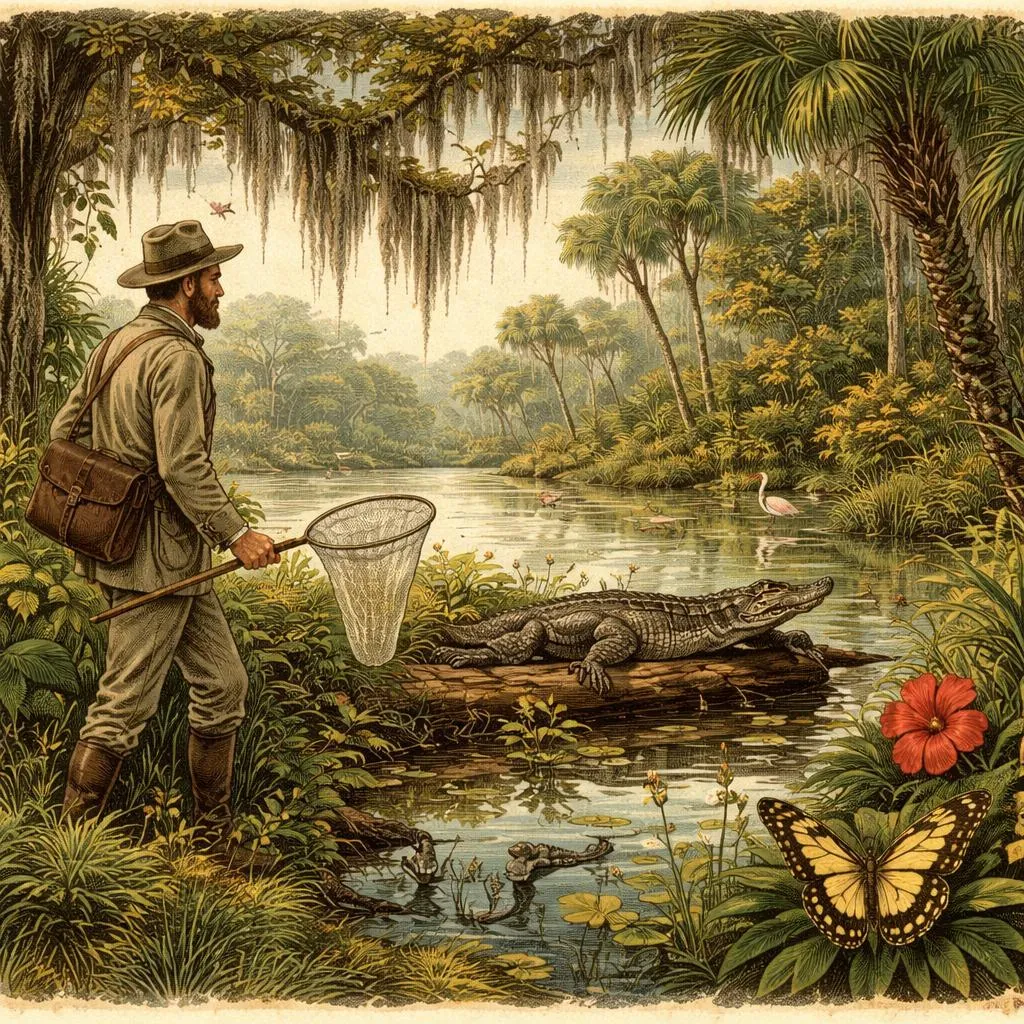
Stalking along the muddy margin of the stream may frequently be seen the Blue Heron (Florida coerulea Baird), and the White Heron (Herodias egretta Gray). There is a California species that much resembles this last. The White or Whooping Crane (Ardea herodias Linn.), and the Egrets (Demigretti Pealii Baird) with white plumage, and another (D. rufa Baird) of a reddish color, are found in this part of the state around the shores of the bay and gulf. Many others of the long or stilt-legged bipeds, of the feathered tribes belonging to the Grallatores, or waders, are met with when rambling through the marshes or exploring the bends, inlets or sloughs of the river, or are seen by us from the boat while rowing up or down the stream. With a scoop net rigged with a long pole, an important and at many times an indispensable implement for the collector, we dipped up from the bed of the stream a small white bivalve shell (Tellina), and a single dead specimen of the fresh-water Mussel, Unio Jewettii Lea. The Floridian Unios have much lighter shells than most of the species found in the tributaries of the Ohio and Mississippi Rivers. The once famous British pearls were obtained from a species of Unio (U. margaritiferus) found in the mountain streams of Great Britain, and the fishery was continued till the end of the last century in Scotland, where the mussels (Unios) were obtained in the River Tay by the peasantry previous to harvest time. The British pearl fishery has long ceased to be remunerative.
The fresh-water mussels must be exceedingly scarce in this vicinity, and in fact for many miles on the western side of Florida, for we found none living nor a fragment in any of the mounds and shell-heaps that we examined. The Portuguese and Spanish narrators of the expedition of DeSoto have given absurd accounts of the quantities of pearls in the possession of the natives. It is highly probable that the Indians inhabiting Georgia and Alabama, at the time of and prior to the invasion of DeSoto, lived in part upon the animals of the various species of Unio found in the rivers of those states, for "heaps of mussel shells are to be seen on our river banks wherever Indians used to live."
It may be that the Indians referred to collected the shells solely for the purpose of procuring the pearls; yet the proportion of shells containing pearls is so small that when, as mentioned in the text, "the Portuguese narrator says they obtained fourteen bushels of pearls" from a certain sepulcher, and as can be found at another place in the text that a common foot soldier, whose name is given as Juan Terron, had "a linen bag in which were six pounds of pearls;" and elsewhere, that everybody, Spanish and Indian had pearls, and "as large as filberts;" either the sources from whence the old historians derived their information were unreliable, or the Unios which are probably as abundant in the rivers as heretofore, have, to a very great extent, ceased to manufacture these much valued concretions. The latter case is hardly supposable. Perhaps one shell in a hundred might yield a pearl, of which not one in a hundred would be either clear or of perfect form, and not one in many thousands would be as large as a filbert.
Between Camp Misery and the river, in wet or springy places upon the under side of pieces of boards or chips, many snails (Helix volvoxis Pareyss) can be collected, and the Coffee-shell (Melampus caffea) is close at hand. It is also found in the West Indies. Just outside of the fence that encloses the reservation of Fort Brooke, to the south, is a good place for obtaining Glandina truncata, a species of snail with a shell of a pink color, sometimes three inches long. It looks much like one that is found in Nicaragua (G. rosea). The Glandinas are carnivorous, and our Floridian is a cannibal, and eats without either hesitation or remorse the smaller snail, Helix volvoxis. The eggs of Glandina are of a whitish color, and about the size of a very small pea; it lives in moist grassy places, and a few boards that were on the ground at the locality referred to made an excellent trap; the Glandinas prefer the shade, and in order to protect themselves from the heat of the sun, hid themselves under the boards, which we frequently turned over, always capturing some. Upon one occasion, in addition to several Glandinas, two specimens of a beautiful lizard rewarded our search.
We had heard at sundry times marvelous stories of numberless snakes of diverse species, and of assorted sizes, that lay in wait to swallow, crush or poison unsophisticated strangers. These fearful tales led us to keep a sharp lookout when on the tramp. Either the snakes snuffed danger from afar and "hunted their holes," or else they are scarce, as we failed to secure a specimen, though two or three were seen. We concluded that our informants had in some way deceived their eyes by using the fusil oil, which hereabouts is sold for whiskey, one dram of which would cause the drinker to see not only snakes but an entire menagerie. From the time when the serpent made mischief for the human race through the beguilement of its original mother, down to the present day, the snake family have had a bad reputation, and stories illustrating their wickedness, however preposterous, are readily believed.
Near the town, and in the immediate vicinity of the spot where Glandinas "most do congregate," stands an ancient mound, in shape a flattened hemisphere, with the plane side down. Its position is such as to furnish a delightful out-look upon the bay and a fine view of the surrounding scenery. It is not of large size, being only one hundred and sixty paces in circumference and fifteen feet high; it was formerly more nearly semicircular in perpendicular outline, as the rains of centuries have washed it off at the summit, thus reducing the elevation, and consequently increasing the circumference of the base.
The mound was covered with grass, and many stately trees are near it whose graceful proportions form, by contrast with the general flatness of the ground, a conspicuous and charming feature in the landscape. From the investigations made by our party it was undoubtedly devoted to burial purposes, and but few shells were used in its construction. Six species of the common marine shells of the neighborhood were collected; also stone implements, and pieces of crumbling bones,--portions of the skeletons of men. This mound may have been the "artificial eminence near the shore," upon which stood the dwelling of the cacique, Hirrihigua, who bravely opposed the adventurous but cruel Pamphilo de Narvaez in his expedition to Florida, in the year 1528; and the meager remnants of a human form whose sepulcher we had rudely violated, may have belonged to the outraged and vindictive chief, who, stung by the remembrance of his wrongs, replied to the overtures of DeSoto with words of scorn.
背景和作者介绍
这个生动的叙述来自于19世纪对佛罗里达州的详细旅行和自然历史描述,那时美国南部的大部分地区仍然是荒野,充满了神秘感。作者很可能是一位博物学家或探险家,他将科学观察与故事讲述相结合,描绘了坦帕湾周围的景观、植物群、动物群和早期定居点的丰富画面。这种描述在1800年代很常见,当时探险家们记录了新的领土及其自然奇观,以供渴望了解遥远地方的观众阅读。写作风格既反映了好奇心,也反映了开拓精神,将事实描述与个人经历融为一体。
详细解读和意义
这篇文章既是一篇游记,也是一本博物学家的日记,为读者打开了一扇通往当时许多人并不熟悉的世界的窗口。它探讨了坦帕湾的地理环境、旅行的挑战、当地的野生动物以及早期的居民点,包括美洲原住民的墓葬。作者对自然环境的观察——树木、植物、鸟类和水生生物——突出了佛罗里达州生态系统的丰富性和多样性。此外,提到像酋长Hirrihigua和西班牙探险家Pamphilo de Narvaez这样的历史人物,将自然历史与人类历史联系起来,提醒读者每个地方都有关于曾经生活、战斗和塑造其过去的人们的故事。
叙述还提到了定居者和旅行者所面临的艰辛,例如在“苦难营”中无情的跳蚤,这为故事增添了人性化和相关的元素。这种奇迹与挣扎的结合反映了在新土地上探险和定居的现实。
给学生的教训和见解
-
好奇心和观察力: 作者的详细笔记鼓励学生仔细观察周围环境,欣赏自然世界。学会注意到细节——无论是在自然、历史还是日常生活中——都可以加深理解并激发好奇心。
-
对自然的尊重: 对植物、动物和生态系统的描述教会人们尊重生物多样性以及保护自然栖息地的重要性。
-
历史意识: 通过将自然特征与历史事件和人物联系起来,学生们了解到历史就在他们身边,通常隐藏在景观或当地故事中。
-
韧性和适应性: “苦难营”的故事表明,挑战是任何冒险或新体验的一部分。学生们可以学会带着耐心和幽默面对困难,适应环境而不是放弃。
-
文化敏感性: 提到美洲原住民的墓葬,引发了对尊重其他文化及其历史的反思,理解地方的意义远不止可见的。
在生活、学习和社会环境中的应用
-
在学习中: 学生们可以通过撰写自己的观察日记来运用作者的方法,无论是在科学、文学还是社会研究中。这种做法可以提高批判性思维和写作能力。
-
在社会生活中: 故事中关于合作和帮助的主题——例如朋友们帮助旅行者找到住所——突出了社区和团队合作的价值。
-
在个人成长中: 拥抱探险精神鼓励学生走出舒适区,尝试新事物,并从成功和挫折中学习。
从故事中培养积极的品质
-
好奇心: 鼓励提问并寻求关于世界的知识。
-
耐心: 理解一些挑战需要时间来克服,比如处理跳蚤或在困难的水域中航行。
-
尊重: 对自然、历史和其他文化,培养同情心和开放的心态。
-
韧性: 克服困难,运用幽默和创造力来应对。
-
观察力: 培养对细节的关注,这在所有学习和生活的领域都很有价值。
通过阅读和思考这个叙述,学生们不仅获得了关于特定地点和时间的知识,还获得了关于探索、尊重和毅力的永恒教训,他们可以将这些教训带入自己的生活中。
