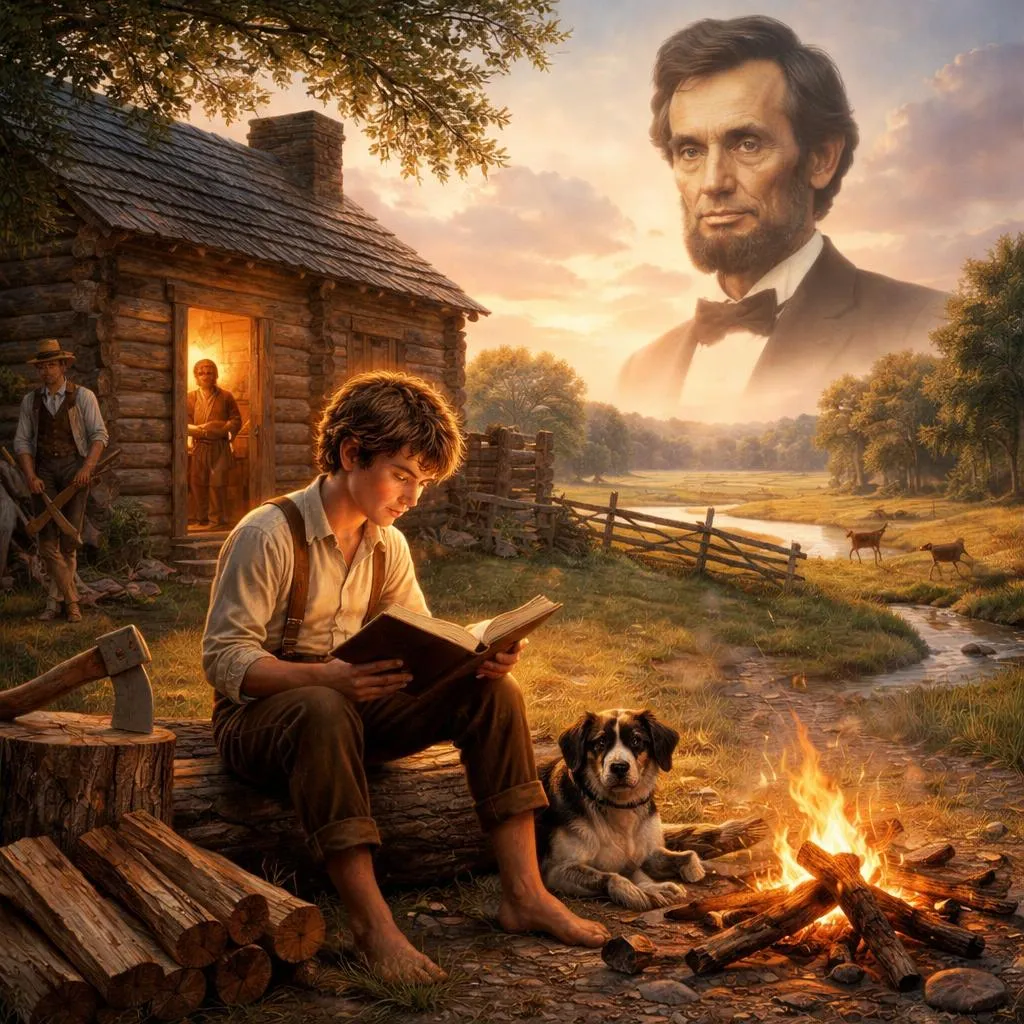

A severe and mysterious sickness broke out in the little Kentucky settlement where the Lincolns lived when Abe was about seven. Nancy Hanks Lincoln, the mother of young Abraham Lincoln died. Meanwhile, Sarah Bush Johnston had married about the time Lincoln’s father married Nancy Hanks. Her husband had died too. She was left with three children. Lincoln’s father went back to his home and married the widow Sarah.
The household goods that she brought with her to the Lincoln home filled a four-horse wagon. Her own three children were well clothed and cared for. She was able to bring little Abraham and his eleven year old sister Sarah comforts they had never known.
The new stepmother quickly became very fond of Abraham. She encouraged him in every way to study and improve himself. Mr. Lincoln once wrote, “It was a wild region, with many bears and other wild animals still in the woods. There I grew up.”
The family moved to Indiana. For two years Lincoln went without schooling of any sort. The school he attended shortly after Sarah came was very simple. The Pigeon Creek settlement had only eight or ten very poor families. They lived deep in the forest. Even if they had the money, it would have been impossible to buy books, slates, pens, ink, or paper.
In Lincoln’s seventeenth year he had more books and better teachers, but he had to walk four or five miles to reach them. We know that he learned to write, and was given pen, ink, a copybook, and a very small supply of writing paper. The instruction he received from his five teachers—two in Kentucky and three in Indiana—stretched over nine years. All together his schooling did not amount to one year.
The fact that he received this instruction, as he himself said, “by littles,” was an advantage. A lazy or not caring boy would have forgotten what was taught him at school. Abraham was neither indifferent or not caring. Every moment of instruction was a precious step to self-help. He worked on his studies with very unusual purpose and determination. He wanted to understand them at the moment. He also wanted to fix them firmly in his mind. His early companions all agree that he employed every spare moment to his studies. His stepmother tells us that “When he came across a passage that struck him, he would write it down on boards if he had no paper. He would keep it there until he did get paper. Then he would rewrite it, look at it, and repeat it. He had a copybook, a kind of scrapbook, in which he put down all things, and thus saved them.” He spent long evenings writing sums on the fire-shovel. Abraham worked his sums by the flickering firelight, making his figures with a piece of charcoal. When the shovel was all covered, he used a drawing-knife to shave it clean again.
He borrowed every book in the neighborhood. The list is a short one: Robinson Crusoe, Aesop’s Fables, Bunyan’s Pilgrim’s Progress, Weems’s Life of Washington, and A History of the United States. When everything else had been read, he began on the Revised Statutes of Indiana, which he visited a neighbor in order to read.
He was a social, sunny-tempered lad, as fond of jokes and fun as he was kindly and industrious. His stepmother said of him: “I can say, what scarcely one mother in a thousand can say, Abe never gave me a cross word or look, and never refused . . . to do anything I asked him. . . I must say . . that Abe was the best boy I ever saw or expect to see.”
He was not only a tall, strong country boy: he soon grew to be a tall, strong, sinewy man. He soon reached the unusual height of six feet four inches. His long arms gave him power as an axman. He usually beat his friends in races and mind puzzles. He could out-run, out-lift, out-wrestle his friends, that he could chop faster, split more rails in a day, carry a heavier log at a “raising,” or beat the neighborhood champion in any frontier athletics made him proud; but stronger than that was his hunger for learning. He felt that using the mind rather than muscle was the key to success. He wished not only to wrestle with the best of them, but also to be able to talk like the preacher, spell and cipher like the schoolmaster, argue like the lawyer, and write like the editor.
Because of his reading and his excellent memory, he soon became the best storyteller among his companions. The training from his studies made his naturally bright mind grow. His wit might be mischievous, but it was never malicious, and his nonsense was never intended to wound. He took no pleasure in hunting. Almost every youth of the backwoods early became an excellent shot and sportsman. The woods still swarmed with game, and every cabin depended largely upon this for its supply of food. But to his strength was added a gentleness, which made him shrink from killing or inflicting pain. The time the other boys spent lying in ambush, he preferred to spend in reading or improving his mind.
In March, 1831, at the end of a terrible winter, Abraham Lincoln left his father’s cabin to seek his own fortune in the world.
背景和作者介绍
这个故事讲述了亚伯拉罕·林肯的早期生活,他是美国第16任总统,以在美国内战期间的领导以及废除奴隶制的努力而闻名。叙述源于历史记载和传记,详细描述了林肯在边境定居地的卑微出身。林肯的生活故事在无数传记、儿童读物和历史小说中被反复讲述,强调了他的毅力、自学和道德品质。
亚伯拉罕·林肯的故事不仅仅是关于一位著名领袖,更是关于在逆境中坚持不懈和学习的力量。许多此类传记故事的作者旨在通过展示林肯如何克服贫困、失去和有限的教育,成为一个伟大的人来激励年轻读者。
详细解读和意义
这个故事突出了几个关键主题:逆境中的韧性、教育的价值和品格的重要性。林肯母亲的去世和一位慈爱的继母的到来表明了家庭支持在个人发展中的关键作用。尽管资源和机会有限,但林肯对知识和自我提升的渴望却显而易见。
这个故事还揭示了边境生活的挑战——学校稀缺、到老师的距离遥远,以及需要在体力劳动和学习之间取得平衡。林肯在木板上书写和抄写段落的方法,说明了他的创造力和学习的决心。他借阅《鲁滨逊漂流记》和《伊索寓言》等书籍,表明了他渴望探索不同的想法和故事。
林肯的体力和运动能力与他温柔的性格和求知欲相平衡,描绘了一个全面发展的性格。他更喜欢阅读而不是打猎,这表明他有一个注重成长而非仅仅生存的思考型头脑。
给学生的教训和见解
- 毅力和自律: 林肯的故事教导学生努力工作并充分利用每一个学习机会的重要性,即使在困难的情况下也是如此。
- 教育的价值: 即使接受的正式教育不到一年,林肯对阅读和写作的奉献也帮助他取得了成功。这表明教育不仅仅是在学校度过的时间,更在于努力和投入的质量。
- 学习中的创造力: 林肯利用现有的任何材料,找到了练习写作和记住重要段落的方法。这鼓励学生足智多谋和坚持不懈。
- 品格和善良: 林肯对继母和朋友的尊重和友善行为树立了良好的礼仪和积极的社会交往的榜样。
- 力量与温柔的平衡: 强大并不意味着严厉;林肯的温柔与他的体力相结合,教导了对他人的同情和尊重。
在日常生活中的应用
- 在学习中: 学生可以效仿林肯,定期投入时间学习,如果资源有限,可以使用创造性的方法,并在课本之外寻求知识。
- 在社交场合: 林肯的尊重态度提醒学生友善地对待他人并互相合作,这有助于建立牢固的关系。
- 在克服挑战时: 面对困难时,学生可以记住林肯坚持不懈和乐观的榜样,理解挫折是成长的一部分。
- 在个人成长中: 将体育活动与智力追求相结合,有助于培养全面发展的个性,就像林肯将力量与对阅读的热爱相结合一样。
从故事中培养积极的特质
- 好奇心: 鼓励提问和探索新话题。
- 勤奋: 为学习设定目标并定期练习。
- 尊重: 表达对家人、老师和同伴的感激之情。
- 韧性: 学会从失败或障碍中恢复过来。
- 同情心: 理解他人的感受,避免造成伤害。
亚伯拉罕·林肯的早期生活故事对年轻读者来说是一个强有力的例子。它表明,伟大始于小的、持续的努力,并且品格和善良与智慧和力量一样重要。通过从他的旅程中学习,学生可以找到鼓舞,以勇气和爱心追求自己的梦想。
