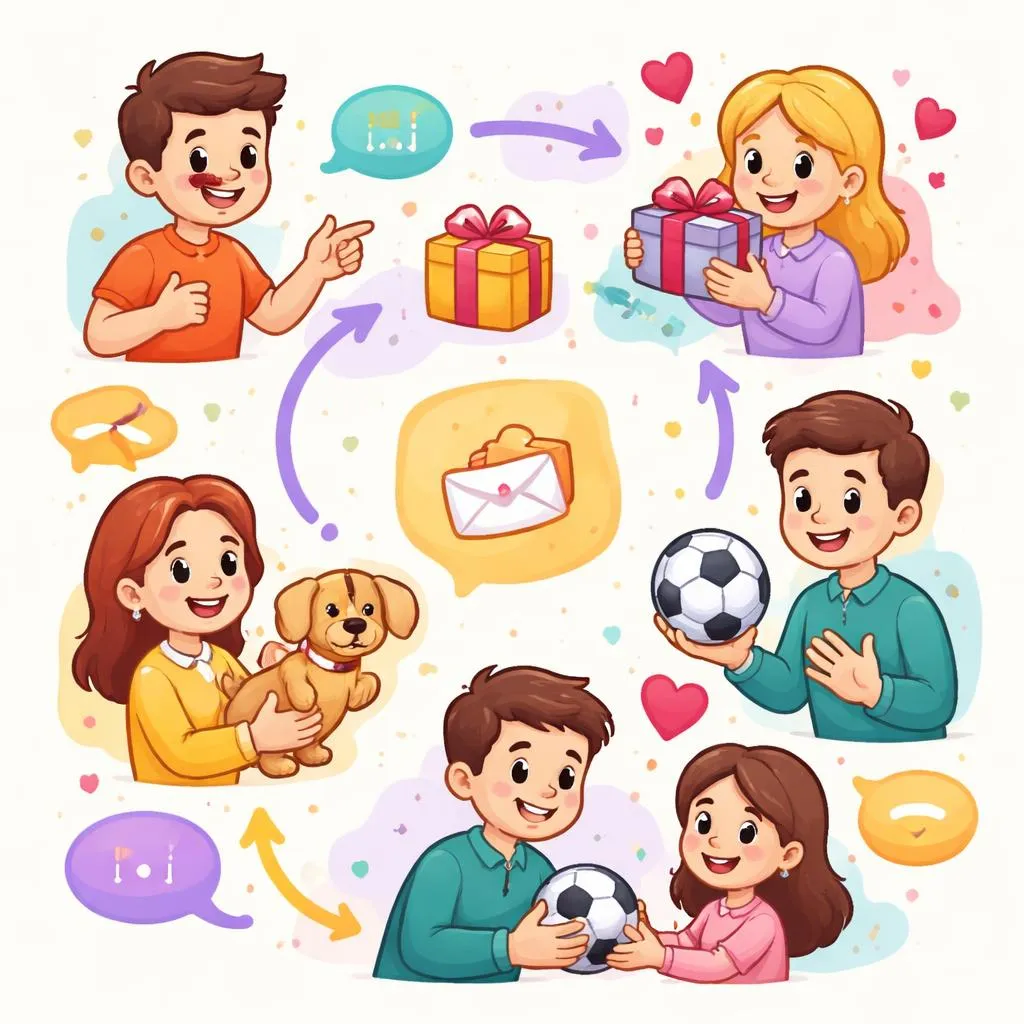

Hello, word builders and sentence detectives. Today we are going to meet some very helpful word friends. Their names are direct and indirect pronouns. These are special little words. They take the place of other words in a sentence. They make our talking smoother and faster. Let us learn what direct and indirect pronouns are. We will see how they work in our sentences every day.
Meaning
First, what is the meaning of direct and indirect pronouns. A pronoun is a word that takes the place of a noun. A noun is a person, place, animal, or thing. A direct pronoun replaces the noun that gets the action of the verb. It answers "what" or "whom." An indirect pronoun replaces the noun that receives the action indirectly. It answers "to whom" or "for whom." For example, in "I see the dog," "dog" gets the action. The direct pronoun for "the dog" is "it." "I see it." In "I give the ball to my brother," "my brother" receives the ball. The indirect pronoun for "to my brother" is "him." "I give him the ball." So, the meaning is about replacing different types of nouns in a sentence.
Conjugation
Conjugation is about changing verbs. But pronouns do not conjugate. They change form based on their job. Direct and indirect pronouns have different forms. The direct pronouns are: me, you, him, her, it, us, you, them. The indirect pronouns are: me, you, him, her, it, us, you, them. Wait, they look the same. In English, many are the same. But the position in the sentence tells us if they are direct or indirect. For example, "I help him." "Him" is direct. "I give him a book." "Him" is indirect. The verb does not change for the pronoun. The pronoun changes its job. This is an important part of using direct and indirect pronouns.
Present tense
We use direct and indirect pronouns in the present tense all the time. The present tense is for now. Let us look at examples. Direct pronoun: "I know her." "Her" replaces a girl's name. It is the direct object. "You see us." "Us" replaces "you and me." Indirect pronoun: "She tells me a story." "Me" is the indirect object. The story is told to me. "We send them a letter." "Them" is the indirect object. The letter is sent to them. Using direct and indirect pronouns in the present makes our sentences clear and quick. We do not repeat names.
Past tense
We also use direct and indirect pronouns when talking about yesterday. The past tense is for finished actions. Direct pronoun: "He called me yesterday." "Me" is the direct object. He called whom. Me. "They found it." "It" is the direct object. They found what. It. Indirect pronoun: "I wrote her a note." "Her" is the indirect object. I wrote a note to her. "We gave him the toy." "Him" is the indirect object. We gave the toy to him. The pronouns stay the same. The verb changes to show past time. The use of direct and indirect pronouns in the past helps tell clear stories.
Future tense
We can use direct and indirect pronouns to talk about tomorrow. The future tense is for what will happen. Direct pronoun: "She will help you." "You" is the direct object. She will help whom. You. "I will do it." "It" is the direct object. Indirect pronoun: "They will send us a package." "Us" is the indirect object. The package will be sent to us. "He will buy her a gift." "Her" is the indirect object. The gift is for her. Using direct and indirect pronouns in the future shows our plans involving people and things. It makes our sentences about the future neat.
Questions
We can ask questions using direct and indirect pronouns. Often, the question word comes first. Direct pronoun in a question: "Whom did you see?" The answer uses a direct pronoun. "I saw him." "What did you eat?" "I ate it." Indirect pronoun in a question: "To whom did you give the book?" The answer uses an indirect pronoun. "I gave it to her." More common is: "Who did you give the book to?" "I gave her the book." Asking questions with direct and indirect pronouns is natural. It helps us get information about people and things in conversations.
Other uses
There are some special rules for direct and indirect pronouns. When you use both in one sentence, the indirect pronoun comes first. "Give me it" sounds awkward. We say "Give it to me." But for some pronouns, we put the indirect first. "Give him it" is okay, but "Give it to him" is better. Another use is with infinitives. "I want you to help me." "You" is the direct object of "want," and "me" is the direct object of "to help." It can be tricky. Also, pronouns can be reflexive. "I hurt myself." "Myself" refers back to "I." This is a different type. Learning these other uses of direct and indirect pronouns makes you a master of sentence building.
Learning tips
How can you learn direct and indirect pronouns. Here are some tips. First, use colors. Write direct pronouns in blue. Write indirect pronouns in green. This gives a visual clue. Second, practice with common verbs. Use "give, show, tell, send, buy." These verbs often have an indirect object. "I show you the picture." "You" is indirect. Third, break down sentences. Find the verb. Ask "what" for the direct object. Ask "to/for whom" for the indirect object. Replace the nouns with pronouns. Fourth, listen to songs and stories. Notice how pronouns are used. Fifth, play substitution games. Take a sentence. "Mom reads a story to the child." Change "the child" to "her." "Mom reads her a story." Keep practicing. Soon, using direct and indirect pronouns will feel easy.
Educational games
Let us play games to practice direct and indirect pronouns. Game one is "Pronoun Toss." Use a soft ball. Say a sentence with a noun. "I throw the ball to Sarah." Toss the ball to a friend. The friend must catch it and say the sentence with a pronoun. "You throw it to her." Then they make a new sentence and toss it. This game is active and fun.
Game two is "Pronoun Sentence Build." Have cards with subjects (I, You, He), verbs (give, show, tell), direct objects (the book, a message, the ball), and indirect objects (to Mom, to the teacher, to my friend). Players draw one of each. They must make a sentence, then say it again using pronouns. "He gives the ball to my friend." becomes "He gives it to him." This teaches sentence transformation.
Game three is "Direct or Indirect Charades." Write actions on cards that involve two people or a person and a thing. "She gives him a pencil." One player acts it out. Others must guess and say the sentence using pronouns. "She gives it to him!" This combines acting and grammar. Play these games and direct and indirect pronouns will become your good friends. You will use them without even thinking.